
Struggling to Win Key Accounts? Twitter Reveals Competitor Intel
Twitter offers a window into competitor strategy that press releases and annual reports simply can't match. Because founders and executives tweet in real time, you get unfiltered access to product launches, hiring sprees, partnership announcements, and even complaints—often hours or days before official channels publish them.
Why it matters: Candid tweets reveal nuanced shifts in positioning and messaging. A CEO's offhand comment about a new target vertical or a product feature can signal a strategic pivot before it's formalized. For example, when a competitor's founder tweets "Excited about our new enterprise beta," that's a clue they're moving upmarket—and you can adjust your sales pitch accordingly.
Practical tips for mining Twitter:
- Create a private Twitter List of key competitors, their executives, and top employees. Check it daily (15 minutes is enough).
- Set up alerts for specific keywords: your competitor's product names, "launch," "beta," "partnership," and "hiring." Tools like TweetDeck or RivalSense can automate this.
- Look for patterns. When a competitor consistently tweets about a new use case or customer type, they're likely repositioning. Track these over weeks, not days.
- Check reply threads. Founders often engage with critics or curious users, revealing roadmaps, pricing plans, or feature gaps.
By integrating Twitter monitoring into your weekly competitive intelligence routine, you'll spot threats and opportunities early—and win accounts before rivals even realize you're watching.
Spotting Product Launches and Line Extensions
Competitors often lean on brand heritage—think iconic logos, signature colors, or recurring motifs—to launch new products while retaining customer trust. Spot these cues by monitoring their social posts for repeated visual or verbal symbols. For example, luxury jewelry brand Chaumet recently expanded its iconic Bee de Chaumet collection with new pieces, leveraging the honeybee as a symbol of happiness. Observing such symbolic expansions reveals how competitors use heritage to strengthen customer loyalty and differentiate new offerings.

Tracking product launches and line extensions like this helps you anticipate how competitors evolve their brand narrative—and where you can counter-position.
Patterns in Product Line Expansions
Watch for clusters in product launches: a sudden push into adjacent categories (e.g., a SaaS company adding mobile features) signals an expanded market focus. Seasonal patterns—like holiday bundles or summer-specific variants—reveal annual strategies. Track these by creating a simple spreadsheet: log launch date, product name, and category each time you spot a new offering.
Practical Tips to Anticipate Competitive Moves
- Monitor launch timing: If a rival consistently launches before industry conferences, expect a similar cadence.
- Analyze promotional language: Phrases like "first-ever" or "returning favorite" hint at line extensions vs. brand-new products.
- Build a launch calendar: Use a shared doc to note each competitor's announcement date, tagline, and imagery. Over 3–6 months, patterns will emerge that let you preempt their next move.
Checklist for Quick Intel:
- [ ] Identify 1–2 iconic motifs your competitor uses.
- [ ] Log every product tweet/post for 30 days.
- [ ] Categorize launches: line extension, new category, or seasonal.
- [ ] Note the emotional tone (nostalgic, urgent, exclusive).
- [ ] Cross-reference with major events (conferences, holidays).
Tracking Regulatory and Compliance Moves
Regulatory shifts can open or close doors in key markets. Competitors often trumpet compliance milestones—like data residency certifications or GDPR updates—on Twitter, signaling where they’re doubling down. For example, RivalSense recently spotted Twilio announcing general availability of data residency for SMS in the European Union. Such a compliance move indicates a deeper commitment to the EU market and could prompt you to accelerate your own GDPR-related features or highlight existing ones in sales conversations.
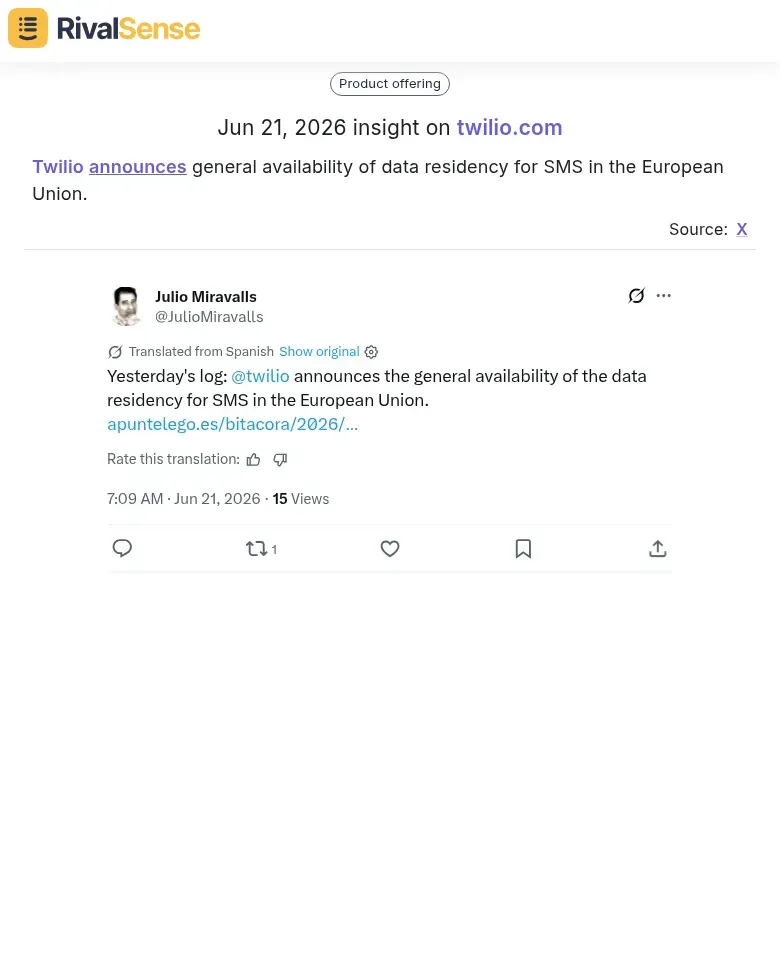
Monitoring compliance announcements helps you anticipate market pushes and adjust your product roadmap before prospects start asking for local data storage.
Actionable steps to uncover regulatory intel on Twitter:
- Create a dedicated list of competitor legal/compliance handles and official accounts.
- Search for keywords like "ISO 27001," "SOC 2," "data residency," "GDPR ready."
- Note timing: A sudden flurry of compliance tweets often precedes a new market push.
- Map to target markets: For every compliance milestone, identify which geography or regulated vertical (fintech, healthcare) it targets.
- Prioritize gaps: Cross-reference with customer requests; prioritize certifications that prospects explicitly ask about.
Checklist:
- [ ] Monitor competitors' compliance announcements quarterly.
- [ ] Map each to a target market.
- [ ] Fill gaps that matter most to your accounts.
- [ ] Bundle compliance into your value proposition: e.g., "Certified in 10 regions vs. their 3." This turns regulatory moves into a competitive wedge for winning risk-averse accounts.
Uncovering Geographic Expansion Plans
Twitter often acts as an early warning system for competitors’ geographic moves. Even before official press releases, tweets can hint at new city or country entries, giving you time to craft a counter-strategy.
1. Monitor localized launch tweets.
Competitors frequently announce new regional availability via local accounts or language-specific tweets. Set up saved searches for phrases like “now available in [City]” or “excited to launch in [Country].” For instance, a fintech company might tweet “🇧🇷 Brazil, we’re here!” weeks before a formal announcement.
2. Spot local partnership signals.
Watch for tweets tagging local retailers, distributors, or media outlets. A B2B SaaS firm partnering with a German IT reseller? That’s a strong signal of European expansion. Create a Twitter list of competitors’ key employees and look for check-ins, event mentions, or “thrilled to work with” posts.
3. Analyze geo-targeted content.
Use Twitter’s advanced search (e.g., from:competitor near:”São Paulo”) to see region-specific campaigns. If a competitor suddenly runs ads in Spanish despite no LatAm footprint, they’re testing the waters.
Quick checklist:
- [ ] Set up alerts for competitor city/country mentions.
- [ ] Track employee location changes in bios.
- [ ] Note any localized hashtags or cultural references.
This intel lets you prepare counter-strategies—like strengthening local relationships or adjusting pricing—before your competitor gains traction.
Analyzing Event Participation and Media Coverage
Trade shows and industry events are goldmines for competitive intel. Track your competitors' presence at key events like CES or MWC by monitoring their Twitter activity before, during, and after. Look for tweet threads teasing product reveals, booth numbers, and live demos. Tip: Create a Twitter list of competitors and set up alerts for event-related keywords (e.g., “booth #” or “launching at”). This gives you real-time visibility into their launch strategies and audience engagement.
Media coverage reveals how competitors shape local perception. A great example: ZENITH launched its Chronometer Revival A384 Tropical at Watches & Wonders 2026 and secured coverage in Vogue Thailand, signaling an Asia-Pacific market push. Tracking such event-linked media mentions uncovers how competitors build regional brand credibility and which publications they use to amplify their message.
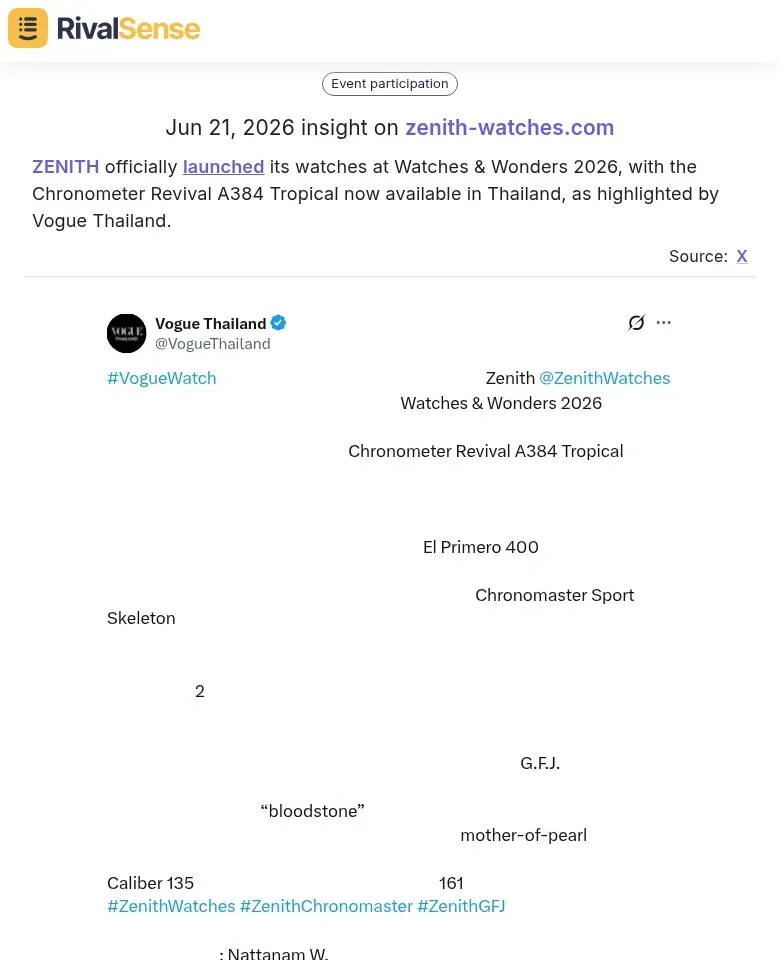
Event participation and local media coverage are strong indicators of expansion priorities and brand positioning. Use this intel to plan your own event presence or to pitch complementary stories to the same journalists.
How to replicate their reach:
- Use Twitter’s advanced search to find media mentions: search “competitor_name” + “@media_account” or check quote tweets from journalists.
- Identify the publications and reporters who regularly amplify their news.
- Follow those reporters and engage with their content to build relationships.
- Note 3–5 top amplifiers per competitor and analyze their audience overlap with your target market.
- Reach out with a personalized pitch offering exclusive insights.
Turning Twitter Intel into Key Account Wins
To turn Twitter intel into key account wins, start by synthesizing competitor weaknesses into tailored proposals. For example, if a rival's tweets reveal customer complaints about slow support, highlight your 24/7 response time in your pitch.
Real-time sales conversations: When a prospect mentions a competitor’s feature, pull up a recent Twitter thread showing users struggling with it. Use phrases like, “We noticed their recent outage—here’s how our uptime guarantee prevents that.”
Continuous CI process: Set up a weekly routine:
- Use Twitter lists to track competitor executives and thought leaders.
- Flag mentions of product gaps, pricing changes, or customer churn.
- Log insights into a CRM or shared doc tagged by account.
- Share weekly briefs with sales teams before key meetings.
Checklist for account-specific strategies:
- [ ] Identify 3 competitor weaknesses per target account.
- [ ] Map Twitter insights to specific pain points for that account.
- [ ] Draft 2–3 counter-narratives using competitor missteps.
- [ ] Update your battle card with real-time examples.
By embedding this intel into your sales process, you pivot from reacting to leading—positioning your solution as the obvious choice.
While manual Twitter monitoring is powerful, tools like RivalSense automate the grunt work—tracking competitor product launches, pricing updates, events, partnerships, regulatory moves, and media mentions across company websites, social media, and registries, then delivering everything in a weekly email report. Get your first competitor report for free today at rivalsense.co and turn intel into account wins.
📚 Read more
👉 Real-World Examples: How to Identify Key Accounts in Tech
👉 Trend Analysis: Pricing Insights from Competitor Journey Mapping
👉 Competitor Partnership Advantages: How Coopetition Drives Growth
👉 Competitive Positioning Benchmarking: Key Benefits for Strategic Vision