
Amazon’s $X Billion Multi-State Push & Project Kuiper’s 350+ Satellites: A Competitor Analysis Blueprint
When a giant like Amazon moves, it rarely does so in a vacuum. The company’s simultaneous announcements on June 19, 2026—major investments across four states and a Project Kuiper satellite fleet exceeding 350 units—are precisely the kind of signals that can reshape entire competitive landscapes overnight.
Understanding these moves goes far beyond reading headlines. They reveal a deliberate blend of local market expansion and global infrastructure dominance, offering a masterclass in how to decode a competitor’s long-term playbook.
🔍 Decoding Amazon’s June 19 Thunderclap
Amazon chose a single day to disclose fresh investments in Kentucky, North Carolina, Pennsylvania, and Washington while also touting over 350 orbiting satellites for its Project Kuiper broadband constellation. This is not a random coincidence; it’s coordinated messaging designed to project unstoppable momentum.
Such an announcement touches multiple competitive fronts: logistics, cloud, retail, and satellite internet. For any company operating in or adjacent to these spaces, ignoring the details is a strategic misstep. A dedicated monitoring approach—especially one that captures early hints and full context—turns a daunting deluge of data into a clear competitive map.
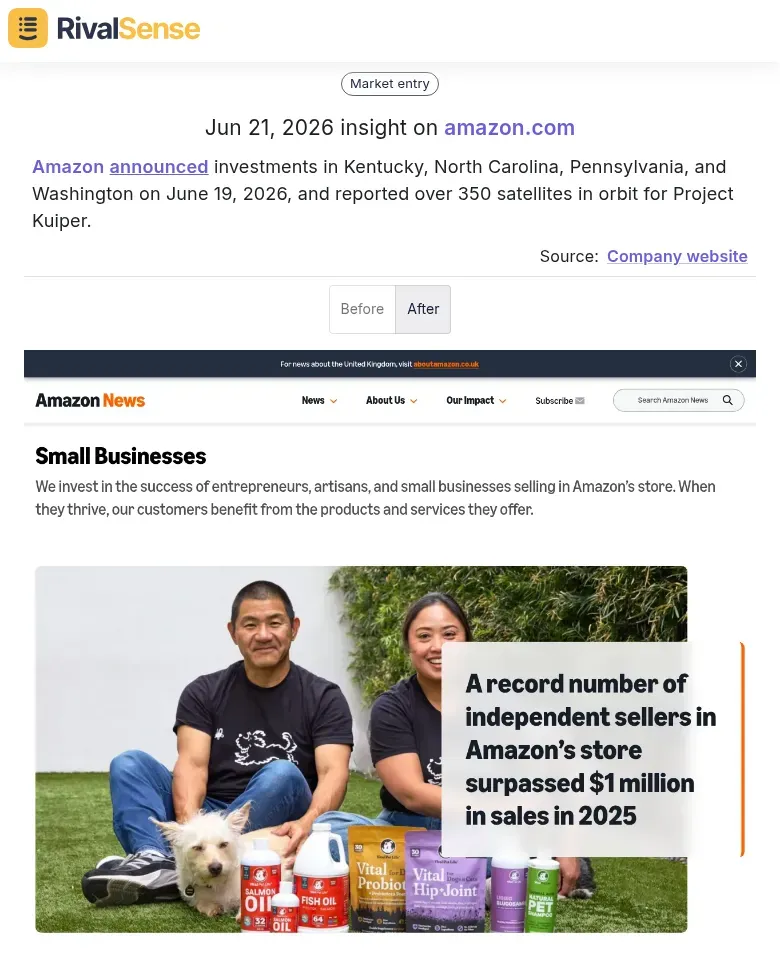
Example of how RivalSense surfaces granular competitor moves like Amazon’s state investments and satellite fleet updates.
Let’s break down the concrete significance:
| Domain | What Was Announced | Competitive Implication |
|---|---|---|
| Physical Footprint | New investments in KY, NC, PA, and WA | Expanded last-mile delivery capacity, tighter regional job market competition, faster Prime speed in those areas. |
| Aerospace & Telecom | Over 350 Kuiper satellites now in orbit | Accelerating path to rival Starlink; potential bundling with AWS for enterprise clients; regulatory momentum. |
| Policy & Influence | Selection of swing states and high-tech hubs | Deepened political ties and tax incentives that can make cost structures harder for competitors to replicate. |
🧭 Actionable Strategies for Your Competitive Intelligence
Monitoring a rival’s announcements is only step one. The real value emerges when you systematically extract patterns and pivot your own strategy. Here are battle-tested ways to use such insights.
✅ Quick‑Response Checklist
- [ ] Map the geographic implications: Mark each announced state on your market share map. Identify which of your key accounts or distribution centers sit in or near these zones.
- [ ] Assess talent drain risk: In Kentucky, North Carolina, and Pennsylvania, anticipate wage pressure or poaching in warehousing and tech roles. Update your HR retention plans.
- [ ] Evaluate Project Kuiper’s enterprise angle: If you compete with AWS or connectivity-heavy services, run a tabletop exercise on how Kuiper could be integrated into cloud bundles.
- [ ] Reverse‑engineer the regulatory signaling: A satellite constellation above 350 often crosses licensing milestones. Check FCC and ITU filings to forecast when laser inter-satellite links might go live.
- [ ] Update your own partnership roadmap: Could your logistics provider, real estate partner, or telco ally be affected? Schedule brief reviews now to avoid being blindsided.
🛠️ Turning Intel into Advantage
Not every competitor move demands an immediate reaction, but the ones that touch infrastructure, geography, and technology all at once qualify as high-priority. The announcements from June 19, 2026 hit all three.
- For key account managers: Amazon’s new fulfillment hubs in KY, NC, and PA mean your enterprise clients in those regions will soon have an even faster Amazon Business option. Preemptively stress your own speed, flexibility, or relationship depth before price pressures mount.
- For partnership managers: A robust Kuiper constellation can lead Amazon to forge deals with airlines, maritime fleets, and governments. If those verticals matter to you, start monitoring Amazon’s press feeds and partner press releases weekly.
📡 Don’t Let the Next Signal Slip By
Competitor intelligence is only as strong as its freshness. Spotting a multi-state investment and a satellite milestone early gives you weeks—or months—to plan. Manual scanning, however, rarely catches cross-domain moves before they’re common knowledge.
Platforms built for this challenge, like RivalSense, automatically track product launches, pricing updates, event participations, partnerships, regulatory shifts, management changes, and media mentions across websites, social channels, registries, and more. The Amazon insight above is exactly the type of discovery that lands in a focused email report, allowing you to act while others are still reacting.
👉 Ready to turn scattered headlines into a clear competitive edge? Try RivalSense for free at https://rivalsense.co/ and get your first report today.
📚 Read more
👉 Competitor Partnership Advantages: How Coopetition Drives Growth
👉 Competitive Positioning Benchmarking: Key Benefits for Strategic Vision
👉 From Insight to Action: Preempting Prenuvo's Expansion with Competitive Intelligence
👉 Quick Tips to Track Competitor Content Performance on Instagram
👉 Advanced Tactics for Winning on Customer Satisfaction in GovTech