
Competitor Partnership Advantages: How Coopetition Drives Growth
When you think of your competitors, “partner” probably isn’t the first word that comes to mind. Yet some of the most successful companies in the world—Apple and Samsung, Pfizer and BioNTech, Boeing and Lockheed Martin—have turned rivals into allies through a strategy called coopetition (cooperation + competition).
Coopetition isn’t about being friends with the enemy. It’s about recognizing that some goals are easier to achieve together than alone. When done right, partnering with a competitor can unlock new markets, reduce costs, and accelerate innovation—giving you a powerful competitive advantage.
In this post, we’ll explore the concrete advantages of competitor partnerships and walk through a practical framework to build your own coopetition strategy.
Why Competitor Partnerships Are a Competitive Advantage
Coopetition works because it turns a zero-sum game into a win-win. Here are four key advantages:
1. Access to New Customers and Markets
Partnering with a competitor—especially one that operates in a different geography or segment—can instantly open doors you couldn’t crack on your own.
Example: Small paintball retailer X Fire Paintball and Airsoft partnered with Amazon (once a competitor) to sell on its marketplace. The result? Instant access to millions of customers and a 300% sales boost.
2. Improved Operational Efficiency
Shared infrastructure, logistics, or R&D can slash costs and let you focus on what you do best.
Example: UPS agreed to fly DHL’s parcels within the US, saving DHL an estimated $1 billion a year while UPS profited from unused cargo space.
3. Enhanced Competitive Position
Co-branded campaigns or shared technology can strengthen both partners’ reputations and market standing.
Example: Samsung supplies OLED screens to Apple despite being fierce smartphone rivals. Apple gets top-tier displays; Samsung earns billions and reinforces its leadership in display tech.
4. Leverage Data and Resources
Pooling data and expertise helps both parties spot trends, improve products, and make smarter decisions.
Example: Telepass, an Italian toll-collection company, used its driver data to partner with insurance firms, creating a new revenue stream while helping insurers find qualified leads.
How to Build a Competitor Partnership Strategy: A Step-by-Step Guide
Step 1: Identify Areas of Mutual Benefit
Look for non-core areas where cooperation creates value without threatening your core differentiators. Common areas include:
- Supply chain and logistics
- R&D for pre-competitive technologies
- Joint marketing to new segments
- Data sharing for industry insights
Tip: Use a tool like RivalSense to monitor your competitors’ partnership announcements, product updates, and strategic moves. Spotting where they’re already collaborating can reveal opportunities for your own coopetition play.
Step 2: Choose the Right Partner
Not all competitors make good partners. Evaluate:
- Complementary strengths (e.g., one excels at manufacturing, the other at distribution)
- Cultural fit and trust level
- Clear boundaries between cooperation and competition
Checklist for partner selection:
- [ ] Does the partner have a strong reputation?
- [ ] Are their goals aligned with yours?
- [ ] Can you compartmentalize areas of cooperation vs. competition?
- [ ] Is there a history of legal disputes that could resurface?
Step 3: Establish Clear Boundaries
Define exactly where you’ll cooperate and where you’ll compete. Write a partnership agreement that covers:
- Scope of collaboration (products, markets, timelines)
- Intellectual property ownership
- Non-compete clauses (if any)
- Data sharing rules
- Exit terms
Real-world lesson: Apple and Samsung simultaneously cooperate on screens and compete in smartphones—but they keep the two relationships separate by having different teams handle each.
Step 4: Negotiate Fair Terms
A fair deal is a durable deal. Avoid the trap of lopsided benefits, as seen in the Delta–American Airlines IROP partnership breakdown. Use benchmarks and third-party data (like RivalSense market reports) to ensure balanced value.
Step 5: Monitor, Measure, and Adapt
Set KPIs for the partnership: revenue generated, cost saved, market share gained, etc. Review progress quarterly and adjust terms if needed. Also keep an eye on the broader competitive landscape—your partner today could become a direct threat tomorrow.
Pro tip: Subscribe to RivalSense to receive weekly email reports on your partners’ (and competitors’) product launches, pricing changes, management moves, and media mentions across 80+ sources. Staying informed helps you spot risks and opportunities early.
Coopetition Checklist: Do’s and Don’ts
| Do | Don’t |
|---|---|
| Start small with a pilot project | Dive into a full-scale joint venture immediately |
| Share only what’s necessary for the partnership | Give away your core IP or trade secrets |
| Communicate openly about goals and concerns | Assume the partner has the same priorities |
| Build an exit strategy upfront | Lock yourself into a rigid long-term contract |
| Use tools to track market changes | Rely solely on intuition or periodic meetings |
🔍 Spotting Partnership Opportunities Through Competitor Intelligence
Even if a competitor isn’t actively looking for partners, their public moves can reveal gaps you can fill. RivalSense monitors changes like pricing updates, positioning shifts, and product launches—each of which can point to a coopetition opening.
-
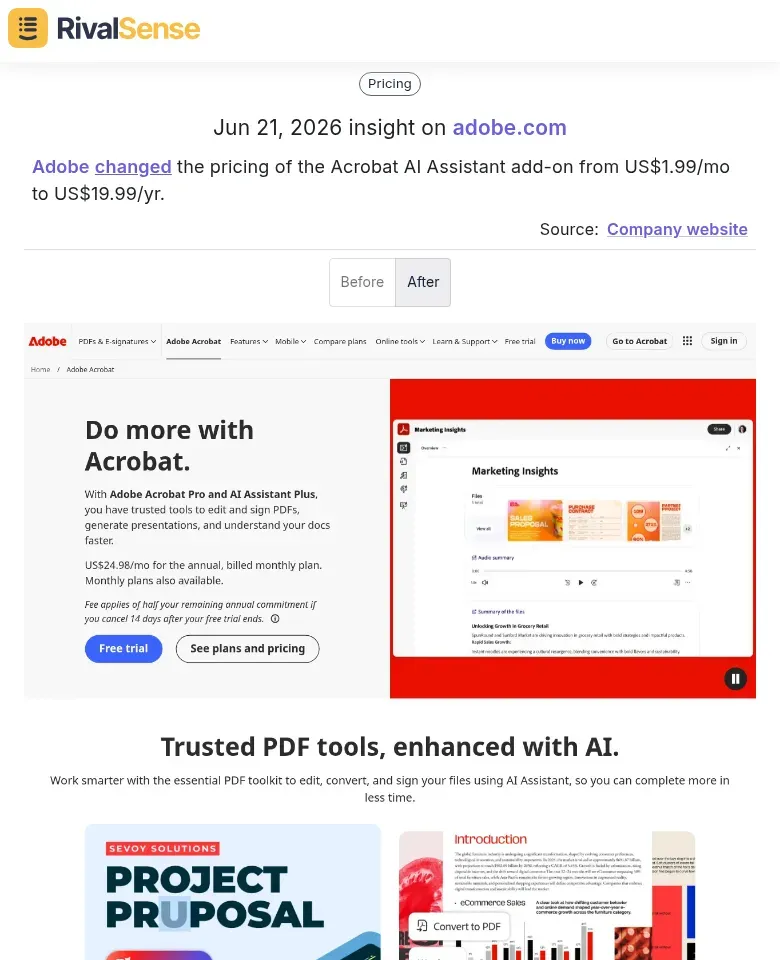
Pricing updates can hint at bundling plays. When Adobe changed the Acrobat AI Assistant add-on from $1.99/month to $19.99/year, it signaled a push toward annual commitments. A B2B software platform could partner to offer this tool as part of a yearly suite, earning recurring revenue and customer lock-in.
-
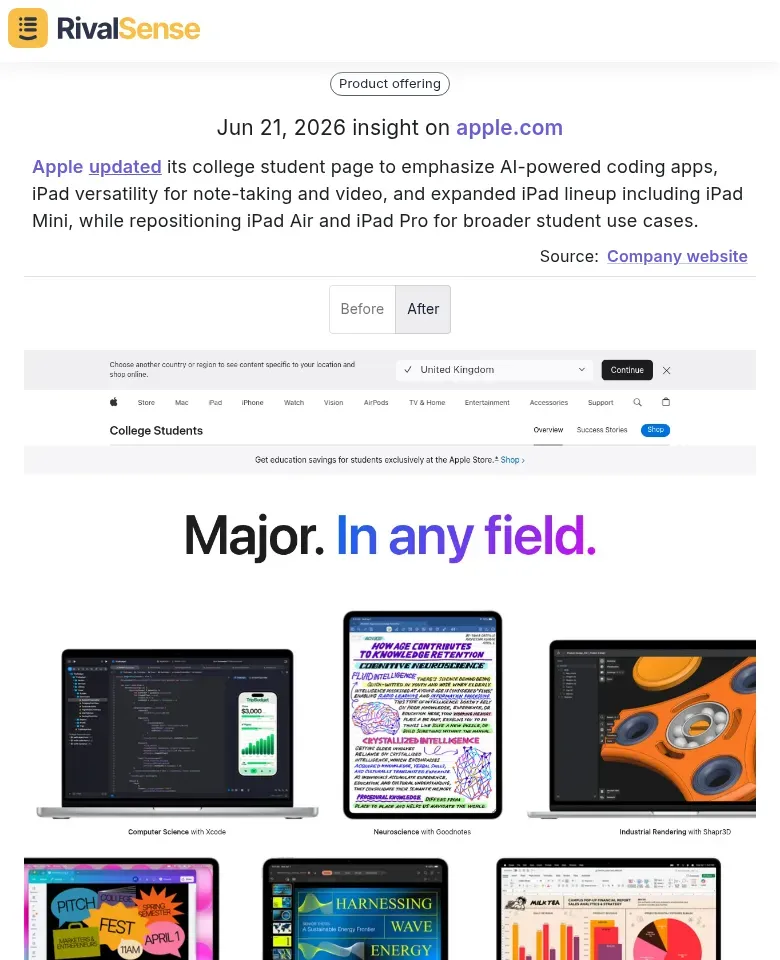
Positioning changes uncover new audience plays. Apple’s overhaul of its college student page—highlighting AI coding apps and iPad versatility—indicates a focused student acquisition strategy. This creates opportunities for educational content providers, accessory makers, or campus resellers to propose co-branded student bundles.
-
Product launches open doors for complementary partnerships. Riot Games’ release of the Summit map for VALORANT isn’t just a gameplay update; it’s a fresh engagement spike. Gaming hardware companies, server hosts, or event organizers can time a partnership to capitalize on the renewed player excitement.

Tracking these signals gives you the early-warning advantage to propose collaboration before anyone else does.
3 Tips for Making Coopetition Work
- Start with a narrow scope. Test the waters with a single product line, market, or project before scaling.
- Focus on complementary strengths. Partner where you’re weak and your rival is strong—and vice versa.
- Keep your competitive intelligence sharp. Even when cooperating, you need to watch for shifts in strategy. That’s where RivalSense comes in: it automatically tracks your competitors’ websites, social media, registries, and news mentions, delivering a concise weekly digest straight to your inbox.
Real-World Examples You Can Learn From
- Pfizer & BioNTech: Combined R&D and manufacturing to deliver a COVID-19 vaccine in record time.
- Boeing & Lockheed Martin: Formed the United Launch Alliance (ULA) joint venture to compete against SpaceX.
- Apple & Microsoft: In 1997, Microsoft invested $150 million in Apple and settled patent disputes, saving Apple from bankruptcy and ensuring Microsoft Office remained on Mac.
Conclusion
Competitor partnerships aren’t a sign of weakness—they’re a strategic lever that can accelerate growth, reduce risk, and strengthen your market position. By following the steps above and staying informed with the right tools, you can turn today’s rival into tomorrow’s ally.
Ready to spot coopetition opportunities in your industry? Start tracking your competitors with RivalSense—it’s the easiest way to know who’s partnering with whom, what products they’re launching, and how their strategy is evolving. Try RivalSense for free at https://rivalsense.co/ and get your first competitor report today.
📚 Read more
👉 Competitive Positioning Benchmarking: Key Benefits for Strategic Vision
👉 From Insight to Action: Preempting Prenuvo's Expansion with Competitive Intelligence
👉 Quick Tips to Track Competitor Content Performance on Instagram
👉 Advanced Tactics for Winning on Customer Satisfaction in GovTech
👉 Advanced Tactics: Turning Regulatory Intel into Customer Service Wins