
Competitive Positioning Benchmarking: Key Benefits for Strategic Vision
Competitive positioning benchmarking is a strategic tool that goes beyond traditional competitor analysis by systematically comparing your company's market position, value proposition, and customer perceptions against key rivals. While traditional analysis often focuses on feature checklists or pricing snapshots, positioning benchmarking evaluates how each competitor is perceived in the market, what unique value they claim, and which segments they dominate. This broader view reveals not just what competitors do, but why customers choose them—laying the groundwork for strategic vision.
The process involves four steps:
- Identify your market's positioning dimensions (e.g., price vs. quality, innovation vs. reliability, niche vs. broad appeal).
- Map each competitor's current position using customer reviews, messaging analysis, and expert interviews.
- Spot gaps and overlaps where you can differentiate or where competition is saturated.
- Synthesize findings into a vision that targets an underserved space.
💡 Practical tip: Score each competitor on a 1–5 scale for every dimension, then plot them on a bubble chart (bubble size = market share). This visual instantly clarifies where your brand can stand out. By grounding vision in market reality, competitive positioning benchmarking turns data into directional clarity—helping leaders avoid me-too strategies and build a defensible future.
Real‑world competitive signals that shape strategy
Before diving deeper, here’s how tracking specific competitor moves can directly inform your decisions:
1. Social media engagement as a benchmark
When Johnson Financial Group connected corporate and advisor teams using Hootsuite, they achieved 1.6M impressions and 314% higher engagement than industry benchmarks.
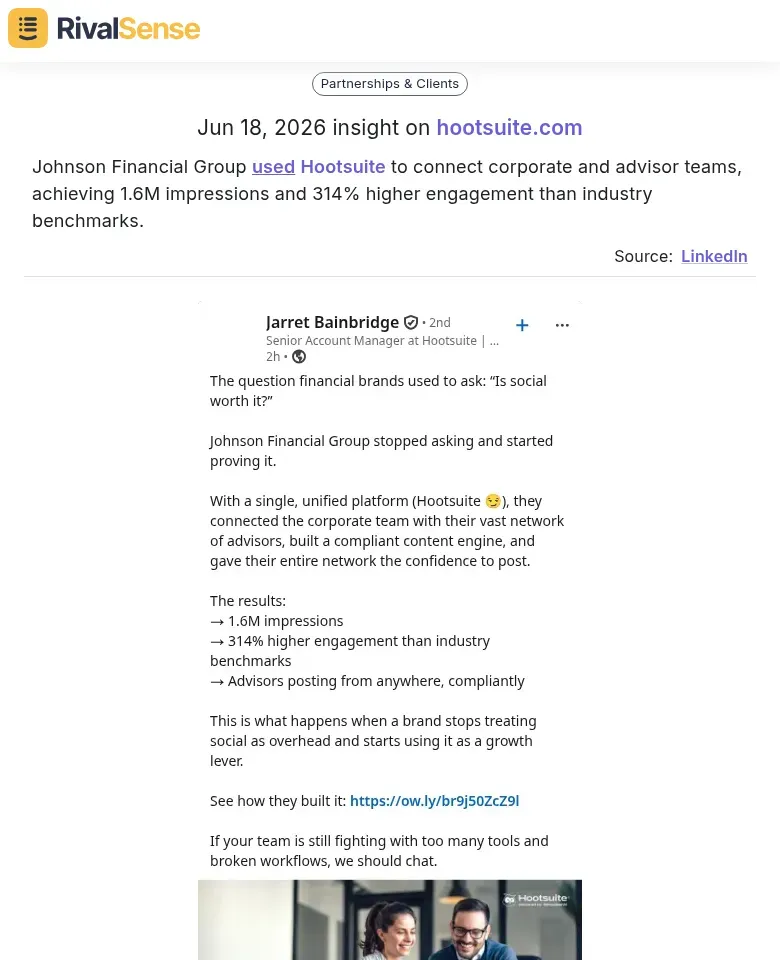
Why this matters: Monitoring such performance data helps you set realistic engagement targets and spot the channels where competitors are winning customer attention. If a rival suddenly doubles its social traction, it may signal a new campaign or audience segment worth investigating.
2. Sponsorhips that reveal market intent
Fanatics sponsored the FIFA World Cup 2026 kick‑off party at the Mexican Cultural Institute on June 11.

Why this matters: Event sponsorships are rarely accidental—they indicate which geographies, demographics, or cultural moments a competitor is targeting. Spotting these moves early lets you adjust your own partnerships and messaging before a rival locks in mindshare.
3. Event demand signals product momentum
CrowdStrike’s Fal.Con 2026 hotel block at Mandalay Bay is sold out, pointing to extremely high interest in the event.
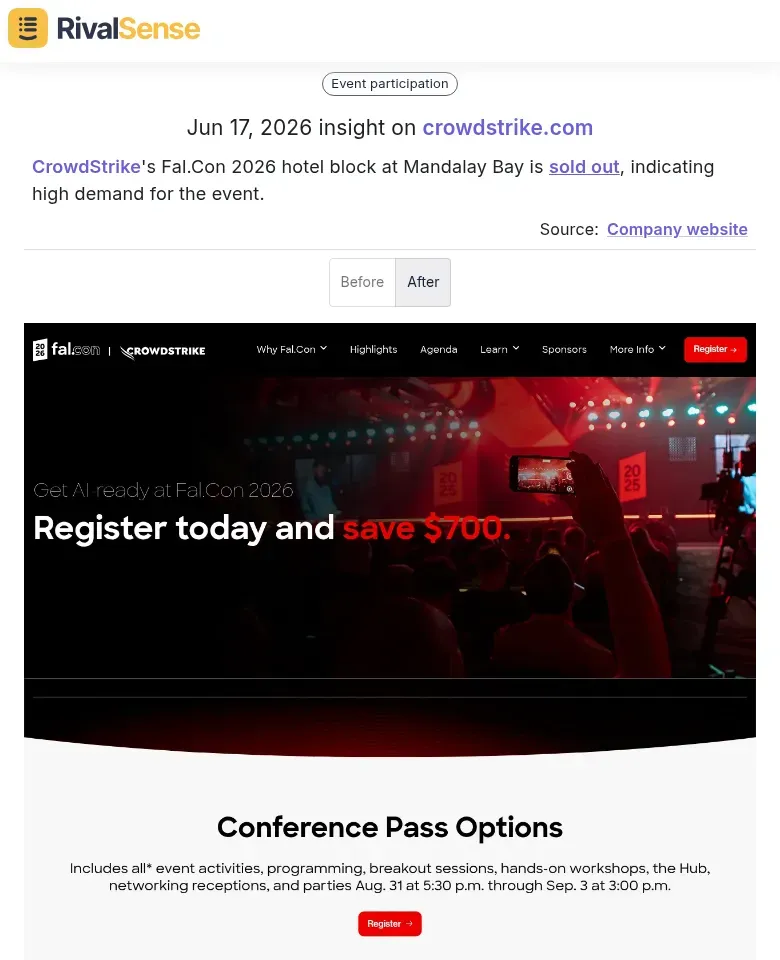
Why this matters: A sold‑out conference is a leading indicator of customer loyalty and community engagement. Tracking such signals helps you evaluate a competitor’s real‑world traction—far beyond what a product datasheet ever shows.
Identifying Market Gaps and Opportunities
To identify market gaps, systematically evaluate each competitor's product features, pricing, customer reviews, and go‑to‑market strategies. Create a matrix comparing strengths (e.g., superior UX) and weaknesses (e.g., poor support). Look for patterns—if multiple competitors neglect a feature customers frequently request, that’s a gap.
Practical steps:
- Map competitor offerings against a checklist of ideal attributes (e.g., integrations, onboarding, SLAs).
- Mine customer feedback on review sites, forums, and social media for recurring complaints or wishlist items.
- Conduct win/loss analysis to understand why prospects choose competitors over you.
🎨 Tip: Use a red–blue–green framework: red for competitor weaknesses you can exploit, blue for areas where you’re equal, green for your unique strengths. Prioritize gaps that align with your core capabilities and address real customer pain points—then innovate with targeted features, messaging, or business models. For example, if competitors charge per seat but customers want flat‑rate pricing, test a fixed‑tier plan to differentiate.
Informing Strategic Decision‑Making
When leadership faces pivotal decisions—like entering a new market or allocating R&D budget—intuition alone is insufficient. Competitive positioning benchmarking replaces guesswork with data, enabling confident, strategic moves.
Practical Steps to Leverage Positioning Data:
- Map the competitive landscape quarterly. Plot competitors on axes relevant to your market (e.g., price vs. feature depth, or enterprise focus vs. SMB agility). Identify white spaces where no competitor dominates.
- Correlate position shifts with financial outcomes. Track how changes in market share align with moves like pricing changes or product launches. This reveals which competitive actions drive real growth.
- Use a weighted scoring model for resource allocation. List your initiatives (e.g., feature X, expansion to region Y) and score each against criteria derived from positioning gaps—market demand, competitive pressure, and strategic fit. Allocate budget proportionally to top‑scoring initiatives.
Reducing Launch Risk: Before a new product launch, benchmark your offering against top competitors on a 1–10 scale for key attributes (usability, support, integrations). If your score average falls below 7, consider delaying or differentiating further.
📊 Pro Tip: Share a condensed “strategic dashboard” monthly with your board, highlighting positioning shifts, emerging threats, and recommended resource reallocations. This builds a culture of data‑driven, proactive strategy.
Enhancing Competitive Advantage
To enhance competitive advantage through positioning benchmarking, start with a systematic audit of your current value proposition against top rivals. Identify gaps where competitors outmaneuver you—these signal opportunities to refine your messaging.
Build defensible moats by doubling down on unique differentiators that competitors can’t easily replicate. For example, if your product offers superior onboarding support, quantify its impact on customer retention and make that your central narrative.
Monitor market trends using tools that capture not just mentions but real competitor actions—product launches, pricing updates, event appearances. A practical checklist:
- Analyze competitors’ social media for engagement leaps or new campaign angles.
- Review G2/Capterra for emerging complaints or praise.
- Track event sponsorships or sold‑out conferences to gauge market momentum.
🧭 Quick tip: Create a ‘competitor move matrix’—list each rival’s recent actions, their likely intent, and your counter‑positioning move. This transforms reactive observation into proactive strategy, ensuring you stay ahead rather than just keeping pace.
Improving Customer Understanding and Alignment
Competitive positioning benchmarking isn’t just about tracking rivals—it’s a lens into your customers’ unmet needs. By systematically mapping competitor customer experiences, you uncover friction points that prospects endure, from confusing onboarding to lackluster support.
Practical step: Conduct a ‘customer journey audit’ of your top three competitors. Use tools like mystery shopping, review analysis (G2, Capterra), and social listening to compile a pain‑point heatmap. Once identified, tailor your value proposition to address those gaps explicitly. For example, if competitors fail at post‑purchase onboarding, position your ‘white‑glove implementation’ as a key differentiator.
Benchmarking also validates your messaging. Tip: A/B test positioning statements against competitor claims using landing page experiments—measure conversion lift when you highlight resolved pain points.
Checklist:
- [ ] Map 3 competitor journeys monthly
- [ ] Update value propositions quarterly
- [ ] Test messaging variations bi‑weekly
This iterative loop ensures your strategy stays aligned with shifting customer preferences, turning competitor weaknesses into your market advantage.
Driving Long‑Term Strategic Vision
Competitive positioning benchmarking isn’t just about snapshots—it’s a strategic compass. To drive long‑term vision, start by mapping benchmark insights directly to your top 3–5 strategic KPIs (e.g., market share growth, customer acquisition cost, NPS). Create a quarterly scorecard that tracks both your performance and competitors’ movements against these metrics. This ensures benchmarking informs, not distracts from, your core goals.
Adapt with agility by embedding a “signal detection” step into your monthly review cycle. Assign a team member to monitor competitor product launches, pricing shifts, event participations, or customer sentiment trends. When a material shift occurs, run a rapid 2×2 matrix exercise: plot the shift’s impact (high/low) vs. your readiness (strong/weak). This helps prioritize which competitive moves demand immediate strategy tweaks vs. watching briefs.
Finally, foster a continuous CI culture by making competitive intelligence a recurring ritual, not a one‑off project. Try a “Competitive Friday” where each team shares one insight from their domain. Use a shared dashboard (e.g., a simple Notion page) to log observations and link them to strategic initiatives. Recognize contributions in all‑hands meetings—this turns benchmarking from a solo analytics task into a company‑wide strategic habit.
Turn insights into action
Competitive positioning only works when you have a steady stream of fresh, relevant data on what your rivals are actually doing—not what they said six months ago. That’s where RivalSense comes in. It automatically tracks competitor product launches, pricing updates, event participations, partnerships, management changes, and media mentions across websites, social channels, and registries—then delivers a clean weekly email report so you never miss a signal.
👉 Try RivalSense for free and get your first competitor report today. See what your rivals are up to, spot gaps, and build a smarter, faster strategy.
📚 Read more
👉 From Insight to Action: Preempting Prenuvo's Expansion with Competitive Intelligence
👉 Quick Tips to Track Competitor Content Performance on Instagram
👉 Advanced Tactics for Winning on Customer Satisfaction in GovTech
👉 Advanced Tactics: Turning Regulatory Intel into Customer Service Wins
👉 How to Decode Competitor Funding Events Like Civinity’s €13.54M Bond Issuance