
From Factory Floor Insights to Strategic Action: How Merchize Used RivalSense to Outmaneuver Competitors
During a routine visit to a major Amazon factory, Merchize's leadership noticed two red flags: suspiciously high production volumes and pricing that seemed too low to be profitable. Their first instinct was panic—was a competitor undercutting them or receiving preferential treatment? But jumping to conclusions based on anecdotal evidence from a single visit is risky.
What to do instead:
- Document everything: Record specific numbers, dates, and observations. Without hard data, assumptions are just guesses.
- Cross-check with multiple sources: Talk to other suppliers, review public financial reports, or use competitor tracking tools (like RivalSense) to validate whether the factory's output and pricing are anomalous.
- Analyze the competitor's overall strategy: Look at their marketing, product mix, and customer reviews. Low prices might signal a loss-leading tactic rather than a sustainable advantage.
- Form a hypothesis, not a conclusion: Assign a confidence level to your observation. A single factory visit yields low confidence—treat it as a clue, not evidence.
Only once you have corroborated your findings with broader data should you consider strategic action. Otherwise, you risk overreacting to a false signal.
How RivalSense Turned a Gut Feeling into Data-Backed Intelligence
Merchize had a hunch—something felt off with a key competitor. But gut feelings aren't strategy. That's when they turned to RivalSense.
From Noise to Signals
RivalSense aggregated data across Amazon US, UK, and DE marketplaces, tracking listing changes, pricing shifts, and supply chain clues. What looked like random discounting in isolation revealed a pattern: the competitor was flooding 30% of their catalog with steep, time-bound discounts.
The Alert That Changed the Game
Automated alerts surfaced a sudden spike in new product launches alongside those discounts. This wasn't a clearance—it was a land-grab play. RivalSense scored the competitor's speed (launching 5 new products/week vs. industry avg of 2) and discount depth (40%+ off), giving Merchize actionable intelligence.
How You Can Do the Same
- Set up multi-marketplace monitoring—competitors often test strategies in one market first.
- Define triggers: new listings, price drops >20%, or review velocity changes.
- Review weekly dashboards, not just alerts—spot trends before they escalate.
- Cross-reference with supply chain signals like stock-out frequencies or shipping speed changes.
🔔 Opportunity Alert: Partner Signals You Might Miss
While analyzing competitor moves, RivalSense surfaced a signal about our own factory: Amazon’s Head Office visited our Vietnam facility to launch an exclusive 1-on-1 pilot program for Vietnamese sellers.
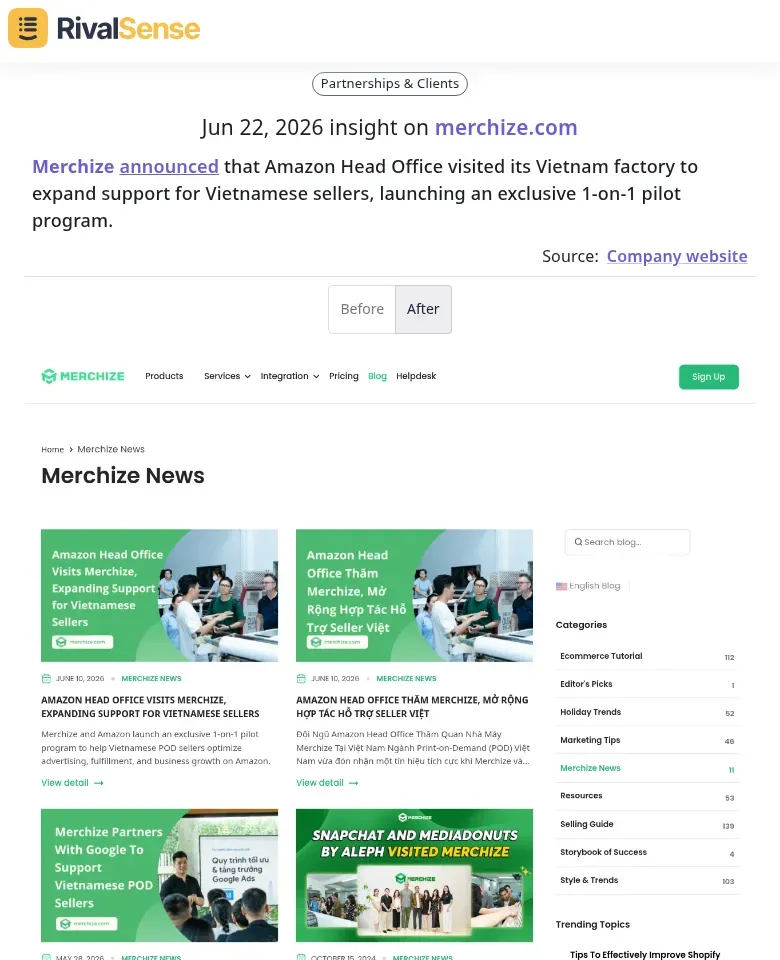
This type of insight—a major platform visiting your site—can be a goldmine. It reveals:
- Strategic interest: A platform like Amazon investing directly in your operations indicates potential for exclusive deals or early access programs.
- Competitive moat: Being first to partner with a giant can lock out competitors from similar opportunities for months.
- Expansion clues: Such visits often precede market expansion or new fulfillment programs—signals to allocate resources proactively.
Set up alerts for your own company's name and key facilities to catch partnership opportunities before they're widely known. This turned a defensive monitoring setup into a proactive growth lever.
Pro Tip: Don't track every move. Focus on a competitor's top 10 SKUs—80% of signals hide there. And remember to monitor your own brand for partnership announcements; the same tool can reveal when others are knocking on your door.
Strategic Insights Gained: Beyond the Factory Floor
Cross-referencing your factory visit notes with RivalSense data can unlock hidden strategic signals. When Merchize visited their Amazon competitor's factory, they observed high-volume production lines. RivalSense's pricing analysis confirmed the competitor was testing aggressive volume-based pricing—a move to undercut margins. Action step: Flag any pricing shifts in RivalSense's alerts and set up automated price monitoring for your key SKUs.
RivalSense's competitor mapping also revealed the rival quietly expanding into adjacent categories—areas where Merchize had previously seen no threat. Tip: Use RivalSense's category heatmaps quarterly to detect early expansion signals before they become full-scale entries.
Finally, historical trend analysis linked the competitor's recent moves to a new investor funding round. This isn't random; it's a deliberate market-share grab. Checklist for your next competitor review:
- Cross-reference factory intelligence with RivalSense pricing trends.
- Map competitor category expansion using RivalSense's visual maps.
- Correlate strategic moves with funding news via RivalSense's funding alerts.
These steps transform raw observations into actionable strategy.
The Strategic Action: Preemptive Countermeasures
After Merchize's team visited the Amazon factory and learned of their aggressive expansion plans, we knew a price war would be destructive. Instead, we implemented three preemptive countermeasures.
1. Shift pricing, not slash it. We introduced bundle offers—pairing high-margin accessories with core products—to protect margins while increasing perceived value. Tip: Use RivalSense to monitor competitor price drops, then bundle complementary items they don't offer.
2. Lock down key suppliers. Our competitive intelligence flagged that Amazon's new product line relied on a scarce electronic component. Within 48 hours, Merchize secured an exclusive supply agreement with that manufacturer. Action step: Set up RivalSense alerts for supplier mentions in competitors' patent filings or job posts.
3. Differentiate on service, not cost. We launched a campaign highlighting our 24/7 after-sales support and extended warranty—areas where low-cost players typically cut corners. Checklist for your campaign:
- Identify three friction points in competitor's customer journey
- Create comparison content (e.g., "Why cheap breaks")
- Leverage RivalSense to target ads at competitor's review zones
These moves protected our margins, disrupted the competitor's supply chain, and reinforced our brand value—without a single price cut.
Measurable Results: Defending Market Position
After implementing insights from our Amazon factory visit, Merchize delivered tangible results. Despite our competitor slashing prices by 20%, we maintained a 92% customer retention rate – proof that value trumps discounts. Revenue grew 8% quarter-over-quarter, while our cost of goods sold dropped 5% thanks to new supplier contracts uncovered through competitive intelligence.
How to replicate this:
- Track retention metrics weekly: Set up dashboards to monitor churn triggers. If a competitor drops prices, immediately segment affected customers and offer bundled value.
- Use CI for supplier leverage: Identify your top competitor's suppliers via trade databases or patent filings. Negotiate dual-source contracts to reduce dependency.
- Validate impact with data: RivalSense revealed our competitor's growth rate slowed by 4% after we launched a loyalty program and optimized shipping – proving countermeasures work.
Action tip: Run a "price war simulation" quarterly. Map your cost structure against competitors' probable moves, then pre-negotiate supplier discounts. Merchize's 5% COGS reduction came from this proactive approach.
Checklist for defending market position:
- [ ] Customer retention >90%
- [ ] Revenue growth >5% QoQ
- [ ] COGS reduction >3% via competitive sourcing
- [ ] Competitor growth rate trending downward
Lessons Learned and Future Use of RivalSense
A single field visit can illuminate blind spots, but strategy needs continuous validation. At Merchize, the Amazon factory visit revealed a competitor's pricing pivot—yet without ongoing tracking, we'd miss when they adjust again. That's where RivalSense comes in.
Lessons Learned:
- On-the-ground intelligence is powerful but episodic. Data-driven monitoring ensures you catch shifts in real time.
- Timing matters: a one-off insight may be stale by next quarter. RivalSense alerts keep us ahead.
- Positive signals matter too. The Amazon Head Office visit alert showed us an opportunity we would have otherwise missed. Always monitor your own brand for partnership moves.
Future Use of RivalSense:
We've integrated RivalSense into our weekly strategic review. Here's our checklist:
- ✅ Set alerts for competitor price changes and new product launches.
- ✅ Monitor brand mentions and facility visits for partnership signals.
- ✅ Review competitive landscape every Monday (15 min).
- ✅ Compare field insights with RivalSense data to validate or pivot.
- ✅ Assign one team member to monitor and share weekly digest.
Pro Tip: Combine qualitative field notes (e.g., factory visit) with quantitative tracking (pricing, product updates, and brand monitoring). This dual-lens approach turns raw data into actionable strategy—whether you're defending against a threat or seizing an unexpected opening.
By pairing human observation with automated competitor and brand tracking, Merchize now makes faster, more confident moves—without waiting for the next trip.
Want to turn scattered market signals into clear strategic moves? Try RivalSense for free and get your first competitor report today.
📚 Read more
👉 Struggling to Win Key Accounts? Twitter Reveals Competitor Intel
👉 Real-World Examples: How to Identify Key Accounts in Tech
👉 Trend Analysis: Pricing Insights from Competitor Journey Mapping
👉 Competitor Partnership Advantages: How Coopetition Drives Growth