
Real-World Examples: How to Identify Key Accounts in Tech
Strategic hires often signal where a company is placing its bets. When a competitor poaches a senior leader from a cloud infrastructure firm, they’re likely targeting enterprise accounts that require deep cloud expertise. Similarly, hiring a former public sector CTO suggests a push into government contracts.
Real-time insight: RivalSense recently captured that Joe Ayers joined Broadcom as Vice President in the United States, previously serving as U.S. Public Sector at AMD.
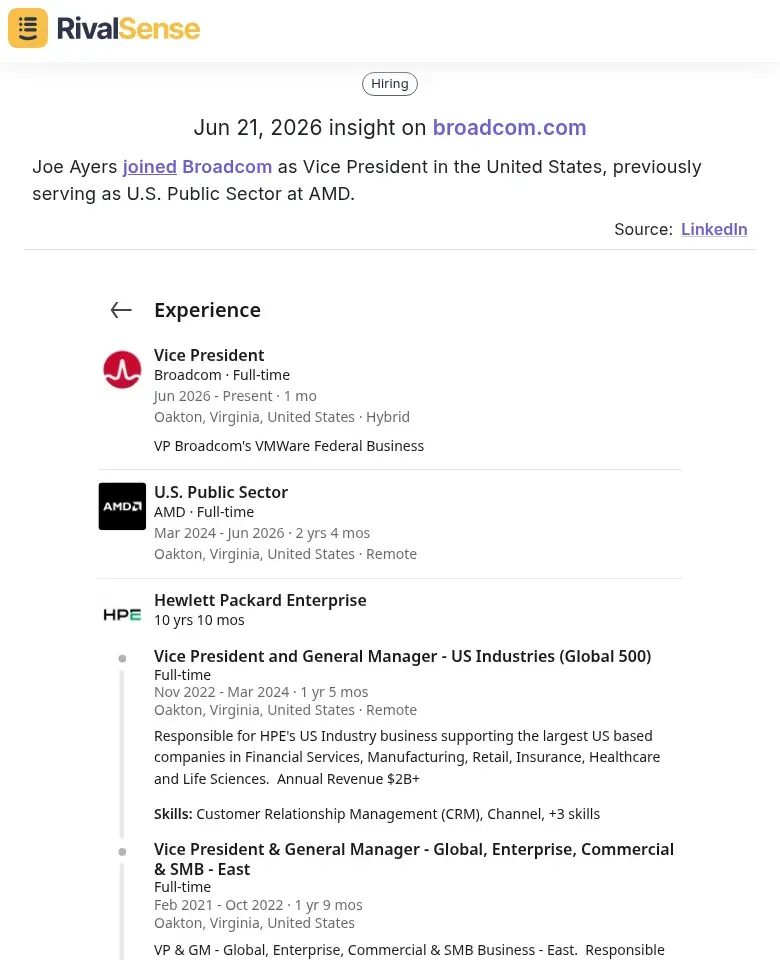
This type of executive move highlights a deliberate focus on government accounts, giving you an early warning to adjust your account list. Monitoring talent flows lets you anticipate where a competitor will compete next.
Practical Steps:
- Set up talent alerts on LinkedIn or through tools like RivalSense to track senior-level movements (C-suite, VPs, Directors) from top competitors and adjacent industries.
- Analyze the source: A hire from Salesforce’s enterprise sales team indicates a focus on large deal-making. A hire from a cybersecurity startup may hint at compliance-heavy key accounts.
- Map the target role: A VP of Strategic Partnerships suggests acquisition targets. A Head of Public Sector signals government key accounts.
- Cross-reference with news: Check if the hire coincides with new product launches or market expansions.
💡 Tip: Look for clusters of hires from the same company—it often precedes a competitive push into that company’s customer base. Use talent flow data to identify potential key accounts being targeted for partnership or acquisition.
🤝 Monitoring Partnerships and Technology Integrations
To uncover key accounts early, monitor co-marketing announcements and joint solution launches. For instance, if two companies announce a bundled offer or co-host a webinar, they likely share a target account or vertical. Set up Google Alerts for partner-specific keywords like “partnership” + company names to catch these signals. However, subtle co-engineering moves often escape simple alerts.
Real-time insight: RivalSense identified a podcast discussion where Paul Turner, Chief Product Officer of the VMware Cloud Foundation Division at Broadcom, detailed how Broadcom and AMD are jointly building AI-ready infrastructure with VMware Cloud Foundation and AMD Instinct MI350P Series GPUs.

Tracking such executive-led technology integrations reveals complementary product stacks and the high-value accounts that deploy both. This intelligence lets you pinpoint exactly who a competitor is co-targeting in the enterprise market.
Next, map complementary technology stacks. If a virtualization vendor integrates with an AI accelerator company, their overlapping customer bases become key accounts for both. Use tools like BuiltWith or similar to identify which accounts deploy both technologies.
- [ ] Identify top 5 partners of each competitor
- [ ] Check which accounts use both
- [ ] Prioritize those accounts
Finally, track executive endorsements. When a CEO tweets about a partner’s product or an exec is featured in a customer success story, it signals a deep alliance. These endorsements often precede formal co-selling initiatives. Hint: Create a spreadsheet to log such mentions and the accounts mentioned alongside. This triangulation of partnerships, tech stacks, and endorsements reveals high-value accounts with minimal effort.
🎙️ Analyzing Executive Communications and Thought Leadership
To uncover key accounts, scrutinize your competitors’ executive communications. Start by reviewing their CEO or CRO appearances on podcasts and webinars. Listen for recurring customer pain points and use cases they emphasize—these signal their target persona. This detective work shows where they’re investing finite resources.
Practical approach:
- Create a tracking sheet: note each mention of specific industry verticals (e.g., fintech, healthcare) or deployment scenarios (cloud migration, hybrid).
- For example, if a competitor’s CTO repeatedly references ‘multi-cloud security for regulated industries,’ that’s a segment they’re prioritizing.
Next, analyze their conference participation. Check which events they sponsor or keynote (e.g., AWS re:Invent, SaaStr Annual). Cross-reference these with recent case studies or press releases for account wins or competitive displacements. A pattern often emerges: a company that speaks at a healthcare IT conference likely has a key account push in healthcare.
💡 Pro tip: Use a tool like RivalSense to aggregate executive transcripts and event calendars automatically. Set up alerts for specific keywords (‘digital transformation,’ ‘enterprise scalability’) to spot shifts in focus. Finally, map messaging themes to specific accounts—if a competitor launches a webinar series on ‘retail AI,’ their top targets are likely large retailers.
🛡️ Identifying Customer Pain Points and Solution Positioning
To identify key accounts, start by scanning for common pain points like security risks, supply chain vulnerabilities, or operational inefficiencies. Use competitor case studies, industry reports, and social listening to detect these themes. For example, if competitors position air-gapped solutions, target compliance-heavy industries (finance, healthcare) where data sovereignty is critical.
Real-world signal: On June 12, 2026, Broadcom appeared on a FedInsider podcast to discuss hidden risks in air-gapped environments, including supply chain and manual updates.
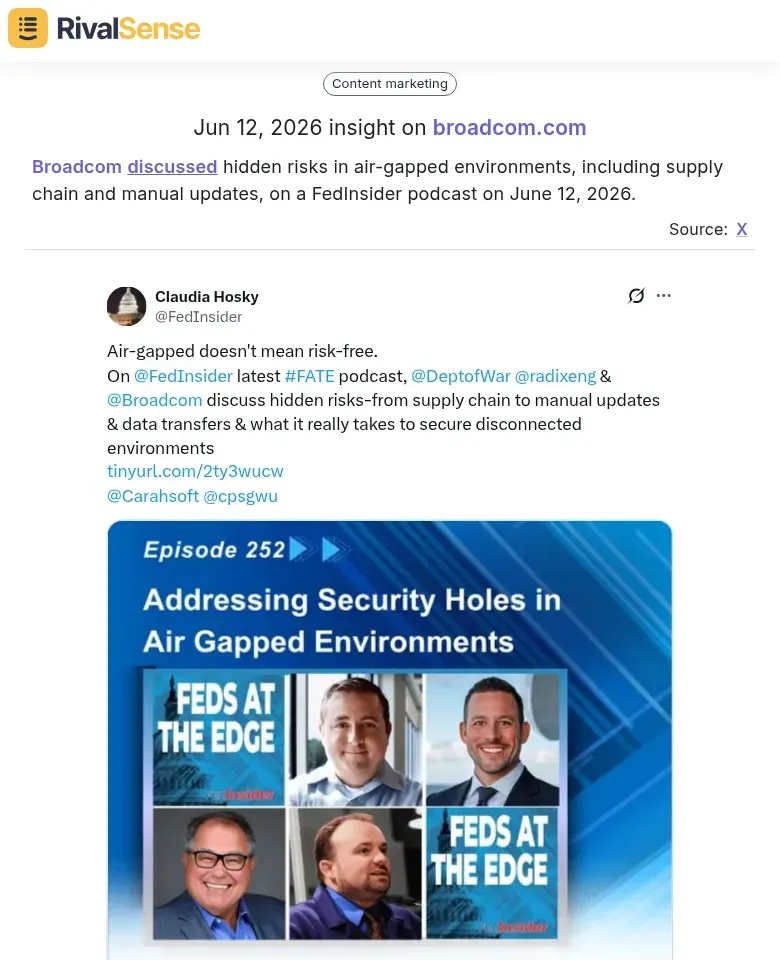
This insight confirms they’re targeting regulated sectors with strict data isolation requirements. By capturing niche discussions like this, you can align your sales efforts to accounts that share the same pain points—long before a formal RFP hits the market.
Practical steps:
- Create a pain-point taxonomy – List recurring challenges (e.g., audit failures, vendor lock-in) and tag accounts facing them.
- Map solution narratives – Align your product’s strengths (e.g., zero-trust architecture) to regulated sectors. Use frameworks like GDPR or HIPAA to prioritize.
- Run problem-centric scoring – Assign weight to accounts based on overlap with competitors’ solved issues. Tools like RivalSense can surface which accounts mention “compliance costs” or “downtime risks” in earnings calls.
Checklist:
- [ ] Identify top 3 pains your competitors address.
- [ ] List 10 accounts in regulated industries with recent security incidents.
- [ ] Compare solution positioning (e.g., air-gap vs. cloud) to account needs.
By focusing on problems rather than product features, you’ll prioritize accounts ripe for engagement.
📊 Building a Proactive Account Identification Framework
Stop chasing accounts reactively. Build a scoring model that combines signals across hiring surges, new partnerships, executive thought leadership, and customer pain points.
Step 1: Define signal weights. Assign points to each signal type. For example: +10 for a VP-level hire, +15 for a strategic partnership, +5 for a blog post mentioning scaling challenges.
Step 2: Set up automated alerts. Use tools like RivalSense or custom Google Alerts to monitor for trigger events: role changes (e.g., ‘hiring VP of Engineering’), joint press releases, or new content releases (e.g., ‘we’re expanding into Asia’).
Step 3: Score and prioritize. Aggregate points per account. A score >50 indicates a high-potential target.
Step 4: Validate hypotheses. Don’t assume signals equal intent. Reach out with a personalized insight (e.g., “Noticed your recent VP hire—here’s how we helped similar teams scale”). Alternatively, use LinkedIn Sales Navigator or public earnings calls to confirm pain points.
💡 Pro tip: Re-score accounts quarterly. A dormant account can become high-value overnight with a single partnership announcement.
Stop guessing and start tracking. RivalSense monitors competitor product launches, pricing changes, partnerships, talent moves, regulatory filings, and media mentions—delivering a clean weekly email report so you never miss a strategic shift.
👉 Try RivalSense free and get your first competitor report today: https://rivalsense.co/
📚 Read more
👉 Trend Analysis: Pricing Insights from Competitor Journey Mapping
👉 Competitor Partnership Advantages: How Coopetition Drives Growth
👉 Competitive Positioning Benchmarking: Key Benefits for Strategic Vision
👉 From Insight to Action: Preempting Prenuvo's Expansion with Competitive Intelligence