
Trend Analysis: Pricing Insights from Competitor Journey Mapping
Pricing decisions directly impact customer acquisition, retention, and profitability—yet many B2B leaders set prices in a vacuum. Competitor journey mapping changes that by revealing how rivals price at each touchpoint of the customer lifecycle: from awareness (freemium tiers) to consideration (discount nudges) to retention (loyalty incentives). Understanding these patterns helps you differentiate your offer and optimize your own pricing model.
Practical Tip: Create a simple pricing touchpoint matrix. List your competitor's key customer stages (e.g., trial, purchase, renewal) and note the price, discount, or promotion at each. Look for gaps—if a competitor lacks a low-commitment entry tier, that's your differentiator.
Checklist for Your First Journey Map:
- Identify 3 direct competitors and their pricing pages.
- Map 5 lifecycle stages: Awareness → Consideration → Purchase → Onboarding → Renewal.
- Note pricing changes (e.g., free trial length, upsell timing, annual discount %).
- Highlight moments where competitors raise or lower prices.
- Ask: Where can we offer better value without competing on price alone?
By systematically dissecting competitor pricing journeys, you move from reactive discounts to proactive pricing strategies that drive growth.
Mapping the Customer Journey for Pricing Clues
To map the customer journey for pricing clues, start by identifying key touchpoints across four stages: awareness, consideration, purchase, and loyalty. For each stage, audit competitor offers systematically.
Step 1: Awareness & Consideration — Look for pricing signals in ads, landing pages, and content. Note freemium tiers, time-limited discounts, or lead magnets (e.g., free eBooks).
Step 2: Purchase Stage — Analyze checkout flows for first-purchase discounts, bundle pricing, or urgency tactics (countdown timers).
Step 3: Loyalty & Retention — Examine loyalty programs, referral bonuses, or subscription discounts.
Checklist for each competitor:
- Free trial length & conditions
- Discount depth and trigger (e.g., email signup, cart abandonment)
- Loyalty reward structure
Pattern Recognition Tip: Watch for common moves like “freemium → paid upgrades” or “high initial discount → higher renewal prices.” These reveal how competitors steer behavior.
Pro Tip: Create a simple matrix with stages as columns and competitor names as rows. Fill in pricing tactics to spot gaps (e.g., no one offers a post-purchase loyalty bonus—your opportunity).
This analysis turns pricing into a strategic map, not just a number.
Free Credits and Usage-Based Offers: Lowering the Entry Barrier
Free credits and usage-based pricing are powerful tactics to lower the entry barrier and accelerate adoption. By offering a risk-free trial with a set amount of credits, you let prospects experience your product's value firsthand—eliminating the friction of upfront commitments. Usage-based pricing further aligns costs with the value customers derive, making it especially effective for variable-usage products like APIs or cloud services.
Practical steps to implement:
- Define credit thresholds – Research competitors to determine standard credit offers. For example, a competitor might offer 500 API calls free; consider beating that with 1,000 calls.
- Tier credits by use case – Offer different credit amounts for different buyer personas (e.g., 100 credits for freelancers, 1,000 for agencies).
- Set a clear expiration – Create urgency with a 30-day window to encourage quick action.
- Pair credits with onboarding – Send automated walkthrough emails or in-app guidance as credits are used, driving activation.
- Monitor conversion patterns – Track which credit amounts and usage levels lead to paid conversions, then iterate.
Monitoring competitor credit offers is crucial for staying competitive. For example, RivalSense recently detected that Deepgram is offering $200 in free voice AI credits (46,000 minutes) for transcription, speech-to-text, text-to-speech, and more.
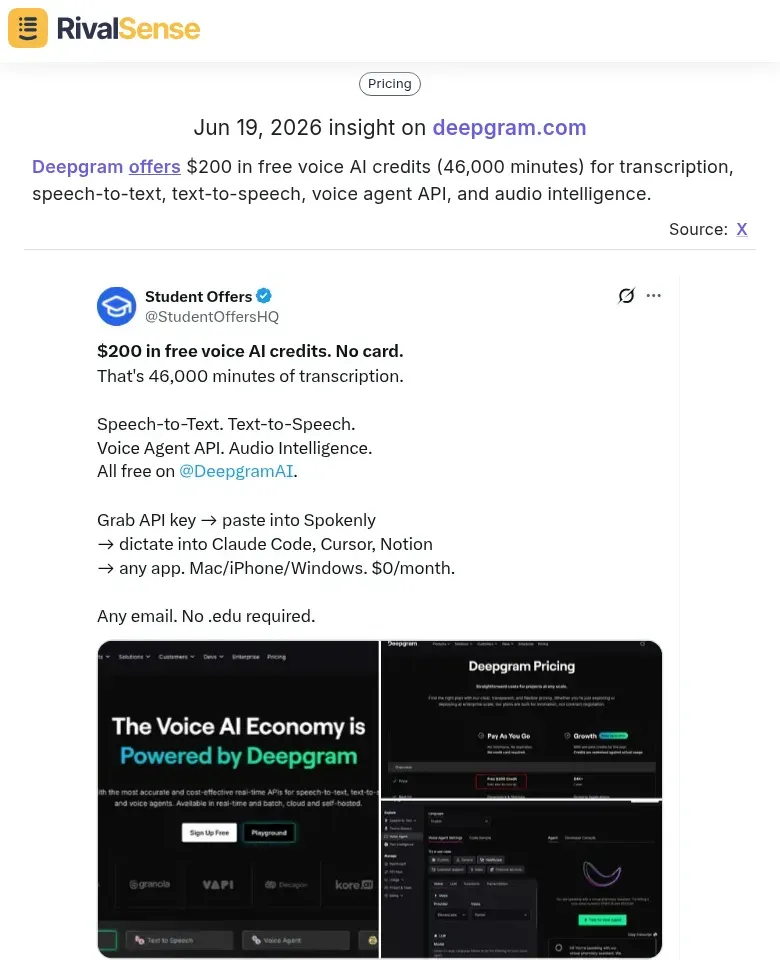
Insights like this reveal industry benchmarks for onboarding incentives, helping you set attractive thresholds that win over customers without giving away too much value. By tracking such offers, you can adjust your own credit packages proactively and avoid being outflanked by more generous competitors.
Pro tip: Use a 'credit health' dashboard to show prospects how their usage maps to potential savings, reinforcing the value story and building trust.
Time-Limited Events and Bonus Rewards: Creating Urgency and Engagement
Time-limited events and bonus rewards are powerful triggers for accelerating purchase decisions by leveraging scarcity and urgency. To implement this effectively, start by mapping competitors' promotional calendars—identify patterns in flash sales, seasonal deals, or product launch events. Use these insights to design your own time-bound offers that align with customer journey stages. For example, offer a 24-hour discount on a premium feature to new sign-ups, or grant bonus loyalty points for first-time purchases during a holiday event.
Practical steps:
- Analyze competitor event frequency – Track how often rivals run limited-time promotions and the average discount depth. Use tools like RivalSense to automate this.
- Define your urgency mechanics – Clear countdown timers, stock indicators, or exclusive badges enhance perceived scarcity.
- Bundle bonus rewards with specific actions – Offer extra points for trying a new feature, referring a friend, or reaching a spend threshold. This drives engagement beyond mere purchase.
A real-world example underlines the strategic importance: Rockstar Games recently offered up to GTA$1.5M and special rewards through its Fine Art Collector Program, with 2X payouts in key heists and missions.
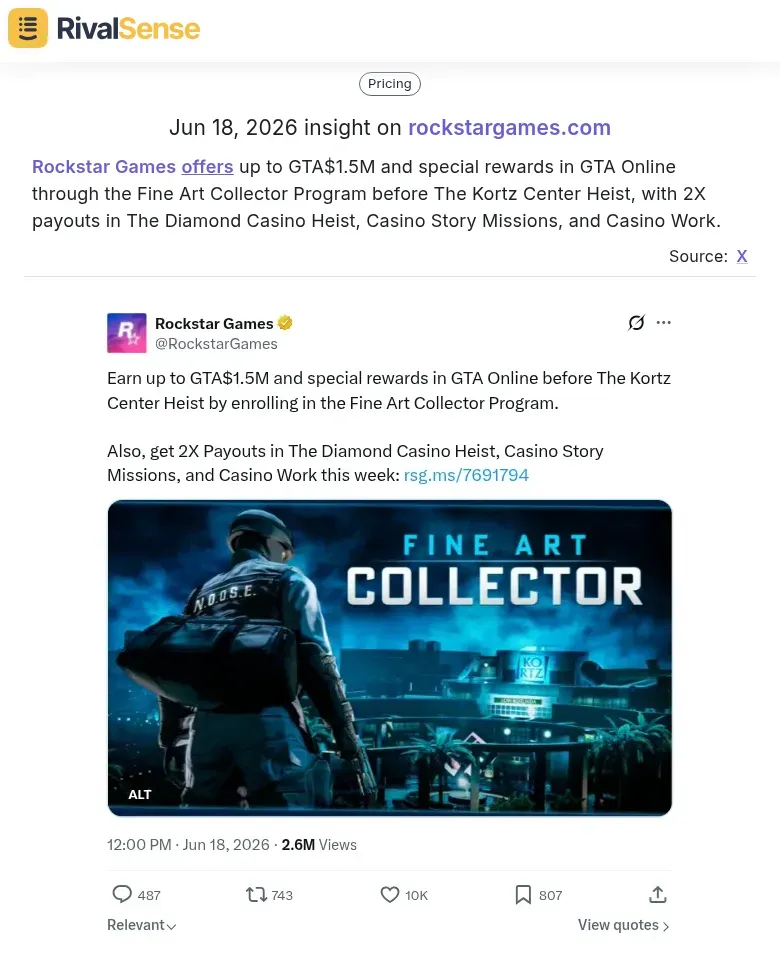
Tracking such limited-time events gives you competitive intelligence on timing, reward magnitude, and incentive themes. You can use that knowledge to schedule your own promotions to avoid direct clashes or to counter with a more compelling offer during quieter periods—turning competitor events into opportunities.
Pro tip: A/B test different urgency triggers (e.g., “Only 3 left!” vs. “Sale ends in 2 hours”) to see which resonates most with your audience. Event-based pricing at product launches or seasonal peaks can boost short-term revenue by 20–30% when combined with clear value communication. Avoid overusing urgency—reserve it for genuine events to maintain credibility and long-term customer trust.
Loyalty Tiers and Threshold Bonuses: Encouraging Repeat Purchases
Loyalty tiers and threshold bonuses are proven mechanisms to drive repeat purchases and boost customer lifetime value. Tiered rewards (e.g., Silver, Gold, Platinum) create a clear progression path that incentivizes higher spending. To implement effectively:
- Define clear tiers based on spend or frequency. Example: Silver (<$500/year) earns 1x points; Gold ($500–$1,500) earns 1.5x points; Platinum ($1,500+) earns 2x points and early access to new products.
- Offer escalating perks. A CNBC study found 57% of consumers spend more to reach the next tier. Make perks tangible: free shipping (Gold), dedicated support (Platinum), or exclusive events.
- Set minimum spend thresholds for bonuses (e.g., “Spend $100 in one order, get 500 bonus points”). This directly increases average order value and basket size.
- Include non-monetary exclusivity for top-tier members—early product drops, birthday gifts, or VIP community access—to foster retention and advocacy.
Keeping an eye on how competitors structure loyalty rewards ensures your program stays competitive. For instance, Sephora’s Major Summer Deals event (through June 23) offers up to 50% off on select brands and awards 500 bonus points for Beauty Insiders spending $75.
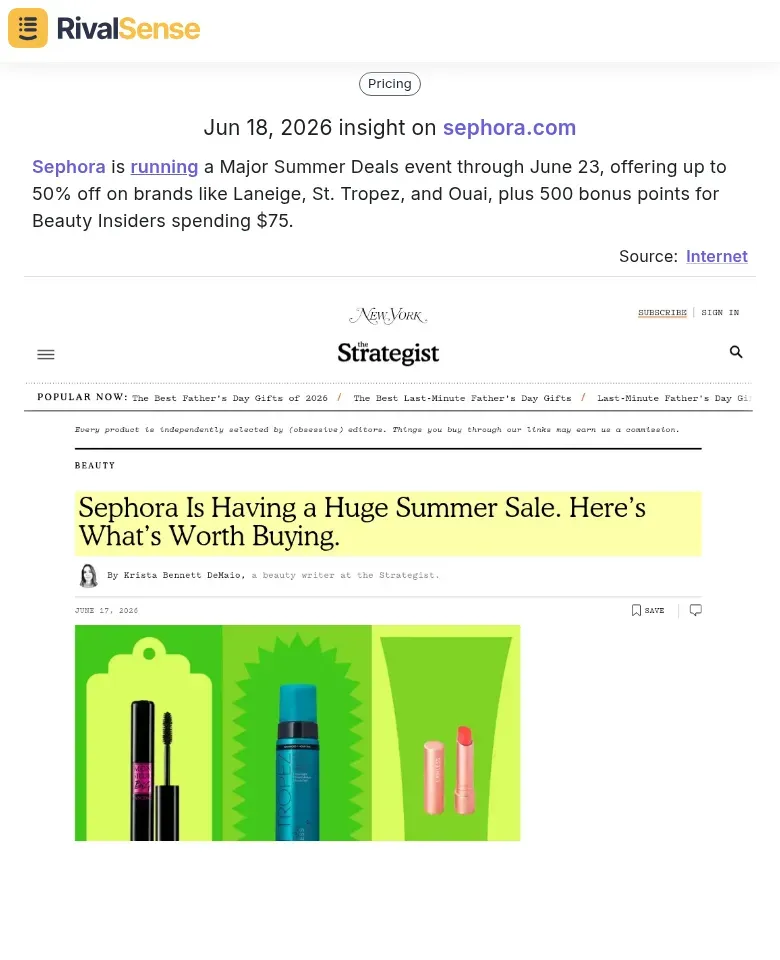
This type of insight shows you what spending thresholds and reward magnitudes are effective in your industry. You can use it to fine-tune your own bonus triggers—say, setting your threshold just below a key competitor’s—to capture cost-conscious customers while still encouraging higher basket sizes.
Practical steps:
- Analyze purchase data to segment customers into natural tiers.
- Communicate tier progression clearly on dashboards and via email.
- Test threshold bonuses at 10–20% above current AOV to gently push basket size.
- Review tier benefits quarterly to ensure they remain compelling vs. competitors.
Pro tip: Use gamification—show a progress bar toward the next tier or bonus. This psychological nudge can increase repeat purchases by up to 30% (Forrester).
By structuring loyalty around tiers and thresholds, you transform casual buyers into brand advocates who maximize lifetime value.
Conclusion: Key Takeaways and Applying Competitor Pricing Insights
By mapping competitor journeys, you uncover actionable pricing strategies across the funnel—from awareness tactics like freemium tiers to retention moves like loyalty discounts. To apply these insights: 1) Audit your pricing gaps by comparing your offers at each journey stage against competitors. 2) Combine competitor intel with your own customer data (e.g., willingness-to-pay surveys, churn reasons) to craft differentiated value props. 3) Run A/B tests on pricing adjustments (e.g., introducing a mid-tier plan, time-limited bundles) to validate changes before full rollout. 4) Set up a monitoring cadence—review competitor pricing quarterly and set alerts for major shifts. Finally, adapt continuously: use a simple scoring system (e.g., 1–5) to track your pricing competitiveness across stages. Remember, the goal isn't to copy but to strategically position your offers where you can win.
Staying on top of competitor moves manually is overwhelming, but tools like RivalSense automate the process, sending you only the pricing updates, promotional events, and product changes that matter.
Try RivalSense for Free
Want to stop playing catch-up on competitor pricing? Get your first competitor report today and see exactly what your rivals are offering, discounting, and promoting—so you can act on real intelligence, not guesswork.
📚 Read more
👉 Competitor Partnership Advantages: How Coopetition Drives Growth
👉 Competitive Positioning Benchmarking: Key Benefits for Strategic Vision
👉 From Insight to Action: Preempting Prenuvo's Expansion with Competitive Intelligence
👉 Quick Tips to Track Competitor Content Performance on Instagram