
Spot Competitor Partnership Threats Before They Steal Your Key Accounts
Even a seemingly minor partnership between a competitor and a tech provider can create a powerful new value proposition that targets your most loyal clients. These alliances often address specific client pain points—like integrating with a popular CRM or reducing operational costs—making them tempting switch triggers. If left unnoticed, you might only discover the threat when your account rep hears, “We found a better fit elsewhere.”
How to Spot These Threats Early:
- Monitor competitor press releases and social feeds. Look for phrases like “integrated solution,” “joint offering,” or “partnership.” Set up Google Alerts for your key accounts paired with your competitors’ names.
- Track tech ecosystem changes. Use tools like BuiltWith or SimilarTech to see which technologies your accounts adopt. A new integration announced by a competitor could directly address that shift.
- Conduct quarterly “partner audits.” List your top 10 clients and cross-reference them against known competitors’ partners. Any overlap is a red flag.
- Listen for account-level whispers. Encourage your customer success team to ask neutral questions like, “Are there any new tools your team is evaluating?” during check-ins.
Early detection gives you time to counter with your own differentiators, deepen relationships, or even explore complementary partnerships before the threat materializes.
Partnerships That Mitigate Client Risks
When scouting for competitor partnerships that mitigate client risks, focus on alliances offering data-driven evidence to reduce liability, improve safety, or lower operational costs. These partnerships can dramatically improve key client metrics—like incident rates, speeding violations, or false claims—making your competitor a more trusted partner.
Actionable Checklist:
- Monitor AI, analytics, and IoT integrations – Look for partnerships that deliver real-time risk insights (e.g., telematics + insurance to reduce crash rates).
- Track client metric improvements – Check if competitors highlight measurable outcomes (e.g., "30% fewer false claims") tied to data-sharing agreements.
- Identify industry-specific risk solutions – For logistics, watch for route optimization + safety scoring; for healthcare, predictive analytics for patient falls.
- Set alerts on partner press releases – Use tools like Google Alerts or RivalSense to catch announcements that bundle risk-mitigation services.
Real insight example: RivalSense recently captured a powerful partnership: Samsara's 360-degree AI Multicam footage helped Walthall Oil Company overturn $5M+ in false liability claims, cut speeding rates by 73%, and improve crash events by 100% while onboarding 50 new drivers.
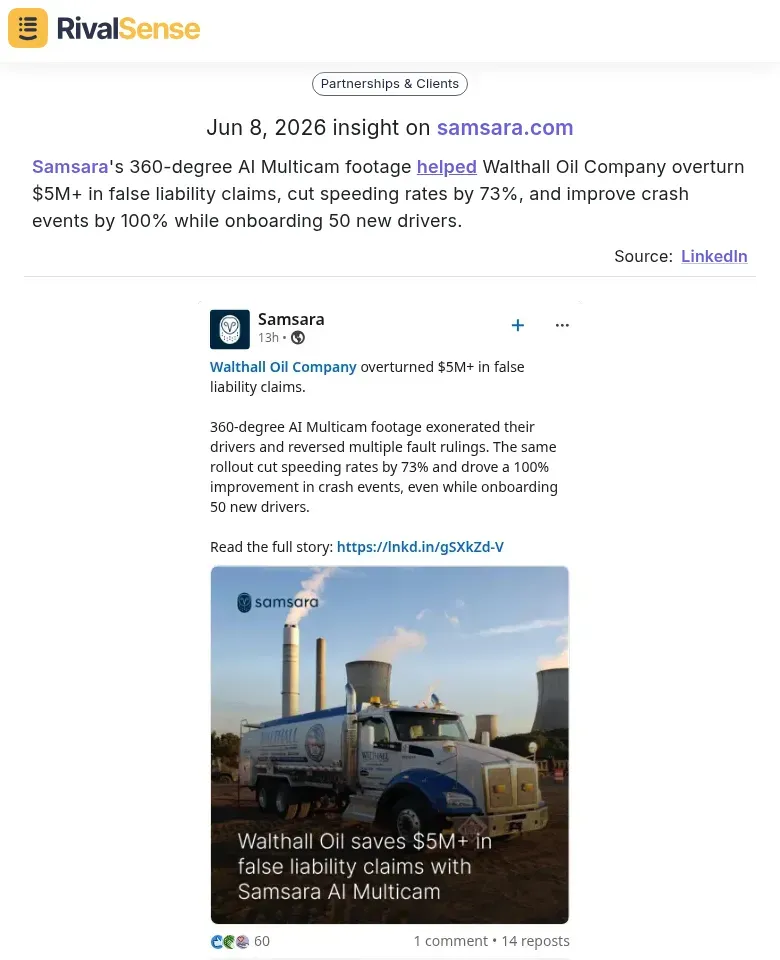
This type of insight is strategically critical—it shows how a competitor’s data-driven partnership can transform them into a client’s trusted safety partner, locking in loyalty and making it far harder for you to win or retain that account. Prioritize monitoring alliances that directly reduce client risk.
Pro Tip: If a competitor pairs with a data provider to offer predictive maintenance, they’re not just selling a service—they’re lowering your client’s downtime risk. Prioritize these threats by mapping which of your key accounts would benefit most from reduced liability or operational savings.
Partnerships That Unlock New Capacity or Resources
When a competitor partners with a utility platform, resource management tool, or flexible infrastructure provider, they can become indispensable by solving your client’s scalability constraints. Here’s how to spot these threats and act fast.
What to watch for:
- Energy capacity: A competitor teams up with a renewable energy broker to guarantee uptime during grid stress.
- Bandwidth burst: They partner with a CDN or edge computing provider to handle traffic spikes for e-commerce clients.
- Talent on demand: An agreement with a staffing platform gives them access to vetted contractors during product launches.
Quick steps to assess risk:
- Map your key accounts’ peak cycles (e.g., Black Friday, end-of-quarter).
- Check competitors’ press releases and LinkedIn for new “partnership” or “integration” announcements related to scaling.
- Ask your sales team: “Have clients mentioned a competitor helping them handle a surge?”
Real insight example: RivalSense uncovered a capacity-focused deal: Google signed a three-year agreement with Voltus to unlock 100 MW of clean electricity capacity annually in PJM through demand response, using flexible resources like smart thermostats and batteries.
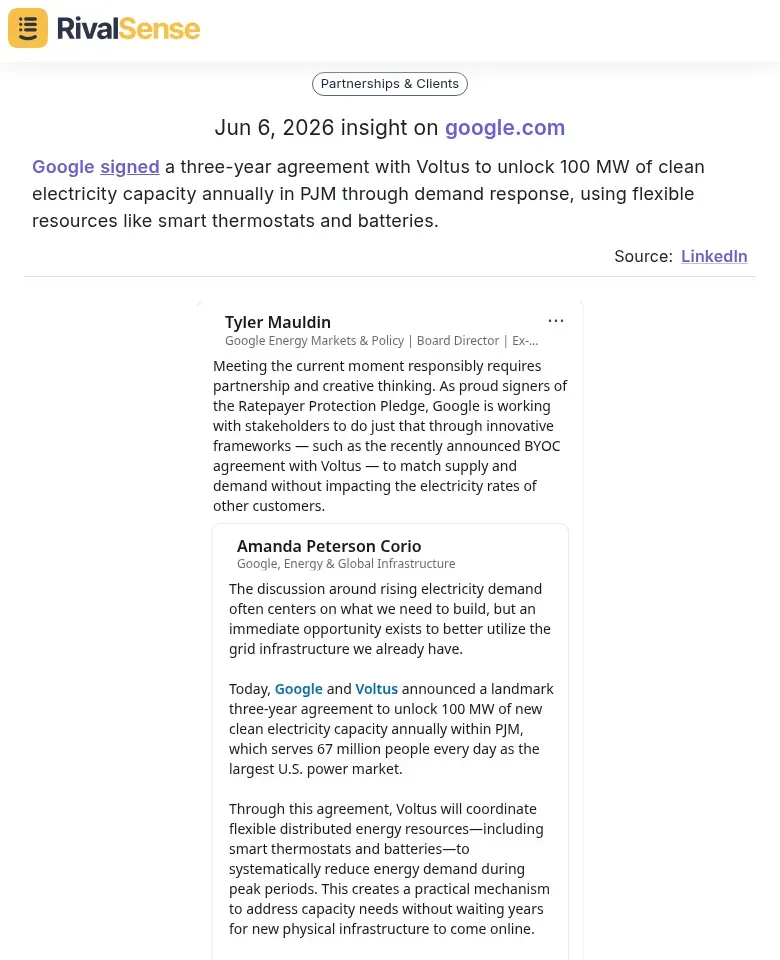
Insights like this are invaluable because they reveal exactly how a competitor is addressing critical scaling bottlenecks—such as energy reliability—that could directly appeal to your key accounts. If a client struggles with uptime or resource constraints, a partnership like this makes the competitor their go-to problem solver.
Action tip: Create a simple table of your top 10 accounts and list each one’s biggest resource bottleneck (staff, compute, energy, etc.). Then monitor whether any competitor partners with a provider that directly addresses that bottleneck. If they do, prepare a counter-strategy—either by building your own partnership or by highlighting the risks of depending on a single provider.
Partnerships That Enhance Real-Time Customer Response
To spot partnership threats, identify if rivals have integrated tools that enable instant, real-time customer response. In emergencies—like system outages or security breaches—companies that can act immediately build deep loyalty and high switching costs, because customers become reliant on that rapid support.
Practical steps to monitor:
- Check partner pages – Look for listed integrations with live chat, automated incident response, or decision-support AI (e.g., PagerDuty, Intercom, Zendesk, ServiceNow).
- Analyze press releases – Search for announcements about “instant response,” “real-time alerts,” or “emergency automation” partnerships.
- Review case studies – See if competitors highlight speed of resolution with a partner (e.g., “resolved in under 2 minutes”).
Real insight example: RivalSense recently tracked this partnership: Ironclad Restoration Marketing partnered with LiveSwitch to help restoration experts provide immediate answers to customers in emergencies.
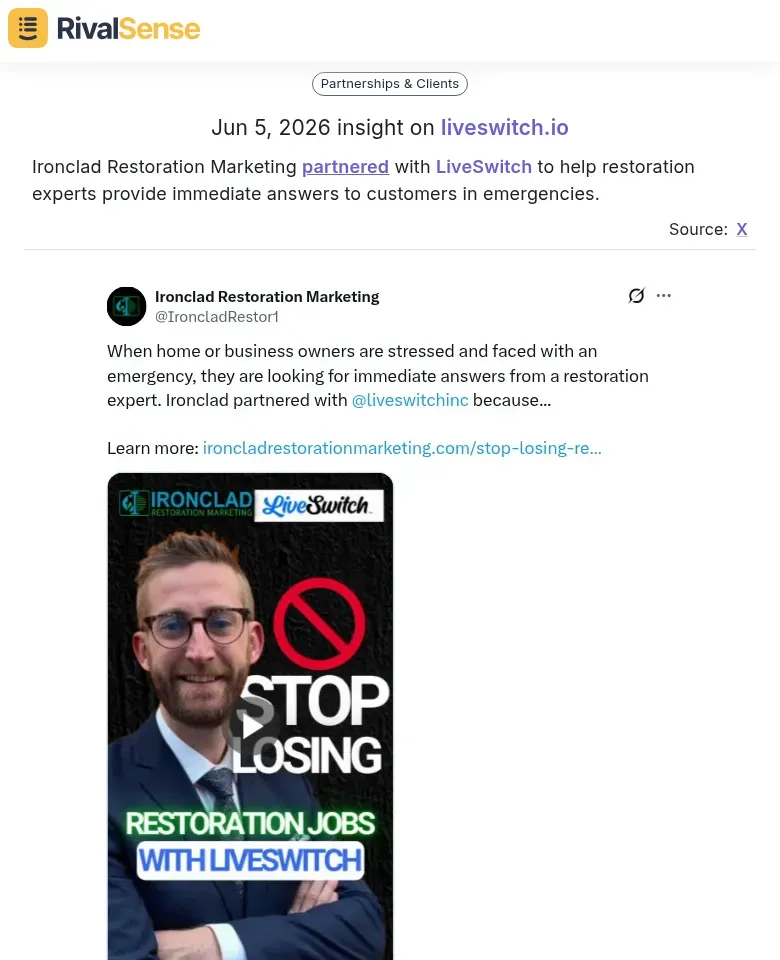
This insight is a direct warning sign: a competitor embedding real-time responsiveness into their offering can dramatically increase switching costs for clients in crisis-prone industries (restoration, healthcare, logistics). Such partnerships turn a vendor into an essential lifeline, making it extremely difficult for customers to leave.
Quick checklist for your next audit:
- [ ] Does the competitor offer 24/7 live support through a partner?
- [ ] Is there an automated escalation system tied to a monitoring tool?
- [ ] Are customers publicly praising their rapid response times?
If yes, prepare a stronger value proposition around your own response capabilities.
Proactive Monitoring and Action Plan
To stay ahead of competitor partnership threats, implement a proactive monitoring system. First, set up Google Alerts or use a competitive intelligence tool for keywords like “[Competitor Name] + partnership” and key technology vendors in your space (e.g., “Salesforce partnership” if you’re in CRM). Review your top accounts weekly and cross-reference any new alliances that could undercut your value.
When a new deal is announced, ask: What specific benefit does it bring? (e.g., integrated analytics, lower cost, faster onboarding). Map that benefit to your key accounts’ pain points. If a competitor partners with a data provider your largest client relies on, prioritize that threat.
Develop counter-strategies immediately. For example, if the partnership offers a unique integration, explore your own integrations with the same vendor or a comparable one. Alternatively, enhance an existing feature to deliver similar value (e.g., build a dashboard that mimics the competitor’s joint offering). Create a checklist: (1) Identify affected accounts, (2) Quantify the gap in value, (3) Brainstorm two counter-moves, (4) Assign an owner and deadline. Proactive action beats reactive scrambling every time.
Conclusion: Stay Ahead of the Curve
Staying ahead of competitor partnership threats requires a proactive, structured approach. Here’s how to integrate this into your workflow:
1. Schedule Regular Competitive Reviews
Dedicate time weekly to scan for new partnerships, renewals, or expansions among competitors. Use a checklist:
- Which new partners did competitors announce?
- Did existing partnerships change scope or exclusivity?
- Are there signals of partner churn (e.g., a partner starts promoting a rival)?
2. Deepen Key Account Engagement
Don’t wait for accounts to tell you they’re evaluating alternatives. Set up quarterly business reviews (QBRs) with key accounts where you:
- Ask: “What emerging needs are we not addressing?”
- Discuss: “Have you seen any new solutions from others that interest you?”
- Map their priorities to your roadmap vs. competitors’ offerings.
3. Leverage Competitive Tracking Tools
Automate monitoring with tools like RivalSense to get real-time alerts on competitor partnership changes. Set up alerts for:
- Joint press releases or product integrations
- Co-marketing campaigns with key accounts
- Changes in partner badges or case studies
4. Act Before Threats Escalate
Create a rapid response playbook: when you spot a new competitor partnership that overlaps with a key account, immediately schedule an internal strategy session. Brainstorm countermeasures—such as offering a pilot of a new feature, adjusting pricing, or strengthening your own partner network in that space.
By embedding these habits into your competitive intelligence process, you’ll turn threats into opportunities to reinforce trust and value with your most important accounts.
Ready to protect your key accounts? Try RivalSense for free at https://rivalsense.co/ and get your first competitor report today—so you can spot partnership threats before your clients do.
📚 Read more
👉 Mastering Competitive Positioning: A Comparative Analysis Guide for Accounting Firms
👉 SiriusXM's Video Expansion: A Competitor's Strategic Response
👉 How to Uncover Competitor Pricing Advantages on Twitter
👉 6 AI Productivity Techniques for Key Account Frameworks
👉 Optimize Key Account Tracking with Competitor Hiring Insights