
Mastering Competitive Positioning: A Comparative Analysis Guide for Accounting Firms
Competitive positioning is the art of differentiating your accounting firm in a way that resonates with your target clients. It’s not just about being better—it’s about being different in a meaningful way. For accounting firms, this means moving beyond compliance and tax preparation to become strategic advisors who help clients navigate business decisions, profitability, and growth.
Why this shift matters: Traditional accounting services are increasingly commoditized. Clients can easily compare prices and switch firms. However, advisory roles—such as CFO-for-hire, financial forecasting, or M&A support—command higher value and loyalty. By positioning your firm as a strategic partner, you escape price wars and build recurring revenue.
Standing out in a saturated market: With thousands of accounting firms competing for the same clients, generic messaging gets ignored. Effective positioning clarifies who you serve, what specific problems you solve, and why your approach is unique.
Practical steps to define your position:
- Identify your niche – Specialize in an industry (e.g., SaaS, healthcare) or service (e.g., fractional CFO, R&D tax credits).
- Analyze competitors – Use tools like RivalSense to track competitor messaging and find gaps.
- Craft a positioning statement – Template: "We help [target client] achieve [outcome] through [unique approach]."
- Align your services – Ensure every offering reflects your chosen position.
Tip: Regularly audit your positioning against market changes. A position that worked two years ago may need refreshing.
The Role of Comparative Analysis in Accounting Strategy
Comparative analysis isn’t just about knowing what competitors charge—it’s about uncovering market whitespace. Start by mapping competitors’ service bundles: do they offer AI-driven bookkeeping but lack niche tax advisory? That gap is your entry point. Benchmark against 5–7 direct competitors using a matrix of service offerings, target industries, and technology stack. For example, if none specialize in crypto accounting for SMBs, that’s a signal.
Practical checklist:
- List competitors’ base vs. premium packages.
- Note features they charge extra for (e.g., forecasting, compliance audits).
- Identify underserved client segments via reviews (e.g., “wish they had X”).
Data-driven pricing: If 80% of rivals price monthly subscriptions at $500–$800, consider a mid-tier $650 option with a unique add-on (e.g., real-time KPI dashboards).
Finally, use tools like RivalSense to track competitor rate changes and feature launches weekly. Adjust your positioning accordingly—if a rival drops their audit fee by 20%, respond with a bundled value proposition (e.g., audit + advisory at same price) to retain margin while appearing competitive.
Key Benefits of Strong Competitive Positioning
A strong competitive positioning strategy delivers three critical advantages for accounting firms.
1. Enhanced client acquisition and retention – Differentiate your value proposition instead of competing on price. Highlight specialized expertise (e.g., “We exclusively serve SaaS startups navigating ASC 606”). Practical tip: conduct a client audit—list your top 10 clients by revenue and identify what they value most. Build your messaging around those differentiators.
2. Improved pricing power and profitability – Niche specialization allows you to command 15-30% higher fees than generalists. Action step: map your team’s existing expertise to an underserved niche; create a service package tailored to that segment’s pain points (like tax-efficient restructuring for PE-backed firms).
3. Greater resilience to market disruptions and regulatory changes – When new regulations (e.g., transfer pricing rules, ESG reporting mandates) hit, well-positioned firms adapt faster by pivoting within their niche. Checklist for resilience: (1) monitor regulatory alerts for your niche quarterly, (2) train staff on two emerging compliance areas annually, (3) build a ‘rapid response’ service menu for urgent client needs. This strategic focus turns uncertainty into competitive advantage.
Steps to Conduct a Comparative Analysis for Accounting Firms
To conduct a comparative analysis for accounting firms, follow these steps:
1. Identify Competitors
- Direct: Firms offering similar accounting services (e.g., tax prep, audit, advisory) to the same client segments.
- Indirect: Bookkeeping software (e.g., QuickBooks), AI-driven tax platforms, or consulting firms that offer adjacent services.
2. Analyze Service Portfolios & Client Segments
- Compare service lines (e.g., compliance vs. advisory) and specialization (e.g., healthcare, real estate).
- Identify underserved niches or premium offerings you can adopt.
3. Assess Marketing Strategies
- Review websites, social media, and content (blogs, whitepapers). Note tone, messaging, and channels used.
- Tip: Use a simple matrix—list competitors in rows, tactics in columns—to spot gaps.
4. Leverage Real-Time Tracking Tools
- Set up alerts with RivalSense to monitor competitor moves: new service launches, pricing changes, thought leadership, or client wins.
- This keeps your analysis current without manual effort.
RivalSense Insight Example: Event & Networking Monitoring
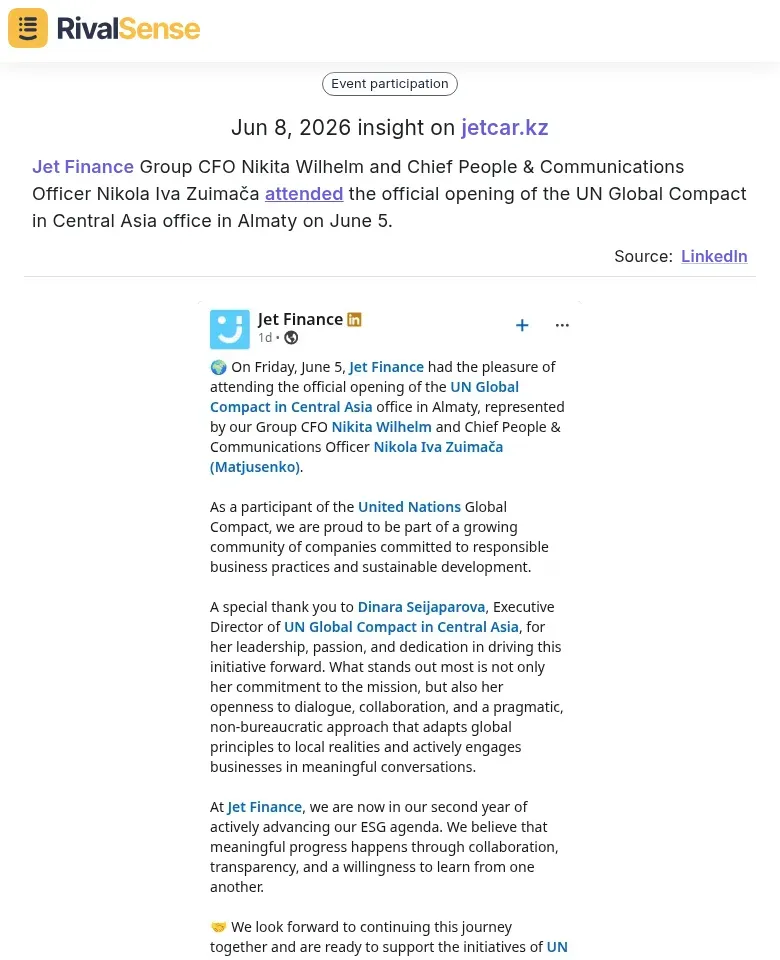
Knowing which events your competitors attend reveals their partnership and business development priorities. For example, Jet Finance Group’s CFO and Chief People & Communications Officer attended the official opening of the UN Global Compact in Central Asia office in Almaty on June 5, 2026.
Value for accounting firms: If a competing firm sends leaders to niche industry events or regulatory summits, you gain early signals about emerging practice areas or potential referral networks. Use this to plan your own event attendance or forge complementary partnerships.
5. Synthesize & Act
- Map findings to a SWOT framework. Prioritize actions: differentiate on a niche, match a pricing change, or target a competitor’s weak segment.
Checklist: Competitor list ✅, portfolio comparison ✅, marketing audit ✅, tracking tool ✅, action plan ✅.
Actionable Intelligence from RivalSense
Beyond events, RivalSense uncovers two other critical insight types that sharpen your competitive edge.
Product & Service Updates
When a competitor launches new features, it reshapes client expectations. RivalSense flagged that Geotab’s Charlotte Argue presented new features for school buses—a typical product move that, in your industry, could mirror a rival unveiling a fresh advisory package or tech integration.

Why it matters: Early detection lets you respond before clients defect. If a competitor rolls out automated expense management, you can fast-track your own innovation or proactively emphasize your firm’s human-led advisory differentiator.
Media & Thought Leadership Tracking
Competitors’ media appearances signal their branding narrative and audience targeting. Eleving Group appeared on the Skanstes City podcast on June 8, 2026, discussing its expansion from Latvia to 17 countries and fintech innovations.

Why it matters: An accounting competitor might appear on a fintech podcast to pitch startup CFO services. Seeing this lets you counter with guest articles on the same platform, refine your messaging, or identify the exact content channels your target clients follow.
Real-World Examples of Successful Positioning
Case Study 1: HealthEdge Advisors (Mid-Sized Firm)
This firm specialized exclusively in healthcare accounting, from hospital revenue cycle management to ASC 606 compliance for healthcare providers. By focusing on one vertical, they developed deep expertise, enabling them to charge 20% premiums while winning 60% of RFPs against generalists. Tip: Choose a vertical with strong growth and regulatory complexity—where specialization creates obvious value.
Case Study 2: SwiftBooks (Boutique Firm)
A 12-person firm invested in cloud-based automation and AI to offer 72-hour monthly closes (industry average: 2–3 weeks). They targeted growth-stage tech companies that value speed over cost. Checklist for tech-led positioning: (1) Identify a pain point tied to speed; (2) Automate data entry, reconciliation, and reporting; (3) Market with case studies showing time saved.
Lessons from Failures
A regional firm tried to serve both mom-and-pop shops and large enterprises without distinct value propositions—they lost to specialists on both ends. Another ignored digital tools and saw 30% of clients leave for tech-enabled rivals. Key takeaway: Positioning without focus leads to being mediocre for everyone.
Actionable Steps:
- Audit your client portfolio to identify natural verticals.
- Survey clients on what they value most (speed, industry knowledge, price).
- Pick one dimension to dominate and align your operations accordingly.
Conclusion: Building a Sustainable Competitive Advantage
Building a sustainable competitive advantage in accounting requires more than a one-time analysis. To stay ahead, integrate competitive insights into your ongoing strategic planning. Start by scheduling quarterly review sessions where your team examines competitor moves, pricing changes, and new service offerings. Use a simple checklist: (1) Update competitor profiles, (2) Analyze their latest content and thought leadership, (3) Identify gaps in your own positioning.
Foster a culture of continuous market monitoring by designating a competitive intelligence champion—someone who tracks news, earnings calls, and social media signals weekly. Provide them with RivalSense’s automated alerts so they never miss a critical update.
Adaptation is key: run small experiments based on your findings, like testing new service bundles or adjusting your value proposition on your website. Track results and iterate. Remember, competitive advantage isn’t static—it’s a muscle you must exercise daily.
Ready to institutionalize this process? Try RivalSense for free at https://rivalsense.co/ and get your first competitor report today.
📚 Read more
👉 SiriusXM's Video Expansion: A Competitor's Strategic Response
👉 How to Uncover Competitor Pricing Advantages on Twitter
👉 6 AI Productivity Techniques for Key Account Frameworks
👉 Optimize Key Account Tracking with Competitor Hiring Insights