
How to Uncover Competitor Pricing Advantages on Twitter
Twitter is a real-time intelligence goldmine for uncovering competitor pricing strategies. For B2B founders and CEOs, it provides unfiltered signals—from funding announcements to strategic pivots—that reveal when rivals might slash prices, introduce bundles, or cut costs. Here’s how to systematically monitor these signals and convert them into strategic advantage.
💰 Monitor Major Financing and Investment Announcements
Competitors’ funding moves often telegraph pricing strategy shifts. Here’s how to decode them on Twitter:
1. Track Large Debt or Equity Raises
When a competitor announces a major raise, ask: Can they now subsidize prices to grab market share? For example, if a rival raises $100M in Series C, they could burn cash on loss-leading pricing for months. Set up alerts for keywords like “secured $X,” “Series B,” or “debt financing” from their official accounts or VC partners.
2. Watch Infrastructure Investments
Tweets about AI compute, data centers, or automation signal long-term cost advantages. A competitor investing in proprietary infrastructure (e.g., training their own LLM) may slash unit costs by 30%+ over time. Create a Twitter list of their engineering and ops leaders for such announcements.
3. Analyze Funding Terms for Margin Pressure
Look for tweets mentioning “growth at all costs” or “revenue targets.” Debt-heavy funding often forces a competitor to prioritize top-line growth over profitability, meaning they may offer aggressive discounts to hit numbers. If they tweet about “aggressive expansion,” prepare for a price war.
Real-World Example from RivalSense:
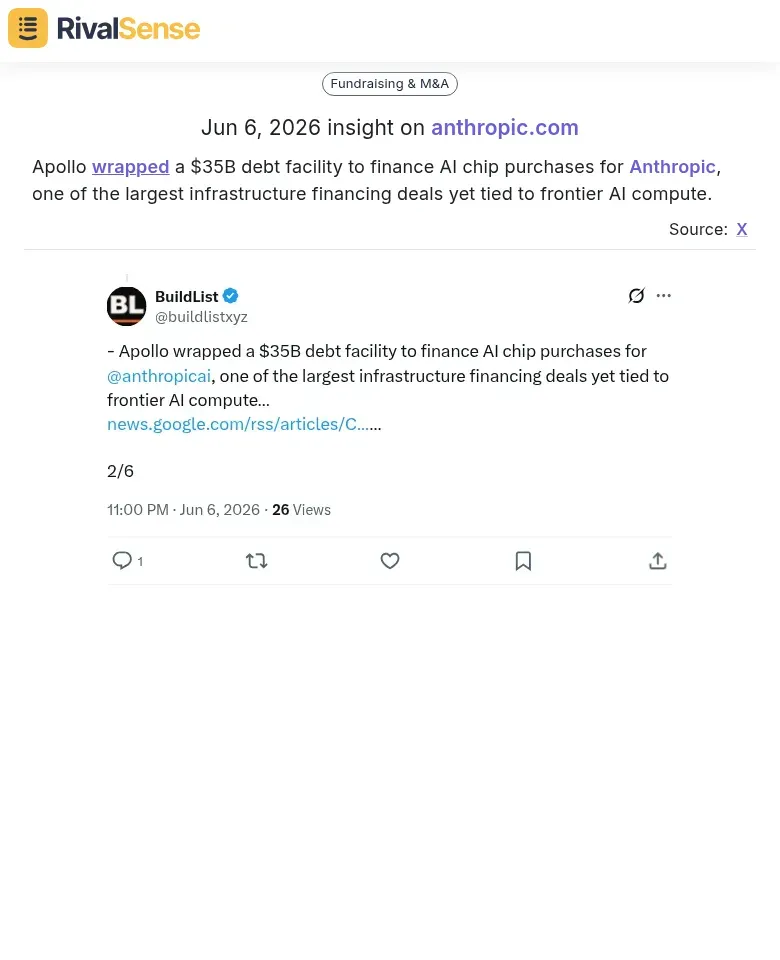
RivalSense recently flagged that Apollo wrapped a $35B debt facility to finance AI chip purchases for Anthropic. This massive financing could enable Anthropic to dramatically subsidize its AI compute costs, potentially triggering price cuts on services. Tracking such announcements helps you anticipate a pricing war before it hits your market.
Quick Checklist:
- ✅ Follow competitor CFOs and investors on Twitter
- ✅ Bookmark tweets with funding amounts and use cases
- ✅ Compare their pricing before and after major funding rounds
🔄 Track Strategic Pivots and Ecosystem Expansions
To uncover pricing advantages from strategic pivots, track competitors' tweets about launching new products or expanding into adjacent markets. A shift from niche offerings to full-service ecosystems often enables cross-subsidization—where they can afford to lower prices on core products because other parts of the ecosystem generate higher margins.
Practical Steps:
- Set up Twitter Lists for each competitor and monitor tweets related to product launches, bundles, or platform expansions.
- Analyze Announcements of Bundles or Platforms: If a competitor introduces a bundled suite (e.g., combining CRM, marketing, and analytics), check if they offer individual components at a steep discount—this often signals they’re offsetting costs through volume or premium tiers.
- Track Pricing-Related Tweets: Look for mentions of “new pricing,” “free tier,” “limited-time offer,” or “discount.” A competitor offering a cheaper standalone price after launching a broader platform suggests they are cross-subsidizing.
- Assess New Revenue Streams: Use earnings call transcripts or press releases linked in tweets to identify new revenue sources (e.g., advertising, data services). These can fund price cuts on core products.
Real-World Example from RivalSense:
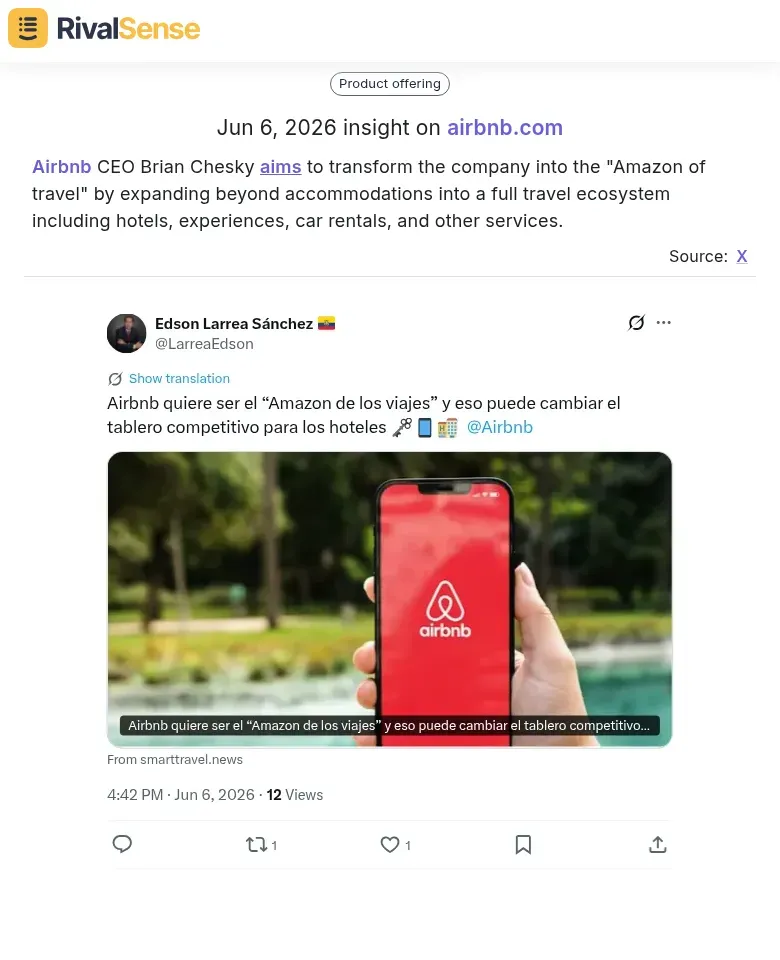
RivalSense spotted Airbnb CEO Brian Chesky’s vision to transform into the “Amazon of travel.” Expanding into hotels, car rentals, and experiences could create multiple revenue streams that allow Airbnb to offer more competitive pricing on accommodations. Monitoring such ecosystem pivots helps you forecast when a competitor might undercut you.
Tip: Create a simple tracker spreadsheet with columns for “Competitor,” “Ecosystem Expansion,” “Standalone Price Change,” and “New Revenue Source.” Update it weekly based on Twitter activity.
By monitoring these shifts, you can anticipate when a competitor’s price cuts are sustainable and adjust your own pricing strategy accordingly.
🚫 Analyze Project Cancellations and Resource Reprioritizations
When a competitor quietly cancels an ambitious project or scales back R&D, it’s a clear cost-cutting signal. Twitter often hosts apologetic threads or vague statements about “strategic realignment.” Search for phrases like “sunsetting,” “deprecating,” or “redirecting resources” from their official accounts or employees.
Practical steps:
- Track announcements of discontinued features or products. A sudden shutdown can indicate cash flow pressure—leading to potential pricing hikes on remaining offerings or aggressive discounts to generate quick revenue.
- Correlate timing: If a competitor cancels a capital-intensive initiative (e.g., AI lab, hardware line), watch for pricing changes within 30–90 days as they rebalance budgets.
Real-World Example from RivalSense:
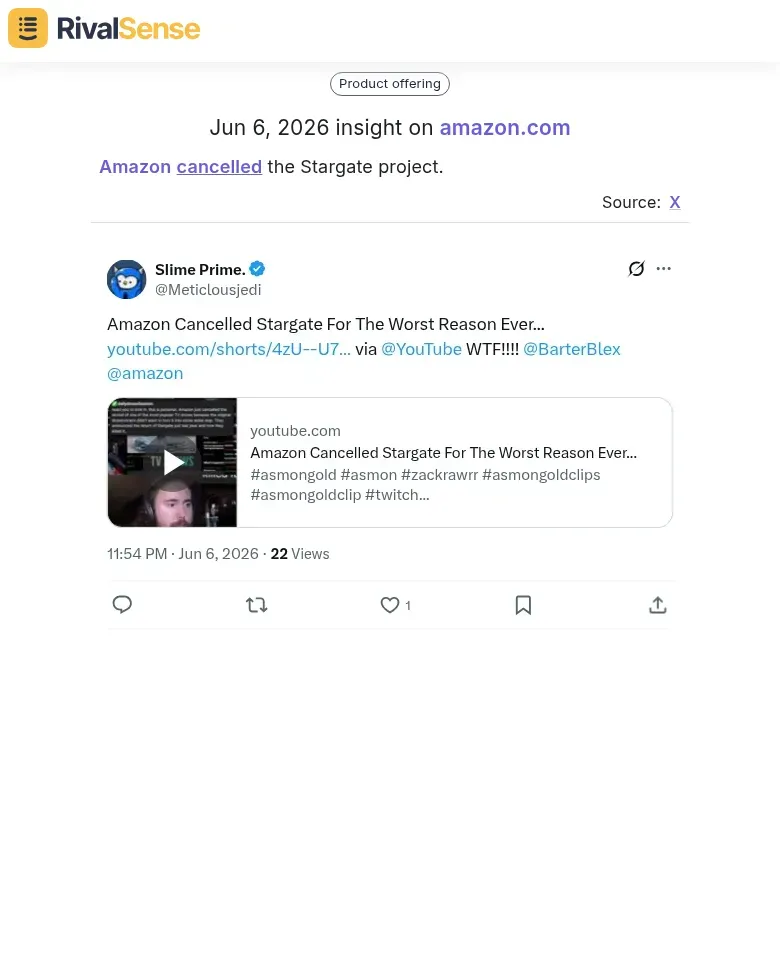
RivalSense highlighted that Amazon cancelled the Stargate project. A major project shutdown like this often forces a company to reallocate resources, potentially leading to price adjustments to protect margins or aggressively retain customers. Keep an eye on such cancellations to anticipate pricing moves.
Checklist:
- Set up Twitter alerts for keywords: [competitor name] + “shutting down,” “pausing,” “reprioritizing.”
- Note any mention of “optimizing costs” or “efficiency” in replies.
- Create a timeline: map cancellations against subsequent price list updates.
Pro tip: Pivots away from capital-heavy areas (e.g., custom manufacturing) often precede more flexible, modular pricing. Competitors that shed fixed costs can undercut you on price without sacrificing margins. Monitor their product roadmap changes—they hint at future pricing strategy.
💬 Leverage Customer Sentiment and Pricing Feedback
Monitor Twitter conversations around your competitors to uncover pricing intelligence. Use social listening tools or X’s advanced search to scan tweets mentioning competitor prices, such as “[CompetitorName] pricing” or “[CompetitorName] too expensive.” This reveals perceived value gaps—where customers feel the price doesn’t match the product’s worth.
Spot Vulnerabilities: Pay attention to complaints about pricing (e.g., hidden fees, sudden hikes, poor ROI). These highlight weaknesses you can exploit by positioning your product as a better-value alternative. For example, if users frequently complain about a competitor’s costly onboarding, emphasize your transparent pricing and free trial.
Track Praise: Conversely, positive mentions about competitor pricing (e.g., “great value for money”) help you benchmark your own strategy. Analyze what customers appreciate—bundles, discounts, or flexible plans—and consider adopting similar tactics.
Quick Checklist:
- Set up saved searches for “[Competitor] pricing” and “[Competitor] expensive/cheap.”
- Categorize tweets as complaints, praise, or neutral feedback.
- Identify recurring themes each month.
- Compare sentiment patterns with pricing changes to gauge market reaction.
This continuous listening gives you real-time insights to refine your pricing strategy and stay competitive.
⏱️ Observe Real-Time Promotions and Discount Strategies
Twitter is a goldmine for tracking competitors’ live promotions and discount tactics. Here’s how to extract actionable pricing insights:
1. Spot Flash Sales & Limited-Time Offers
- Create a private Twitter list of key competitors and monitor their tweets for phrases like “24-hour sale,” “flash deal,” or “limited stock.”
- Use Twitter’s advanced search (e.g.,
from:competitor flash sale) to catch time-bound offers you might miss.
2. Analyze Discount Depth & Frequency
- Log each price cut: note the discount percentage, product, and date. After 10–15 events, look for patterns—are discounts deeper when inventory is high (e.g., end-of-season) or when a rival launches a product?
- Track retweets and replies: high engagement on a discount may signal strong competitive pressure or desperate inventory clearing.
3. Map Promotion Timing
- Compare when competitors run promotions: do they always drop prices on the last week of the quarter? That suggests recurring quota-driven discounts you can anticipate.
- Use a simple spreadsheet: column for date, discount %, and type (e.g., “flash,” “seasonal”). Overlay your own sales calendar to avoid launching campaigns during their deepest cuts.
Pro Tip: Set up Twitter alerts for keywords like “50% off” or “discount code” from your list. If a competitor runs a flash sale three Fridays in a row, prepare a targeted response for next Friday.
🧠 Identify Cost Structure Insights from Executive Statements
To decode competitor pricing moves, analyze CEO and executive statements on Twitter for cost structure hints. Here’s a practical checklist:
-
Scan for operational efficiency signals: Look for tweets about ‘automation investments,’ ‘supply chain optimization,’ or ‘margin improvements.’ A CEO boasting about cost reductions may signal upcoming price cuts to gain market share.
-
Track input cost mentions: Follow keywords like ‘raw material inflation,’ ‘logistics bottlenecks,’ or ‘labor shortages.’ If a competitor repeatedly highlights rising costs, prepare for price hikes. Conversely, mentions of ‘favorable input costs’ could precede aggressive pricing.
-
Correlate sentiment with pricing: Use a simple mood tracker—note optimism (e.g., ‘record efficiency’) vs. caution (e.g., ‘uncertain demand’). Optimistic executives may feel emboldened to lower prices; cautious ones may hold or increase them.
Pro tip: Create a spreadsheet with columns for executive, tweet date, cost mention, sentiment, and predicted pricing action. Review weekly to spot trends. For example, if a competitor’s COO tweets about ‘successful automation rollout,’ monitor their price lists for reductions within 30 days. This Twitter intelligence turns casual commentary into strategic foresight.
Turn Twitter Noise into Pricing Signals
Manually tracking these signals across Twitter, news sites, and registries is time-consuming. RivalSense automates competitor monitoring—including product launches, pricing updates, financing rounds, and strategic pivots—and delivers them in a weekly email report. Start spotting game-changing moves like the ones above.
Try RivalSense for free and get your first competitor report today: https://rivalsense.co/
📚 Read more
👉 6 AI Productivity Techniques for Key Account Frameworks
👉 Optimize Key Account Tracking with Competitor Hiring Insights
👉 The Strategic Benefits of Mystery Shopping Your Competitors: A Guide for B2B Leaders
👉 Master Competitor Target Audience Analysis: Optimize Your Repair Business Strategy