
Optimize Key Account Tracking with Competitor Hiring Insights
In the world of key account management, staying ahead of competitors is paramount. While traditional signals like product launches or pricing changes are useful, they often arrive too late. Hiring moves offer a powerful leading indicator of where your competitors are investing or retreating. When a competitor hires a senior executive from a strategic account, it signals an intent to deepen relationships or challenge your foothold. Similarly, a spike in R&D hires suggests upcoming product shifts that could disrupt your value proposition.
To leverage this, start tracking senior talent acquisitions in your key accounts. Use LinkedIn alerts or competitive intelligence tools to monitor hires at target companies. Look for patterns: Are they building a new sales team? Hiring industry veterans with deep relationships? These moves often precede strategic pivots by 6–12 months.
Combine hiring data with account activity—meeting requests, contract renewals, or support ticket volumes—to build a predictive view. For example, if a competitor hires a key account manager for your top customer while that customer’s support tickets rise, it’s time to proactively intervene. Establish a monthly review where hiring insights are cross-referenced with account health metrics. This fusion of data transforms raw signals into actionable intelligence, helping you defend key accounts with precision.
Identifying Strategic Shifts Through Senior Hires
Senior hires are a goldmine of competitive intelligence. When a competitor brings in a C-suite executive from an unrelated industry (e.g., a fintech hiring a healthcare VP), it often signals expansion into new verticals or capabilities. Conversely, the sudden departure of key talent—especially founders or long-tenured leaders—may indicate internal turmoil, funding issues, or a strategic pivot. Look for patterns: three or more hires from the same company within a quarter reveals a deliberate poaching strategy or systematic capability building.
Real-world examples bring this to life. Proxima Fusion appointed Sergei Galperin, former European Head of Financial Technology Advisory at J.P. Morgan and investor at Ribbit Capital, as Chief Financial Officer.
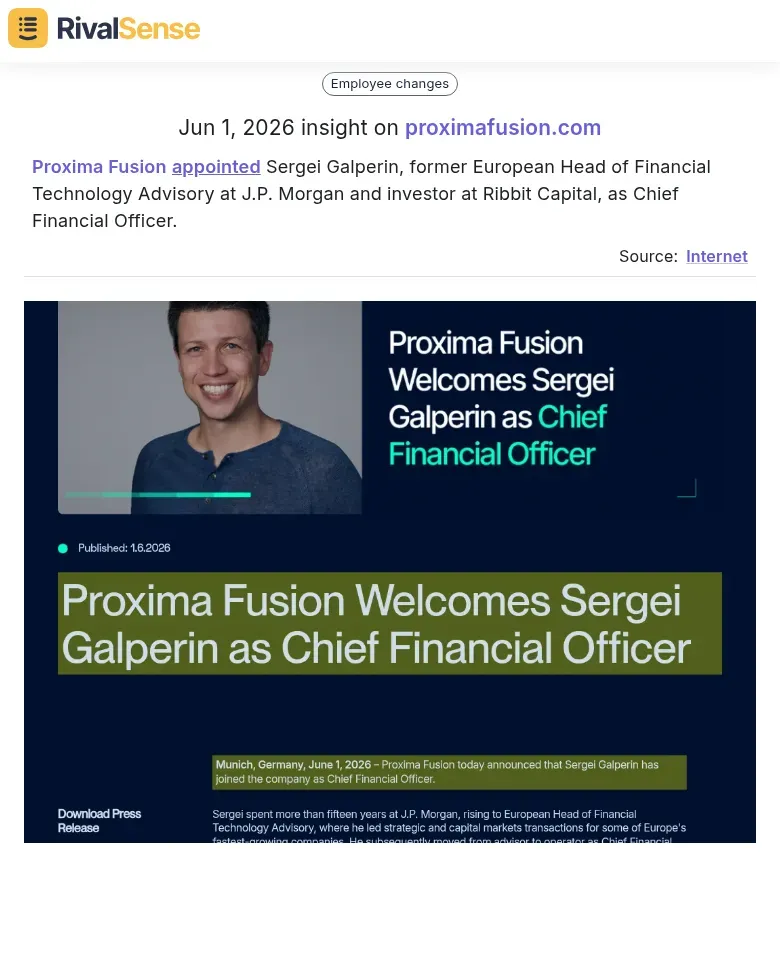
This type of insight is highly valuable for business strategy: a CFO with deep fintech and investment expertise often signals preparation for a major funding round or an IPO—both of which could dramatically shift the competitive landscape and your key accounts’ loyalty. By tracking such high-profile moves, you can anticipate financial events that may destabilize your commercial relationships.
Practical steps:
- Track senior roles (C-suite, VP, Director) using LinkedIn alerts or tools like RivalSense.
- Map each new hire’s background: industry, function, and tenure. Flag cross-industry moves.
- Monitor departure announcements—check news, press releases, and LinkedIn “left company” feeds.
- Build a hiring pattern matrix: if a rival hires a CFO from a public company, expect IPO preparation; if they hire a COO from a logistics firm, anticipate supply chain overhaul.
Pro tip: Follow hiring clusters. If Competitor A hires three ex-Company X executives in six months, they’re likely cloning Company X’s playbook—study it to preempt their next move.
Spotting Expansion or Retrenchment Patterns
Competitor hiring patterns are a leading indicator of strategic shifts. Here’s how to decode them:
1. Spot Geographic Expansion
When a competitor posts roles like "Country Finance Lead" or "Regional Sales Director" for a new market, it signals intent to scale operations there. For example, Rajkumar Singh joined Jumio as Associate Director (India finance lead) in India, previously serving as Senior Manager, Accounting at Clarivate.
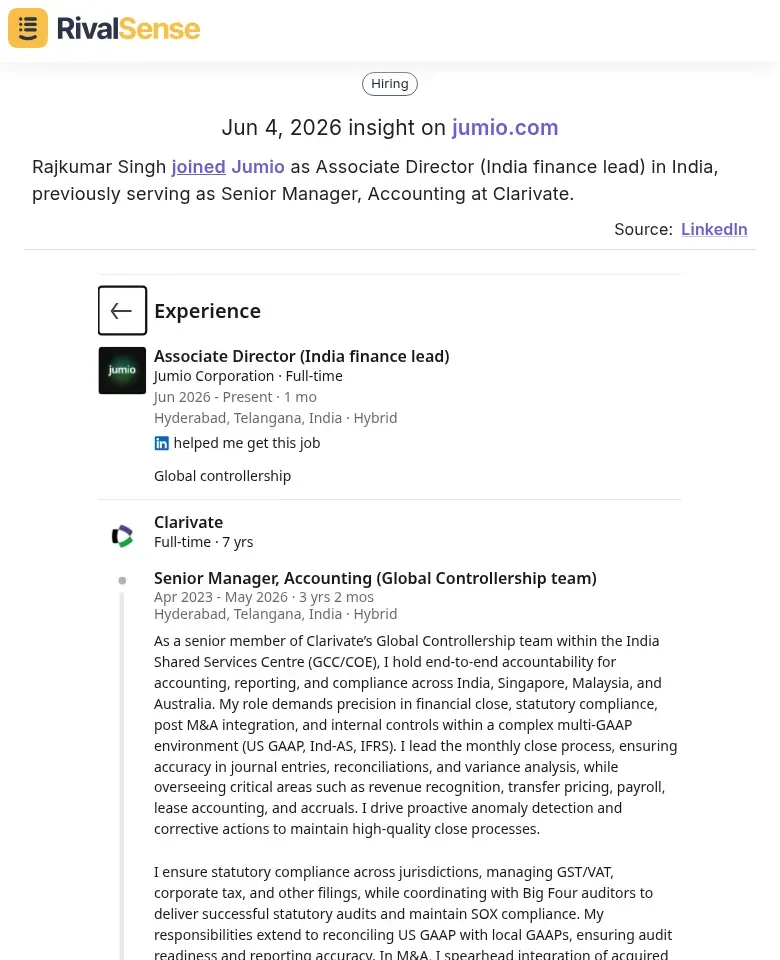
This specific hire indicates a concrete step toward establishing or expanding financial operations in India. For your business, such a signal means a competitor is entering a region where your key accounts operate—prepare for heightened competition or partnership opportunities. Action step: Set up alerts for location-specific job titles using LinkedIn or tools like RivalSense.
2. Detect Product/Service Diversification
New executive hires for emerging business lines (e.g., "Head of AI Solutions") reveal diversification plans. Tip: Cross-reference these with your account’s needs. A competitor launching a complementary offering may weaken your value proposition—proactively upsell or bundle to retain the account.
3. Flag Retrenchment Signals
A freeze in hiring, layoffs, or departures from specific functions (e.g., R&D, customer success) often indicates downsizing. Checklist:
- Monitor job board activity for 30+ days
- Track departures via LinkedIn profile changes
- Assess if affected areas align with your account’s reliance on the competitor
Pro Tip: Create a quarterly "Hiring Heatmap" that maps roles to geographies and business lines. Share insights with your account team to adjust engagement strategies proactively.
Leveraging Role Changes to Predict Account Priorities
When a competitor hires a new C-suite or board member, it often signals upcoming shifts in partnership models, pricing, or client engagement strategies. To leverage this, set up alerts for key executive appointments at your tracked accounts. Then analyze the new hire's track record: Do they come from a company known for aggressive pricing? Have they previously shifted a competitor's account management approach?
A powerful example: Frank Oh left Loop Capital as Managing Director to join Academy Securities as Head of Municipal Banking in the United States.
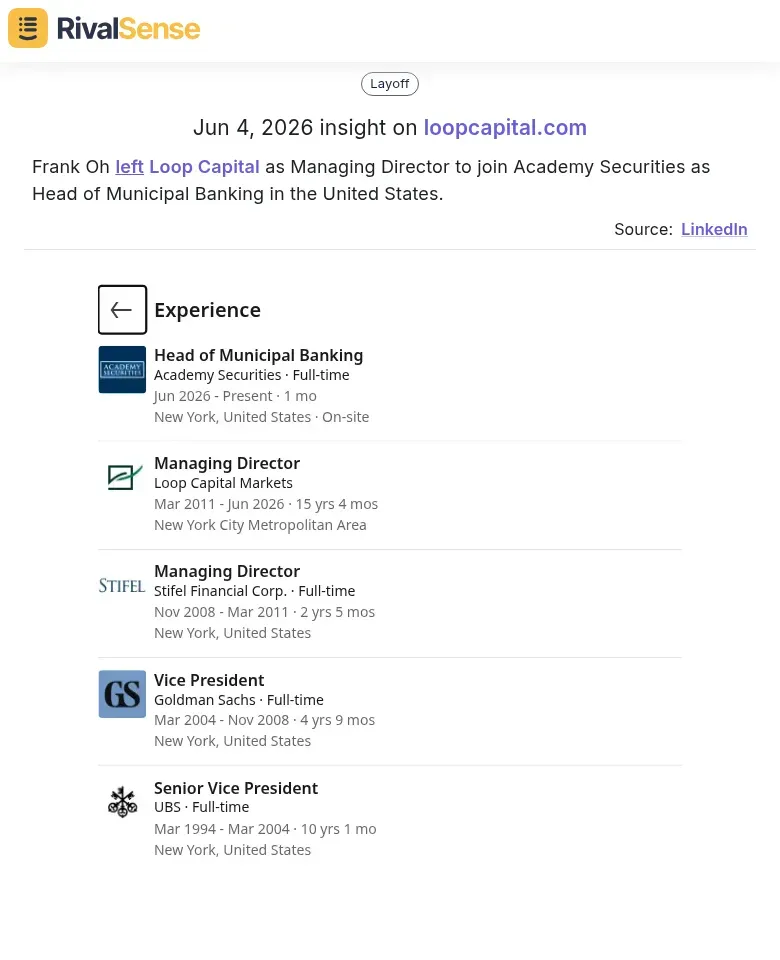
This senior move directly signals Academy Securities' strategic investment in municipal finance, which could threaten your key accounts in that vertical. Monitoring such role changes lets you anticipate where the competitor will focus relationship-building efforts. Similarly, track movements of sales and client relationship leaders. A new VP of Customer Success may herald a more consultative (or purely transactional) engagement model. Create a simple matrix mapping each key role change to likely account impact.
For specialized hires—like a fintech advisory expert—consider that your competitor is preparing a product launch or regulatory play targeting your key accounts. Actionable step: After identifying such a hire, review your account's current product adoption and regulatory exposure to anticipate where pressure will come. Then proactively adjust your account strategy—offering early access to new features or sharing compliance insights—to maintain your competitive edge. Regularly audit your competitor's LinkedIn and press releases for these signals, and integrate findings into your account planning meetings. This turns hiring intel into a predictive tool for protecting key accounts.
Integrating Hiring Data into Your Competitive Tracking Workflow
To integrate hiring data into your competitive tracking, start by setting up automated alerts for key competitor job changes. Use LinkedIn’s job-change notifications, Google Alerts for press releases mentioning new hires, and tools like RivalSense to aggregate data from multiple sources. Next, map each new hire to your account segmentation. For example, if a competitor hires a former enterprise sales director from your industry, flag that as a potential threat to your top-tier accounts. Create a simple spreadsheet or CRM tag to log which accounts are at risk or might see personalized outreach from the competitor. Finally, combine hiring signals with other intelligence like funding rounds, product launches, or pricing changes. A competitor hiring a VP of AI just after a Series B suggests they are doubling down on AI features—cross-reference this with any product release timelines from their blog or press releases. This holistic view lets you anticipate moves, adjust your messaging, and proactively strengthen relationships with key accounts. Tip: Assign a team member to review new hire alerts weekly and update a shared competitive intelligence board with action items for each account segment.
Conclusion: Turning Insights into Actionable Strategy
Hiring data isn’t just a signal—it’s a strategic lever. To turn insights into action, follow this three-step playbook:
1. Map hires to your roadmap.
- Sales: If a competitor hires a Key Account Manager at your top account, arm your team with a counter-playbook (e.g., case studies, executive outreach).
- Marketing: A new Product Marketing hire signals a pending launch—trigger targeted ad campaigns or gated content around that topic.
- Product: Hiring multiple engineers in a specific domain (e.g., AI, compliance) indicates a feature push. Prioritize those in your backlog.
2. Build a triggered response system.
Create a competitive playbook where each hire type links to a specific action:
- Leadership hire → Schedule executive briefing
- Sales hire → Run win/loss analysis
- Support hire → Proactively offer white-glove onboarding
3. Refine your tracking criteria quarterly.
Competitors evolve. Remove roles that no longer signal shifts (e.g., generic “admin”) and add emerging functions like “Revenue Operations” or “Customer Success AI.” Use a simple tier system: critical hires trigger immediate alerts; others go to monthly reviews.
Quick checklist for your next review:
- [ ] Align hire categories to your three biggest risks/opportunities
- [ ] Assign a response owner per hire type
- [ ] Set a 30-day review for high-impact alerts
By weaving competitor hiring intelligence into your daily workflow, you shift from reactive to proactive—protecting revenue, outmaneuvering rivals, and uncovering white space before your competitors do.
Stay Ahead with Real-Time Competitive Hiring Insights
Manually tracking executive moves across dozens of competitors is a time drain. RivalSense automates the heavy lifting: it monitors competitor websites, social media, registries, and the web for product updates, pricing changes, management shifts, and more—including the kind of high-impact hires highlighted above. Every insight is delivered in a concise weekly report, so you can focus on strategic action instead of data gathering.
👉 Try RivalSense for free and get your first competitor report today. Turn hiring signals into your key account advantage.
📚 Read more
👉 The Strategic Benefits of Mystery Shopping Your Competitors: A Guide for B2B Leaders
👉 Master Competitor Target Audience Analysis: Optimize Your Repair Business Strategy
👉 CFO Appointment Signals Funding Round: How to Pounce Before Your Rival
👉 LinkedIn Competitor Insights Cheat Sheet: Protect Your Key Accounts from Silent Poaching