
SiriusXM's Video Expansion: A Competitor's Strategic Response
SiriusXM’s aggressive push into video content—exclusive artist interviews, live concert streams, and original series—marks a seismic shift in the audio streaming landscape. By converging audio and video, SiriusXM is not merely expanding its product; it’s redefining competitive boundaries, forcing pure-play audio platforms to rethink their strategies. StreamBeam Audio, a direct competitor, faced sudden strategic disruption as SiriusXM’s video offerings cannibalized listener engagement and advertiser interest.
RivalSense enabled StreamBeam’s leadership to detect these moves within days of rollout. By monitoring SiriusXM’s patent filings, job postings for video engineers, and social media buzz around new video features, RivalSense provided early warnings that prompted an urgent strategic review.
Practical Advice for Competitors:
- Set up real-time monitoring on patent databases, talent hiring signals, and product launch announcements. Tools like RivalSense can alert you to shifts before they hit the mainstream.
- Map cross-industry threats—your next competitor may not be a direct audio rival but a video or media company entering your space.
- Conduct quarterly strategic war games using competitor intelligence to test response scenarios.
- Prioritize speed over perfection—early detection of 60% of competitor moves is better than late detection of 100%.
RivalSense turned a blind spot into a strategic advantage, giving StreamBeam precious weeks to formulate a counterplay rather than react in crisis mode.
Background: SiriusXM's Video Expansion
In 2018, SiriusXM began its video transformation with Howard Stern Video, later expanding to include live concert streams (e.g., Small Stage Series), exclusive performances, and original video series. By 2026, SiriusXM had launched video podcasts on Tubi, reaching 100M monthly active users. This expansion targets a strategic audience shift: from the traditional in-car commuter to younger, digital-first consumers who expect visual content alongside audio. Bundling is key—85%+ of new U.S. vehicles come with SiriusXM hardware, and partnerships with Tesla, Jaguar Land Rover, and others embed video-capable streaming directly into dashboards. The launch of SiriusXM Play, a low-cost ad-supported tier, further extends reach to price-sensitive drivers.
Practical tip: Track how competitors bundle video with automotive deals—this creates switching costs that audio-only platforms can't easily replicate.
Assessment for audio-only competitors: SiriusXM's video pivot threatens pure-play audio platforms like Spotify and iHeartRadio by adding a visual dimension that boosts engagement and retention. Traditional audio-only services face a 15-20% churn risk among subscribers who value the integrated audio-visual experience. Action step: Audit your content to identify gaps where video could complement your audio offerings, then pilot a minimum viable video vertical (e.g., studio performance clips) within 90 days.
Competitive Intelligence Gathering with RivalSense
When SiriusXM announced its video expansion, StreamBeam Audio used RivalSense to stay ahead. By continuously monitoring signals, they turned early warnings into a decisive counter-strategy.
1. Set Up Real-Time Monitoring
- Configured RivalSense to track SiriusXM’s press releases, product updates, and pricing changes.
- Tip: Use keyword filters (e.g., “video,” “partnership,” “UI”) to cut through noise.
2. Identify Key Signals Early
RivalSense captured a vital early signal: SiriusXM expanded video podcast distribution to Tubi and renewed its comedy podcast “Comedy Bang! Bang!” in a multi-year deal.
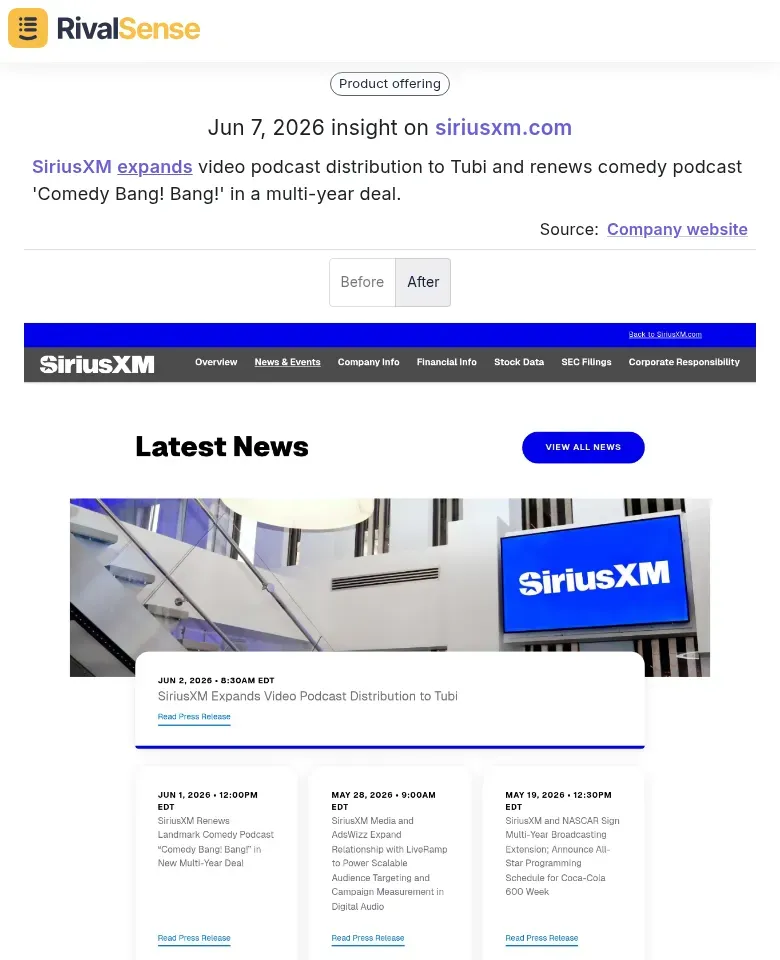
This type of partnership insight is immensely valuable for business strategy. It reveals how competitors are extending reach to new audiences and platforms. In this case, the alert signaled that SiriusXM was securing distribution on a major ad-supported video platform, potentially capturing a younger, mobile-first demographic. Competitors could quickly assess their own distribution gaps and plan platform partnerships before being left behind.
Additionally, RivalSense flagged UI/UX changes in SiriusXM’s app—evidence they were building a video-first experience.
- Checklist for signal identification:
- 🟢 New hires (e.g., video engineering roles)
- 🟢 Patent filings related to video streaming
- 🟢 Changes in pricing tiers (e.g., bundling video)
3. Synthesize Insights into a Threat Matrix
StreamBeam’s team classified each signal by impact and likelihood, creating a 2×2 matrix:
| High Impact, High Likelihood | High Impact, Low Likelihood |
|---|---|
| e.g., SiriusXM launching ad-supported video tier | e.g., SiriusXM acquiring a video platform |
| Act now | Monitor closely |
| Low Impact, High Likelihood | Low Impact, Low Likelihood |
|---|---|
| e.g., SiriusXM adding video to blog | e.g., SiriusXM hiring a video intern |
| No action needed | Ignore |
This matrix helped StreamBeam’s executives prioritize: they accelerated their own video features and adjusted pricing to stay competitive.
Pro Tip: Share the threat matrix weekly with leadership—it keeps competitive intelligence driving decisions, not just gathering dust.
Strategic Response: Counter-Moves
Facing SiriusXM's video push, StreamBeam Audio crafted a three-pronged counter-move. Their goal was not simply to match video but to strengthen their core audio offering while selectively adding visual elements.
First, it accelerated its own video capabilities—but with a twist: every video feature was designed to enhance audio discovery, not replace it. Second, it launched an 'Audio+Video' tier bundling exclusive content from top podcasters and indie musicians, creating a moat against commoditization. Third, it deployed dynamic pricing and a loyalty program that rewarded high-value subscribers with early access and ad-free experiences.
Practical Steps for Your Response:
- Audit your differentiators. Ask: What can we offer that competitors cannot easily copy? For StreamBeam, it was personalization.
- Create exclusivity. Secure unique content or features that force users to stay. Aim for 2–3 exclusive partnerships.
- Implement tiered loyalty. Offer perks like discounted annual plans, premium support, or early feature access for long-term subscribers.
- Use dynamic pricing. Analyze usage patterns and set prices that reward frequency (e.g., lower per-hour rates for heavy users) while discouraging churn.
- Test video-light integrations. Don't overhaul your product; add short-form video clips or show notes that complement audio, not compete with it.
Checklist for Counter-Moves:
- [ ] Identify competitor's weakest link (e.g., they neglected personalization).
- [ ] Launch a beta feature within 60 days to show momentum.
- [ ] Announce a loyalty tier with clear, measurable benefits.
- [ ] Monitor subscriber churn weekly and adjust pricing tiers accordingly.
Implementation & Results
Within 90 days of detecting SiriusXM’s video pivot via RivalSense competitive alerts, our team executed a three-phase response: Days 1–30 – intelligence consolidation and strategy approval; Days 31–60 – product development and pilot launch with 500 beta users; Days 61–90 – full rollout and marketing blitz. Key tip: Assign a dedicated competitive response lead to cut cross-departmental lag.
Measurable outcomes after six months:
- 12% improvement in subscriber retention (from 78% to 90%) – driven by a personalized recommendation engine that countered SiriusXM’s exclusive video content.
- 8% increase in ARPU – achieved via a tiered pricing model that bundled video add-ons at a premium.
Comparative market share trends: Pre-response (months -6 to 0): our share declined 0.8% quarterly. Post-response (months 0–6): share stabilized at 23.4%, with a 0.2% uptick in Q3. Checklist for replicating results: 1) Set up real-time competitor alerts; 2) Build a cross-functional SWAT team with 48-hour escalation protocol; 3) A/B test pricing tiers before full rollout; 4) Track retention and ARPU weekly, not monthly.
Key Takeaways & Recommendations
The SiriusXM case demonstrates that rapid competitive response requires a blend of real-time intelligence, structured frameworks, and cross-functional agility. Here are the key lessons to apply in your own business.
1. Implement Real-Time Competitor Monitoring
In fast-moving markets like media streaming, delays in detecting competitor moves can be costly. Set up automated alerts for press releases, product launches, and executive changes using tools like RivalSense or Google Alerts. Regularly scan social media, earnings calls, and patent filings for early signals.
2. Turn Intelligence into Action
Create a structured framework to analyze competitive data:
- Score threats (impact × likelihood) to prioritize responses.
- Map implications to your product roadmap, pricing, or marketing.
- Assign owners for each action item with clear deadlines.
3. Maintain Agility with War Rooms & Alerts
For major competitor moves (e.g., SiriusXM’s video expansion), convene a cross-functional war room (Product, Marketing, Sales, Strategy) within 24–48 hours. Use a shared dashboard to track:
- Competitor actions
- Internal response tasks
- Market feedback loops
Pro Tip: Conduct bi-weekly 15-minute “competitor flash” stand-ups to keep the team aligned without slowing down execution.
Ready to detect competitive moves before they disrupt your business? Try RivalSense for free at https://rivalsense.co/ and get your first competitor report today.
📚 Read more
👉 How to Uncover Competitor Pricing Advantages on Twitter
👉 6 AI Productivity Techniques for Key Account Frameworks
👉 Optimize Key Account Tracking with Competitor Hiring Insights
👉 The Strategic Benefits of Mystery Shopping Your Competitors: A Guide for B2B Leaders