
Boost Key Account Productivity with Competitor and Compliance Tracking
In key account management, productivity often takes a backseat to compliance—but it shouldn’t. When you track key account metrics within compliance contexts, you unlock significant productivity gains by reducing manual reporting and minimizing risk exposure. Instead of scrambling to gather data before audits or regulatory reviews, a structured metrics system provides real-time visibility into account health indicators like contract adherence, regulatory filings, and audit readiness. This shift enables proactive management: you can spot compliance gaps before they escalate, reallocate resources efficiently, and keep accounts moving forward. Here’s how to start:
- Define compliance-critical KPIs (e.g., license renewals, incident reports, policy acknowledgment rates) for each key account.
- Set up automated dashboards that pull data from CRM, ERP, and compliance tools—eliminating manual consolidation.
- Schedule weekly 15-minute reviews of these dashboards with your compliance and account teams.
- Create trigger alerts for metric thresholds (e.g., approaching license expiration, overdue training).
- Align account strategies with evolving regulations by integrating regulatory change monitoring into your account planning.
By embedding compliance metrics into your daily workflow, you reduce firefighting, improve decision velocity, and turn regulatory requirements into a competitive advantage. Proactive account management isn’t just about meeting standards—it’s about outperforming them.
🔍 Monitoring Executive Moves to Anticipate Strategic Shifts
When a key account hires a new executive—especially from a high-growth adjacent company—it’s often a signal of an impending strategic shift. For instance, if your account appoints a Chief Compliance Officer from a fintech disruptor, they may be preparing to launch a regulated product line. Similarly, a new COO from an operations-focused SaaS firm could hint at scaling efforts that expand your opportunities.
For example, RivalSense captured this executive move:
John McCauley joined Vanta as Chief Financial Officer in the United States, previously serving as Chief Operating Officer at Calendly.
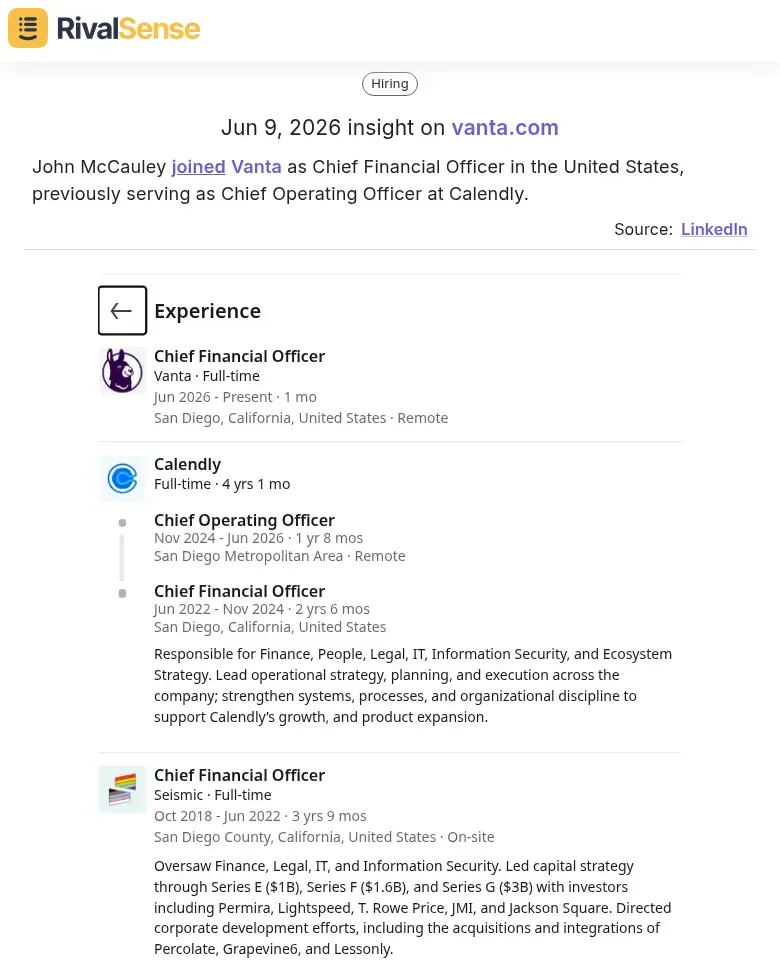
This type of insight is valuable for business strategy because a CFO hire from a high-growth operations background often signals IPO preparation or a major compliance/operational scaling effort. For your team, it provides a 3–6 month lead time to adjust account strategies, tailor messaging around financial compliance capabilities, or anticipate new buying triggers.
How to build this into your workflow:
- Set up executive hire alerts for your top 20 accounts using LinkedIn Sales Navigator, Crunchbase, or tools like RivalSense.
- Map the hire to strategic context: Does the new exec’s background align with compliance, operations, or growth? That tells you where the account is investing.
- Share insights cross-functionally—tag the account team in a Slack channel with a 1-paragraph summary of what the hire means for your relationship.
- Update account plans to reflect potential changes in buyer personas, budget cycles, or product needs.
Practical tip: Don’t just track C-suite moves—also monitor VP-level hires in compliance, legal, and operations. These roles often precede strategic pivots by 3–6 months, giving your team a valuable lead time to adjust messaging and outreach.
🗣️ Analyzing CEO Messaging Amid Competitive Pressure
When competitive pressure mounts, CEOs often reveal their strategic priorities in earnings calls and interviews—signaling where they’re vulnerable or doubling down. By systematically tracking these public statements, you can spot shifts in focus (e.g., from customer growth to valuation momentum) that directly affect your key accounts.
Take this RivalSense insight:
Vanta CEO Christina Cacioppo, facing increased AI competition, maintains the company's lead with 16K+ customers and a $4.2B valuation.
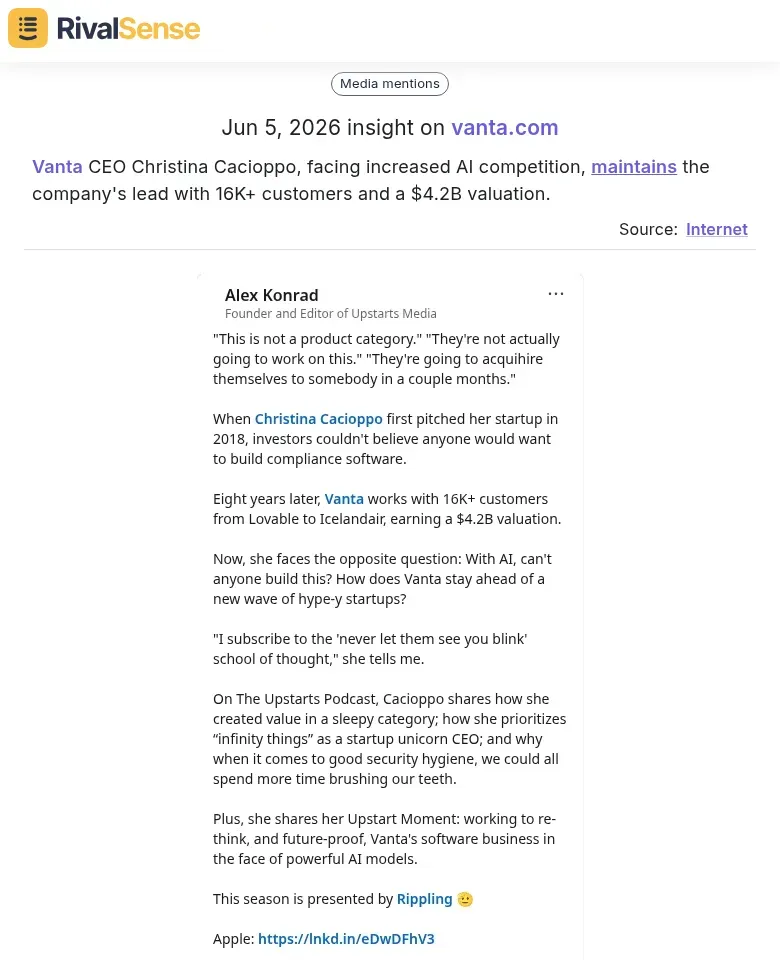
CEO messaging analysis is valuable because it reveals defensive vs. offensive postures. Here, the emphasis on customer numbers and valuation despite AI competition suggests Vanta is focused on protecting its installed base—a signal that your compliance solution could win on innovation or ease of integration if you highlight those differentiators.
How to analyze CEO messaging:
- Set up alerts for competitor CEO mentions using tools like Google Alerts or RivalSense. Focus on earnings call transcripts, investor days, and press releases.
- Create a theme tracker—categorize statements by topic (pricing, product, retention, market expansion). Use a simple spreadsheet with columns for date, source, quote, and strategic theme.
- Identify defensive vs. offensive moves. Defensive: “We’re protecting our installed base.” Offensive: “We’re gaining share in segment X.” Match these to risks or opportunities in your accounts.
- Tailor your value proposition. If a competitor’s CEO emphasizes AI features, prepare a counter-narrative showing your unique advantages or lower complexity.
Tip: Share your analysis with account teams in a monthly “Competitor Watch” one-pager. Highlight 3–5 key quotes and recommended talking points to keep retention conversations proactive.
🎙️ Leveraging Media and Industry Appearances for Deeper Insights
Media appearances—think CNBC slots or keynote stages—signal the topics your competitors prioritize to shape market perception. A CEO’s interview on a major business show often previews product roadmaps or partnership narratives before any press release.
For instance, RivalSense flagged:
Vanta appeared on NYSE Live to discuss combating cyber threats.

This type of insight is valuable because a media appearance on a topic like cyber threats reveals a competitor’s immediate marketing and product focus. You can anticipate that compliance features around cybersecurity will be central in their upcoming campaigns—and you can proactively adjust your own positioning or highlight complementary strengths.
To leverage media appearances:
- Set up media monitoring alerts for your competitors’ executives (e.g., Google Alerts, Meltwater). Track appearances on shows like Bloomberg or industry podcasts.
- Analyze speaking slots: If a competitor is speaking at a cloud-security summit, they’re likely doubling down on compliance features. Map these to your account insights—if a target client attended the same event, reference the talk in your outreach.
- Mine editorial coverage: Look for bylines or quotes in trade publications. These often reveal unannounced product priorities.
- Apply to account outreach: When preparing for a prospect meeting, use media intelligence to tailor your messaging. For example, “I noticed your competitor’s CEO emphasized zero-trust compliance on CNBC. Here’s how our solution addresses that.”
Pro tip: Create a shared “Competitor Media Tracker” spreadsheet with columns for event, topic, date, and relevant accounts. This turns noise into actionable insights for your sales and marketing teams.
🤝 Building a Competitive Intelligence Workflow for Account Teams
To transform competitive intelligence into action, account teams need a structured workflow. Start by integrating competitor metric tracking directly into your CRM. Use tools like RivalSense to feed data into Salesforce or HubSpot, triggering real-time alerts when a competitor launches a product, changes pricing, or wins a client. This ensures account managers act on intel without leaving their primary workspace.
Establish a regular cadence of intelligence briefings. Schedule weekly 15-minute syncs where each account manager shares one key competitor move and its impact on their accounts. Tether these insights to account action plans by updating opportunity stages with competitive flags.
Tip: Create a simple template: “Competitor Move → Account Risk/Opportunity → Action Item.”
Balance compliance with speed. Set up a tiered intelligence system: (a) automated alerts for urgent moves, (b) weekly curated summaries for routine tracking, and (c) monthly deep-dives for strategic shifts. Use a shared compliance checklist to vet sources, ensuring sensitive data doesn’t violate legal boundaries.
Checklist:
☐ Source verified?
☐ Data anonymized?
☐ Shared only on need-to-know basis?
This workflow keeps account teams proactive, compliant, and laser-focused on winning key accounts.
Conclusion: Turning Competitive Insights into Measurable Productivity Gains
Synthesizing executive moves, CEO messaging, and media presence into a unified account intelligence dashboard transforms scattered data into actionable insights. To start, identify the 3–5 metrics that matter most to your compliance team—e.g., competitor leadership changes, regulatory signals, or product announcements. Use a tool like RivalSense to automate data collection and alerting, freeing your team from manual research. Measure productivity gains by tracking time saved (aim for 2–4 hours per week per analyst) and win rate improvements (target 10–15% increase within three months).
Practical steps to implement:
- Define key metrics with your compliance and sales teams.
- Set up automated tracking using RivalSense (or similar) to monitor executive moves, earnings calls, and media coverage.
- Create a weekly 30-minute dashboard review to surface critical insights.
- Measure baseline for manual research time and win rates, then reassess quarterly.
By automating competitive intelligence, you scale insights without straining compliance workflows—turning data into measurable productivity wins.
Ready to see it in action? Get your first competitor report today with RivalSense—try it free at https://rivalsense.co/ and start tracking the moves that matter to your key accounts.
📚 Read more
👉 Spot Competitor Partnership Threats Before They Steal Your Key Accounts
👉 Mastering Competitive Positioning: A Comparative Analysis Guide for Accounting Firms
👉 SiriusXM's Video Expansion: A Competitor's Strategic Response