
How to Spot Market Shifts with Competitor Analysis: A Real-World Example from Crete’s Car Rental Boom
Staying ahead in competitive markets isn’t just about knowing your own performance—it’s about seeing what your rivals are doing before they impact your share. Regular, structured competitor analysis turns public data into early warnings and growth opportunities.
Let’s break down how you can use competitor insights to act faster, using a recent real-world example from the travel industry.
🔍 What to Monitor (and Why)
Effective competitor tracking goes beyond social media stalking. Focus on these signal categories:
| Category | Example Signals | Why It Matters |
|---|---|---|
| Product & Listing Updates | New brands, location expansions, service changes | Reveals market entry or exit |
| Pricing & Packaging | Rate adjustments, bundle offers | Shows competitive positioning |
| Partnerships & Alliances | New resellers, integrations, ecosystem moves | Uncovers channel shifts |
| Customer Sentiment | Updated reviews, rating trends | Highlights strengths and weaknesses |
| Operational Changes | Management shifts, regulatory filings | Indicates strategic pivots |
These signals rarely appear in a neatly packaged press release—they surface piecemeal across websites, social media, and registries. That’s why automated monitoring is essential.
🚗 Real-World Insight: Crete Island’s Car Rental Market Suddenly Expands
Recently, a RivalSense alert caught a significant competitor move: EconomyBookings updated its customer reviews and car rental company listings for Crete Island, adding 11 new rental companies such as Dirent a car, AcaRent, addCar, Alma Car Hire, and expanding Royal Rentals to 9 locations across 7 cities.
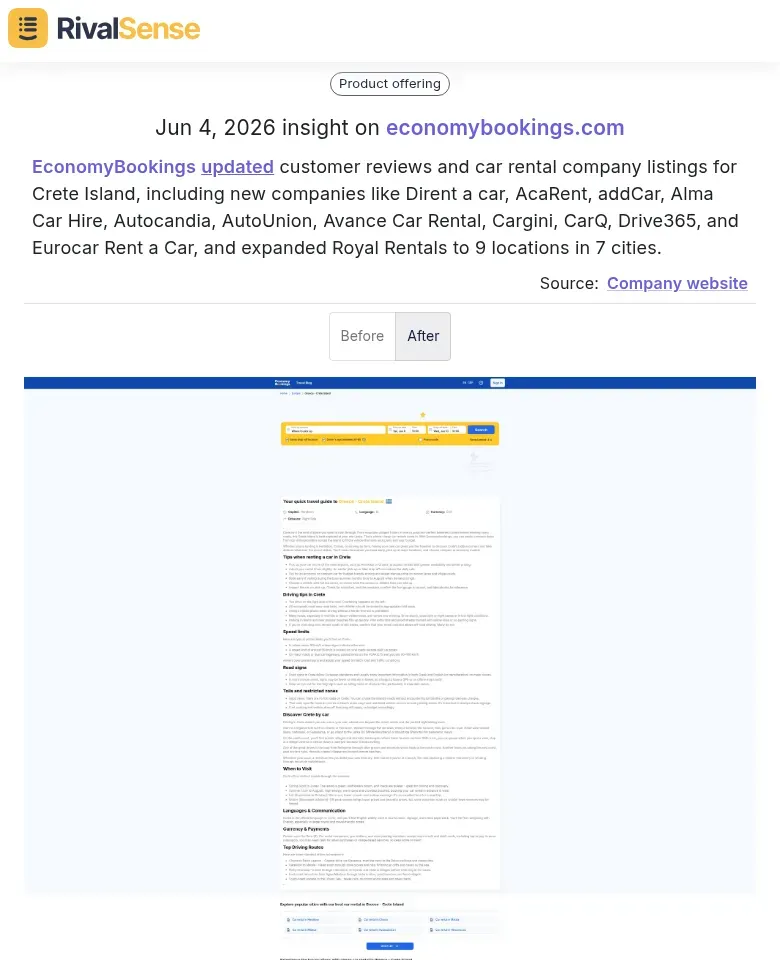
This single update tells you that:
- ✅ Crete is a strategic growth market for EconomyBookings
- ✅ They’re actively onboarding new suppliers to widen their inventory
- ✅ The competitive landscape on the island just became more crowded
- ✅ Incumbent local players may soon face pricing pressure
For a competing OTA or a local car rental business, this is a trigger to re-evaluate Crete strategies immediately—before the summer season peaks.
🧠 Turn Insights into Action: A 3‑Step Checklist
Once you spot a competitor’s update like this, follow these steps:
- [ ] Contextualize the move: Map the update to your own market presence. Are you exposed? Can you respond with a partnership or enhanced offer?
- [ ] Validate with other signals: Cross-check similar activity on social media, hiring pages, or domain registrations. A single listing change might be noise; multiple signals confirm intent.
- [ ] Act swiftly but deliberately: Adjust your pricing visibility, launch a targeted local campaign, or accelerate a supplier deal. Speed matters when rivals are expanding footprints.
📈 Why Manual Tracking Falls Short
Relying on team members to manually check competitors’ websites and social feeds is unreliable. Important updates slip through, and you’ll never see the full picture because registries, review sites, and press mentions are too scattered. Automated intelligence captures changes you’d miss, delivering them in a digestible report so your team can focus on strategic responses.
Ready to transform competitor monitoring into a strategic advantage? Try RivalSense for free today and get your first report to start uncovering actionable insights just like the EconomyBookings example. No complex setup—just the intelligence you need to stay ahead.
📚 Read more
👉 The Strategic Benefits of Mystery Shopping Your Competitors: A Guide for B2B Leaders
👉 Master Competitor Target Audience Analysis: Optimize Your Repair Business Strategy
👉 CFO Appointment Signals Funding Round: How to Pounce Before Your Rival
👉 LinkedIn Competitor Insights Cheat Sheet: Protect Your Key Accounts from Silent Poaching