
Pricing Cheat Sheet: Key Account Management Insights
Pricing is one of the most powerful levers for profitability in B2B key account management. A 1% price increase can boost operating profit by 8–11% on average, yet many account managers shy away from pricing conversations, fearing they might damage relationships. The reality? Strategic pricing actually strengthens partnerships when done transparently.
Competitor pricing moves are a goldmine of market intelligence. When a rival raises prices, it often signals increased customer willingness to pay or rising costs. When they drop prices, they may be chasing market share or reacting to a new entrant. Tracking these shifts helps you anticipate customer expectations and position your value proposition accordingly.
Practical tips for pricing in key accounts:
- Monitor competitor price changes weekly using tools like RivalSense. Look for patterns—are they discounting to win new logos or raising prices on renewals?
- Segment your accounts by price sensitivity. High-value strategic accounts may tolerate annual increases of 3–5% if tied to added value; transactional accounts may need more competitive pricing.
- Use value-based pricing language: Instead of "we're raising prices," say "we're enhancing our service package to deliver X% more value."
- Create a pricing playbook with approval thresholds, discount limits, and escalation paths for key accounts.
This cheat sheet synthesizes lessons from real-world pricing changes across SaaS, manufacturing, and professional services. Apply these insights to turn pricing from a negotiation friction point into a strategic advantage.
Leverage Seasonal and Promotional Pricing to Drive Volume
To maximize volume, implement time-limited discounts like “up to 50% off + free shipping” to trigger urgency and acquire new customers. However, protect margins by bundling free shipping with a minimum order threshold (e.g., “Free shipping on orders over $50”). This tactic increases average order value while maintaining perceived value. Align promotions with seasonal events—Mother’s Day, Black Friday, or back-to-school—to ride natural buying cycles. For example, a B2B supplier could offer “20% off bulk orders for Mother’s Day inventory” in March. Create a promotional calendar: map key dates 6–12 months ahead, assign discount tiers (e.g., 10% for early-bird, 25% for peak week), and set clear start/end times to enforce scarcity. Use countdown timers on checkout pages and email reminders to reinforce urgency. Track performance per campaign: compare order volume, average order value, and customer acquisition cost against non-promotional periods. Adjust thresholds and discount depths based on margin goals. Finally, segment your audience—offer deeper discounts to new customers while rewarding loyal ones with early access or exclusive bundles.
💡 Real-world insight: Mixbook, rated No. 1 in photo books, offered up to 50% off plus free shipping on orders over $79 for Mother's Day. They paired this with a drag-and-drop editor featuring over 200 themes and an iOS app for creating photo books from a phone.
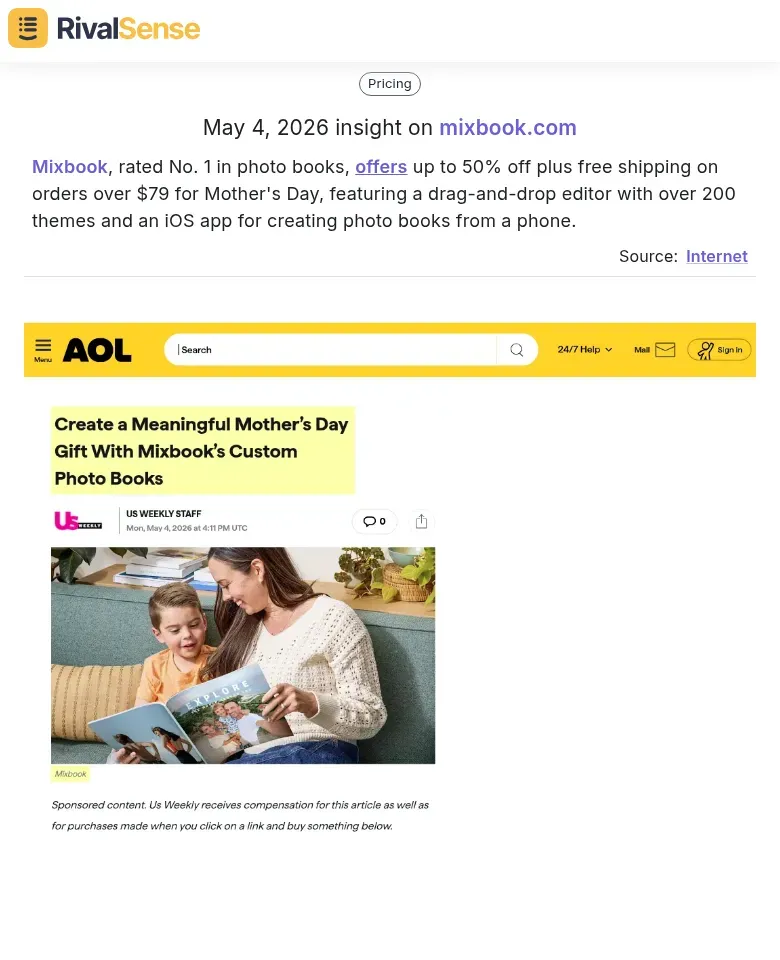
Why this matters for your strategy: Seasonal promotions like this reveal competitors' pricing aggressiveness and timing. Tracking them helps you calibrate your own promotional depth and avoid being undercut. If a rival runs a deep discount on a key product, you may need to match or differentiate with added value.
Implement Value-Based Price Increases with Added Services
To implement value-based price increases without alienating clients, follow a gradual, transparent approach. Start by raising core service prices (e.g., reflexology, massages) by 5–10% annually, framing each increase as an investment in enhanced quality—better products, advanced training, or upgraded facilities. Pair each price hike with a new add-on service offered at a modest fee. This creates an upsell opportunity that offsets price sensitivity: clients perceive greater value even as core prices rise.
Practical Steps:
- Audit your services – Identify which core offerings have the strongest perceived value. These are safest for incremental increases.
- Design one add-on – Keep it simple and low-cost to deliver (e.g., hot towel treatment, aromatherapy upgrade).
- Communicate early – Send an email or post a notice 2–4 weeks before the change. Explain why prices are rising (e.g., “to source organic oils” or “to extend session times”).
- Train staff – Ensure every team member can articulate the new value proposition confidently.
- Monitor feedback – After 30 days, survey a sample of clients. If resistance is high, adjust the add-on or delay the next increase.
Checklist for a Smooth Rollout:
- [ ] Price increase announced at least 2 weeks in advance
- [ ] Add-on service clearly described and priced
- [ ] Staff prepared with talking points
- [ ] Loyalty program or grandfathered rates considered for top clients
💡 Real-world insight: The Spa Leamington increased prices for several services (Reflexology 40 mins from £47 to £50, Hopi Ear Candles from £36 to £39, Indian Head Massage from £54 to £57, Zen Package from £126 to £138) and added a Scalp Massage add-on for £20.
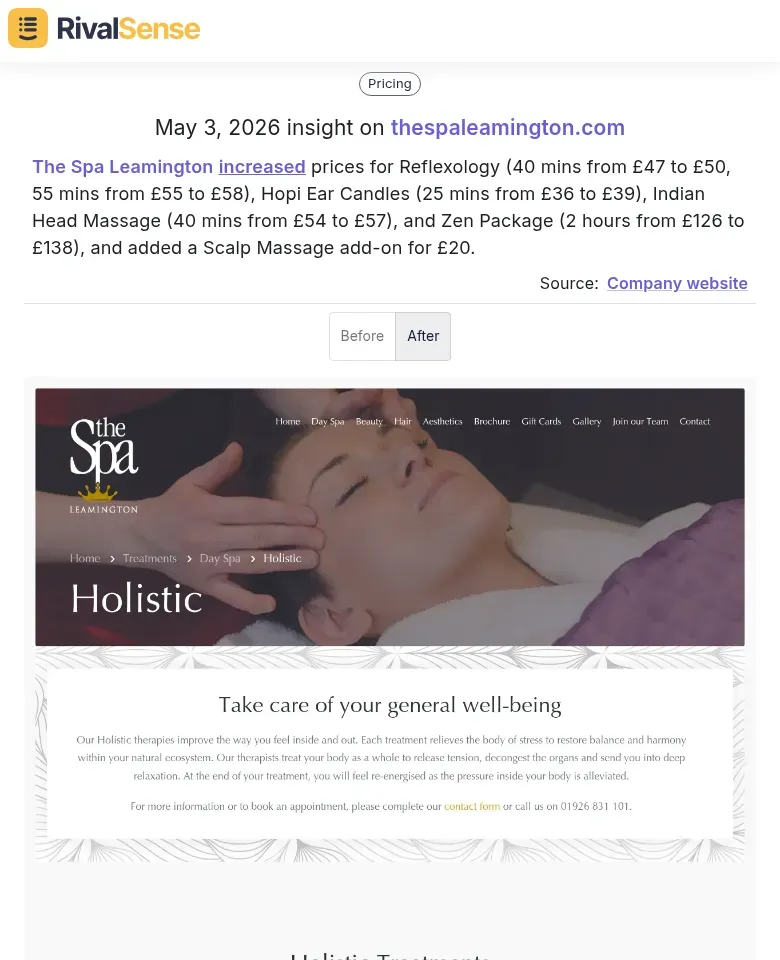
Why this matters for your strategy: Pricing changes combined with new add-ons signal how competitors justify increases while offering upsell opportunities. Monitoring such moves helps you anticipate similar expectations from your own clients and craft justifiable price adjustments.
Use Free Trials and Low-Risk Entry Points to Win Key Accounts
To win key accounts, lower their risk of adoption. Offer a 14-day free trial (no credit card required) so prospects can validate your solution without commitment. Pair this with waived implementation fees—removing upfront costs accelerates sign-off and builds goodwill.
Practical steps:
- Automate onboarding with self-service setup for order intake and quoting. This shows efficiency and reduces time-to-value.
- Provide a dedicated trial success kit: a checklist of key features to test, sample data, and a 15-minute walkthrough call.
- Track engagement during the trial—if a prospect hasn't logged in after 3 days, trigger a personalized email with a quick-win use case.
Checklist for low-risk entry:
- [ ] Free trial duration aligned with evaluation cycle (14–30 days)
- [ ] No hidden fees or auto-renewal surprises
- [ ] Automated onboarding flow with progress indicators
- [ ] Case studies of similar key accounts that started with a trial
💡 Real-world insight: Gelato launched a 14-day free trial of GelatoConnect with no implementation fee, allowing print businesses to test automated order intake and quoting.
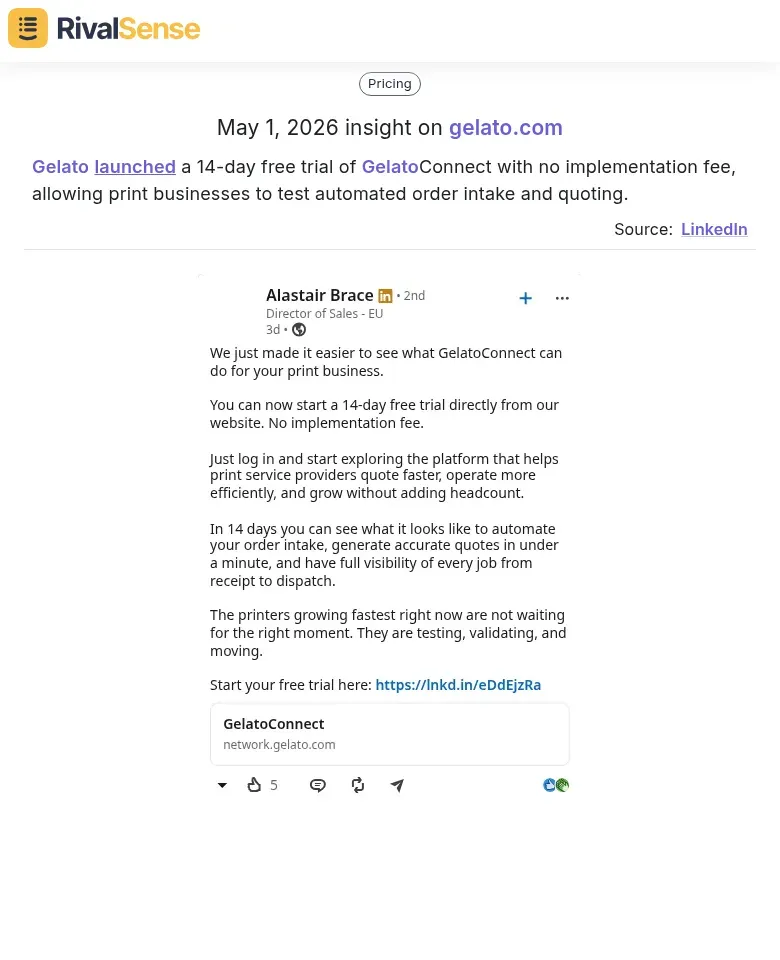
Why this matters for your strategy: Free trials with no setup cost lower the barrier for key accounts to evaluate your solution. Tracking competitors' trial offers helps you benchmark your own risk-reduction tactics and stay competitive in enterprise buying cycles.
Segment Pricing by Customer Type and Usage Behavior
Segment pricing by customer type and usage behavior to maximize lifetime value. High-volume key accounts should receive volume discounts or tiered pricing that rewards larger commitments, while low-volume accounts pay a premium per unit. This incentivizes growth and locks in revenue.
Practical Steps:
- Analyze usage data – Identify high, medium, and low-volume segments based on consumption patterns.
- Design tiers – Example: Tier 1 (<100 units) at $10/unit, Tier 2 (100–500) at $8/unit, Tier 3 (500+) at $6/unit.
- Set thresholds – Ensure tiers align with natural customer breakpoints (e.g., monthly active users, API calls).
- Monitor competitors – Use tools like RivalSense to track competitor pricing changes weekly. Adjust your tiers if rivals undercut your high-volume discounts.
Checklist:
- [ ] Segment customers by volume and usage frequency.
- [ ] Define 3–5 pricing tiers with clear benefits.
- [ ] Automate tier assignment based on real-time usage.
- [ ] Set alerts for competitor price moves.
- [ ] Review segmentation quarterly.
Tip: Offer a loyalty bonus (e.g., free month) when a low-volume account crosses into a higher tier to encourage expansion.
Monitor Competitor Pricing Moves to Inform Your Own Strategy
To stay ahead, systematically monitor competitor pricing moves. Set up alerts for price changes, promotions, and new offerings using competitive intelligence tools like RivalSense. Track key metrics: discount frequency, trial lengths, and price increase patterns. Create a simple spreadsheet to log changes weekly—note the tactic, timing, and market reaction. For example, if a rival offers a 20% discount for annual plans and sees a 15% uptick in sign-ups, test a similar offer. Automate alerts to avoid manual checks; tools can notify you of price drops or new bundles instantly. Analyze which tactics resonate: Are flash sales driving conversions? Are free trials converting to paid? Use this intel to adjust your pricing strategy proactively. A practical checklist: (1) Identify top 5 competitors, (2) Set up automated tracking, (3) Log changes weekly, (4) Correlate with market response, (5) Test winning tactics in your own pricing. This turns raw data into strategic advantage.
Ready to simplify competitor pricing tracking?
The challenges described in this post—monitoring seasonal promotions, justifying price increases, and crafting effective trial offers—are all easier when you have a steady stream of competitive intelligence. Try RivalSense for free at https://rivalsense.co/ and get your first competitor report today. No commitment, just actionable insights delivered weekly.
📚 Read more
👉 The Key Account Management Playbook: A Leader's Guide to Empowering SAMs
👉 How to Control Access to Competitor Intelligence in Your B2B Company
👉 How NVIDIA's Nemotron Launch Spurred a Rival's AI Agent Pivot