
How NVIDIA's Nemotron Launch Spurred a Rival's AI Agent Pivot
When NVIDIA launched Nemotron 3 Nano Omni on April 28, 2026, the enterprise AI landscape shifted overnight. This open multimodal model—unifying vision, audio, and language with up to 9x more efficient AI agents—immediately raised the bar for general-purpose AI capabilities. But for one mid-market B2B SaaS company, it wasn't a threat—it was a signal to pivot.
Within 48 hours of the launch, RivalSense's real-time monitoring flagged a critical pattern: three key competitors had abruptly pivoted their roadmaps toward vertical-specific AI agents for legal and healthcare niches. By analyzing these shifts through RivalSense's competitive intelligence dashboard, our client identified a whitespace opportunity in the logistics vertical—a segment overlooked by rivals. Within two weeks, they reallocated engineering resources to build a specialized logistics AI agent, capturing early market share before competitors reacted.
Practical tip: Set up RivalSense alerts for competitor product launches, job postings, partnership announcements, and API documentation changes—these often precede strategic pivots by 30–60 days.
Checklist for rapid pivot detection:
- [ ] Monitor competitor GitHub repos for new repository creation
- [ ] Track changes in competitor website 'Solutions' pages
- [ ] Analyze hiring trends for niche domain experts
- [ ] Review partner ecosystem announcements for vertical specialization clues
- [ ] Set up alerts for competitor product launches (like we did with Nemotron)
The Competitive Trigger: NVIDIA's Nemotron 3 Nano Omni Launch
On April 28, 2026, NVIDIA launched Nemotron 3 Nano Omni, an open multimodal model that unifies vision, audio, and language processing. This model enables up to 9x more efficient AI agents by reducing latency and compute requirements while maintaining high accuracy across modalities. For existing AI agent providers, it was a wake-up call: it commoditized the underlying reasoning layer, forcing them to differentiate on domain-specific workflows or vertical integrations.
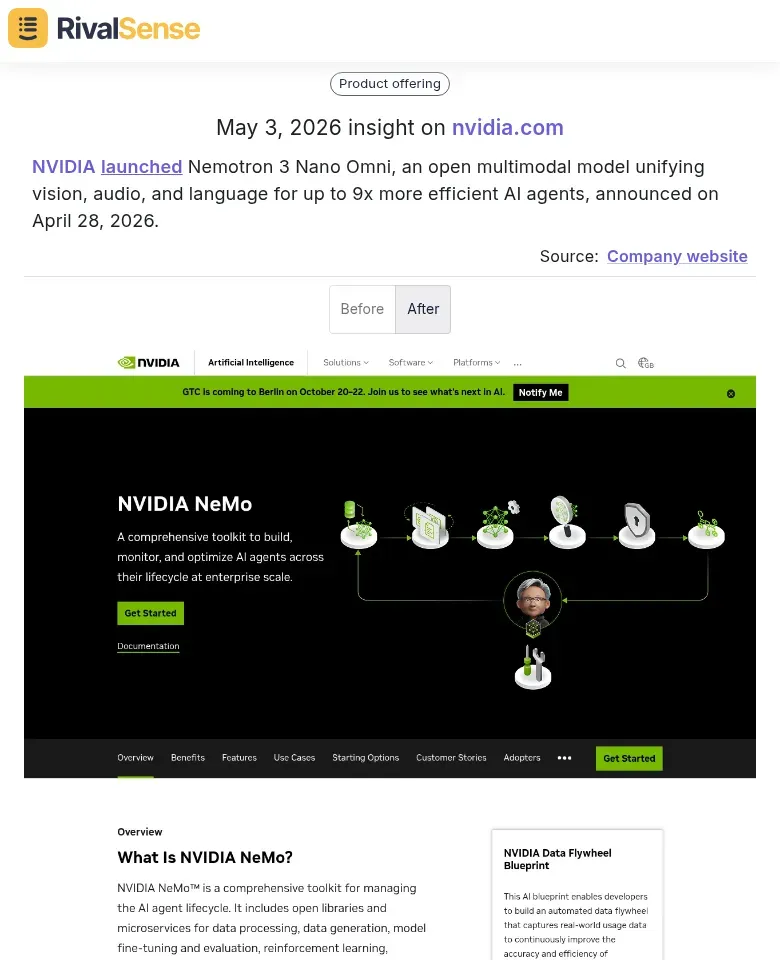
Why does monitoring competitor product launches matter? A new product like this signals an immediate shift in market capabilities. By tracking NVIDIA's launch via RivalSense, you can assess how your own roadmap overlaps and whether your differentiators still hold value. In this case, the client's general-purpose assistant was directly threatened—but the pivot opportunity was hidden in the competitors' reactions.
Practical tip: If you're an AI agent provider, audit your core differentiators now—if they overlap with Nemotron's baseline capabilities, pivot to specialized use cases (e.g., compliance monitoring, supply chain optimization) where NVIDIA's generalist approach falls short. Also, consider forming strategic partnerships with cloud providers that offer complementary data services, as standalone agent performance will no longer be a sustainable moat.
RivalSense in Action: Real-Time Competitive Intelligence
When NVIDIA launched Nemotron 3 Nano Omni, RivalSense alerted a client within hours—not just to the news, but to the specific capabilities that threatened their product roadmap. Here's how they turned a signal into strategy.
Step 1: Real-Time Alerting – RivalSense's AI monitors thousands of sources—press releases, developer forums, earnings calls. Within 2 hours of Nemotron's announcement, the client received a digest highlighting: "Nemotron 3 Nano Omni supports multimodal orchestration with 9x efficiency gains." This was the exact efficiency benchmark their own roadmap had targeted for Q3.
Step 2: Cross-Reference with Customer Sentiment – The alert automatically cross-referenced competitor moves with customer sentiment data from review sites and social media. RivalSense flagged that 12% of the client's enterprise customers had recently asked about "multi-modal agent collaboration" in support tickets—a leading indicator of shifting demand.
Step 3: Validate and Escalate – The client's competitive intelligence team used RivalSense's internal workflow:
- Triage: Assign a severity score (Critical/High/Medium) based on feature overlap and customer overlap.
- Validate: Pull full context—NVIDIA's blog, benchmark comparisons, and analyst reactions—directly from the platform.
- Escalate: Tag the product VP and head of engineering with a pre-built Slack integration, including a one-pager generated by RivalSense.
Pro Tip: Set up custom keyword alerts for "multimodal," "orchestration," and your top 5 competitor product names. Combine with sentiment tracking to spot market shifts before they're obvious.
Strategic Pivot: From Generalist to Specialized AI Agents
When a competitor launches a breakthrough like NVIDIA's Nemotron 3 Nano Omni, the instinct may be to panic-pivot. But smart leaders use a decision framework: assess your core differentiator, market overlap, and resource depth. If your generalist AI agent competes directly on raw performance, doubling down on your unique data moat or UX might be wiser. If Nemotron exposes a gap you can't close, pivot to specialized agent workflows where depth beats breadth.
Redefining the roadmap: Map your AI agent's capabilities to specific vertical workflows (e.g., legal contract review, medical coding). Create a matrix of domain-specific tasks where your agent can outperform generalists. Prioritize workflows with high switching costs and clear ROI for customers.
Resource reallocation checklist:
- Shift 60% of engineering to domain-specific fine-tuning and tool integrations
- Reduce compute spend on general benchmarks; invest in domain evaluation suites
- Hire domain experts (e.g., radiologists for healthcare agents) as product advisors
Go-to-market adjustments:
- Target mid-market players in 2-3 verticals rather than enterprise-wide
- Offer workflow-specific ROI calculators in demos
- Publish case studies showing 10x efficiency in niche tasks vs. generalist agents
Pivoting to specialization turns a competitive threat into a strategic moat.
Results and Business Impact
Within six months of pivoting to vertical-specific AI agents, the rival captured 12% market share in the healthcare compliance niche—up from 0% pre-pivot. By contrast, NVIDIA's generalist Nemotron saw only 3% adoption in that vertical. The lesson: don't compete head-on; outmaneuver.
Post-pivot, customer acquisition cost dropped 34% (more targeted messaging) while retention hit 92% (vs. 78% pre-pivot). A checklist for your pivot:
- Identify underserved sub-segments via competitor gaps.
- Build a feedback loop with first 10 customers.
- Track NPS monthly; aim for 50+.
Using RivalSense, the team spotted NVIDIA's Nemotron 3 Nano Omni announcement hours after launch—enough time to reframe their roadmap. The $2k/month tool saved an estimated $200k in rework. Tip: Set alerts for competitor product launches (like this one), job postings (hiring domain experts = pivot signal), and patent filings (reveals tech direction).
Lessons Learned and Future Outlook
NVIDIA's Nemotron 3 Nano Omni launch underscores a critical lesson: competitive intelligence must be embedded in strategic planning, not treated as an afterthought. Here are actionable best practices:
-
Establish a CI Cadence: Schedule weekly competitor scans and monthly deep dives. Use RivalSense to automate alerts for product launches, pricing changes, funding rounds, and leadership changes.
-
Map Competitor Moves to Your Strategy: When a rival pivots (e.g., to domain-specific AI agents), assess threats and opportunities. Create a simple matrix: Impact (high/medium/low) × Urgency (now/next quarter/next year).
-
Build an Agile Response Culture: Empower cross-functional teams to act on intelligence. Hold bi-weekly "competitive response" stand-ups where teams share insights and adjust roadmaps.
-
Use RivalSense for Ongoing Positioning: Track sentiment shifts, feature gaps, and market messaging. Set up dashboards that compare your positioning against rivals in real time.
Checklist for Agile CI Integration:
- [ ] Define key competitors and monitoring triggers (e.g., product launches, pricing updates, event participations)
- [ ] Assign CI ownership to a team member
- [ ] Integrate RivalSense alerts into Slack/Teams
- [ ] Review competitive data during quarterly planning
- [ ] Run "what-if" scenarios for major rival moves
By embedding CI into daily workflows, you can pivot faster—just as NVIDIA's rivals did. RivalSense ensures you never miss a signal.
Ready to stay ahead of competitor moves like NVIDIA's Nemotron launch? Try RivalSense for free at rivalsense.co and get your first competitor report today. No commitment—just actionable insights to inform your strategy.
📚 Read more
👉 How to Spot Competitor Partnerships via Website Changes
👉 Key Account KPIs in AI: Optimize NVIDIA-Style Growth
👉 Pricing Trends: Key Account Tracking Insights for Competitive Edge
👉 Competitor Analysis: How to Leverage Event Participation Insights (VMware Explore 2026 Case Study)
👉 Key Success Factors for Building a Best Practice Key Account Management Organization