
How to Spot Competitor Partnerships via Website Changes
In the fast-paced world of B2B, your competitors’ websites are constantly evolving. While most teams focus on major press releases or product launches, the real strategic signals often hide in plain sight—on the website itself. A new logo on the homepage, a shifted pricing page, or a subtle change in partner listings can reveal a strategic pivot, a fresh partnership, or an upcoming revenue stream days or weeks before any official announcement.
Website changes are a goldmine of real-time competitive intelligence, yet they’re frequently overlooked. By systematically monitoring these updates, you can spot early indicators of your rivals’ moves and adjust your own strategy accordingly.
How to start monitoring:
- Use a website change detection tool (e.g., Visualping, Wachete, or RivalSense) to track key pages: homepage, partners page, pricing page, about us, and careers.
- Set daily or weekly checks for high-traffic pages; weekly or monthly for deeper pages.
- Create a shared log (e.g., in a spreadsheet or CRM) to record changes and tag them by type: partnership, pricing, product, hiring, or content.
What to look for:
- New partner logos or testimonials from unfamiliar companies.
- Updated case studies featuring joint solutions or co-branded content.
- Changes in the ‘Integrations’ or ‘Partners’ section—new logos often signal a formal partnership.
- Shifts in language from “we integrate with X” to “powered by Y” or “in partnership with Z.”
By turning website monitoring into a routine practice, you transform a passive observation into a proactive competitive weapon. This post will walk you through the exact steps to systematically detect, interpret, and act on these hidden signals.
Detecting Revenue and Growth Signals from Pricing and Offer Changes
Pricing and offer changes are among the most direct signals of a competitor's revenue health and growth trajectory. When a company adjusts its pricing tiers, introduces volume discounts, or launches promotional campaigns, it often reflects internal performance shifts or strategic targets. This type of insight is valuable because it helps you gauge your competitor's financial momentum and adjust your own pricing or go-to-market strategy accordingly.
How to detect these signals:
-
Monitor pricing pages regularly. Use a change detection tool (e.g., Visualping, Wachete) to track updates to pricing tables, discount codes, and bundle offers. A shift from flat-rate to usage-based pricing may indicate a push for higher average revenue per user (ARPU).
-
Look for volume discounts or minimum order values. If a competitor suddenly introduces a "20% off annual plans" or a "spend $5,000, get 10% off" tier, it could signal a need to boost cash flow or hit quarterly revenue targets. Conversely, removing discounts might mean they’re confident in demand.
-
Track promotional cadence. Frequent discount codes (e.g., "SUMMER30") suggest aggressive customer acquisition goals, while a sudden halt may indicate margin pressure or a shift to value-based selling.
-
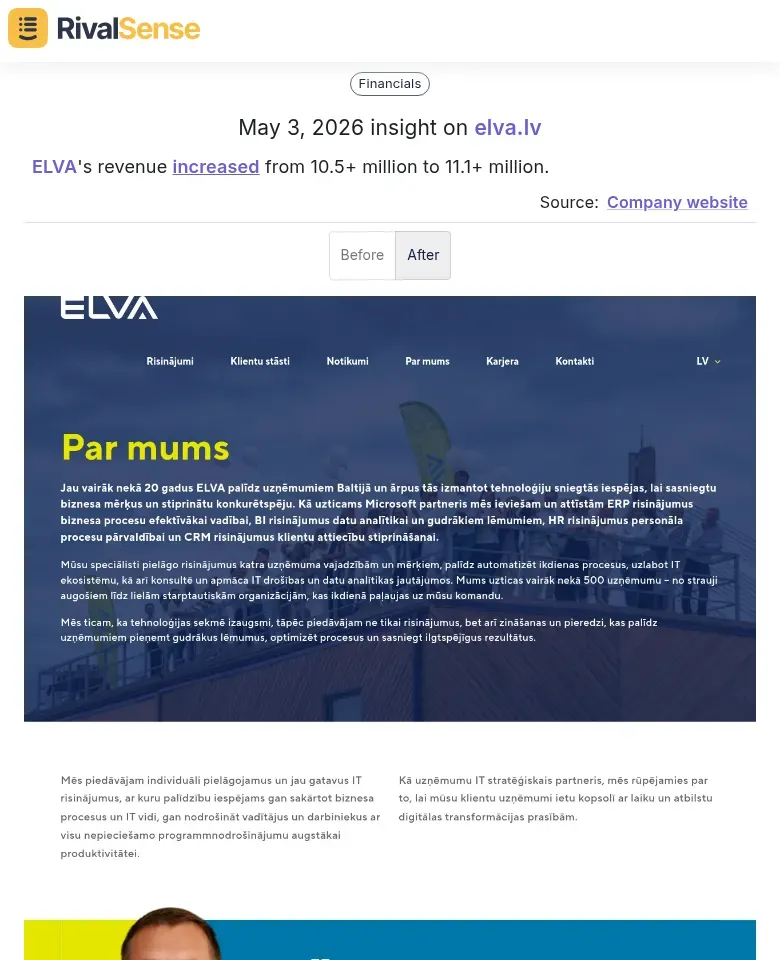
Infer revenue milestones. For example, a competitor may publicly display revenue figures on their website. RivalSense detected that ELVA's revenue increased from 10.5+ million to 11.1+ million—a clear sign of growth that could inform your positioning or partnership moves.
Practical checklist:
- [ ] Set up weekly screenshots of pricing pages.
- [ ] Archive email promotions and landing pages.
- [ ] Note changes in minimum order values or contract lengths.
- [ ] Correlate pricing changes with public funding announcements or hiring sprees.
By systematically tracking these signals, you can gauge a competitor's growth stage, revenue pressure, and strategic priorities—without needing access to their financials.
Uncovering Content and Programming Partnerships via Schedule Updates
Schedule changes on media brands’ websites can reveal content and programming partnerships before official announcements. When a new show time slot appears or a program is replaced, it often signals a licensing agreement, talent deal, or strategic alliance. This type of insight is valuable because it gives you early visibility into content investments that could shift audience attention or create new revenue streams for your competitor.
How to spot these partnerships:
-
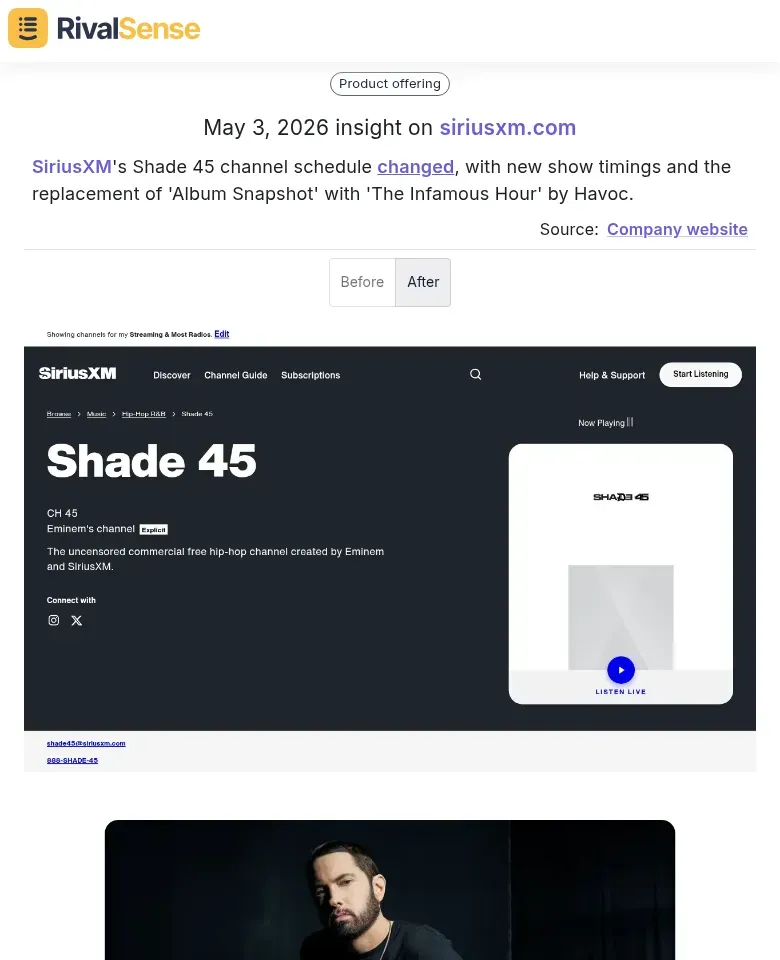
Track program lineups weekly. Use a spreadsheet to log show names, times, and hosts for key competitors. Any unexplained change—like the one RivalSense spotted: SiriusXM's Shade 45 channel schedule changed, with new show timings and the replacement of 'Album Snapshot' with 'The Infamous Hour' by Havoc—warrants investigation.
-
Look for pattern shifts. If a competitor suddenly adds multiple new programs from the same producer or network, it likely indicates a bulk content deal.
-
Cross-reference with press releases or social media. A schedule change alone isn’t proof; confirm by checking the partner’s website or LinkedIn for mentions of the collaboration.
-
Set up alerts for specific keywords. Use tools like Google Alerts or RivalSense to monitor terms like “new show,” “time slot change,” or “partnering with” on competitor sites.
Pro tip: Pay attention to time slots that were previously empty or filled with reruns. Filling those slots with original content often points to a new exclusive partnership.
By systematically monitoring schedule updates, you can uncover content and programming deals that give you early insight into competitors’ strategic moves.
Identifying Brand Collaborations from Promotional Campaigns
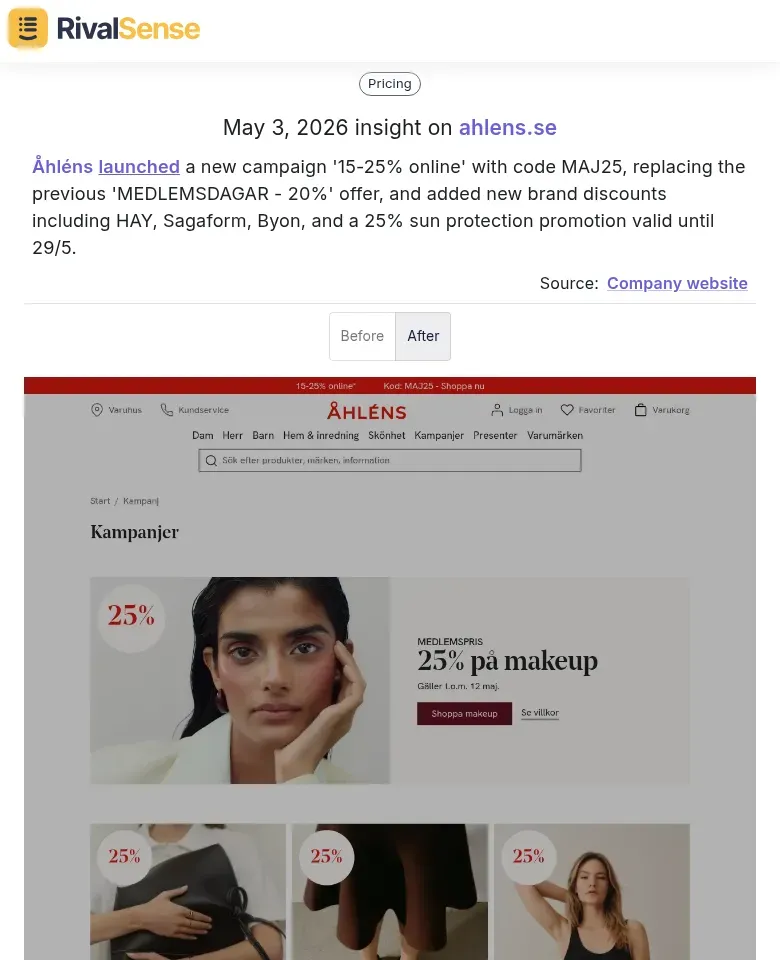
To spot brand collaborations from promotional campaigns, start by monitoring homepage banners and category pages for multi-brand campaigns. This type of insight is valuable because it reveals co-marketing or distribution partnerships that can expand your competitor's reach and customer base, helping you anticipate market shifts. For example, RivalSense detected that Åhléns launched a new campaign '15-25% online' with code MAJ25, replacing the previous 'MEDLEMSDAGAR - 20%' offer, and added new brand discounts including HAY, Sagaform, Byon, and a 25% sun protection promotion valid until 29/5—a clear signal of multi-brand collaboration.
Practical Steps:
- Set up alerts for new banners on competitor sites using tools like Visualping or Distill.
- Track campaign pages weekly; note any new brand logos or product bundles.
- Check promo code patterns—if a code appears across multiple brands, it's a collaboration clue.
- Analyze landing pages for co-branded content or shared value propositions.
Checklist:
- [ ] New banner featuring ≥2 brands?
- [ ] Limited-time offer with shared promo code?
- [ ] Category page listing new vendor brands?
- [ ] Co-branded social posts or email campaigns?
Pro Tip: Use RivalSense to automatically detect homepage changes and flag new brand mentions, saving hours of manual checking.
Tools and Techniques for Systematic Website Change Monitoring
To systematically monitor competitor website changes, start by using a change detection tool like RivalSense to automate the process. Manually checking pages is inefficient; automation lets you track multiple competitors at scale.
Focus on high-signal areas where partnerships are most visible:
- Pricing pages: New partner tiers or bundled offers often appear here.
- Schedule pages: Look for joint webinars or co-branded events.
- Campaign banners: Promotional banners may announce co-marketing initiatives.
- Partner logos: Footer or “Our Partners” sections are goldmines for new alliances.
Set up keyword alerts to catch changes instantly. Configure alerts for terms like:
- “new,” “launch,” “partner,” “announce,” “collaboration”
- Discount codes (e.g., “PARTNER20”) or co-branded phrases
Practical steps:
- List your top 5 competitors and identify their high-signal URLs.
- Add each URL to RivalSense with a daily check frequency.
- Create keyword alerts for the terms above.
- Review detected changes weekly; flag any that mention new partners.
Pro tip: Use negative keywords (e.g., “-job,” “-careers”) to filter out hiring updates. This keeps your alerts focused on partnership signals.
Conclusion: Turning Website Changes into Strategic Action
Regularly monitoring competitor websites isn't just about keeping tabs—it's a strategic practice that yields a steady stream of actionable intelligence. By systematically tracking changes in partner logos, testimonials, integration pages, and press mentions, you can detect new partnerships early. To ensure accuracy, always cross-reference website findings with other sources: check the partner's social media, official press releases, and industry news. This validation step helps you distinguish genuine alliances from mere marketing tests.
Once validated, act proactively. If a competitor partners with a complementary tool, consider reaching out to similar providers before they're locked in. If they announce a pricing change alongside a new partnership, reassess your own pricing strategy. Use insights to refine your messaging—highlight your unique integrations or undercut their bundled offers. Create a simple checklist: (1) Scan competitor sites weekly, (2) Log any new partner logos or mentions, (3) Verify via external sources, (4) Map implications for your positioning, (5) Execute a tactical response within 48 hours. Turning website changes into strategic moves keeps you ahead, not just reactive.
Ready to put these tactics into action? Try RivalSense for free here to automatically track competitor website changes across pricing, partnerships, campaigns, and more. Get your first competitor report today and start uncovering the hidden signals that give you a strategic edge.
📚 Read more
👉 Key Account KPIs in AI: Optimize NVIDIA-Style Growth
👉 Pricing Trends: Key Account Tracking Insights for Competitive Edge
👉 Competitor Analysis: How to Leverage Event Participation Insights (VMware Explore 2026 Case Study)
👉 Key Success Factors for Building a Best Practice Key Account Management Organization
👉 Key Account Management FAQs: Advanced Tactics for SEO & Content Marketing