
Key Account Dashboard Cheat Sheet for Compliance Automation
Why Your Key Account Dashboard Needs a Compliance Automation Lens
Compliance automation has evolved from a back-office checkbox exercise into a strategic trust signal for key accounts. In today’s B2B landscape, enterprise buyers demand real-time proof of controls—not just annual SOC 2 reports. Your key account dashboard must evolve to capture this shift.
Why it matters: Competitors are already repositioning compliance as a system of record for trust. They embed compliance posture into their dashboards, turning audits into competitive wins. If your dashboard still treats compliance as a static PDF, you’re falling behind.
Practical steps to upgrade your dashboard:
- ✅ Add a compliance health score – A simple green/yellow/red indicator summarizing control status (e.g., evidence freshness, policy violations).
- ✅ Surface real-time evidence – Link to automated evidence collection (e.g., AWS Config rules, access logs) so key accounts can self-serve proof.
- ✅ Track compliance milestones – Show upcoming audits, policy changes, or control gaps that affect your customer’s risk posture.
- ✅ Benchmark against peers – Anonymized comparison of your compliance posture vs. industry averages builds credibility.
Quick tip: Start with the top three frameworks your key accounts care about (e.g., SOC 2, ISO 27001, HIPAA). Map each control to a dashboard widget that auto-updates from your compliance automation tool. This transforms compliance from a periodic fire drill into a continuous trust signal.
Section 1: From Compliance to Trust Infrastructure – The Strategic Pivot
Compliance automation leaders are no longer just selling checkboxes—they’re positioning themselves as “systems of record for trust.” This strategic pivot means your key account dashboards must evolve beyond audit logs and policy acknowledgments. Add trust metrics that matter: continuous audit readiness scores, real-time evidence availability, and third-party risk posture.
📊 Real insight from RivalSense: Drata has evolved from a compliance company into the system of record for trust, helping organizations prove continuously and at scale that they operate as they claim.
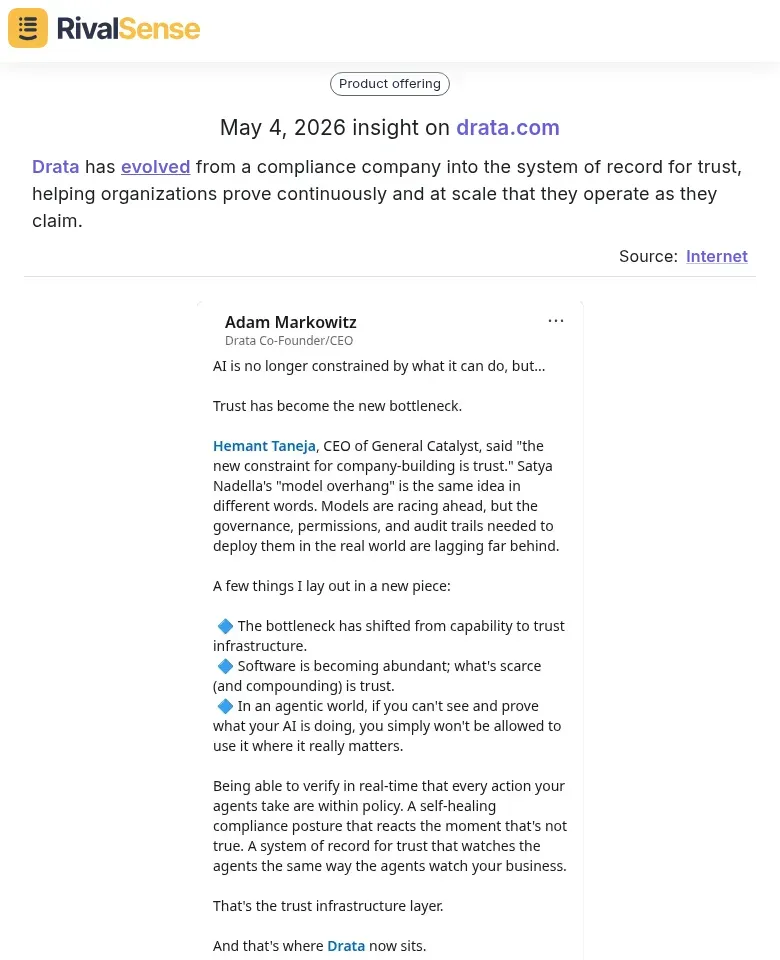
Why this type of insight matters: When a competitor reframes its entire value proposition around “trust,” it signals a shift in how enterprise buyers will evaluate vendors. Your dashboard should mirror this trend by tracking competitor messaging evolution—not just feature lists. Use it to benchmark your own trust narrative and adjust your account playbooks.
Practical steps to build a trust-centric dashboard:
- Track real-time readiness – Show a live percentage of controls passing automated tests (e.g., SOC 2, ISO 27001).
- Monitor evidence freshness – Flag stale artifacts (e.g., penetration tests older than 90 days).
- Include trust signals – Display certifications, customer references, and uptime SLAs.
How sales and CS teams can leverage trust data:
- Shorten sales cycles – Share a “trust snapshot” during demos to preempt security questionnaires.
- Reduce churn – Proactively alert customers when their compliance posture drifts, offering remediation before renewal.
Tip: Use a color-coded trust score (green/yellow/red) that updates daily. This turns compliance from a cost center into a competitive advantage.
Section 2: Tapping into Ecosystem Signals – Panels, Partnerships, and Positioning
To stay ahead in compliance automation, you must look beyond direct competitors and monitor ecosystem signals. Track panel participation: When a competitor appears on AI-focused panels, it signals intent to embed compliance into emerging tech stacks. Monitor event presence: Note which adjacent markets (e.g., AI, browser automation) competitors target by tracking their booth topics and sponsored tracks. Build a partner ecosystem tracker: Create a dashboard column for each competitor’s announced partnerships and co-marketing campaigns.
📊 Real insight from RivalSense: Drata is participating in the Camp AI panel on May 7, 2026, alongside Browserbase, Fireworks AI, Mastra, and Auth0.
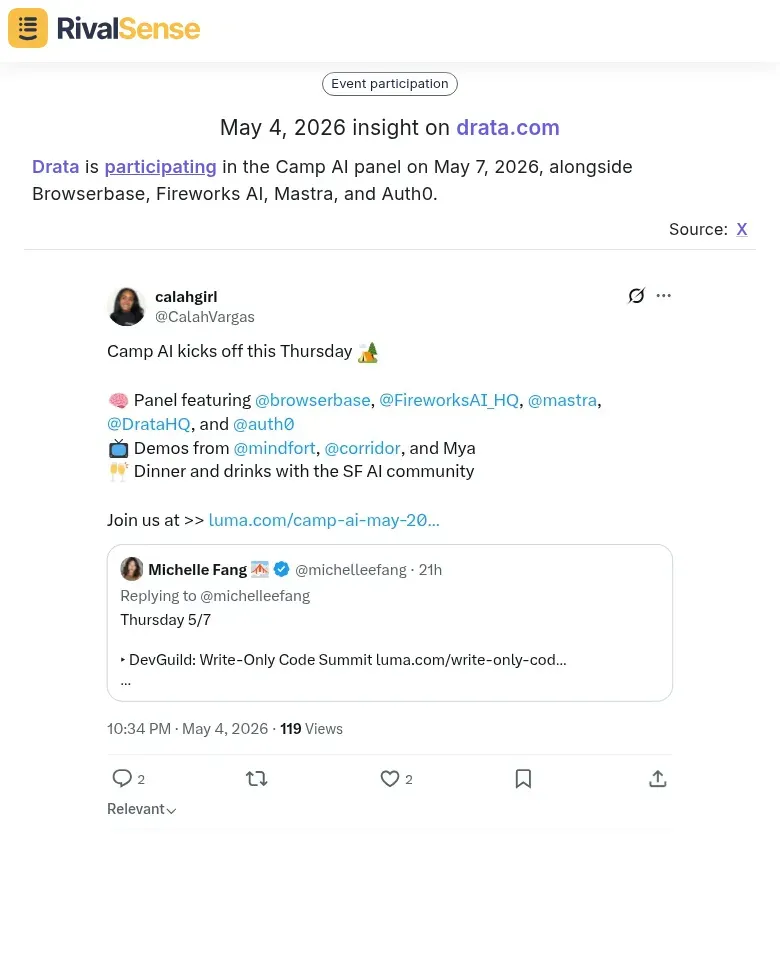
Why this type of insight matters: Panel participation reveals which tech stacks and buyer personas a competitor is actively courting. By knowing they’re co-located with AI infrastructure players, you can anticipate bundled compliance solutions or joint go-to-market plays. Add this to your dashboard as a “signal” column to correlate with account vulnerability.
Actionable checklist:
- Set up Google Alerts for competitor names + “panel” or “keynote”.
- Review event agendas monthly.
- Update a shared spreadsheet with partner announcements and co-marketing webinars.
- Flag any partnership that overlaps with your target verticals.
This early-warning system helps you anticipate competitive moves and adjust your positioning before the market shifts.
Section 3: Leadership Moves as Competitive Intelligence
Leadership changes are early signals of strategic pivots. When a competitor hires a CRO with a strong GTM background—say, from a subscription billing company—it’s a clear push for revenue growth and enterprise sales. Such moves often precede shifts in pricing, packaging, or target segments.
📊 Real insight from RivalSense: Brian Clark joined Drata as Chief Revenue Officer in the United States, previously serving as President, GTM at Chargebee.
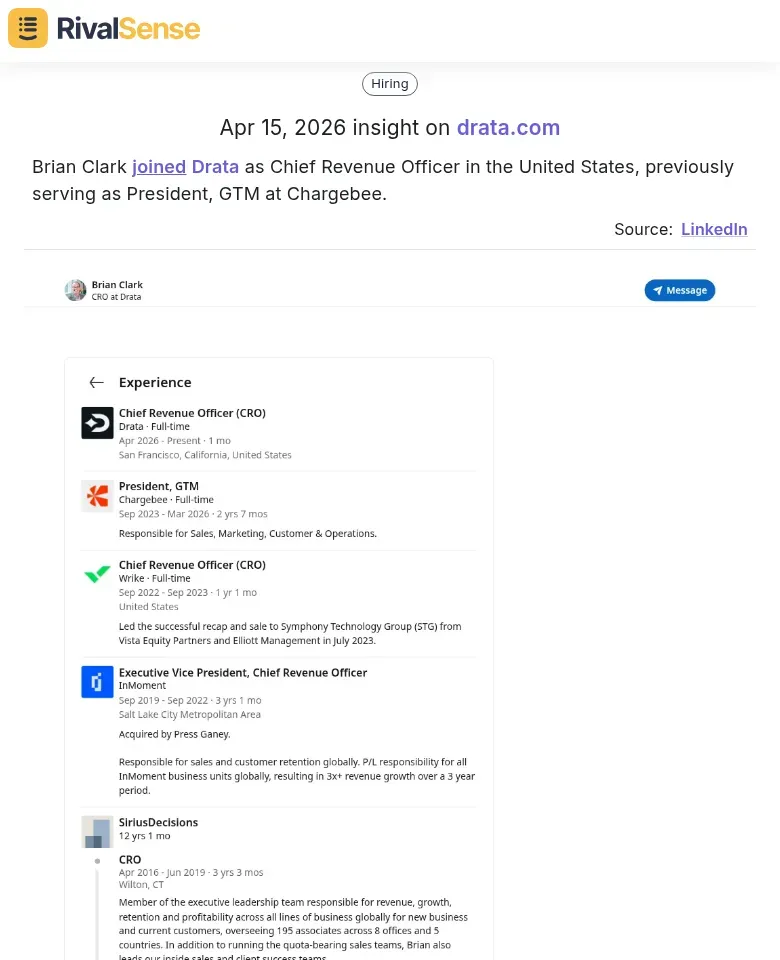
Why this type of insight matters: A CRO with a subscription billing background signals imminent changes in Drata’s pricing model (e.g., usage-based, tiered) and enterprise sales approach. For your key accounts, this could mean a new competitor bid, a price war, or a bundled offering. Tracking leadership hires lets you proactively adjust account strategies before the market reacts.
How to leverage this in your dashboard:
- Flag executive hires as soon as they’re announced (use LinkedIn alerts, press releases).
- Map the hire’s past roles to predict future moves. For example, a CRO from a usage-based pricing company may signal a shift to consumption models.
- Adjust account strategies proactively: if a competitor targets your enterprise accounts, strengthen your relationships or offer bundled pricing.
Quick checklist:
- Set up alerts for C-suite changes at top 5 competitors.
- Analyze the new hire’s previous company’s go-to-market playbook.
- Update your account plans within 48 hours of the announcement.
Pro tip: Track hiring trends over time. A pattern of sales hires from a specific industry (e.g., fintech) may indicate a new vertical focus. Stay ahead by adjusting your competitive positioning before the market feels the shift.
Section 4: Building a Future-Proof Key Account Dashboard
To build a future-proof key account dashboard, start by integrating compliance status, trust center activity, and audit history alongside traditional account health metrics like usage and NPS. This unified view reveals risk and opportunity in real time. Next, automate alerts for competitor events—such as leadership changes, product launches, or funding rounds—that impact your accounts. Use tools like RivalSense to feed these signals directly into your dashboard. Finally, turn insights into action: when a competitor announces a security breach, proactively share your compliance benchmark report with the account. This positions you as a trusted advisor.
Quick checklist:
- Map compliance milestones to account stages.
- Set up webhook-based alerts for competitor news.
- Create a library of value-add assets (e.g., whitepapers, benchmarks) to deploy on trigger events.
- Review dashboard weekly with the account team to adjust strategy.
By embedding competitive intelligence into your daily workflow, you strengthen relationships and future-proof your accounts against disruption.
Conclusion: Turning Competitive Signals into Account Growth
The best key account dashboards don’t just track your own data—they surface competitor intelligence in real time. By monitoring how competitors evolve their messaging, partnerships, and leadership, you can anticipate and counter threats before they impact your relationships.
Practical Steps to Get Started:
- Add a trust metric – Track competitor NPS, review scores, or case study velocity to gauge account satisfaction shifts.
- Set up a competitor event feed – Monitor leadership changes, funding announcements, and partnership news via tools like RivalSense or Crunchbase alerts.
- Create a signal-to-action map – For each signal (e.g., a competitor hires a new VP of Sales), define a response (e.g., schedule a check-in with your account champion).
- Review weekly – Dedicate 15 minutes to scan the feed and update your account plans.
Checklist for This Quarter:
- [ ] Identify one trust metric (e.g., NPS trend, renewal rate).
- [ ] Enable one competitor event feed (e.g., Google Alerts, RivalSense).
- [ ] Define 3 signal-response pairs for your top key accounts.
Start small: add one trust metric and one competitor event feed to your dashboard this quarter. That single step will transform your account reviews from reactive reporting to proactive growth planning.
Ready to streamline competitor tracking? Try RivalSense for free at https://rivalsense.co/ and get your first competitor report today. No strings attached—just actionable insights to outpace your competition.
📚 Read more
👉 Pricing Cheat Sheet: Key Account Management Insights
👉 The Key Account Management Playbook: A Leader's Guide to Empowering SAMs
👉 How to Control Access to Competitor Intelligence in Your B2B Company
👉 How NVIDIA's Nemotron Launch Spurred a Rival's AI Agent Pivot