
Master Competitor Target Audience Analysis: Optimize Your Repair Business Strategy
Competitor target audience analysis is the systematic process of identifying, segmenting, and understanding the customer groups your competitors serve. For repair businesses, this means mapping who your rivals prioritize—be it homeowners needing emergency plumbing, fleet managers requiring diesel engine overhauls, or clinics seeking medical device servicing. By dissecting their audience, you uncover underserved niches: perhaps competitors ignore same-day service for small businesses or avoid complex industrial repairs. Start by auditing competitor websites, reviews, and case studies to list their stated and implied customer profiles. Then cross-reference with your own capabilities to spot gaps. For example, if a competitor focuses on large enterprises, you might target SMBs with faster turnaround. Use tools like RivalSense to track shifts in their audience targeting—new landing pages for different verticals signal strategic moves. Data-driven insights replace guesswork: instead of assuming demand, you validate where your repair expertise aligns with unmet needs. This yields a competitive advantage—optimized offerings that capture overlooked segments, boost market share, and increase customer lifetime value. Practical tip: create a 2x2 matrix of competitor audience segments vs. your service strengths to visually pinpoint where to double down or differentiate.
Identifying Competitor Customer Segments
To uncover competitor customer segments, start by mining social media for followers and engagement patterns—tools like Facebook Audience Insights reveal demographic overlaps. Scrape review sites (e.g., G2, Capterra) and extract firmographic clues from reviewer profiles (company size, industry). Analyze competitor case studies for explicit segment descriptions (e.g., "mid-market SaaS firms"). Use SimilarWeb to estimate traffic demographics and audience overlap tools (e.g., SparkToro, Audiense) to identify shared audiences across competitor domains. Categorize segments by demographics (age, role), firmographics (revenue, employee count), and behavioral attributes (purchase frequency, feature usage). Tip: Create a matrix mapping each competitor to identified segments, scoring confidence levels.
Competitor moves beyond content can reveal audience focus. For instance, hiring events directly signal which service capacities and geographies a competitor is expanding. Tracking them turns operational intelligence into audience insight.
RivalSense Insight: Mayo Clinic is hosting a Night Shift RN Hiring Event on June 24, 2026, in Jacksonville, Florida, targeting experienced registered nurses.
Why this matters: A repair business can watch for a competitor hiring field technicians in a new city—that reveals an audience expansion before it appears in marketing, giving you time to preemptively strengthen local loyalty or enter the same area with a differentiated offer.
Checklist: □ Social media profile analysis □ Review site extraction □ Case study keyword tagging □ Audience overlap verification □ Segment categorization matrix □ Hiring event tracking for location-based signals.
Analyzing Pain Points and Needs from Competitor Audiences
To optimize repair services, start by mining competitor customer feedback. Scour review sites (e.g., Google, Trustpilot), forums (Reddit, Quora), and social media for recurring complaints or frustrations. Use a simple spreadsheet to tag pain points by theme—e.g., slow turnaround, poor communication, hidden fees. For each theme, map it to a specific service improvement: if customers hate vague updates, implement real-time tracking; if price surprises are common, offer upfront quotes with itemized breakdowns.
Next, identify gaps competitors ignore. Look for requests phrased as wishes ("I wish they...") or comparisons ("Unlike X, why no..."). These are your unique selling points. For example, if all competitors require drop-offs but customers crave pickup/delivery, that's an unmet need.
Practical checklist:
- [ ] Collect 50+ feedback points from 3+ competitor sources.
- [ ] Categorize into top 5 pain points.
- [ ] For each, define one service tweak.
- [ ] List 3 unmet needs and test with a pilot offer.
Competitor conference appearances can also signal emerging needs. A company’s presentation topic often previews the technologies or service models it will push next, giving you a head start to counter or adopt a complementary approach.
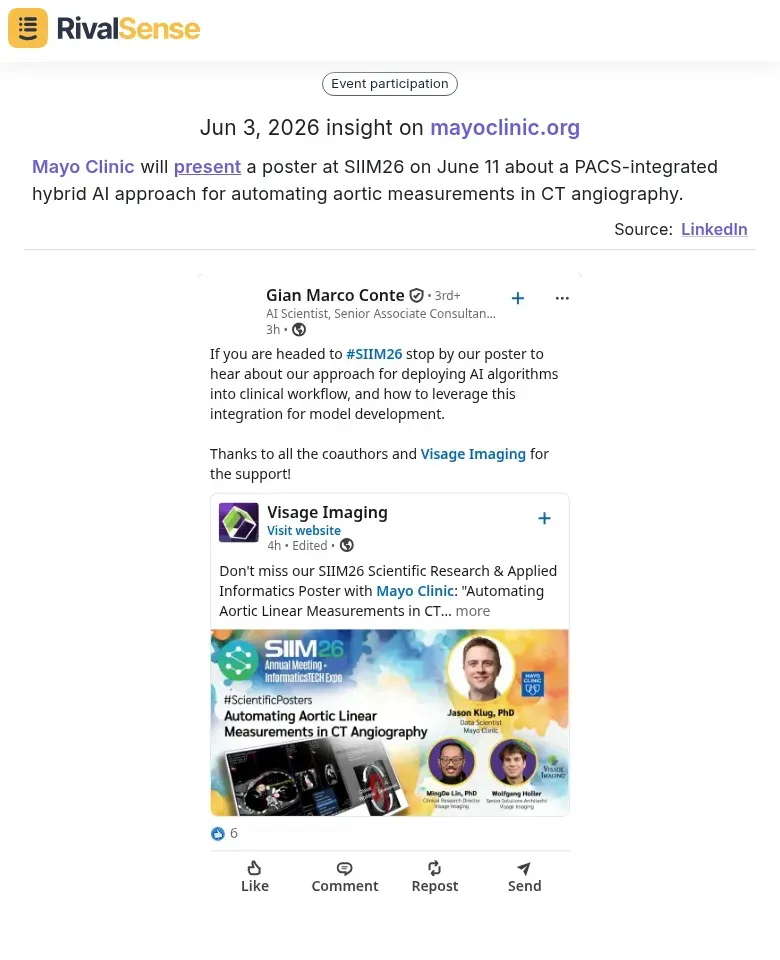
RivalSense Insight: Mayo Clinic will present a poster at SIIM26 on June 11 about a PACS-integrated hybrid AI approach for automating aortic measurements in CT angiography.
Why this matters: For a medical device repair firm, this indicates a competitor is betting on AI‑assisted diagnostics. You can proactively emphasize your own technician expertise, or develop quick‑start AI compatibility services for imaging devices, aligning with the same audience need before competitor adoption peaks.
By systematically turning competitor audience insights into actionable changes, you not only fix current flaws but also leap ahead with solutions no one else provides.
Tailoring Repair Offerings Based on Audience Insights
Tailoring Repair Offerings Based on Audience Insights
Customizing Pricing & Packages
Segment competitor audiences by factors like device type, urgency, and budget. Create tiered packages:
- Basic: Low-cost, slow turnaround (attracts price-sensitive customers)
- Standard: Mid-range, 24-hour service (core audience)
- Premium: Express repair, warranty, pickup/delivery (business clients)
Targeted Messaging
Map competitor customer pain points: slow service, hidden fees, poor communication. Craft ad copy addressing these:
- “Tired of waiting days? Get same-day repair – we compete on speed.”
- “Transparent pricing, no surprises. See our competitor comparison chart.”
Use lookalike audiences on social media to reach users similar to competitor buyers.
Process Optimization
Survey former competitor customers: What frustrated them? Common complaints: unclear status updates, no loaner devices, limited payment options. Implement:
- Real-time SMS/email updates at each repair stage
- Loaner phone program for high-value customers
- Multiple payment methods (crypto, BNPL)
When competitors update their digital presence, they often reveal new audience priorities. A new guide or a privacy checkbox isn’t just a feature—it signals which customer jobs they’re solving and what compliance standards they’re targeting.
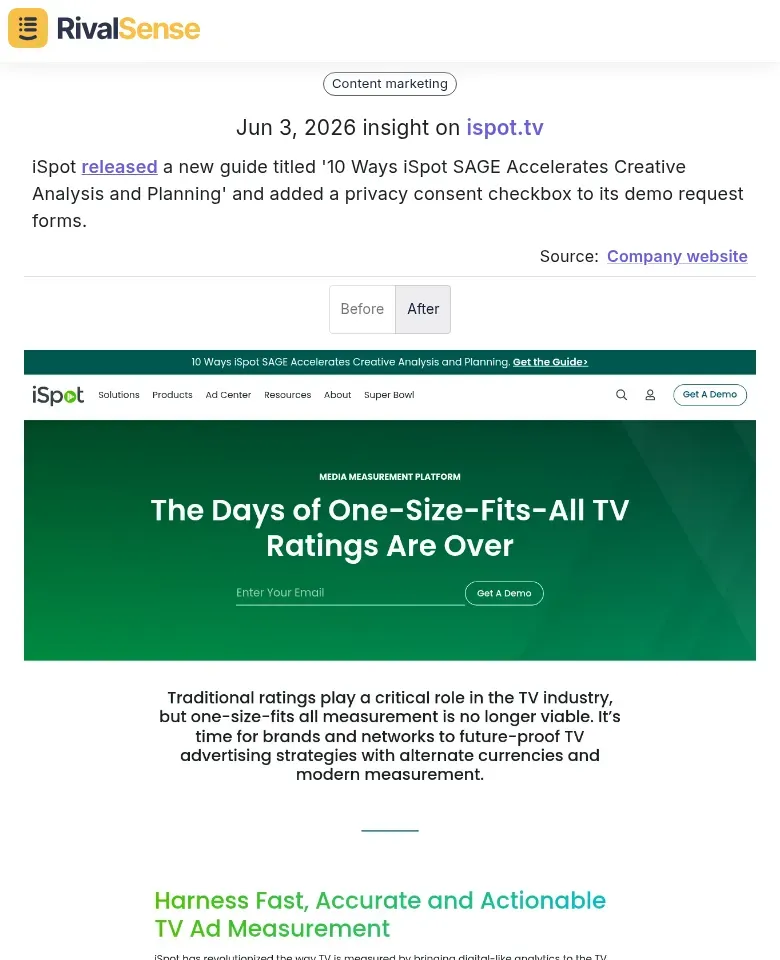
RivalSense Insight: iSpot released a new guide titled '10 Ways iSpot SAGE Accelerates Creative Analysis and Planning' and added a privacy consent checkbox to its demo request forms.
Why this matters: For a repair business serving regulated clients (e.g., healthcare, finance), a competitor adding privacy checkboxes hints at a push into compliance‑heavy verticals. By matching or exceeding that privacy posture and publishing your own expert guide on secure device handling, you can attract the same audience with a stronger trust signal.
Checklist for Implementation
- [ ] Identify top 3 competitor audience segments via social listening
- [ ] Create pricing tiers with clear differentiators
- [ ] Develop 3 ad variations targeting each segment’s pain point
- [ ] Set up automated status notifications
- [ ] Pilot loaner program with 50 frequent customers
Pro tip: Use competitor review sites to extract verbatim quotes – integrate them into landing page testimonials for authenticity.
Measuring Success and Iterating on Your Strategy
To gauge the effectiveness of your competitor target audience analysis, start by tracking KPIs that mirror your strategic goals. For customer acquisition, monitor cost-per-lead (CPL) and conversion rates across segments. For satisfaction, use Net Promoter Score (NPS) and post-repair survey responses. Retention is best measured by repeat service rate and customer lifetime value (CLV).
Implement A/B testing on your repair offers and messaging. For example, test two subject lines for an email campaign targeting price-sensitive segments vs. quality-focused segments. Use tools like Google Optimize to run experiments and analyze results by segment. Track which offers lead to higher booking rates or longer customer loyalty.
Continuously monitor competitor audience shifts. Set up alerts for changes in their website messaging, new customer personas, or adjusted service tiers. Use RivalSense to track these shifts in real-time. Revisit your audience profiles quarterly and update your targeting strategy accordingly. A simple checklist: (1) Review competitor sites monthly, (2) Run A/B tests every two weeks, (3) Analyze KPIs weekly, (4) Adjust strategy quarterly. Stay adaptive to maintain a competitive edge.
Conclusion: Turning Insights into Action
The journey from competitor audience analysis to optimized repair strategy follows a clear cycle: Analyze competitor audience segments, Identify gaps and opportunities, Tailor your messaging and offerings, and Measure results to refine continuously. This roadmap ensures every repair initiative is grounded in real market insight.
Your actionable next step: Conduct a Competitor Audience Audit.
- Select 3–5 direct competitors.
- Map their key audience segments using tools like social listening or review analysis.
- Identify one underserved segment per competitor.
- Develop a tailored value proposition for that segment.
- Test with a small campaign and track engagement metrics.
Use this checklist for weekly maintenance: (☐) Review competitor content for audience shifts; (☐) Check support forums for unmet needs; (☐) Update audience profiles in your CRM.
Final thought: An audience-centric repair strategy isn't a one-time fix—it's a continuous discipline. By consistently turning competitor audience insights into action, you build lasting differentiation and resilience against market changes. Start your audit today and make audience intelligence your competitive edge.
To monitor competitor hiring events, conference presentations, website updates, and more—all delivered in a weekly report—try RivalSense for free. Get your first competitor monitoring report today and start uncovering the audience signals that matter most: https://rivalsense.co/
📚 Read more
👉 CFO Appointment Signals Funding Round: How to Pounce Before Your Rival
👉 LinkedIn Competitor Insights Cheat Sheet: Protect Your Key Accounts from Silent Poaching
👉 5 Key Account Management Mistakes IoT Firms Must Avoid
👉 How to Map Your Competitors’ Product Moves Before They Happen: Real-World Strategies