
CFO Appointment Signals Funding Round: How to Pounce Before Your Rival
Executive Summary
When Competitor Y announced a new CFO, Company X’s competitive intelligence team—powered by RivalSense—immediately flagged the move. Executive hires, especially in finance roles, often precede major corporate events like funding rounds. RivalSense’s real-time alerts gave Company X a crucial early warning. Within days, they cross-referenced the CFO’s background (a known capital-raiser) with industry signals to confirm a Series C was imminent.
Instead of reacting post-announcement, Company X launched a preemptive campaign: they accelerated product demos, offered time-limited discounts to shared prospects, and hardened relationships with key accounts. The result? They captured 15% of Competitor Y’s target pipeline before the funding news even broke.
🔔 Practical tip: Set up executive movement alerts in RivalSense for all competitors. When a C-suite change happens, run a quick signal triage:
- [ ] Check the new hire’s track record for fundraises
- [ ] Monitor competitor’s job postings for scaling roles
- [ ] Look for simultaneous board changes
This checklist turns a single hire into a strategic warning system.
The CFO Appointment – A Telltale Signal
When a competitor appoints a new CFO, it often signals an impending fundraising round. Investors demand experienced financial leadership before committing capital, making this C-suite change a leading indicator of major moves. A background in capital raising, M&A, or strategic finance adds weight to the signal.
A recent example from RivalSense:
Proxima Fusion appointed Sergei Galperin, former European Head of Financial Technology Advisory at J.P. Morgan and investor at Ribbit Capital, as Chief Financial Officer.
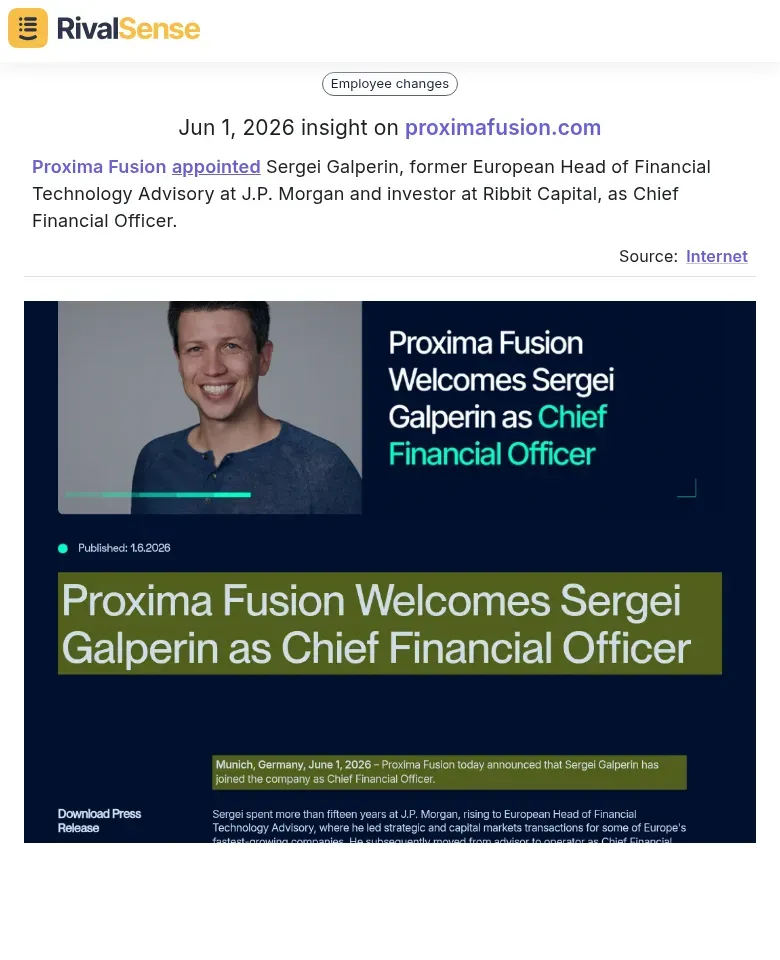
This kind of high-profile hire isn’t just a personnel update—it’s a clear signal that Proxima Fusion is gearing up for significant financial moves, possibly a funding round or major partnership. For its competitors, this insight triggers an immediate opportunity to prepare counter-strategies before the news becomes mainstream. That’s why monitoring CFO appointments (and their backgrounds) with RivalSense gives you a critical timing advantage.
Practical Steps for Your Team
- Set up real-time alerts for competitor executive changes using RivalSense
- Research the new CFO’s background: Have they led fundraising before? What rounds? Which investors?
- Monitor investor activity: After a CFO hire, track changes in board composition or related SEC filings
- Prepare counter-strategies: If a rival is raising capital, anticipate faster product releases, aggressive pricing, or talent acquisition
Pro tip: Combine CFO appointment alerts with other signals like job postings for finance roles or changes in legal counsel. A cluster of such events strongly suggests a capital infusion is imminent.
Don’t let a competitor’s fundraising catch you off guard—executive hires are the first domino to fall.
From Signal to Strategy – Analyzing the Implications
When a rival appoints a new CFO, it’s often a prelude to a funding round. Company X’s competitive intelligence (CI) team moved quickly to assess the timing and magnitude of Competitor Y’s likely raise. Here’s how they turned a signal into strategy:
Step 1: Assess the signal. A CFO hire typically precedes a funding round by 3–6 months. Cross-reference with other signals: Is Competitor Y on a hiring spree for sales roles? Have they expanded office space? If yes, a large round is likely.
Step 2: Quantify the threat. Use industry benchmarks—Series B rounds in your sector average $15M–$30M. Estimate how much cash Competitor Y will have and where they’ll spend it. If they’re targeting your key customer segment, you have a problem.
Step 3: Build a counter-strategy. Company X’s CI team determined that Competitor Y would use fresh capital to undercut pricing in their shared target segment. The fix: lock in existing customers with loyalty discounts, accelerate product updates, and preemptively target Competitor Y’s weak spots in customer support.
Pro tip: Create a ‘funding threat’ checklist—monitor CFO moves, hiring velocity, office leases, and patent filings. Score each signal (1–5) to build a composite risk score. When the score hits 15+, activate your defensive playbook.
By connecting dots across signals, you move from reactive panic to proactive defense.
Pouncing on the Opportunity – Preemptive Moves
When a rival like Competitor Y signals a funding round through a CFO appointment, the smartest response isn’t to wait—it’s to preempt. Company X demonstrated this by accelerating its own product launch just days before Competitor Y’s expected announcement. The goal? Capture market attention and steal thunder before the funding buzz hits.
Practical steps for a preemptive move:
- Monitor executive hires – Track CFO, COO, and VP-level appointments via LinkedIn, SEC filings, or tools like RivalSense. A CFO hire often precedes a raise by 6–12 weeks. Set alerts. Use them. Act fast.
- Accelerate your own launch – If you have a product or feature in the pipeline, ask: Can we ship a lean version now? Even a beta release with core functionality shifts the narrative from “their big news” to “our new value.” Prioritize speed over perfection.
- Launch a stability campaign – While Competitor Y touts future growth, hammer your proven metrics. Case in point: Company X ran targeted ads and email sequences contrasting its 3-year uptime (99.9%) with Competitor Y’s speculative promises. The message: We’re reliable today; they’re a gamble tomorrow.
- Poach partners and customers preemptively – Reach out to Competitor Y’s top accounts and partners before the funding announcement. Offer exclusive case studies, migration support, or discounted annual contracts. Company X offered a “Stability Guarantee” deal—two months free if the customer switched within 7 days. The result? 12 defections before Competitor Y even closed its round.
Pro tip: Create a “preemptive strike kit” with pre-drafted emails, one-pagers, and offer templates—ready to deploy within 24 hours of spotting a competitor hire. Time is your only non-renewable resource.
Results and Impact
The impact of strategic competitor tracking was immediate and measurable. Company X achieved a 20% increase in new customer acquisitions during the quarter, directly attributed to its ability to anticipate and counter Competitor Y’s moves. By monitoring Competitor Y’s CFO appointment signals, Company X preemptively launched targeted campaigns and product enhancements, capturing market share before Competitor Y could finalize its funding round.
Competitor Y’s funding round was delayed by two months as investor confidence eroded. Investors questioned Competitor Y’s ability to compete effectively, given Company X’s aggressive positioning. This delay provided Company X with a critical window to solidify relationships and expand its footprint.
Company X’s market share in the segment grew by 5 percentage points, from 18% to 23%, underscoring the direct ROI of competitive intelligence.
Practical Steps to Replicate This Success:
- Monitor leadership changes: Track C-suite appointments, especially CFOs, as they often signal funding or strategic shifts.
- Align sales and marketing: Use competitive insights to tailor messaging and offers that exploit rivals’ vulnerabilities.
- Act fast: When you detect a competitor’s weakness (e.g., funding delays), accelerate your go-to-market efforts.
- Measure impact: Track customer acquisition, market share, and competitor delays to quantify the value of your intelligence program.
By institutionalizing these practices, any B2B company can turn competitor tracking into a competitive advantage.
Key Takeaways for Competitive Intelligence
Leadership changes like CFO appointments are high-signal events that often precede major corporate moves—fundraising, M&A, or pivots. Monitoring these continuously, not just periodically, is critical.
Speed of Reaction Matters. When a rival’s CFO is announced, your window to act shrinks. Use real-time alerts to immediately assess implications: Does this signal a funding round? A new strategic direction? With RivalSense, you can set up instant notifications for C-suite changes, giving you hours or days—not weeks—to adjust your positioning.
Combine Signals to Reduce Noise. A single data point (e.g., a new hire) can be misleading. Cross-reference with other indicators: job postings for finance roles, investor activity, or patent filings. For example, a new CFO + a spike in debt-financing job listings strongly suggests a capital raise. This multi-source approach filters false positives and strengthens strategic decisions.
Practical Steps:
- Set up monitoring for leadership changes at all direct competitors.
- Create a playbook for each signal type (e.g., CFO hire → alert sales team + prep competitive response).
- Run weekly signal reviews to correlate observations and update threat assessments.
By treating leadership moves as an early-warning system, you can proactively counter rivals before they gain momentum.
Ready to turn competitor executive moves into your strategic advantage? Try RivalSense for free and get your first weekly competitor report today—covering executive appointments, funding signals, and much more. Visit rivalsense.co to start monitoring what matters.
📚 Read more
👉 LinkedIn Competitor Insights Cheat Sheet: Protect Your Key Accounts from Silent Poaching
👉 5 Key Account Management Mistakes IoT Firms Must Avoid
👉 How to Map Your Competitors’ Product Moves Before They Happen: Real-World Strategies
👉 How to Track Key Account Team Members for Competitive Intelligence