
Leverage Website Changes for Competitor SEO Wins
In the fast-paced world of SEO, staying ahead of competitors often means catching their moves before they pay off. Every change a competitor makes to their website—whether a new landing page, updated meta tags, or a restructured navigation—signals a shift in strategy. These updates are a goldmine for actionable insights: they reveal new keywords they’re targeting, content gaps they’re filling, and optimization tactics they’re testing. By proactively monitoring competitor website changes, you can identify emerging trends and opportunities before they become industry standards. For example, if a competitor adds a page targeting “AI-powered analytics,” that keyword may be gaining traction. Start by setting up change alerts using tools like Visualping or RivalSense. When you detect a change, immediately analyze the new content: extract the primary keyword, check on-page SEO elements (title tag, H1s, meta description), and note any new internal links. Then, audit your own site for similar opportunities—create a better, more comprehensive piece targeting the same keyword. This systematic approach turns competitor activity into a continuous source of SEO wins, keeping your strategy agile and data-driven.
Detecting Content Gaps and New Keyword Opportunities
To detect content gaps and new keyword opportunities, monitor competitor website changes systematically. When a competitor adds a new page or section—such as an FAQ page—it signals emerging customer questions and search demand. For example, if a competitor launches a 'Pricing FAQ' page, they are targeting long-tail keywords like 'how much does [product] cost' or 'is there a free trial'. This reveals a content gap you can fill with a more comprehensive guide.
Conversely, removed or replaced content highlights declining relevance. If a competitor deletes an old case study about a specific industry, that topic may no longer drive traffic. Check if the page was redirected or 404s; if redirected, the new topic might be a higher priority for them.
Actionable steps:
- 🔍 Use a change tracking tool (e.g., RivalSense, Visualping) to monitor competitor sitemaps weekly.
- 📂 Categorize changes: new pages (opportunity), removed pages (declining interest), updated pages (refined targeting).
- 🏷️ For each new page, extract the main keywords from the URL, title, and H1. Run them through a keyword research tool to assess search volume and difficulty.
- 📊 Prioritize topics where the competitor has weak content (thin pages, low backlinks) or where you can offer a unique angle.
- ✍️ Create content that answers the question more thoroughly—include examples, data, or expert quotes.
Pro tip: Set up alerts for specific competitor pages (e.g., /blog, /resources) to catch new content the day it publishes. Early detection gives you a first-mover advantage in search rankings.
Spotting Product or Service Evolution Through Site Updates
When a competitor updates their website, it often signals a shift in their product or service strategy. For instance, swapping out a health monitoring tool for a more advanced alternative might indicate a new feature or partnership. By tracking these changes, you can uncover fresh long-tail keywords and value propositions to target.
Real-world insight:
Clinique La Prairie replaced a sleep quality test and pulmonologist consultation with the Corsano Health Monitoring Solution in its Revitalisation Premium program, and added a detailed FAQ section about the program.
Why this matters: This product evolution insight reveals a new partnership (Corsano) and an upgraded offering. You can benchmark their new value proposition, target keywords around “Corsano health monitoring” or “revitalisation premium program,” and create comparison content (e.g., “Clinique La Prairie vs. [Your Competitor]”) to capture evaluation traffic.
Practical Steps:
- Set up alerts for specific pages (e.g., pricing, features) using tools like RivalSense or Visualping.
- Compare old vs. new content to spot replaced solutions, updated program descriptions, or new case studies.
- Extract keywords from the new messaging—these often reflect emerging search trends.
- Create comparison content (e.g., "X vs. Y") to capture traffic from users evaluating both options.
Pro Tip: Focus on pages where competitors highlight integrations or use cases—these changes often reveal partnership opportunities or feature gaps you can exploit.
Leveraging Regulatory and Compliance Shifts for SEO
Regulatory changes create immediate SEO opportunities. When competitors add resources on new regulations like DORA (Digital Operational Resilience Act), they signal rising search interest and compliance needs. Conversely, removing outdated compliance content (e.g., HIPAA updates) suggests a pivot to more current topics.
Real-world insight:
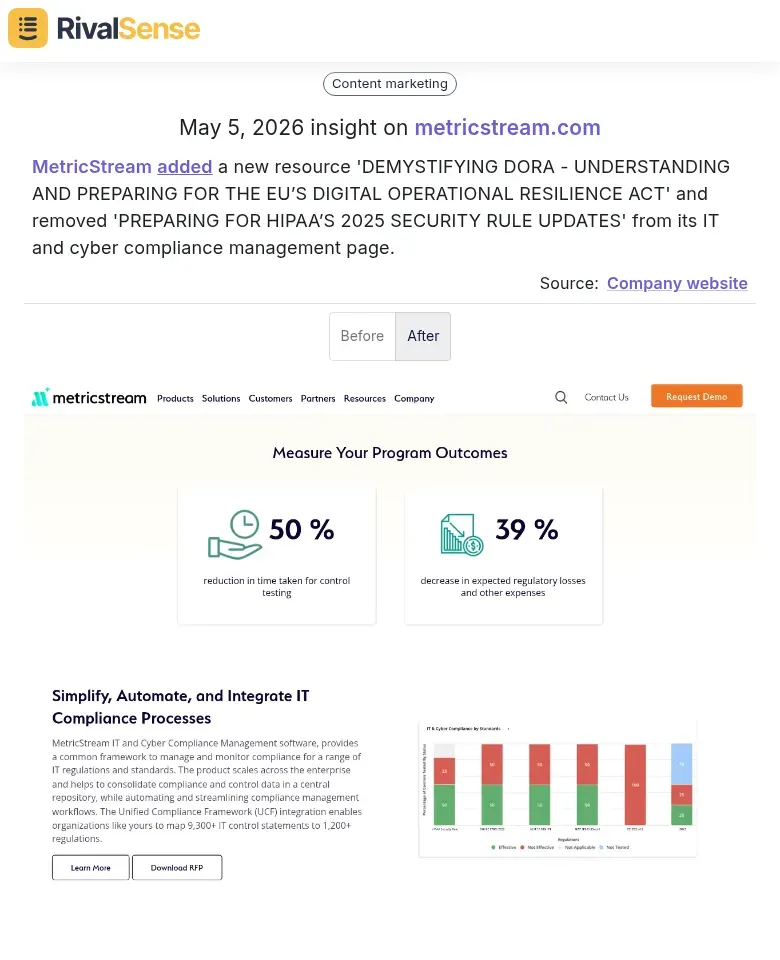
MetricStream added a new resource 'DEMYSTIFYING DORA - UNDERSTANDING AND PREPARING FOR THE EU’S DIGITAL OPERATIONAL RESILIENCE ACT' and removed 'PREPARING FOR HIPAA’S 2025 SECURITY RULE UPDATES' from its IT and cyber compliance management page.
Why this matters: This shift indicates that DORA is becoming a hot compliance topic while HIPAA 2025 updates are losing relevance. By creating authoritative content on DORA (e.g., a checklist, guide, or webinar), you can capture high-intent traffic from organizations scrambling to comply. The removal of HIPAA content also tells you to reassess your own coverage of that topic.
Actionable Steps:
- Monitor competitor compliance pages weekly using change detection tools. Flag additions on new regulations (e.g., DORA, GDPR updates) and removals of old content.
- Create timely content around these shifts: publish a guide, checklist, or FAQ addressing the new regulation. For example, "DORA Compliance Checklist for Fintechs" targets high-intent searches.
- Optimize for niche queries: Use long-tail keywords like "DORA compliance steps 2026" or "HIPAA update removal impact."
- Update your own compliance pages to reflect current regulations, signaling freshness to search engines.
Pro Tip: Set up Google Alerts for regulatory keywords and combine with competitor monitoring to be first-to-market with authoritative content. This attracts high-intent, niche audiences actively seeking compliance solutions.
Using Case Study Rotations to Understand Audience Targeting
Case studies are a goldmine for competitive intelligence. When a competitor publishes a new case study featuring a large enterprise client, it signals a strategic shift toward upmarket targeting or a new vertical. Conversely, if they remove or archive case studies from certain industries or geographies, they may be de-emphasizing those segments.
Real-world insight:
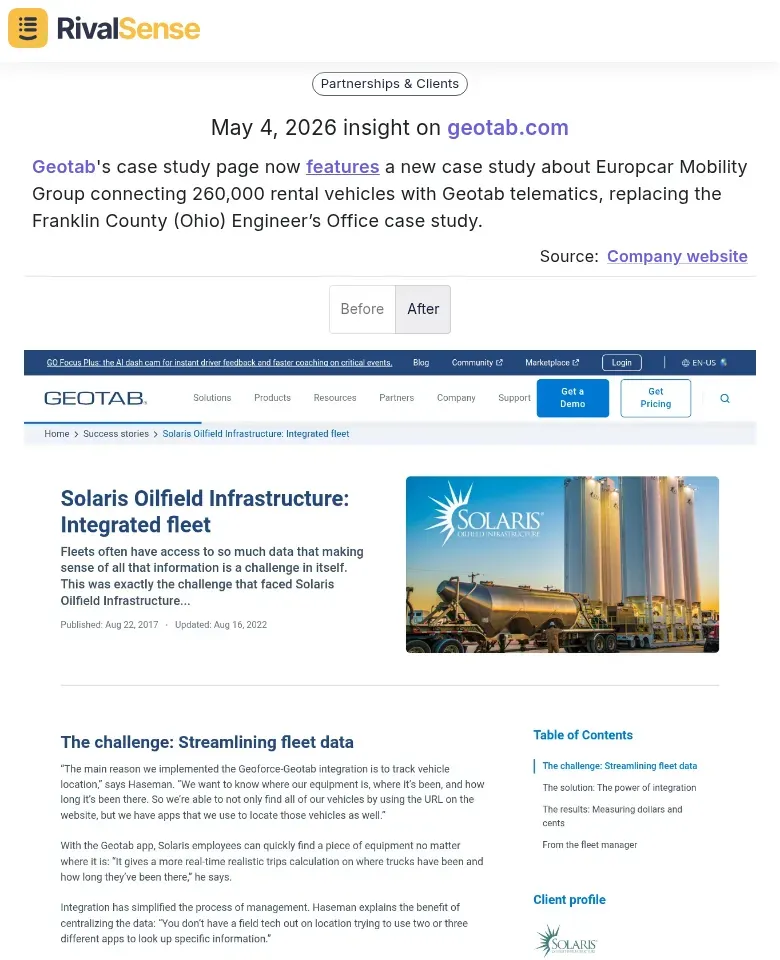
Geotab's case study page now features a new case study about Europcar Mobility Group connecting 260,000 rental vehicles with Geotab telematics, replacing the Franklin County (Ohio) Engineer’s Office case study.
Why this matters: This rotation suggests Geotab is shifting focus from municipal government (Franklin County) to large enterprise mobility (Europcar). For you, this could mean an opportunity to own the municipal or SMB vertical with targeted content, or to counter-position against their enterprise play. The specific number (260,000 vehicles) also gives you a keyword angle: "fleet management for 260,000 vehicles" or "Europcar Geotab case study."
How to analyze case study rotations:
- Track additions and removals monthly. Use a spreadsheet or tool to log case study URLs, client names, industries, and geographies.
- Identify patterns. Are they moving upmarket (e.g., from SMB to enterprise)? Entering new verticals (e.g., healthcare, finance)? Exiting specific regions?
- Adjust your content strategy. If they target enterprise, you could double down on SMB-friendly content to own that niche. Or create counter-positioning content that highlights your strengths in their new focus area.
Practical steps:
- Set up alerts for new case study pages (e.g., via Google Alerts or change monitoring tools).
- Archive case study pages weekly to catch removals.
- Map each case study to your own ICP segments and note any gaps or overlaps.
Pro tip: If a competitor removes a case study from a geography you serve, consider creating content that fills that void—targeting the same region with your own success stories.
Building a Sustainable Competitor Website Monitoring Process
To build a sustainable competitor website monitoring process, start by setting up automated alerts for changes to key competitor pages. Use tools like RivalSense or Visualping to monitor product pages, case studies, resource sections, and pricing pages. Configure daily or weekly checks to capture new content, removed pages, and structural updates. Next, conduct regular manual audits—bi-weekly or monthly—to review your competitor’s site for new pages, deleted content, and changes in navigation or URL structure. Document findings in a shared spreadsheet or dashboard, noting the date, type of change, and potential SEO impact. Finally, integrate these insights into your SEO roadmap. For each change, assess whether it signals a new keyword opportunity (e.g., a new case study targeting a specific use case), a content gap you can fill, or a shift in competitor strategy. Prioritize actions based on search volume, relevance, and your resources. This continuous loop of monitoring, auditing, and integrating ensures your keyword targeting and content strategy stay ahead of the competition.
💡 Ready to turn competitor website changes into your SEO advantage? Try RivalSense for free at https://rivalsense.co/ and get your first competitor report today. No strings attached—start spotting product updates, pricing shifts, and content gaps before your competitors do.
📚 Read more
👉 Key Account Dashboard Cheat Sheet for Compliance Automation
👉 Pricing Cheat Sheet: Key Account Management Insights
👉 The Key Account Management Playbook: A Leader's Guide to Empowering SAMs
👉 How to Control Access to Competitor Intelligence in Your B2B Company
👉 How NVIDIA's Nemotron Launch Spurred a Rival's AI Agent Pivot