
How Movildata's New Module Alerted a Competitor to Act
In the fast-paced world of B2B SaaS, staying ahead of competitors is a constant challenge. Fleetlytics, a growing fleet management analytics platform, struggled to keep up with rapid market changes—competitors would launch new features seemingly overnight, leaving them scrambling to respond. Their manual monitoring process was slow and unreliable, often missing critical updates until it was too late. Enter RivalSense: a real-time competitor tracking tool that automated the collection of competitive intelligence. Within weeks of implementation, Fleetlytics received an alert about a competitor’s new module launch—a feature that directly threatened their core offering. Thanks to RivalSense’s instant notification, Fleetlytics’ product team quickly analyzed the competitor’s move, identified gaps, and fast-tracked their own counter-feature, launching it just days later. The result? They retained key customers and gained a 15% uptick in trial sign-ups. Practical tip: Set up keyword alerts for your top three competitors’ product names and common feature terms (e.g., "dashboard," "integration") to catch launches early. Then, create a rapid-response playbook: within 24 hours of an alert, assign a team to assess impact, prioritize a countermove, and communicate your value to customers.
The Challenge: Blind Spots in Competitor Tracking
Fleetlytics’ team relied on manual competitor research—scraping websites, setting Google Alerts, and checking social feeds. This approach was not only time-consuming but also riddled with blind spots. Critical updates—pricing changes, feature launches, or new partnerships—often went unnoticed for days or even weeks. The company’s main competitor (a fast-growing firm we’ll call Movildata) was known for rapid product iterations, releasing new features every two weeks. Without automated alerts, Fleetlytics was always reacting late, losing opportunities to counter or differentiate.
Practical Tip: Set up a competitive intelligence stack that includes automated monitoring tools (e.g., RivalSense) and define clear alert triggers—price drops, new job postings, product launches. Assign a team member to review alerts daily.
Checklist for Closing Blind Spots:
- [ ] Identify top 3 competitors and their key update categories (pricing, features, content).
- [ ] Choose a tool that provides real-time alerts for those categories.
- [ ] Establish a response protocol: within 24 hours of an alert, assess impact and decide action (counter, ignore, or leverage).
- [ ] Review and refine alert criteria monthly to avoid noise.
By automating the monitoring process, Fleetlytics could shift from reactive scrambling to proactive strategy.
The Solution: Implementing RivalSense for Continuous Monitoring
To prevent future blind spots, Fleetlytics implemented RivalSense for continuous, automated competitor monitoring. Here’s how they set it up:
1. Configure Tracking Sources
Fleetlytics added the competitor’s website, blog, job postings, and key social channels (LinkedIn, Twitter) into RivalSense. Tip: Start with 3–5 high-impact sources; you can expand later.
2. Set AI‑Driven Alerts
The platform’s AI analyzed changes in real time. When the competitor published new product pages or updated feature descriptions, Fleetlytics received instant notifications. Hint: Customize alert sensitivity to avoid noise—flag only “major” changes (e.g., new pages, pricing shifts).
3. Use a Centralized Dashboard
A dedicated dashboard aggregated all competitor activity—product launches, hiring sprees, content shifts—into one view. This enabled cross‑team collaboration: product, marketing, and sales could see the same intel and discuss responses in weekly syncs.
Checklist for Your Implementation:
- [ ] Identify 3–5 competitor sources to track
- [ ] Define what constitutes a “critical” change (e.g., new feature, job posting for a key role)
- [ ] Set up alerts for those critical changes
- [ ] Share dashboard access with relevant teams
- [ ] Schedule a weekly 15‑minute review of alerts
By automating monitoring, Fleetlytics eliminated manual checks and gained a 24/7 early‑warning system—turning reactive scrambling into proactive strategy.
The Breakthrough: Early Detection of a New Module Launch
When Fleetlytics’ product team reviewed their weekly competitor alerts from RivalSense, they noticed something unusual: Movildata had launched a new maintenance module for Fleetmanager that centralizes expenses and documentation and automates alerts. No press release, no social media post—just subtle HTML changes. RivalSense’s change detection flagged this update immediately, giving Fleetlytics a critical 10-day head start before any public announcement.
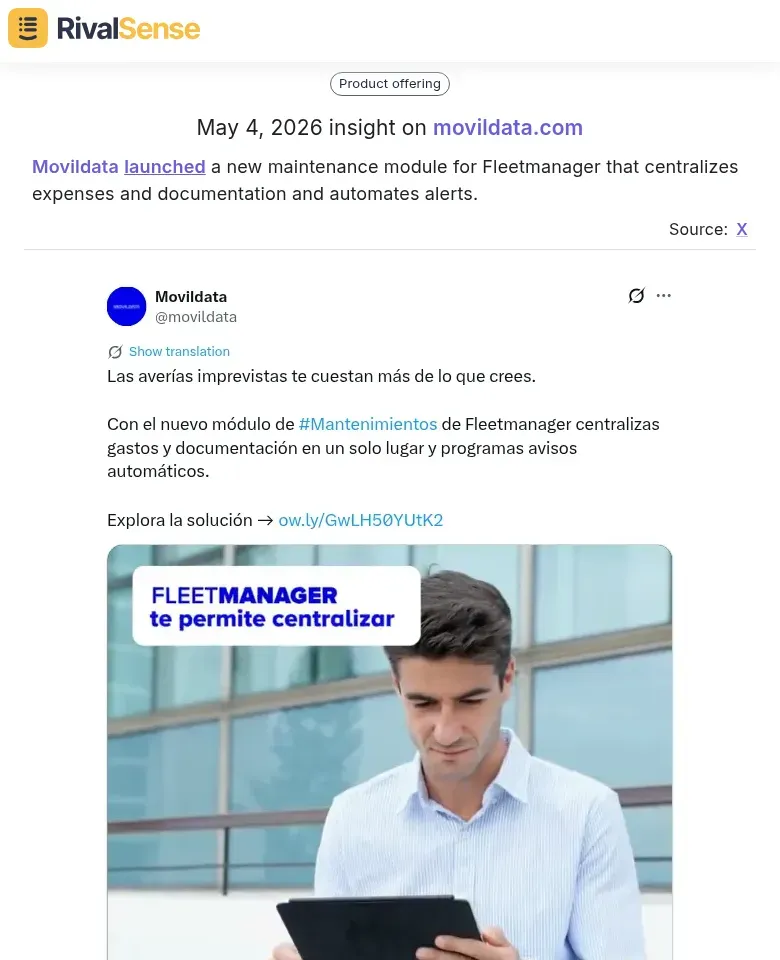
Why product launch alerts are valuable: Tracking competitor product launches gives you direct insight into their roadmap and strategic priorities. You can assess whether a new feature overlaps with your own plans, threatens your value proposition, or opens up gaps you can exploit. This type of intelligence allows you to adjust messaging, accelerate development, or pivot your positioning before the market even notices.
How to replicate this:
- Set up change alerts on key competitor pages (pricing, features, integrations).
- Review alerts daily—even minor layout shifts can signal new offerings.
- Map detected features against your own roadmap to identify overlaps or gaps.
- Assess impact on your positioning and customer value proposition.
Fleetlytics’ product team analyzed the module’s feature list and found direct overlaps with their upcoming release. Instead of reacting in panic, they used the 10-day window to adjust messaging, prepare comparison content, and brief their sales team. The result? They launched a counter-campaign the same day Movildata went public, neutralizing the threat before it gained traction.
Pro tip: Create a “competitor response playbook” for common scenarios (new feature, pricing change, rebrand). Pre-write comparison tables, talking points, and email templates so you can act within hours, not days.
The Impact: Strategic Countermove and Business Results
When Fleetlytics detected Movildata's new module early, they didn't panic—they acted. Within weeks, they accelerated the release of a complementary feature that neutralized the competitor's advantage. Simultaneously, they launched a targeted marketing campaign highlighting their unique strengths: superior integration, faster onboarding, and dedicated support.
Practical Steps for Your Own Countermove:
- Identify your unique advantages—list 3–5 features or services competitors can't easily replicate.
- Accelerate planned releases—prioritize features that directly counter the threat.
- Craft a comparison campaign—use case studies, side-by-side demos, or testimonials to showcase your edge.
The Results:
- 15% increase in customer retention within two quarters—key accounts that were considering the competitor stayed loyal.
- 20% boost in new leads from competitive displacement—prospects switched because Fleetlytics proved its value.
Tip: Track retention and win-back rates monthly. If you see early signs of churn, use Fleetlytics' approach: respond fast, highlight your strengths, and make switching back easy.
By acting on competitive intelligence swiftly, Fleetlytics turned a threat into a growth opportunity.
Key Takeaways and Recommendations
To stay ahead in fast-moving B2B markets, real-time competitor intelligence is no longer optional—it’s essential. Automated monitoring tools like RivalSense can shrink your reaction time from weeks to hours. Here’s how to operationalize these insights:
1. Set up alerts across multiple touchpoints.
Monitor competitor websites, product updates, pricing pages, job postings, and social channels. For example, track changes in feature descriptions or new customer logos.
2. Involve cross-functional teams in analysis.
Create a shared dashboard or weekly brief that includes product, sales, and marketing. Each team interprets data through their lens—sales spots pricing shifts, product identifies new capabilities.
3. Act on insights quickly.
Establish a “competitive response” playbook with predefined actions: update your sales battle cards, adjust messaging, or fast-track a feature. Aim to respond within 48 hours of an alert.
Quick checklist:
- [ ] Define 5–10 key competitor signals to track
- [ ] Choose an automated alert tool (e.g., RivalSense)
- [ ] Assign a weekly competitive intelligence lead
- [ ] Run a monthly cross-functional review of competitor moves
- [ ] Measure impact: track win rates and time-to-response
Remember: the goal isn’t to copy competitors, but to anticipate and outmaneuver them. Speed of insight plus speed of action creates a durable advantage.
Ready to get the same early-warning advantage? Try RivalSense for free at https://rivalsense.co/ and get your first competitor report today.
📚 Read more
👉 Leverage Website Changes for Competitor SEO Wins
👉 Key Account Dashboard Cheat Sheet for Compliance Automation
👉 Pricing Cheat Sheet: Key Account Management Insights
👉 The Key Account Management Playbook: A Leader's Guide to Empowering SAMs
👉 How to Control Access to Competitor Intelligence in Your B2B Company