
Key Account Management Workflow for Travel Startups
Understanding Key Account Management (KAM) is a strategic approach to nurturing your most valuable B2B relationships—think hotel chains, OTAs, or corporate travel desks. Unlike transactional service and reactive support, KAM is proactive and relationship-driven, aiming to deepen partnerships and drive mutual growth. For travel startups, KAM is critical because winning a single key account can unlock scalable revenue and market credibility.
Differentiation checklist:
- Standard AM: quarterly check-ins, issue resolution, upselling.
- KAM: dedicated strategist, joint business planning, executive alignment.
Align KAM with growth objectives:
- Map key accounts to revenue goals – Identify which accounts contribute to 80% of your revenue.
- Set joint targets – Co-create KPIs (e.g., booking volumes, co-marketing campaigns).
- Track health metrics – Use NPS, expansion revenue, and retention rates.
Quick tip: Start with a pilot of 3–5 accounts. Assign a KAM lead who understands travel industry dynamics (seasonality, distribution channels). Regularly review account plans against your startup’s milestones (e.g., new market entry, product launch). KAM isn't just account care—it's a growth engine.
Privacy-Compliant Personalization in Account Onboarding
For travel startups, first impressions matter. Personalizing the onboarding experience can dramatically reduce friction, but it must be done transparently. Here’s how to balance relevance and privacy.
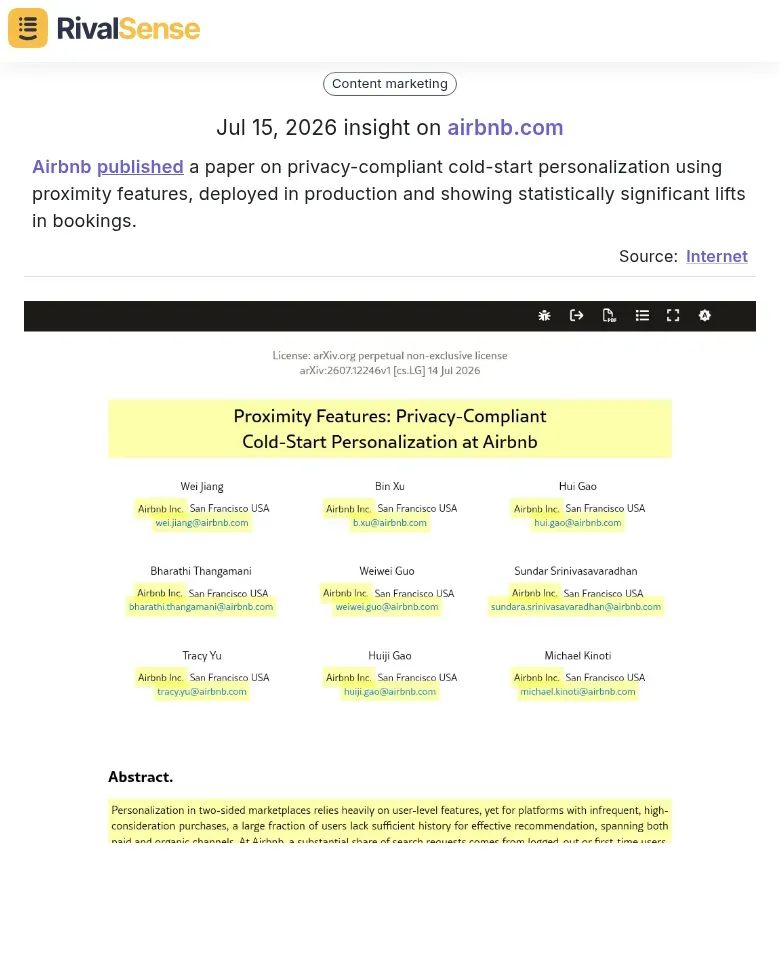
Example from the field: RivalSense recently surfaced a development that puts this into practice—Airbnb published a paper on privacy-compliant cold-start personalization using proximity features. Deployed in production, it showed statistically significant lifts in bookings. Tracking such innovations from market leaders helps your startup validate and adopt tested personalization strategies without reinventing the wheel.
1. Leverage Proximity & Location Data Wisely
Use IP geolocation or opt-in location services to pre-fill departure airports, suggest nearby destinations, or highlight local deals. Always ask for permission first and store data minimally. Tip: Show a clear 'Use my location' toggle with a one-line benefit explanation.
2. Implement Cold-Start Personalization
When a new account has zero history, infer preferences from behavior. Ask 2–3 simple questions during signup (e.g., “Beach or city?”), or analyze referral source and device type. Checklist:
- [ ] Offer minimal, optional preference selectors
- [ ] Use session-based signals (click patterns, time on page)
- [ ] Gradually refine profiles as data accrues
3. Build Trust with Transparent Data Usage
Clearly state why you collect data and how it improves the experience. Provide a simple privacy dashboard where users can view, edit, or delete their data. Hint: Place a short 'How we use your data' link next to any personalization feature.
4. Action Steps for Implementation
- Step 1: Map touchpoints where personalization adds value (e.g., welcome screen, destination suggestions).
- Step 2: Choose privacy-first tools (e.g., anonymized location APIs, on-device processing).
- Step 3: A/B test personalization versus generic onboarding to measure impact.
By starting with consent and minimal data, you create a foundation of trust while reducing onboarding drop-offs. Travel startups that master this balance will turn first-time users into loyal travelers.
Strategic Partnerships to Boost Account Value
Strategic partnerships can significantly enhance your key accounts’ experience and loyalty. By monitoring the broader ecosystem, you can spot partnership models worth emulating. For instance, RivalSense recently detected that Airbnb became a new Regional Sponsor of Argentina in North America. Insights like this reveal how major players target regional markets—information you can use to shape your own sponsorship or co-marketing strategies with key accounts.

Follow these steps to maximize value:
1. Identify Complementary Partners
Look for brands that serve the same target audience but are not direct competitors. For a travel startup, consider airlines, luggage brands, travel insurance, or local experience providers. Use tools like Crunchbase or LinkedIn to find potential partners with aligned values and customer segments.
2. Co-Marketing Initiatives
Propose joint campaigns: exclusive packages, co-branded content, or cross-promotional emails. For example, partner with a luggage company to offer a "pack light, travel more" bundle for your top accounts. Track performance with UTM links and shared metrics.
3. Leverage Sponsorships & Regional Activations
Sponsor travel fairs, local events, or pop-up experiences where your key accounts are present. This boosts brand visibility and provides networking opportunities. Offer your accounts VIP access or exclusive meet-and-greets.
4. Create Exclusive Partnership Benefits
Negotiate perks only for your key accounts: priority boarding, room upgrades, free travel insurance, or discount codes. For instance, a hotel booking startup could partner with a concierge app to offer a free airport transfer for top-tier clients.
Quick Checklist:
- [ ] Audit current accounts for partnership opportunities
- [ ] Shortlist 3-5 potential partners
- [ ] Draft a one-page partnership proposal
- [ ] Set KPIs (co-branded bookings, redemption rate)
- [ ] Launch a pilot program with one account
Tip: Always formalize partnerships with an MOU outlining mutual benefits, data sharing, and exit clauses. Start small, measure results, then scale.
Expanding Service Offerings via Platform Integration
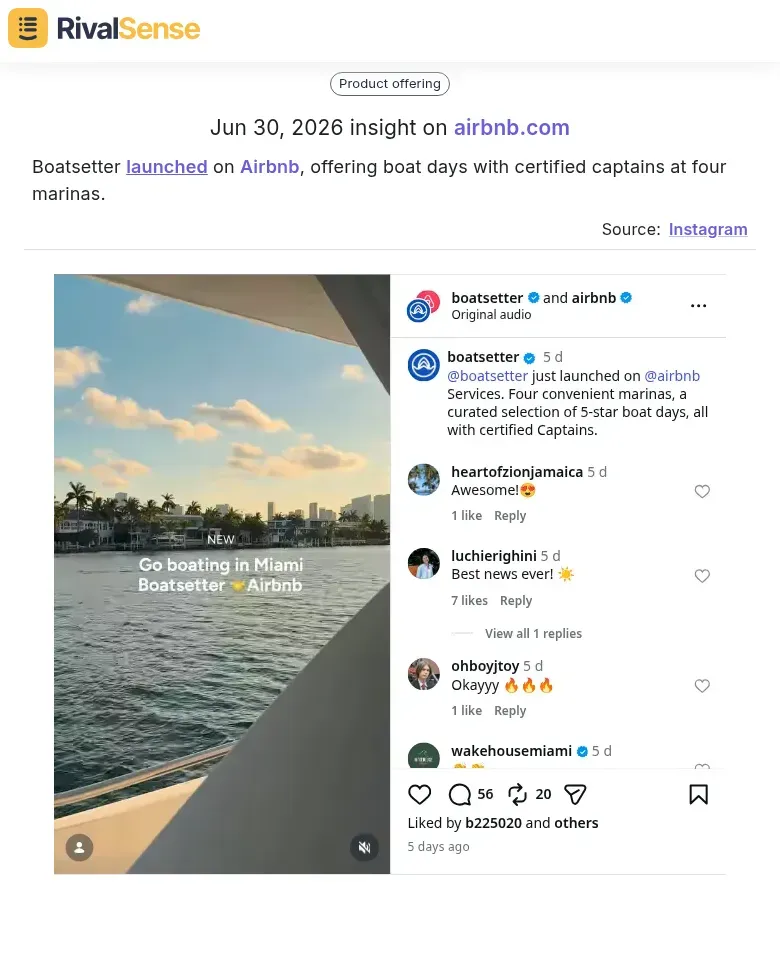
To expand your service offerings without overextending resources, integrate third-party platforms that bundle complementary services. For travel startups, this could mean partnering with local experience providers (e.g., food tours, adventure activities) or adding insurance, car rentals, or airport transfers through APIs. Competitor monitoring can highlight successful integrations—RivalSense recently captured Boatsetter launching on Airbnb, offering boat days with certified captains at four marinas. This signals a rising trend of platform-based service expansion that your key accounts might expect or value.
Practical Steps:
- Audience Needs Assessment: Survey your top accounts to identify unmet needs. For example, business travelers might prioritize fast-track airport services.
- Platform Scouting: Use marketplaces like Travelport, Expedia Affiliate Network, or Booking.com’s connectivity partner program to find compatible APIs.
- Integration Prioritization: Map integration complexity vs. value. Start with low-effort, high-demand offerings (e.g., travel insurance via Cover-More).
- Test & Validate: Launch a beta with 5–10 accounts, track usage and NPS, then iterate.
Checklist for Launch:
- [ ] Select 2–3 complementary services aligned with account profiles.
- [ ] Negotiate revenue-sharing or white-label terms.
- [ ] Develop a unified checkout experience (single cart, one invoice).
- [ ] Train account managers to cross-sell new offerings.
Tip: Use platform integration to create “bundled packages” (e.g., flight + hotel + local guide) that increase per-account revenue and stickiness. Tangible value like exclusive rates or priority support differentiates you from OTAs.
Measuring Success and Iterating the KAM Workflow
To refine your KAM workflow, start by tracking KPIs that directly tie to account health and revenue growth. Key indicators include: account retention rate, net revenue retention (NRR), upsell/cross-sell conversion rate, response time to account requests, and Net Promoter Score (NPS) among key accounts. For travel startups, also monitor booking volume growth and partnership co-marketing ROI.
Collect and Act on Account Feedback
After each quarterly business review, send a short pulse survey (3-5 questions) asking about personalization quality, partnership responsiveness, and unmet needs. Tag insights in your CRM to spot patterns: e.g., if multiple accounts request last-minute inventory alerts, build that into your standard workflow. Use feedback to segment accounts by maturity—new partners may need more onboarding touchpoints, while mature ones value strategic roadmap alignment.
Scale What Works
Identify your top-performing KAM tactics (e.g., a monthly “market insights” newsletter drove 20% higher engagement). Codify these into playbooks and train the wider team. Run A/B tests on outreach cadence or proposal templates with a sample of accounts before rolling out changes. Finally, create a KAM dashboard that tracks leading indicators weekly and triggers alerts when an account’s engagement drops—proactive iteration prevents churn and turns your workflow into a competitive advantage.
Pro Tip: Host a bi-monthly “KAM lab” where team members share wins and failures. Pair this with a shared library of templates and case studies to accelerate learning across the portfolio.
Stay Ahead with RivalSense
Key account management thrives on understanding the competitive landscape—who’s innovating, who’s partnering, and what’s next. RivalSense automatically tracks competitor product launches, partnerships, pricing updates, and more across websites, social media, and registries, delivering crisp weekly email reports. Spot opportunities early, adjust your approach, and never miss a critical move.
👉 Try RivalSense for free and get your first competitor report today.
📚 Read more
👉 Uncover Competitor Pricing Secrets Hidden in App Reviews
👉 Unlock Growth: Key Account Productivity for Medical Equipment Distributors
👉 How Nextiva's Shift to Workforce Management Sparked a Competitive Response
👉 A Beginner’s Guide to LinkedIn Competitor Insights for Key Account Managers
👉 Why Competitor Analysis Matters: A Checklist for Social Media Teams