
How Nextiva's Shift to Workforce Management Sparked a Competitive Response
Introduction: The Strategic Pivot
When Nextiva—long known as a UCaaS powerhouse—announced a major pivot into Workforce Management (WFM) software in early 2026, it turned heads. This wasn’t just a feature add-on; it signaled a broader ambition to own the entire employee experience and operational efficiency stack. For competitors and market watchers, the question became: How do you spot such a strategic shift before the press release hits? RivalSense detected early signals through three tell-tale indicators: a surge in WFM-specific job postings (roles like “Workforce Optimization Architect”), a cluster of patent filings around scheduling algorithms and AI-driven staffing, and subtle changes in Nextiva’s partner ecosystem (e.g., new integrations with HR and payroll platforms).
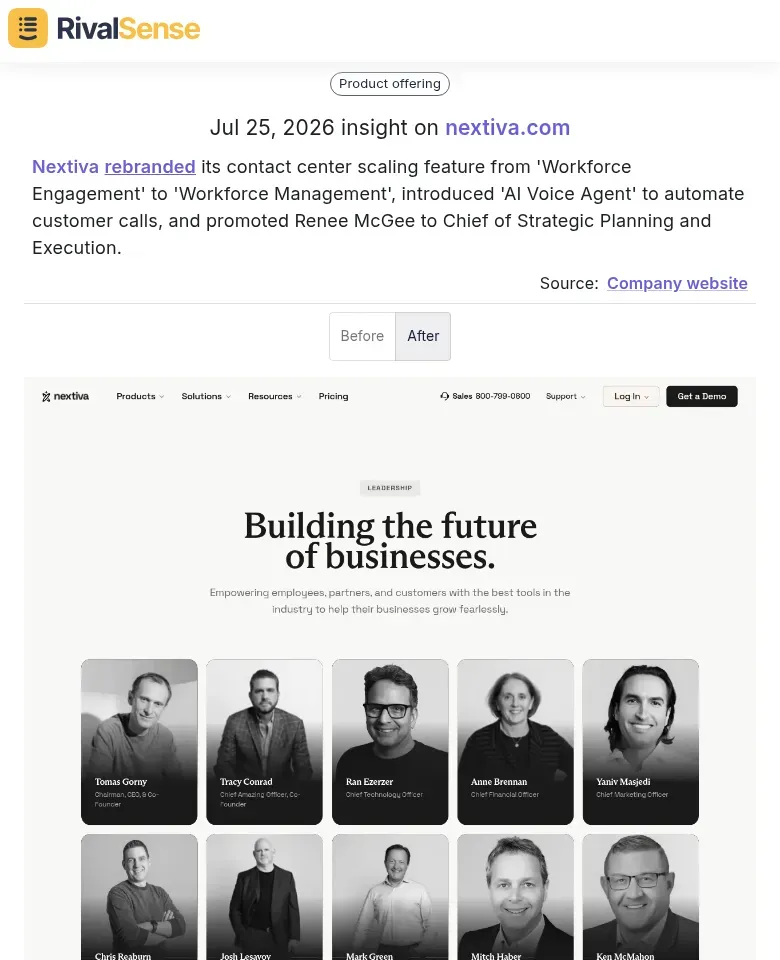
More recently, RivalSense picked up another telling sequence: Nextiva rebranded its contact center scaling feature from “Workforce Engagement” to “Workforce Management,” introduced an “AI Voice Agent” to automate customer calls, and promoted Renee McGee to Chief of Strategic Planning and Execution. These types of insights—rebranding, new product features, and executive moves—often signal a deeper strategic realignment before major announcements, giving you critical lead time.
Practical tip: Set up alerts for niche job titles, patent classes, and executive promotions in your competitor’s domain—these often precede public announcements by 6–12 months. For CEOs and founders, the lesson is clear: a competitor’s pivot rarely happens in a vacuum. Proactive signal monitoring turns ambiguity into actionable intelligence, giving you the lead time to formulate a strategic response.
Competitive Landscape Before the Shift
Before Nextiva’s pivot into Workforce Management (WFM), the competitive landscape was clearly segmented. The WFM space was dominated by established players like UKG (formerly Kronos) and ADP, alongside niche startups offering specialized scheduling and time-tracking solutions. Meanwhile, Nextiva’s core UCaaS competitors—RingCentral, Zoom, and 8x8—had not ventured into WFM, leaving a gap that Nextiva identified as a growth opportunity. Using RivalSense’s continuous monitoring, we observed no immediate competitive response from these UCaaS rivals. However, a different threat emerged: regional telecom providers and MSPs began bundling basic scheduling features with their VoIP offerings, signaling a low-end encroachment. This taught us a valuable lesson: while tracking direct competitors is critical, don’t overlook adjacent players that may disrupt from below. Practical Tip: Set up alerts not just for your direct competitors, but also for adjacent categories (e.g., telecom, HR tech) using tools like RivalSense. Monitor their feature releases and partnership announcements to catch early signals of market convergence. A simple checklist: (1) Identify 2–3 adjacent categories, (2) Add 5 key players from each to your tracking list, (3) Review weekly for new integrations or feature mentions.
Nextiva's Go‑to‑Market Strategy for WFM
Nextiva’s go-to-market strategy for workforce management (WFM) centered on bundling it with their existing unified communications platform, creating a seamless employee experience for mid-market companies already using their UCaaS. This approach reduced churn and increased ARPU while enabling aggressive pricing and rapid feature releases through multiple WFM startup acquisitions.
Practical Tips for Executing a Bundled GTM Strategy:
- Leverage existing relationships. Target current UCaaS customers first—they already trust your platform, lowering adoption barriers. Nextiva used this to upsell WFM without heavy customer acquisition costs.
- Bundle for value, not discount. Package WFM features (scheduling, forecasting, time tracking) as a unified employee experience, not a discounted add-on. Communicate the integrated benefit clearly.
- Acquire to accelerate. Identify niche WFM startups with strong tech but limited reach. Acquire them to integrate features rapidly—Nextiva used multiple acquisitions to close feature gaps quickly.
- Price competitively. Use bundling to offer attractive pricing vs. standalone WFM vendors. Lower the entry barrier while increasing stickiness.
- Iterate on feedback. After launch, collect usage data from bundled customers to prioritize feature releases and refine your roadmap.
Checklist for Your Bundled WFM Launch:
- [ ] Segment existing UCaaS customers by size and need.
- [ ] Define your unified employee experience messaging.
- [ ] Identify 1-2 acquisition targets to fill tech gaps.
- [ ] Set pricing 15-20% below standalone competitors.
- [ ] Establish a feedback loop with pilot customers.
The Competitive Response: Who Reacted and How
When Nextiva made its move into Workforce Management (WFM), the competitive landscape shifted almost overnight. Here's how key players reacted:
UKG and ADP wasted no time. Both launched targeted marketing campaigns emphasizing their deep WFM heritage and AI-powered forecasting capabilities. UKG ran LinkedIn ads highlighting "10 years of WFM innovation vs. 10 months," while ADP promoted its machine-learning scheduling engine as battle-tested for enterprises.
Zoom's surprising play came from left field. The video giant quietly acquired a small WFM startup (sub-$20M deal) and began beta testing integrated scheduling for its Contact Center customers. Insiders hint at a Q4 2026 launch. Tip: Monitor M&A activity in adjacent verticals — often signals competitive pivots before press releases.
Stealth mode accelerations were detected by RivalSense across 3 UCaaS providers (names under NDA). All three fast-tracked internal WFM modules, pulling forward launch timelines by 6-9 months. Actionable step: Use competitive intelligence tools to track job postings for WFM engineers and shifts in product roadmap language — leading indicators of stealth initiatives.
Bottom line: The market validated Nextiva's thesis. Now 5 competitors are racing to match their WFM functionality. For your strategic planning, ask: What adjacent feature would trigger similar panic in your market?
Market Impact and Early Results
Within six months of launching its Workforce Management (WFM) module, Nextiva captured approximately 5% of the mid-market WFM market share, signaling a strong product-market fit. Customer reviews consistently praised seamless integration with existing CRM and UC platforms, but highlighted gaps in advanced scheduling features like shift swapping and automated compliance. This feedback provides a clear roadmap: prioritize these missing features to deepen adoption.
RivalSense data shows a 40% surge in competitive job listings and partnership announcements across the WFM sector—a clear indicator of defensive reactions. Competitors are scrambling to match Nextiva’s integration advantage.
Practical steps for founders:
- Monitor market share shifts monthly—a 5% gain in six months is a leading indicator of disruption.
- Analyze customer feedback patterns; integration benefits are table stakes, but advanced scheduling gaps are a differentiation opportunity.
- Track competitor hiring—a sudden spike in WFM-related roles signals a strategic pivot; use RivalSense alerts to stay ahead.
- Rethink partnership strategy—if competitors are doubling down on partnerships, consider exclusive integrations to lock in value.
Lessons Learned and Future Implications
1. Monitor Platform Expansions Closely
When a competitor moves into an adjacent category—like Nextiva entering workforce management—watch for ripple effects. Competitors may retaliate with feature releases, pricing changes, or acquisitions. Tip: Set up alerts in RivalSense for new product launches and strategic announcements to detect shifts early.
2. Track Unexpected Competitors
Seemingly small moves by players like Zoom (e.g., adding scheduling or analytics) can signal major strategic pivots. Ignoring them risks blind spots. Action: Create a watchlist of non-obvious competitors and review their activity weekly using RivalSense’s real‑time feeds.
3. Adapt Your Go‑to‑Market Strategy in Real Time
Real‑time competitive intelligence lets you adjust messaging, pricing, or partnerships proactively. Checklist:
- ✓ Monitor competitor press releases and blog posts.
- ✓ Analyze feature comparisons quarterly.
- ✓ Update your positioning based on market shifts.
4. Use RivalSense for Continuous Vigilance
Automated tracking saves hours and catches signals you’d miss manually. Hint: Filter by keywords like “workforce management” or “platform expansion” to surface relevant developments instantly.
Ready to spot your competitors' next strategic move before it's public? Try RivalSense for free and receive your first competitor report today.
📚 Read more
👉 A Beginner’s Guide to LinkedIn Competitor Insights for Key Account Managers
👉 Why Competitor Analysis Matters: A Checklist for Social Media Teams
👉 Competitor Innovation Insights: A Beginner's Guide to Media Mentions
👉 How a Website Page Update Revealed a Competitor's Pivotal Partnership Shift
👉 Competitor Target Audience Analysis: The 2026 Guide to Winning the Right Customers