
Why Competitor Analysis Matters: A Checklist for Social Media Teams
In the fast-paced world of social media, standing still means falling behind. Competitor analysis isn't just about keeping tabs—it's your strategic compass. By monitoring competitors, you uncover what works (and what doesn't) in your industry, spot emerging trends before they become mainstream, and identify content gaps your brand can own.
The payoff is direct:
- Content performance: Analyze competitor posts with high engagement—what format, hook, or CTA drove results? Repurpose those learnings with your unique angle.
- Campaign strategy: Track competitor campaign timing, hashtag usage, and influencer partnerships to refine your own calendar.
- Differentiation: If rivals all use similar visuals or messaging, that's your cue to zig while they zag.
Quick-start checklist:
- Audit 3–5 key competitors across platforms.
- Catalog their top 10 posts by engagement rate.
- Identify patterns: Content types, posting frequency, tone.
- Spot gaps: Topics they ignore that your audience craves.
- Document insights in a shared team dashboard.
Remember: The goal isn't to copy—it's to learn, adapt, and outpace. Use competitor insights to fuel creative risks, not safe imitations.
Spotting Innovation: What New Feature Launches Tell You
New feature launches from competitors are more than product updates—they're signals of shifting market demands and unresolved user pain points. By deconstructing what competitors build and why, your social media team can turn these signals into actionable insights.
Real-world example: RivalSense recently tracked SocialPilot’s launch of AI Pilot, a feature that generates fresh content ideas, platform-ready posts, and one-click rewrites to eliminate creative block.
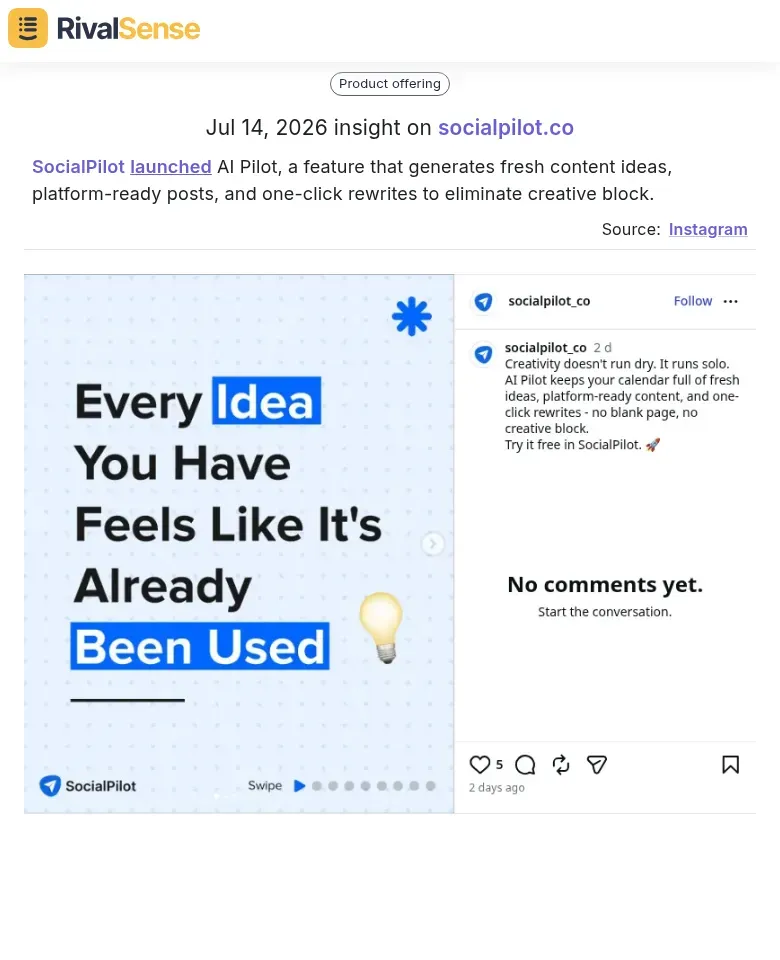
Why this insight matters: Innovation alerts like this reveal where competitors are investing to solve creative friction. For your business, it signals an industry shift toward AI-assisted content creation—knowledge you can use to evaluate your own tools or craft messaging about your unique, human-driven approach before the trend saturates. Tracking feature launches helps you anticipate market needs and adjust your social media strategy proactively.
How to analyze a competitor's feature launch:
- Identify the friction solved. Does the feature reduce creative workload (e.g., auto-captioning, template libraries)? If so, it highlights a pain point your audience shares. Map it to your own workflow gaps.
- Trace the launch pattern. Did they roll out to beta users first? Announce via a blog post with clear use cases? Use similar timing (e.g., before a major conference) to prioritize your roadmap.
- Quantify the impact. Check social chatter, engagement rates, or support tickets related to the feature. If users celebrate it, that’s a market demand signal.
Pro tips:
- Create a “feature launch log” tracking the problem, solution, and user reaction for each competitor release. Update monthly.
- Use the insights to adjust your content calendar: if a competitor just launched a scheduling tool, your next post could be “How we handle content planning without [competitor's tool].”
- Prioritize features that align with your core strengths—don't blindly copy; adapt the insight to your unique value proposition.
By systematically analyzing what competitors ship, you'll spot innovation patterns early and keep your social media strategy ahead of the curve.
Optimizing User Experience: Lessons from Feature Updates
When competitors roll out feature updates, look beyond the feature itself—analyze how it streamlines the user experience. Reductions in friction often lead to higher response rates and conversions. For example, when a competitor introduced one-click checkout, their cart abandonment dropped by 20%. Apply this thinking to your social media campaigns.
Case in point: As detected by RivalSense, SocialPilot updated its review generation feature to allow sending Quick Review Requests instantly after service or via QR codes, individually or in bulk, to increase responses and boost campaign conversions.
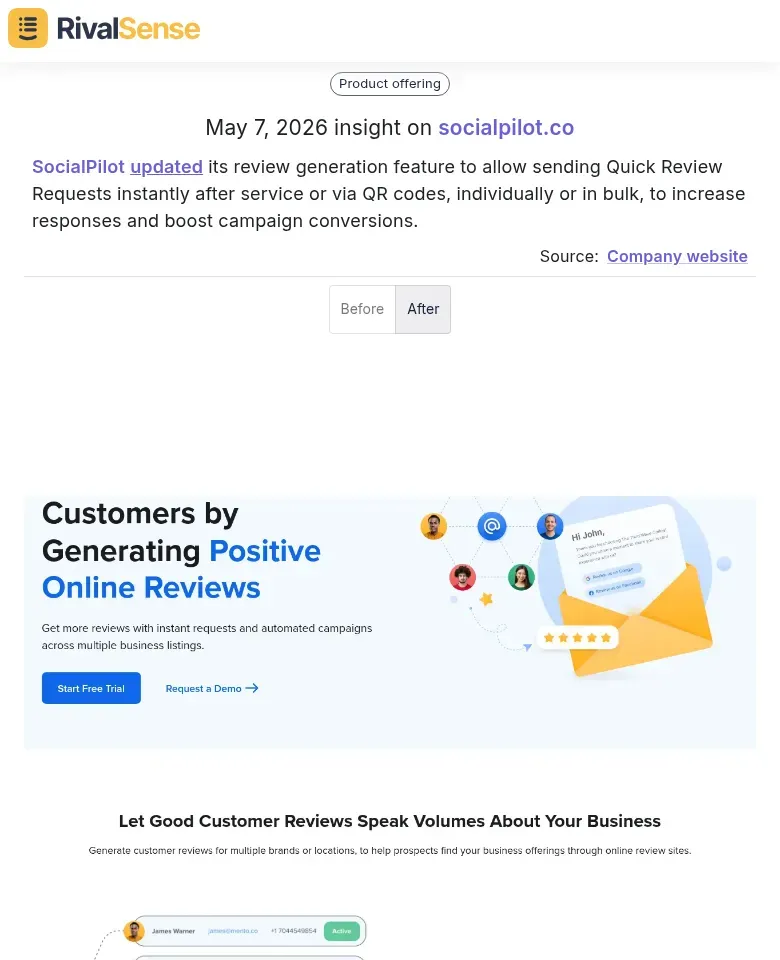
Why this insight matters: User experience updates like this show competitors are removing barriers to customer feedback. For you, it's a cue to examine your own social CTAs—are you making it effortless for followers to engage? This type of insight directly influences conversion rate optimization and customer journey design, helping you stay competitive without guessing.
Friction-Reduction Checklist:
- Map Your Customer Journey: Identify every step from discovery to conversion. Count clicks, forms, and decision points.
- Audit Competitor Updates: Track feature releases (e.g., auto-fill forms, saved payment details, quicker reply buttons). Note which steps they eliminated.
- Prioritize High-Friction Steps: Focus on steps where users drop off most. Common culprits: multi-field forms, login requirements, manual data entry.
- Test One-Click Actions: Add a direct “Shop Now” button in stories, prefill contact forms via UTM parameters, or enable saved payment for repeat buyers.
- Measure Impact: Monitor conversion rates before and after each change. Aim for at least 10% improvement per reduced step.
Pro Tip: Use tools like heatmaps or session recordings to see exactly where users get stuck. Then mimic competitor solutions that solve similar bottlenecks.
Improving Reliability: Insights from Behind‑the‑Scenes Changes
Behind closed doors, your social media team may be duplicating efforts or sending mixed signals. Competitor analysis helps spot these blind spots before they erode trust. Here's how to strengthen reliability:
Real-world example: RivalSense flagged that SocialPilot launched Duplicate Request Prevention on April 14, 2026, a feature that prevents customers from receiving multiple review requests across campaigns by setting a brand-level waiting period.
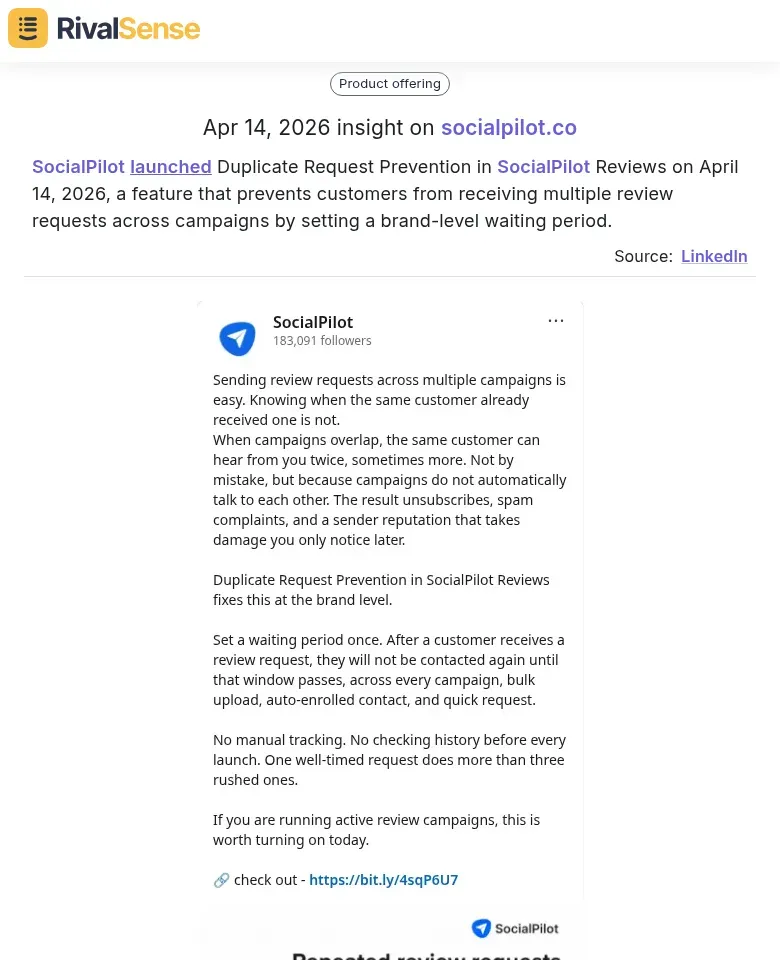
Why this insight matters: Operational safeguards like this show competitors are prioritizing customer experience reliability. For your business, monitoring such changes reveals how others are mitigating brand fatigue and avoiding spam—actionable intelligence to set your own frequency caps or conflict-detection rules. It’s a strategic move that protects brand loyalty and reduces churn, and you'd only catch it with systematic competitor tracking.
✅ Prevent Duplicate or Conflicting Actions
- Cross-check post schedules and campaign calendars against competitor moves to avoid launching a “huge sale” the same day a rival announces a price drop.
- Use a shared dashboard to flag overlapping messaging (e.g., both your brand and a competitor tweeting about the same industry event from opposite angles).
✅ Set Brand‑Level Safeguards
- Create a “competitor response playbook” that defines when to engage directly (e.g., correcting a misconception) and when to stay silent.
- Automate alerts for competitor announcements that might conflict with your planned posts, so your team can pause and adjust.
✅ Turn Operational Wins into Brand Loyalty
- When you catch a conflict early, share internally what happened and how it was resolved. This builds a culture of reliability.
- Measure sentiment before and after operational changes—lower confusion scores often correlate with higher customer retention.
Practical Tip:
Run a monthly “reality check” where your social team compares last month's posts against competitor activity. Identify at least one instance where you could have avoided a duplicate or counter‑messaging. Document the fix and share it company‑wide.
Building a Social Media Competitor Analysis Checklist
A structured checklist ensures you capture actionable intelligence, not just vanity metrics. Here's how to build yours:
1. Establish a Regular Cadence
Set a weekly or bi-weekly schedule to monitor competitor product and feature updates. Use tools like Google Alerts, Feedly, or RivalSense to track launches, pricing changes, and content experiments—RivalSense even sends a curated weekly email report so your team never misses a beat. Tip: Assign one team member as the 'competitor watch' lead to avoid duplication of effort.
2. Categorize Insights into Three Pillars
Organize findings to avoid data overload:
- Innovation: New features, formats (e.g., LinkedIn carousels), or campaign themes.
- Experience: Customer service response times, community engagement tactics, or UX changes on their social profiles.
- Reliability: Posting frequency, consistency of brand voice, and crisis response patterns.
Example: A competitor launches a weekly Twitter Spaces session. Under 'Innovation', note the format; under 'Experience', note how they moderate questions; under 'Reliability', note the day/time consistency.
3. Create an Action Plan
For each insight, decide: Test it? Adapt it? Ignore it? Use a simple scoring system (e.g., impact × feasibility) to prioritize. Checklist:
- [ ] Identify 1–2 quick wins to test this month.
- [ ] Define success metrics (e.g., engagement rate, share of voice).
- [ ] Assign ownership and deadline.
- [ ] Review results in 30 days and iterate.
By following this checklist, your team moves from passive observation to strategic action.
Conclusion: Turning Insights into Competitive Advantage
Competitor analysis isn't a one-and-done task—it's an ongoing process that keeps your social media strategy sharp and adaptable. By applying a systematic checklist, you ensure no valuable insight slips through the cracks. Here's a quick framework to turn monitoring into measurable wins:
- Track weekly: Review competitors' top posts, engagement rates, and new tactics.
- Categorize insights: Separate content ideas, format trends, and audience feedback.
- Align your team: Share findings in a weekly standup or a shared dashboard.
- Test one insight: Pick one competitor-inspired idea, run a split test, and measure engagement or conversions.
- Iterate: Double down on what works, drop what doesn't, and update your checklist.
When your team consistently follows this cycle, you'll spot shifts before your competitors do—and turn raw data into higher engagement, stronger brand positioning, and better ROI. Stop reacting; start anticipating.
Ready to implement these strategies with automated intelligence? Try RivalSense for free and get your first weekly competitor report delivered today. Simply visit rivalsense.co to stay ahead of every move your rivals make.
📚 Read more
👉 Competitor Innovation Insights: A Beginner's Guide to Media Mentions
👉 How a Website Page Update Revealed a Competitor's Pivotal Partnership Shift
👉 Competitor Target Audience Analysis: The 2026 Guide to Winning the Right Customers
👉 Workflow Breakdown: Telecom Competitor Market Research Reports