
Unlock Growth: Key Account Productivity for Medical Equipment Distributors
In today’s hyper-competitive medical device market, sustainable growth hinges on maximizing the productivity of your largest accounts. For medical equipment distributors, key accounts—major hospitals and health systems—represent both the highest revenue potential and the most complex relationship dynamics. Yet many distributors struggle with disjointed communication, siloed data, and reactive service models that erode trust and leave revenue on the table.
Optimizing key account performance isn’t just about increasing sales; it’s about building enduring partnerships that drive market share and reduce churn. A proactive, data-driven approach to account management can uncover cross-selling opportunities, streamline procurement, and align your services with the strategic goals of health systems.
Practical steps to start:
- Audit your top 20% of accounts—they likely generate 80% of revenue. Map their decision-makers, pain points, and purchase history.
- Implement a CRM with competitive intelligence feeds to track RFPs, contract renewals, and competitor movements in real time.
- Assign dedicated account teams with clear KPIs—retention rate, share of wallet, and net promoter score.
- Conduct quarterly business reviews with hospital stakeholders to align on outcomes and identify service gaps.
By shifting from a transactional to a strategic partnership model, distributors can unlock compounding growth. Start small: pick one key account, apply these steps, and measure the impact within 90 days.
Identifying Your Most Valuable Accounts: Segmentation and Prioritization
Not all large accounts are created equal. To maximize productivity, segment accounts beyond revenue using a weighted scoring model that considers: Account Potential (market share, expansion opportunities), Strategic Value (access to key opinion leaders, innovation influence), and Relationship Depth (executive access, cross-departmental engagement). Use data analytics to rank accounts by lifetime value (LTV), growth trajectory, and referral influence—this reveals hidden gems like a growing regional chain with high referral rates.
Actionable Steps:
- Build a data model combining CRM, sales history, and external market data.
- Score each account on a 1–10 scale for LTV, growth rate, and referral impact.
- Create tiers (e.g., Platinum, Gold, Silver) with differentiated service levels: dedicated teams for Platinum, quarterly business reviews for Gold, automated nurture for Silver.
Checklist for Tiering:
- [ ] Revenue threshold not the sole criterion.
- [ ] Growth trajectory > 20% YoY flagged.
- [ ] Referral sources mapped.
Avoid the trap of treating all large accounts equally—this dilutes resources, frustrates high-potential accounts, and leaves growth on the table. A tiered approach ensures your best accounts get white-glove treatment while optimizing team bandwidth.
Streamlining Account Management with Data-Driven Processes
Streamlining account management for medical equipment distributors starts with automating routine tasks. Use CRM tools like Salesforce or HubSpot to automate follow-ups, lead scoring, and data entry, freeing reps for high-value relationship building. Combine with BI platforms (e.g., Tableau or Power BI) to visualize account performance, pipeline health, and inventory trends. Schedule a weekly 15-minute "account pulse check"—review top KPIs (revenue, order frequency, equipment uptime) and flag risks. Monthly, hold a cross-functional forecast review with sales, service, and finance to align on demand signals.
Pro tip: Create a shared dashboard with real-time competitive intelligence feeds (via tools like RivalSense) that surfaces competitor product launches, pricing shifts, or hospital contract wins. Reps can then proactively engage customers with tailored insights—e.g., "Noticed Hospital X adopted Competitor Y's imaging system—here’s how our support package reduces downtime 30%."
Real-World Competitor Insights via RivalSense
Here are examples of competitor intelligence that tools like RivalSense can surface. While these come from different industries, they illustrate the types of signals you can monitor in the medical equipment space—product launches, strategic updates, and expansions.
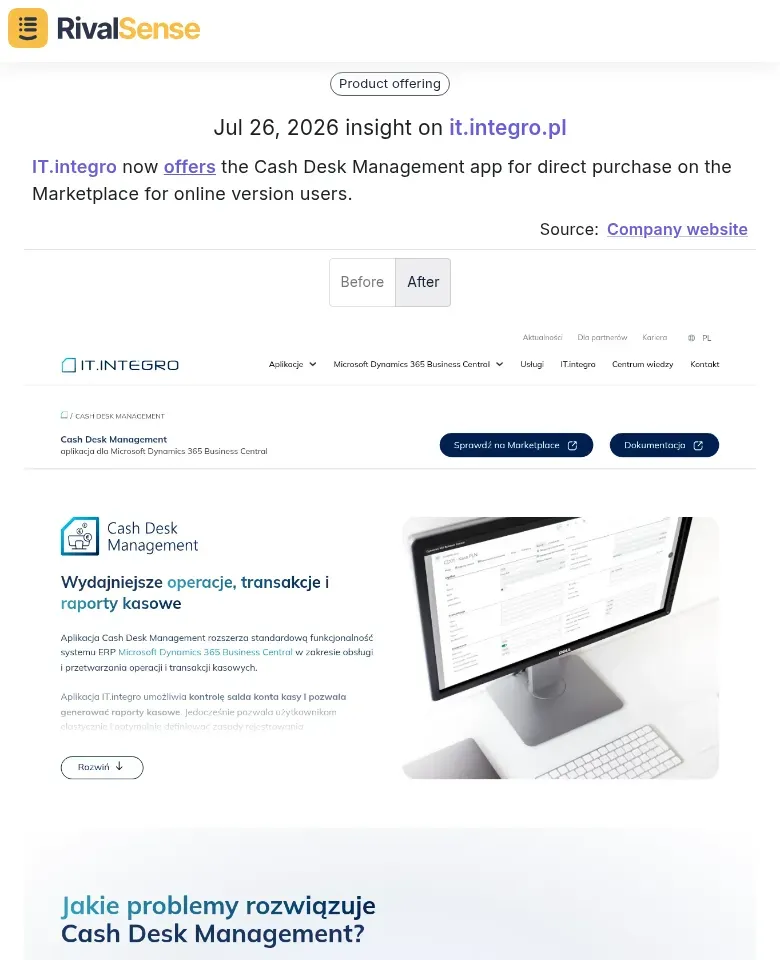
Product launch alert: IT.integro now offers the Cash Desk Management app. This type of update helps you anticipate new competitive offerings. In medical equipment, a manufacturer launching a new surgical robot could disrupt your key accounts—early awareness lets you counter-position.
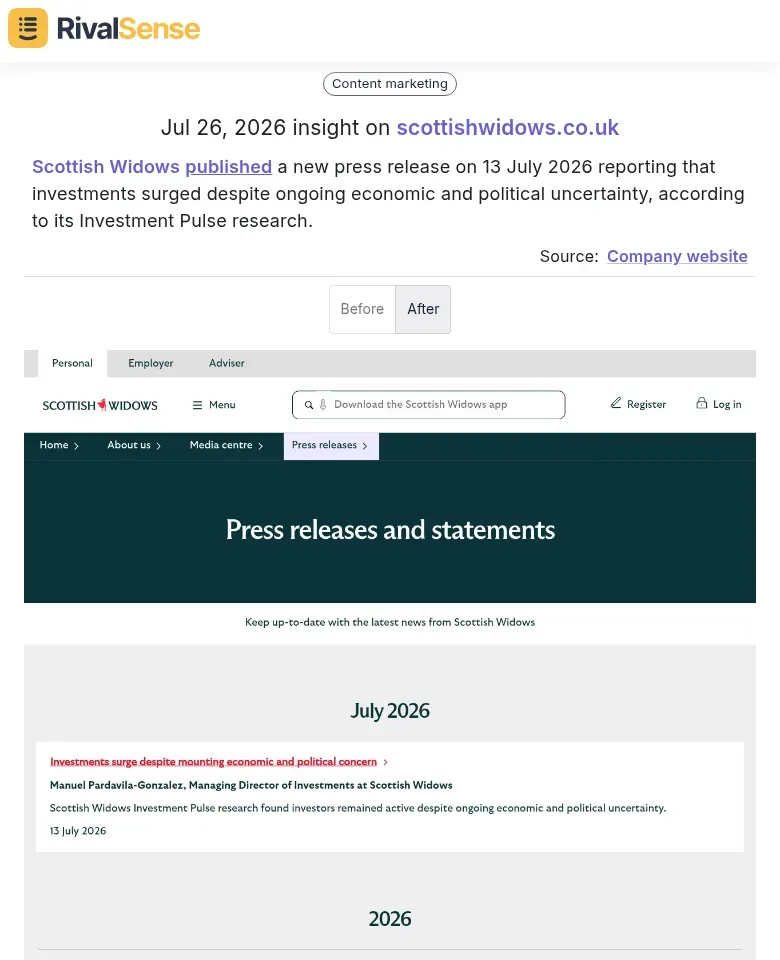
Press release / media mention: Scottish Widows published a release on 13 July 2026 about investment surges. Media mentions reveal strategic narratives and confidence. For a medical distributor, if a competitor announces record investment in R&D or new partnerships, it may signal upcoming product innovations or pricing changes that affect your account strategy.
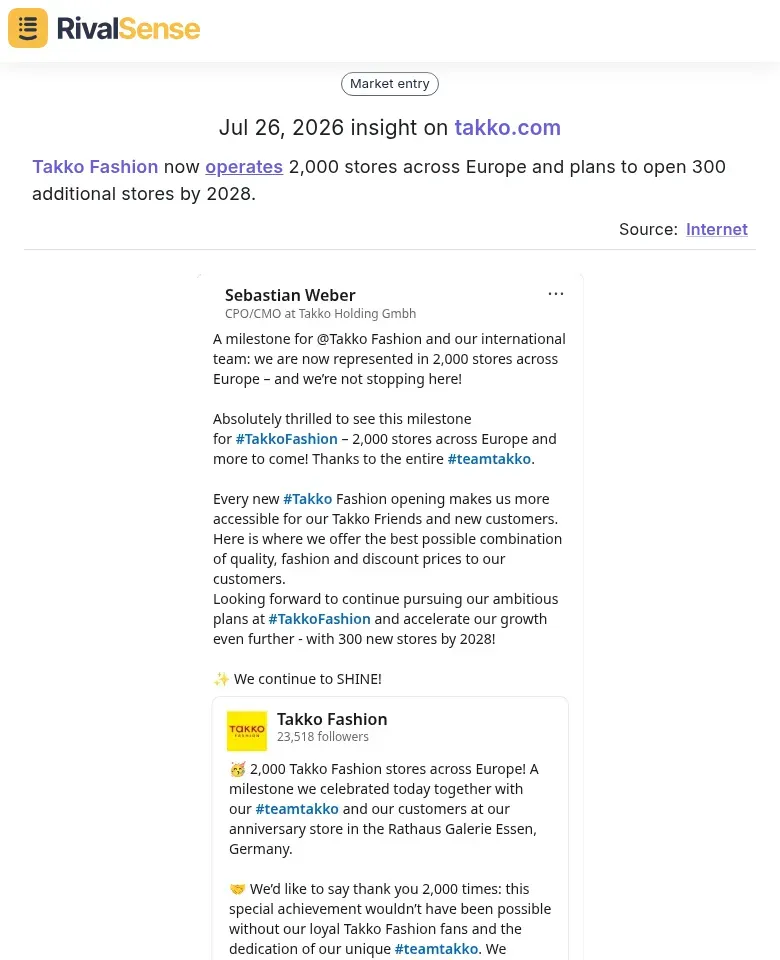
Expansion insight: Takko Fashion now operates 2,000 stores and plans 300 more by 2028. Monitoring competitor expansion helps you preempt market shifts. In medical distribution, knowing a rival is opening new service centers in your territory lets you reinforce relationships before they capture share.
To operationalize, implement a 3-step checklist: (1) Automate data collection, (2) Standardize review cadence (weekly pulse, monthly forecast, quarterly strategic review), (3) Enable reps with real-time competitor alerts. Finally, allocate 20% of saved time to strategic account planning—map customer goals, identify expansion opportunities, and build advocacy programs. This data-driven approach transforms account management from reactive to predictive, driving growth and customer loyalty.
Aligning Sales, Service, and Support for Account Excellence
To achieve account excellence, medical equipment distributors must break down silos between sales, clinical support, and customer service. Start by creating cross-functional account teams with shared goals and KPIs. Define clear roles: sales owns relationship growth, clinical support ensures product adoption, and service handles uptime. Establish communication protocols for seamless handoffs—e.g., a shared CRM with real-time updates and weekly sync meetings.
Practical Steps:
- Map the customer journey – Identify every touchpoint where silos cause friction (e.g., delayed support handoffs).
- Create a unified account plan – Each team contributes to a single document outlining goals, challenges, and action items.
- Implement a handoff checklist – Before transferring a customer issue, ensure all relevant context (history, contact, urgency) is documented.
Measure Account Health:
- Response time (service level agreements met)
- Equipment uptime (mean time between failures)
- Training adoption (percentage of staff completing onboarding)
Use a composite scorecard weighting these metrics (e.g., 40% uptime, 30% response time, 30% training adoption) to flag at-risk accounts early. For example, if uptime drops below 95%, trigger a joint service-sales intervention. This alignment turns reactive support into proactive growth.
Developing Strategic Relationships: From Vendor to Trusted Partner
To transition from vendor to trusted partner, deepen executive engagement by scheduling quarterly business reviews with C-suite stakeholders. Use these meetings to share market insights and align on strategic goals. Map decision-makers across departments—procurement, clinical, finance—and tailor communications to each persona.
Co-create value by bundling service agreements with clinical education programs (e.g., hands-on training for new equipment) and outcomes-based agreements that tie pricing to metrics like reduced downtime or improved patient outcomes. Offer a 'Value Realization Checklist' to track these KPIs jointly.
Leverage account feedback systematically: implement a voice-of-customer (VoC) program with quarterly surveys and advisory panels. Use insights to refine product features—e.g., adding IoT sensors for predictive maintenance based on clinician requests. This creates a competitive moat by embedding your solutions into their workflow.
Practical tip: Assign a 'Partner Success Manager' to each strategic account, responsible for executing these steps and reporting progress monthly.
Tracking Performance and Scaling Best Practices
To truly optimize account productivity, medical equipment distributors must move beyond vanity metrics and focus on KPIs that drive growth. Revenue per account reveals which relationships are most profitable, while share of wallet indicates penetration within each customer—a low share signals untapped potential. Retention rate is a loyalty proxy; high churn suggests service or value gaps.
Conduct regular account audits (quarterly or bi-annually):
- Compare top-performing vs. stagnant accounts.
- Identify patterns: which products, service tiers, or sales motions correlate with high productivity?
- Interview your best reps: what behaviors or tools drive wins?
From these audits, build a Scalable Account Productivity Playbook:
- Segment accounts (strategic, growth, maintenance).
- Define clear actions per segment: e.g., for strategic accounts—quarterly business reviews, dedicated support; for growth—targeted upselling, training sessions.
- Create templates and checklists so any rep can execute consistently.
- Roll out via pilots—test with 5-10 accounts, refine, then scale across the portfolio.
Pro tip: Use CRM dashboards to automate KPI tracking. Set alerts when share of wallet drops below 30% or retention slips, enabling proactive intervention. This disciplined approach turns isolated wins into repeatable growth.
Ready to put competitor intelligence to work? Try RivalSense for free and get your first weekly competitor report today: https://rivalsense.co/.
📚 Read more
👉 How Nextiva's Shift to Workforce Management Sparked a Competitive Response
👉 A Beginner’s Guide to LinkedIn Competitor Insights for Key Account Managers
👉 Why Competitor Analysis Matters: A Checklist for Social Media Teams
👉 Competitor Innovation Insights: A Beginner's Guide to Media Mentions
👉 How a Website Page Update Revealed a Competitor's Pivotal Partnership Shift