
Key Account Management Training: A Strategic Blueprint for B2B Leaders
Key Account Management (KAM) is often misunderstood as simply “VIP customer service.” In reality, it’s a strategic discipline that separates high-growth B2B companies from the rest. If you’re a founder or CEO overseeing enterprise accounts, investing in KAM training can directly impact retention, expansion revenue, and competitive positioning.
But not all training is equal. Generic courses teach theory; great ones force you to apply frameworks to your real accounts. Below is a practical guide to what world-class KAM training should cover—plus how to extend that intelligence into a continuous competitive advantage.
1. 🎯 Identifying True Key Accounts (Beyond Revenue)
Most teams define key accounts solely by deal size. That’s short-sighted. A strategic KAM framework scores accounts on multiple dimensions:
- Revenue & potential: Current spend + clearly identifiable expansion opportunities.
- Strategic alignment: Does the customer’s roadmap align with your product direction?
- Relationship depth: Are you connected to multiple stakeholders—not just a single champion?
- Competitive vulnerability: How likely is a competitor to displace you?
Action step: Create a weighted scorecard with your team. Score each account quarterly. Any account scoring below a threshold should be reassigned to a non-key account manager.
2. 🛠️ The Five Stages of a Key Account Relationship
Advanced KAM training (like the CIM Masterclass) teaches that key accounts evolve through distinct stages. Misdiagnosing the current stage leads to wasted effort.
| Stage | Characteristics | Your Focus |
|---|---|---|
| Exploratory | Testing, small deals, limited trust | Build credibility; deliver quick wins |
| Basic | Regular purchasing, single contact | Expand relationship; introduce new stakeholders |
| Cooperative | Joint planning, multiple touchpoints | Formalise account planning; align incentives |
| Interdependent | Shared roadmaps, integrated systems | Co-innovate; become difficult to replace |
| Synergistic | Strategic partnership, risk-sharing | Protect the relationship; watch for complacency |
Practical tip: At the beginning of each quarter, have your account managers assign a stage to each key account. If an account has been in “Basic” for more than two quarters, it signals a need to change approach.
3. 📋 Building the Strategic Account Plan (The 90-Minute Framework)
A common complaint: “Account plans are too long—nobody reads them.” The solution is a one-page living document built collaboratively. Here’s a streamlined template taught in top KAM programmes:
- Customer snapshot (2 sentences) – Their business model, biggest challenge, and why they matter to you.
- Key stakeholders (Decision Making Unit map) – Name, role, influence level, and their personal win.
- Our current position – What we sell, our share of wallet, relationship health (1-10).
- Competitive landscape – Who else is in the account? What’s their relationship strength? Any recent moves?
- Opportunity list – Top 3 expansion opportunities with expected revenue and timeline.
- Risks – Anything that could derail the relationship (e.g., competitor poaching, leadership change).
- 90-day actions – Concrete steps for you and your internal support team.
Pro tip: Use a shared tool (like Notion or a CRM) so the plan updates in real time. Review it in every weekly team meeting—even for 5 minutes.
4. 👥 Developing Internal Teams to Serve Key Accounts
KAM isn’t a solo sport. You need a virtual team spanning product, support, and sometimes even legal. Training should teach you to:
- Identify internal resources who can add value (e.g., a product manager who can attend quarterly reviews).
- Set clear roles – Who handles escalations? Who owns reporting? Who’s the backup?
- Communicate the account strategy internally so every touchpoint reinforces the same narrative.
Checklist: For each key account, document a RACI matrix covering at least: relationship owner, technical lead, escalation contact, and executive sponsor.
5. 🔍 Using Competitive Intelligence to Strengthen Key Accounts
This is where most KAM training falls short. It teaches you to identify competitors in an account, but rarely how to continuously monitor them. Yet, the biggest risk to a key account is often a competitor you didn’t see coming—a new product launch, a pricing change, a leadership hire.
That’s where a tool like RivalSense becomes your KAM force multiplier. RivalSense tracks competitor product launches, pricing updates, event participations, partnerships, management changes, and media mentions from 80+ sources. Every week, you receive a concise email report. No more manually checking competitor websites or LinkedIn profiles.
How to integrate competitive intel into KAM:
- Before your quarterly account review, check your RivalSense report for any competitor moves relevant to that account.
- If a competitor is launching a feature your key account has been requesting, flag it internally and adjust your roadmap pitch.
- When a competitor loses a key executive, that’s your window to approach the account with a “stability” narrative.
Here are three real examples of competitor insights from RivalSense and how you can turn them into account growth opportunities:
📌 New Product & Partnership Insight
Why it matters: Knowing about a new product or alliance lets you proactively discuss emerging tech with your key accounts, position your solution as complementary, or highlight your own partnerships.
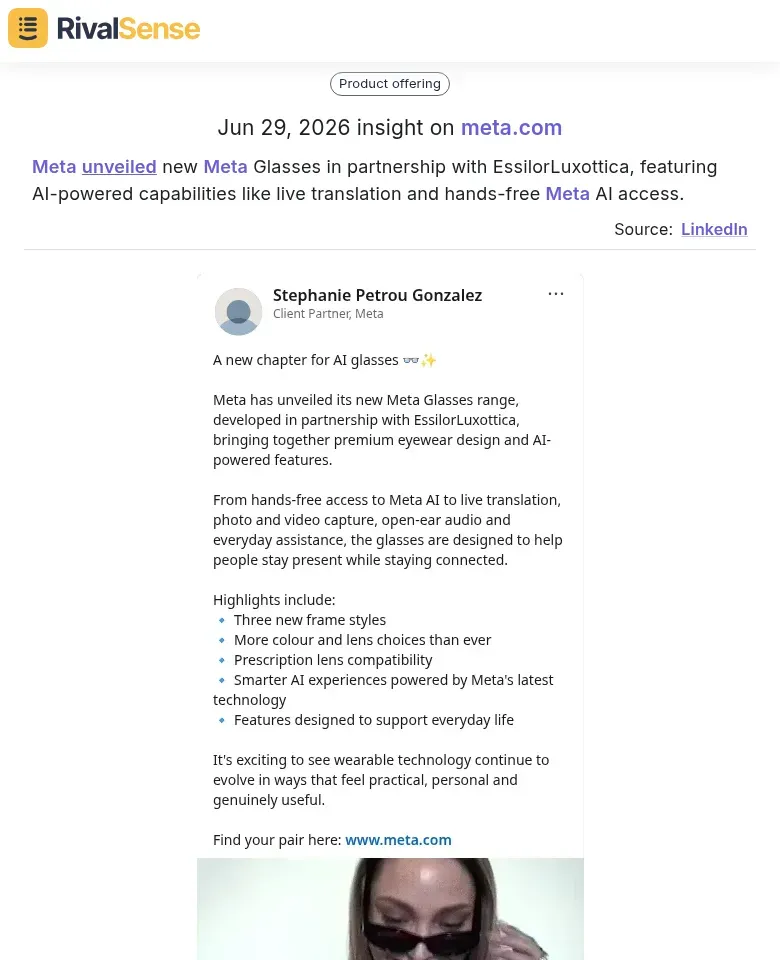
Insight: Meta unveiled new Meta Glasses in partnership with EssilorLuxottica, featuring AI-powered capabilities like live translation and hands-free Meta AI access.
- If you sell into AR/VR or enterprise wearables, this alert signals a new competitive offering that your key account’s innovation team might already be evaluating. Use it to start a conversation about their future tech roadmap.
📈 Policy & Timeline Shift Insight
Why it matters: Shifts in support timelines or product delays directly affect your key account’s planning, budgets, and risk assessments.
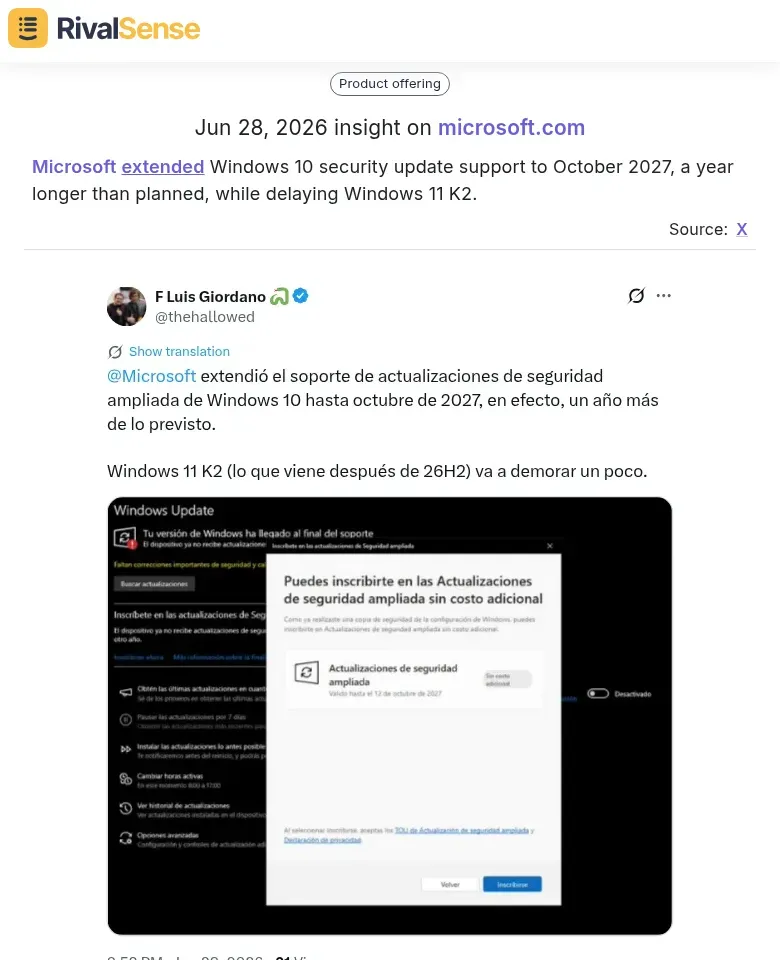
Insight: Microsoft extended Windows 10 security update support to October 2027, a year longer than planned, while delaying Windows 11 K2.
- If your software runs on Windows, this extension means your key accounts now have a longer window before forced upgrades. You can re‑align your support commitments, advisory services, or migration plans—and show them you’re one step ahead.
🎮 Product Lineup Restructuring Insight
Why it matters: Even changes in portfolios of tech giants signal strategic shifts. Watching them helps you refine your own bundling, pricing, or feature prioritisation for key accounts.
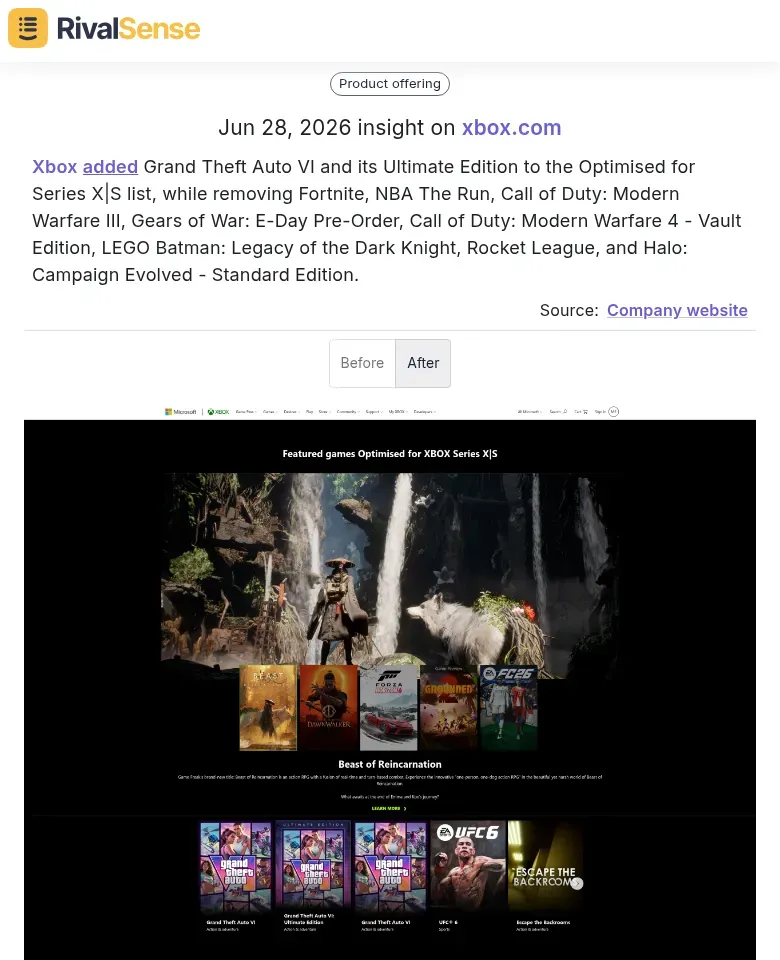
Insight: Xbox added Grand Theft Auto VI and its Ultimate Edition to the Optimised for Series X|S list, while removing Fortnite, NBA The Run, Call of Duty: Modern Warfare III, Gears of War: E-Day Pre-Order, Call of Duty: Modern Warfare 4 - Vault Edition, LEGO Batman: Legacy of the Dark Knight, Rocket League, and Halo: Campaign Evolved - Standard Edition.
- While this comes from the gaming world, the pattern is universal: a competitor tidying its product line often signals a sharper go‑to‑market focus. You can use similar curation logic to tighten your own offering set—making your key account value proposition harder to beat.
6. 📊 Measuring KAM Success (Beyond Revenue)
Leading KAM training shifts measurement from output (revenue) to outcome (relationship health and share of wallet). Consider tracking:
- Net Promoter Score among key account stakeholders (survey quarterly).
- Share of wallet (estimated vs. actual spend across all categories).
- Relationship breadth (number of contacts in the account).
- Competitive win rate in renewal/expansion situations.
Dashboards: Create a simple weekly view that shows any changes in these metrics—so you can act before a small issue becomes a churn risk.
💡 Final Thought
Key Account Management training is an investment that pays for itself many times over—if you choose a programme that combines strategic frameworks with practical tools. The best attendees come with a real account in hand, apply each concept immediately, and leave with a plan they can execute on Monday morning.
And remember: the best account plan in the world is useless if you’re blind to what your competitors are doing in that same account. Complement your KAM skills with a steady stream of competitive intelligence—tools like RivalSense make it effortless.
Ready to protect and grow your key accounts? Enrol in a CIM Key Account Management Masterclass or your preferred training. While you’re at it, try RivalSense for free today—get your first competitor report now—and your key accounts will thank you. 👉 Get your first report at RivalSense
📚 Read more
👉 Key Account Performance Dashboard: Real Examples for Heavy Equipment Repair
👉 How DoYouSpain’s SIXT Addition Revealed a Lucrative Gap—and How We Exploited It
👉 Productivity Techniques: Uncover Competitor Sales via Website Changes
👉 Genomics Competitor Research: 5 Methods to Stay Ahead
👉 How Competitor Branding Insights Shape Market Entry Trends