
Genomics Competitor Research: 5 Methods to Stay Ahead
In genomics, a single breakthrough can rewrite treatment paradigms, and a missed move can cost millions in sunk R&D. Competitors evolve at breakneck speed—new CRISPR edits, AI-powered discovery platforms, liquid biopsy patents emerge weekly. Standard tools like basic patent searches or quarterly market reports can't keep pace with the scientific nuance or strategic velocity. This guide gives you five actionable areas to track—partnerships, AI bets, leadership changes, conference signals, and cross-functional synthesis—with practical tactics and real competitor intelligence examples RivalSense has surfaced.
Tracking Strategic Partnerships and Collaborations
Partnerships in genomics are often the first public signal of a strategic pivot or a big resource commitment. A co-development deal can indicate where a competitor is placing a multi‑year, capital‑intensive bet. To catch collaboration news early, monitor regulatory filings (e.g., SEC 8‑Ks) and clinical trial registries for co‑development names weeks before press releases hit the wire.
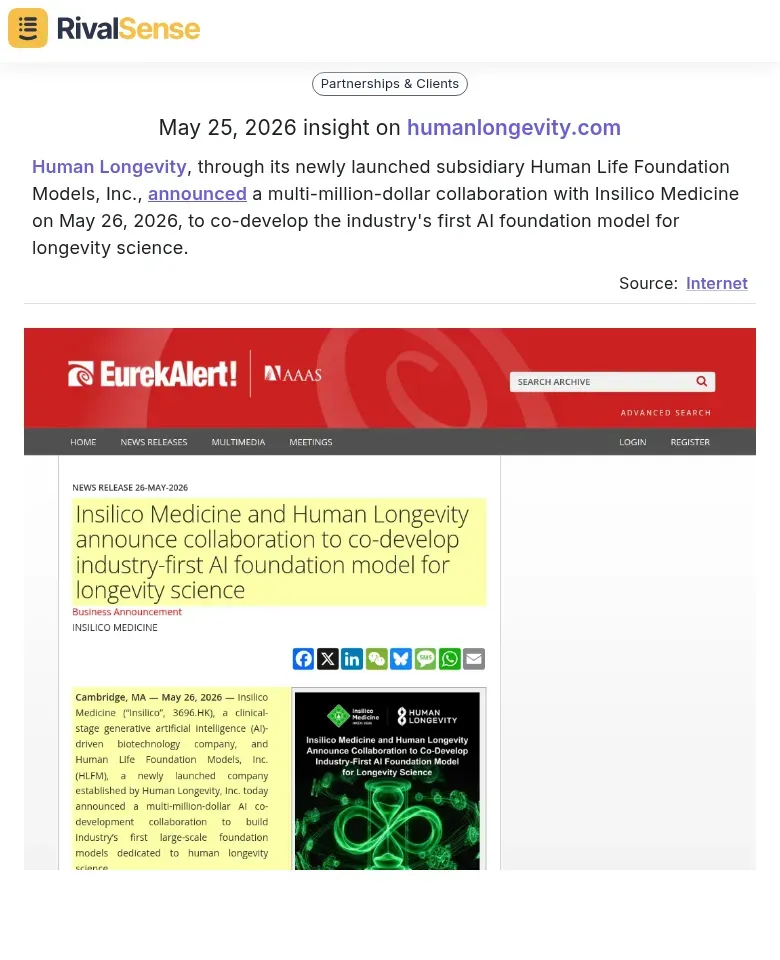
For example, RivalSense picked up that Human Longevity, through its newly launched subsidiary Human Life Foundation Models, Inc., announced a multi‑million‑dollar collaboration with Insilico Medicine on May 26, 2026, to co‑develop the industry’s first AI foundation model for longevity science. This kind of insight is pure gold: it reveals not just a partnership, but a commitment to foundational AI, signalling a long‑term moat in longevity research. Without automated monitoring, such niche announcements could easily slip under the radar.
Practical steps to assess a partnership:
- Map the deal’s financial scope (e.g., $50M upfront vs. $2B total) against the competitor’s R&D burn rate—anything exceeding 20% of annual cash reserves signals a major strategic pivot.
- Use the announcement to infer deprioritized areas: if a competitor pairs with an AI shop on “foundation models for longevity”, they’re likely pulling back from traditional therapeutic discovery.
- Create a partnership tracker with columns for partner, deal value, therapeutic area, technology type, and exclusivity clauses.
- Cross‑reference with patent filings: a new patent family filed within 6 months of a partnership often reveals the specific platform or target being developed.
💡 Quick win: Set up Google Alerts for “joint venture”, “co‑development”, “exclusive license” + competitor names. But for completeness, an automated tool like RivalSense catches regulatory filings, website updates, and less‑visible announcements.
Monitoring AI and Technology Initiatives
AI is no longer a buzzword in genomics—it’s a competitive weapon. Tracking a competitor’s in‑house AI foundation models, computational biology hires, or proprietary platform claims gives you a read on their future differentiation. Most AI announcements are backed by patent activity or new talent, so you can separate hype from reality.
Actionable tactics:
- Follow press releases and funding rounds for “proprietary AI foundation model” language. For instance, Verge Genomics’ €100M Series B for its CONVERGE platform signalled a definitive in‑house AI commitment.
- When a competitor claims an “industry first”, verify novelty using Google Patents or Lens.org and peer‑reviewed publications (PubMed).
- Track AI hiring surges on LinkedIn: a sudden spike in computational biology roles often precedes a product launch by 3‑6 months.
- Maintain a simple tracker listing each competitor, their AI initiative, patent count, and publication trends—update quarterly.
Following Leadership and Advisory Board Changes
A single C‑suite or advisory board addition can speak volumes about where a genomics company is heading next. These moves aren’t just about prestige; they’re bets on a technology roadmap. When a firm taps a Nobel laureate or a gene‑editing pioneer, it’s often telegraphing a new research direction or a desire for scientific credibility before a funding round.
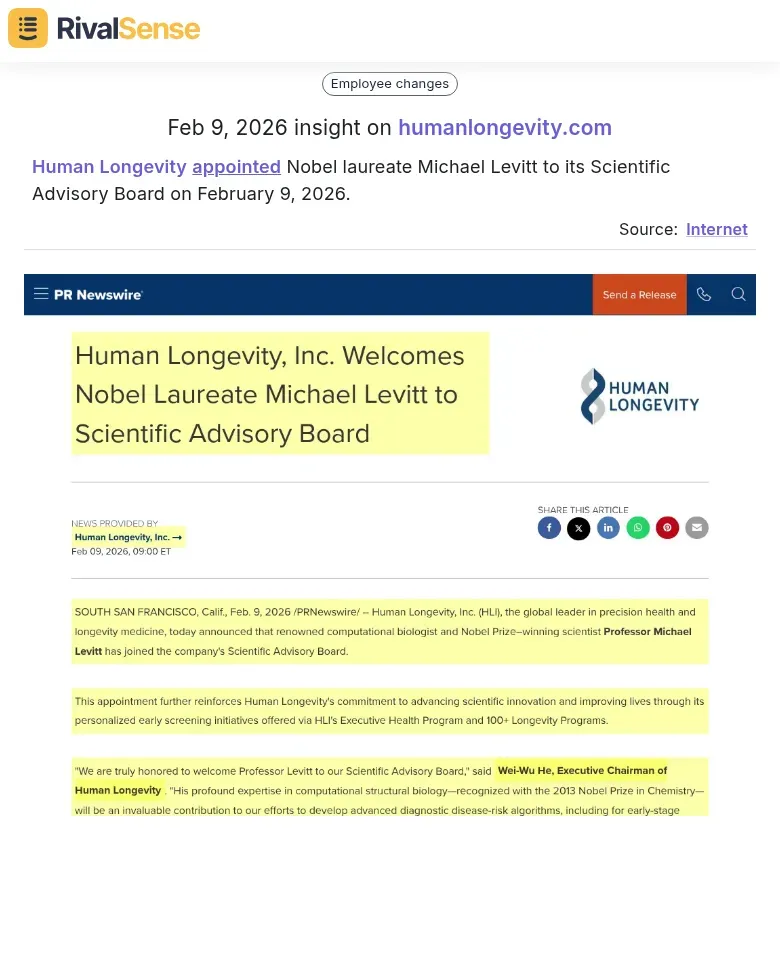
Consider this RivalSense insight: Human Longevity appointed Nobel laureate Michael Levitt to its Scientific Advisory Board on February 9, 2026. Levitt’s background in computational structural biology immediately suggests a deepening investment in AI‑driven modeling—a strategic signal that would take hours to piece together manually. Tracking board additions like this helps you anticipate a competitor’s technology stack before they announce a product.
Checklist for analysing leadership moves:
- [ ] Note every new board member’s primary domain (gene editing, delivery, bioinformatics, regulatory).
- [ ] Compare the current board’s expertise with the company’s public pipeline; look for mismatches that hint at a pivot.
- [ ] Watch for clustered appointments in a short window—often a pre‑launch signal.
- [ ] Set alerts for “departure”, “appoints”, “joins” + competitor names.
- [ ] Track where departing executives land via LinkedIn; it mirrors where the industry is placing its next bets.
Attending and Monitoring Industry Conferences
Conferences are where genomics competitors reveal roadmaps, gauge reactions, and poach talent—often before any press release. Even if you can’t attend in person, program analysis and social listening provide a wealth of strategic intelligence.
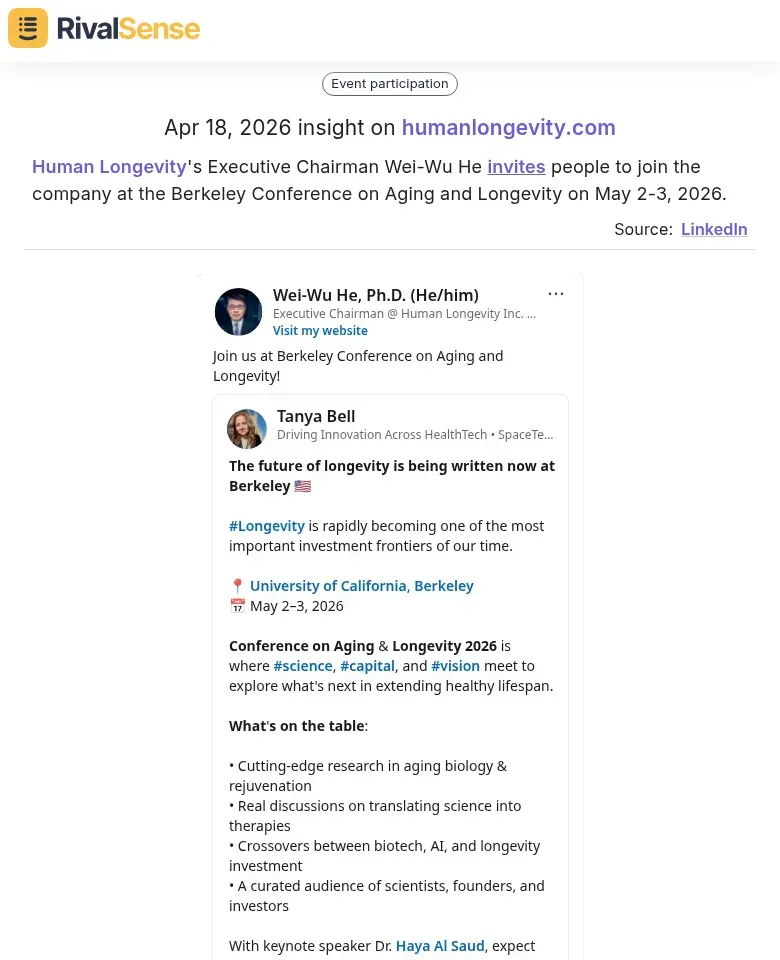
RivalSense spotted that Human Longevity’s Executive Chairman Wei‑Wu He invited people to join the company at the Berkeley Conference on Aging and Longevity on May 2‑3, 2026. This seemingly small social signal tells you the company is actively showcasing its brand at high‑profile longevity events, likely courting partners or investors. Such invitations are easy to miss without systematic monitoring, yet they reveal event engagement depth.
Action plan for conference intelligence:
- Before: list all competitors presenting, review their recent publications, and set team members to cover their sessions and networking events.
- During: capture key quotes, slide content (where permitted), and audience Q&A intensity—high engagement signals novelty or controversy.
- After: cross‑reference new claims with actual product launches over the next 6 months to identify window‑dressing.
💡 Pro tip: Assign one team member to attend competitor pitches and another to network with their engineers; you’ll gather complementary intelligence.
Synthesizing Insights into Competitive Strategy
Disparate bits of intelligence only become a strategy when you structure them. Build a matrix that scores signals from partnerships, technology, leadership, and events on two dimensions: potential disruption (high/medium/low) and time to market (near‑term vs. long‑term). A CRISPR startup filing a broad IP portfolio scores high disruption, near‑term; a new conference speaking slot may be medium disruption, long‑term.
Focus immediate action on the high‑disruption, near‑term quadrant. Cross‑reference signals—a patent filing combined with a key clinical affairs hire strongly suggests an imminent launch. To sustain this rhythm, set up a weekly review cadence:
- Daily: scan alerts (Google Alerts + RivalSense digest) for new competitor events.
- Weekly: update your signal matrix.
- Monthly: hold a strategy sync to reprioritize based on fresh signals.
A simple dashboard tracking patent counts, partnership announcements, board changes, and event presence keeps your team aligned and proactive.
Start Getting Competitor Insights Delivered to Your Inbox
Manually stitching together partnership announcements, board changes, conference appearances, and AI bets is a full‑time job—and a fragile one. Miss one signal and you might miss a market shift. RivalSense monitors your competitors’ websites, social media, internet, and registries, then delivers all critical insights in one weekly email report. It’s how we caught the Human Longevity moves you saw in this post.
Try RivalSense for free and get your first competitor report today — https://rivalsense.co/
📚 Read more
👉 How Competitor Branding Insights Shape Market Entry Trends
👉 How to Turn a Competitor’s Feature Tease into Your Next Win
👉 Key Account Tracking Cost: How to Measure, Monitor, and Protect Margins
👉 Trend Analysis: Competitor Matrix Benefits in Pharma Logistics