
How CoreStream’s Free TPRM RFP Exposes a Powerful Competitive Move
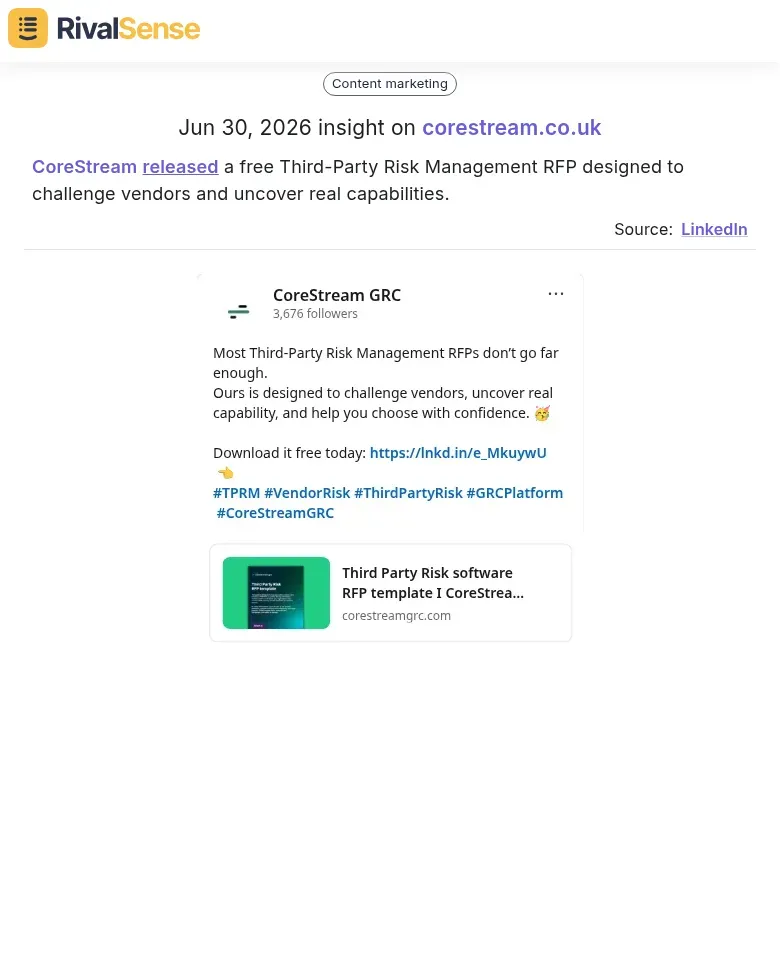
Have you noticed how the smartest competitors often give away something valuable for free? This week, CoreStream released a free Third-Party Risk Management (TPRM) RFP template designed to challenge vendors and uncover real capabilities. At first glance, it’s a helpful tool for procurement teams. But dig deeper, and it’s a brilliant competitive signal.
By putting this RFP into the market, CoreStream is doing far more than generating leads. They’re subtly setting the evaluation criteria that will favour their own platform – all while painting themselves as the transparent, impartial guide. It’s a masterclass in shaping the playing field before your rivals even realise the game has changed.
📸 Here’s the alert that caught our eye:
🔍 Why This Move Matters for Your Competitor Analysis
A free RFP template might seem like a simple content marketing play, but for anyone analysing the TPRM space it’s a strategic weapon. The template is unlikely to be neutral – it will emphasise the very capabilities CoreStream excels at, frame requirements in a way that excludes certain competitors, and put pressure on vendors to justify their shortcomings.
Too often, competitor monitoring focuses on press releases, pricing pages, or product updates. Moves like this are equally threatening because they shape the buyer’s perception months before a formal purchase process begins. If you only track obvious changes, you miss the subtle, high-impact plays.
🛠️ How to Spot and Interpret Such Competitive Moves
To match this level of vigilance, build a routine for monitoring content‑led competitive strategies. Here’s a practical checklist you can start using today:
- [ ] Track downloadable assets – whitepapers, RFPs, assessment frameworks, calculators. These often encode a vendor’s unique viewpoint.
- [ ] Watch for “free advice” that defines the category – e.g., “The 5 Questions Every TPRM Vendor Must Answer”.
- [ ] Analyse the evaluation criteria they propose; map each criterion to known product strengths of the publisher.
- [ ] Check social shares and partner amplification – if a template is being pushed by a partner network, it’s a coordinated campaign.
- [ ] Set up alerts for phrases like “free RFP”, “assessment template”, “buyer’s guide”, “vendor selection toolkit” in your industry.
📊 Reactive vs Proactive Competitor Monitoring
| Reactive Monitoring | Proactive Monitoring |
|---|---|
| You find out when a customer tells you they used a rival’s RFP. | You see the RFP release the day it goes live and prepare counter‑messaging immediately. |
| You scramble to explain why your product doesn’t “tick the box” after the RFP is already in the customer’s hands. | You publish a side‑by‑side comparison or a rebuttal guide before the RFP gets traction. |
| You assume competitive intelligence only matters during a head‑to‑head deal. | You understand that many deals are lost before a formal RFP is even sent out. |
💡 Turning CoreStream’s Tactic into Your Competitive Advantage
- If you compete with CoreStream: Immediately audit the RFP’s questions. Identify the implied “must‑haves” that skew toward CoreStream’s architecture. Train your sales team on how to reframe those criteria and address gaps without sounding defensive.
- If you operate in a different market: Could you emulate this strategy? Publishing a free vendor evaluation framework that highlights your differentiators can reposition you as the thought leader while making it harder for competitors to respond.
- For key account managers: Share this insight with your top accounts. Help them see through the embedded bias and position your solution as the smarter choice – you’ll strengthen the partnership and build trust.
CoreStream’s move reminds us that competitor analysis isn’t just about product roadmaps – it’s about understanding how rivals change the rules of choice. The more early signals you capture, the more time you have to shape the narrative in your favour.
🚀 Stay Ahead with RivalSense
Tracking every whitepaper, toolkit, and hidden competitive move manually is exhausting. That’s why we built RivalSense – it automatically monitors your competitors’ websites, social media, and the wider web for exactly these kinds of signals, and delivers a curated report straight to your inbox. You’ll catch the RFPs, the subtle positioning plays, and the partnership shifts before they become headlines.
👉 Try RivalSense for free and get your first competitor insights report today – so you’re never blindsided by a move like CoreStream’s again.
📚 Read more
👉 Key Account Management Training: A Strategic Blueprint for B2B Leaders
👉 Key Account Performance Dashboard: Real Examples for Heavy Equipment Repair
👉 How DoYouSpain’s SIXT Addition Revealed a Lucrative Gap—and How We Exploited It
👉 Productivity Techniques: Uncover Competitor Sales via Website Changes