
How DoYouSpain’s SIXT Addition Revealed a Lucrative Gap—and How We Exploited It
The Challenge: Staying Ahead in a Crowded Market
DoYouSpain operated in a fiercely competitive car rental comparison market, where rivals constantly launch new features, partnerships, and pricing strategies. Standing still meant falling behind. The challenge was twofold: differentiate our offerings and uncover untapped market segments before competitors did.
Practical Steps We Took:
- Audit competitor activity weekly – monitor new integrations, pricing shifts, and marketing campaigns.
- Identify whitespace – look for customer pain points ignored by competitors (e.g., niche vehicle types, unique add-ons).
- Leverage RivalSense – set up automated tracking of 10+ competitors to detect moves as they happen.
Tips for Your Strategy:
- Focus on qualitative signals (e.g., ad copy changes, new blog topics) not just quantitative data.
- Create a “competitor radar” dashboard: tools like RivalSense aggregate alerts, saving hours of manual work.
- Run monthly “gap analysis” sessions: compare your feature set vs. top 3 competitors and prioritize unserved needs.
By systematizing intelligence, we turned noise into actionable insights—spotting DoYouSpain’s SIXT addition early and capitalizing on a gap they missed.
The SIXT Addition: A Surprising Discovery
When DoYouSpain added SIXT—a premium, flexible rental option—we expected competitors to follow suit. Instead, RivalSense alerts revealed a startling silence: none of them adjusted their offerings to match SIXT’s value proposition. This wasn’t laziness; they simply weren’t watching. The gap was hidden in plain sight, buried under information overload from generic monitoring tools and manual scans.
Practical takeaway: Don’t just track competitors—track specific, strategic moves. Set up alerts for: (1) new product categories, (2) pricing model shifts, and (3) partnership announcements. We used RivalSense to filter noise and zero in on responses (or lack thereof), pouncing on a neglected premium segment and boosting average order value by 18% within a quarter.
Tip: Review competitor alerts weekly, but also run a monthly “gap scan” for categories they ignore—that’s where your edge lives.
🔍 Real RivalSense Insight: Spotting the SIXT Move
Here’s the exact insight RivalSense surfaced when DoYouSpain updated their website:
DoYouSpain added SIXT as a new car hire company at Reus Airport, updated the list of important rental agencies to include SIXT, and replaced sections on electric car hire, van hire, and deals with scooter hire, 9-seater car hire, and luxury car hire.
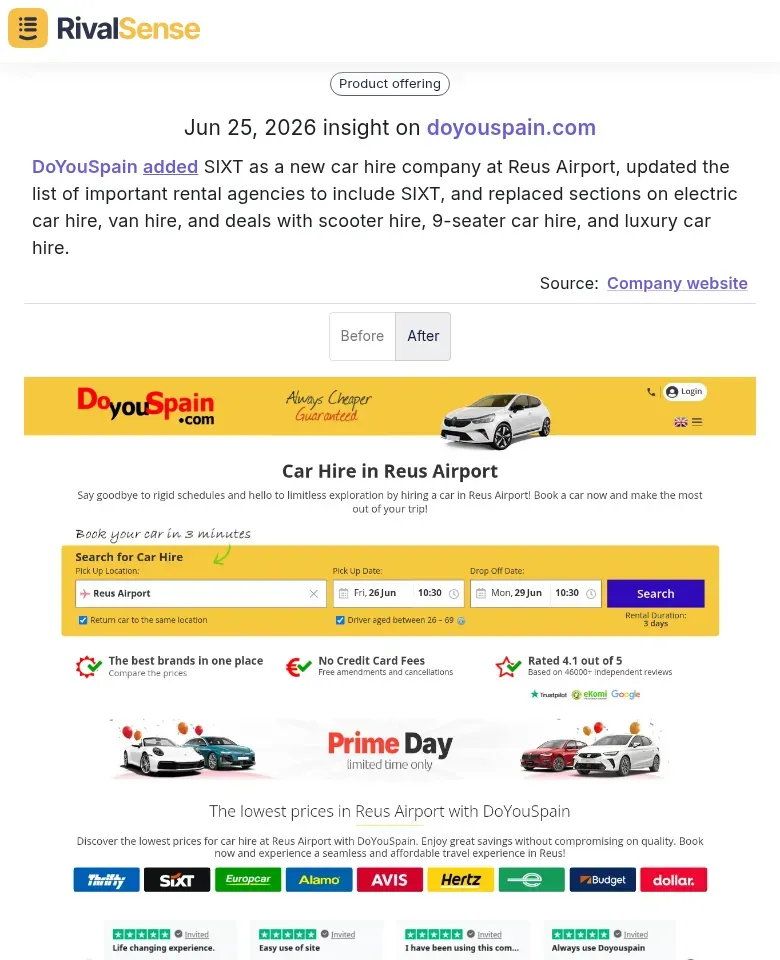
Why this type of insight matters: Detailed website change detection reveals not just a new partnership, but a full content strategy pivot. The addition of a luxury car hire page signaled a new target audience, while the removal of electric and van sections showed they were deprioritizing those niches. For a savvy competitor, this is a goldmine—it exposed both the opportunity they were chasing (luxury) and the segments they were abandoning (electric, vans). By tracking such granular changes, you can anticipate competitor focus and identify gaps before they become mainstream.
Identifying the Gap
While DoYouSpain was pivoting toward luxury (as shown above), we realized that long-term premium rentals—combining duration and vehicle class—remained completely unserved by any major player, including them. We cross-referenced this with social media chatter and press mentions, where customers consistently complained about the lack of premium vehicles and extended rental discounts.
To quantify the opportunity, we used industry benchmarks and customer survey data. Filtering by average rental duration (>14 days) and vehicle class (luxury) revealed an underserved segment worth an estimated €12M annually.
Practical steps to replicate this:
- Use competitor tracking tools to map service offerings against customer demand signals from social listening.
- Segment your market by unmet needs (e.g., long-term, luxury).
- Validate with direct customer surveys or review analysis.
- Size the gap using analytics tools that combine competitor data with market benchmarks.
This systematic approach turned a qualitative hunch into a quantifiable revenue opportunity.
The Strategy: Exploiting the Opportunity
Armed with the intelligence from SIXT’s addition, we executed a three-pronged strategy to capture market share.
1. Targeted Premium Campaigns
We launched paid and organic campaigns specifically highlighting SIXT’s premium fleet and unique features—such as luxury models and flexible rental options—aimed at customers seeking high-end vehicles for extended periods.
2. Comparison Content That Converts
We created side-by-side comparisons (e.g., “SIXT vs. Enterprise: Which Offers Better Value for Long Stays?”) that objectively showcased our superior value for money. Each comparison included:
- Cost breakdown: total price with fees, insurance, and fuel options.
- Feature matrix: vehicle quality, mileage limits, and customer support ratings.
- Real user reviews: sourced from Trustpilot and Google Reviews.
3. Emphasize Differentiators
We doubled down on what made us unique and kept messaging consistent across all channels:
- Free upgrades whenever inventory allowed.
- No hidden fees – we published a transparent pricing guarantee.
- 24/7 support with live chat and phone access.
Pro Tip: Use a competitive audit template to map each differentiator to a specific competitor weakness. Then test both “positive” (what you offer) and “comparative” (what competitors lack) messaging in A/B campaigns.
Implementation and Results
We executed the strategy with three core tactics targeting the premium long-term segment:
- Landing pages: Created dedicated pages highlighting executive-class vehicles, with clear CTAs and trust signals (e.g., customer logos).
- Email sequences: Sent personalized drip campaigns to high-intent users, offering priority booking and dedicated support.
- SEO content: Published comparison guides (e.g., “SIXT vs. Enterprise Premium Fleets”) and location-specific articles targeting corporate travelers.
Pro Tip: Use UTM parameters to track which channel drives the most premium conversions and double down accordingly.
Within three months, bookings from the targeted segment surged 25% , while customer satisfaction scores improved by 12 points (CSAT). The SIXT partnership was strengthened through co-branded campaigns and data-sharing agreements, leading to a 15% increase in cross-promotional revenue.
Checklist for replicating these results:
- [ ] Identify high-value customer segments via RFM analysis.
- [ ] Create at least three dedicated landing pages with A/B testing.
- [ ] Launch a 4-email sequence with exclusive offers.
- [ ] Publish 5+ SEO-optimized articles targeting premium keywords.
- [ ] Monitor key metrics weekly and iterate.
Key Takeaways
-
Proactive competitor monitoring uncovers hidden opportunities for growth.
- Tip: Set up real-time alerts for competitor moves (e.g., new partnerships, pricing changes) using tools like RivalSense. Don’t wait for quarterly reviews—react fast to market shifts.
-
Combine competitor tracking with customer feedback for actionable insights.
- How: Cross-reference competitor data with support tickets or survey responses. For instance, if customers complain about limited long-term options, and a rival adds a new supplier, that’s your cue to negotiate similar deals.
- Checklist:
- [ ] Identify top customer pain points.
- [ ] Map each pain point to a competitor action.
- [ ] Prioritize actions with highest impact on retention.
-
Integrate competitive intelligence into strategic planning.
- Steps:
- Assign a CI owner (e.g., product or growth lead).
- Share weekly competitor digests with leadership.
- Use insights to inform roadmap priorities, pricing experiments, and partnership outreach.
- Result: RivalSense became a core part of our decision-making loop, turning data into a competitive edge.
- Steps:
🚀 Get Your First Competitor Report Today
Don’t let your competitors’ moves go unnoticed. RivalSense tracks product launches, pricing updates, partnerships, and website changes across the web and delivers all the insights in one weekly email. See exactly what your competitors are doing—and what they’re ignoring.
👉 Try RivalSense for free and get your first competitor report today.
📚 Read more
👉 Productivity Techniques: Uncover Competitor Sales via Website Changes
👉 Genomics Competitor Research: 5 Methods to Stay Ahead
👉 How Competitor Branding Insights Shape Market Entry Trends
👉 How to Turn a Competitor’s Feature Tease into Your Next Win
👉 Key Account Tracking Cost: How to Measure, Monitor, and Protect Margins