
How Competitor Branding Insights Shape Market Entry Trends
When entering a new market, your competitors' branding choices offer a treasure trove of strategic insights. Their visual identity, messaging, and positioning reveal not only market readiness but also evolving consumer preferences. For instance, a competitor's shift toward localized branding signals that the market values cultural relevance, while a focus on sustainability may indicate a growing eco-conscious segment. By observing these moves, you can identify gaps—such as underserved customer needs or overlooked brand attributes—and uncover opportunities to differentiate. Branding decisions also telegraph strategic priorities: a competitor investing in influencer partnerships suggests community-driven growth, while a minimalistic rebrand may hint at a premium pivot.
Practical tip: Use a competitor branding audit checklist—analyze their visual identity, tone of voice, value proposition, and target audience. Track changes quarterly to spot trends early. Pay attention to new logos, taglines, or campaign themes; they often precede product launches or market expansions. For example, if a rival adopts a more formal tone, they might be targeting enterprise clients—a signal to refine your own positioning. By decoding these signals, you can align your market entry strategy with real-time consumer sentiments and outmaneuver competitors.
Localization and Language Adaptation as Branding Signals
When a competitor localizes their website, app, or marketing materials, they're sending a strong signal about market commitment. Analysis of localization depth—beyond mere translation to cultural adaptation (currencies, imagery, humor)—reveals how seriously they take a region. Practical tip: Track competitors' language rollouts using tools like Wappalyzer or built-in browser language detection. Note when they add new languages; early localization often signals a market entry priority. For example, a SaaS firm adding Japanese and Korean before Spanish may indicate an Asia-first strategy.
Multilingual support itself is a competitive differentiator, especially in regions like the EU, Canada, or Southeast Asia where customers expect native-language experiences. Checklist:
- Identify top 3 markets your competitor targets by language additions.
- Compare their localization quality: is it simply translated or truly culturally adapted?
- Note if they offer region-specific pricing or payment methods alongside language.
Action step: Create a timeline of competitors' language releases vs. their fundraising, hiring, or press mentions. Patterns emerge—e.g., localization often precedes major marketing pushes by 6–12 months. Use this intel to anticipate your own market moves or preemptively strengthen your position.
💡 Insight from RivalSense: Amazon’s Alexa+ is now fully available across Canada in English and French, free for Prime members, and the assistant has expanded to Brazil.
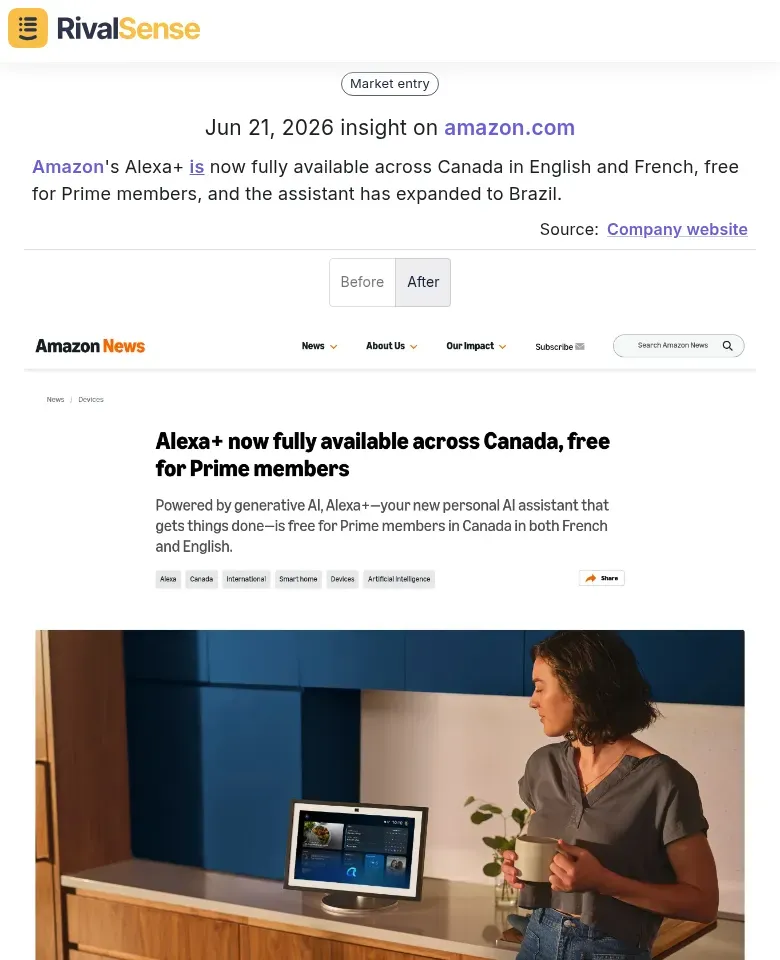
Why it matters: Monitoring both language rollouts and pricing bundles reveals not only market entry priorities but also adoption tactics. Amazon’s move signals a bilingual push tied to a free bundled offer—lowering barriers via Prime membership. By tracking such signals, you can decode localisation depth and anticipate go‑to‑market strategies that you can replicate or counter.
Leveraging Government Partnerships for Credibility and Speed
When entering a new market, aligning with government entities can fast-track credibility and operations. Here’s how to leverage public-private partnerships effectively:
1. Involve Officials in Launches
Invite government representatives to product unveilings or factory openings. Their presence signals regulatory endorsement and builds trust with local customers and partners.
2. Invest in Physical Infrastructure
Building factories or R&D centers demonstrates long-term commitment. This tangible investment often grants preferential treatment in permits and tax incentives.
3. Use Partnerships to Accelerate Approvals
Formal agreements with government agencies (e.g., joint innovation labs) can streamline licensing and compliance. Example: Tesla’s Shanghai Gigafactory benefited from rapid approvals due to local government collaboration.
Practical Checklist:
- [ ] Identify key government stakeholders in your target market.
- [ ] Propose a joint initiative (e.g., training program, co-branded facility).
- [ ] Highlight your investment’s economic impact (jobs, technology transfer).
- [ ] Secure a memorandum of understanding (MoU) to formalize support.
Pro Tip: Research competitors’ government ties using tools like RivalSense to uncover which partnerships gave them speed advantages—then replicate or differentiate.
💡 Insight from RivalSense: Frankenburg Technologies opened a factory in Riga, Latvia, on June 20, 2026, with EU officials Airis Rikveilis, KubiliusA, and KustiSalm attending.
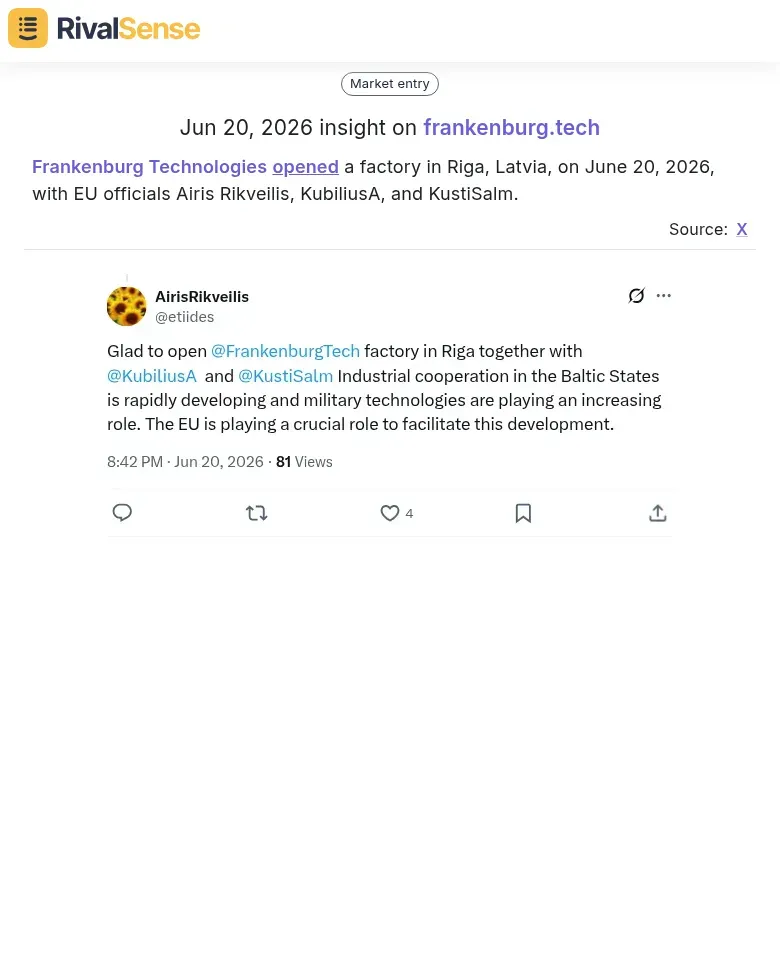
Why it matters: Tracking such high-profile government partnerships tells you which markets are receiving special incentives and fast-track approvals—knowledge you can use to lobby for similar support or to anticipate a competitor's accelerated product rollout.
Scaling Service Regions: From Regional to Global Footprint
Scaling from regional to global requires navigating diverse legal and regulatory environments. Actionable tip: Create a regulatory checklist for each target market—covering data privacy (e.g., GDPR), employment law, and industry-specific licenses. Engage local legal counsel early to avoid costly missteps.
Brand consistency across regions builds global recognition. Practical step: Develop a 'brand core' playbook defining your voice, visuals, and values, then allow regional teams to adapt execution (e.g., localizing messaging while keeping logos and color palettes intact). Audit competitor branding in each new market to identify positioning gaps you can exploit.
Phased regional expansions let you test and adapt. Recommended approach:
- Pilot in one region (e.g., EU) for 6 months.
- Measure brand recall, customer feedback, and regulatory fit.
- Refine based on competitor branding insights—what resonates locally vs. globally.
- Scale to adjacent regions, iterating the playbook.
Checklist for market entry:
- [ ] Regulatory compliance audit
- [ ] Local competitor brand analysis
- [ ] Brand asset localization
- [ ] Pilot launch with KPIs
- [ ] Feedback loop for adaptations
💡 Insight from RivalSense: Prenuvo expanded its service regions from US/CA to North America, Australia, and the United Kingdom.
Why it matters: Monitoring service region expansions signals that a competitor has likely cleared major regulatory hurdles and is adapting its brand strategy for new audiences—intelligence that helps you scope your own expansion timeline and avoid overlapping markets.
Pricing and Bundling Strategies to Accelerate Adoption
When entering a new market, pricing and bundling strategies can make or break adoption. One proven tactic is offering free tiers or bundled services—Slack did this effectively by letting teams use its free plan before converting them to paid. Start by analyzing local economic conditions: in price-sensitive markets, low-cost or freemium models lower the barrier to entry. Practical steps: 1) Audit competitor pricing for similar offerings to identify gaps; 2) Test a localised bundle that combines your core product with a complementary service (e.g., software + onboarding); 3) Monitor competitor reactions to your pricing—sudden discounts or new bundles indicate they feel threatened. Competitor pricing moves also reveal market entry barriers: if rivals consistently offer zero-commitment trials, that suggests trust is a hurdle. Use a simple checklist: ✓ Assess average customer lifetime value in the target market. ✓ Compare your unit economics against local incumbents. ✓ Pilot a tiered pricing structure (free, basic, premium) for 90 days. Remember, aggressive pricing can signal desperation; instead, frame bundles as value-adds. For example, if competitors charge separately for support, bundle it in at a 20% premium to differentiate.
Conclusion: Synthesizing Insights for Your Market Entry Strategy
To succeed in market entry, synthesize competitor branding insights into a cohesive strategy. First, aggregate data from visual identity, messaging, positioning, and customer sentiment to spot patterns—e.g., a shift toward sustainability signals green market opportunities. Use these branding cues to anticipate competitor moves: if a rival rebrands to emphasize ease-of-use, expect feature simplification or user experience upgrades. Continuously monitor branding changes—set up alerts for logo updates, tagline shifts, or tone changes on social media and websites. Create a live dashboard tracking these elements monthly. Actionable checklist:
- Audit 3–5 competitors quarterly for branding changes.
- Map messaging shifts to potential strategic pivots (e.g., new audience segments).
- Conduct sentiment analysis on competitor brand mentions to gauge market reception.
- Test your own branding against competitor cues to differentiate.
By weaving these insights into your market entry plan, you reduce blind spots and capitalize on emerging trends before competitors solidify their positions.
Implementing these strategies requires continuous monitoring of competitor moves. RivalSense delivers weekly reports on competitor expansions, pricing changes, government partnerships, and more, straight to your inbox. Try RivalSense for free and get your first competitor report today.
📚 Read more
👉 How to Turn a Competitor’s Feature Tease into Your Next Win
👉 Key Account Tracking Cost: How to Measure, Monitor, and Protect Margins
👉 Trend Analysis: Competitor Matrix Benefits in Pharma Logistics
👉 Struggling to Win Key Accounts? Twitter Reveals Competitor Intel