
How Website Changes Uncover Competitor Financial Insights
When your competitor quietly adds a 'Pricing' page or removes a 'Careers' section, they're not just updating their site—they're telegraphing strategic bets worth millions. Website changes are one of the most underutilized signals in competitive intelligence because they're public, frequent, and often unintentionally revealing.
Consider this: a B2B SaaS competitor launching an enterprise tier typically adds pages for 'Security Compliance,' 'Case Studies,' or 'ROI Calculator.' Conversely, removing a 'Self-Serve' page may signal a pivot upmarket. By systematically tracking these modifications, you can infer budget allocation, product roadmap priorities, and even hiring surges before official announcements.
Here's how to start monitoring like a CI pro:
- Set up automated alerts using tools like Visualping or Distill to track specific URL patterns (e.g., /pricing, /solutions, /partners).
- Maintain a changelog spreadsheet with dates, page URLs, and your inferred strategic rationale.
- Correlate changes with external events—a new 'Enterprise' page coinciding with a funding round signals a go-to-market shift.
- Analyze content depth: multiple new pages on compliance? They're chasing regulated industries.
By turning website changes into a leading indicator, you move from reactive to proactive strategy—spotting competitors' financial bets weeks or months before they surface in earnings calls.
Strategic Pivots Revealed Through Navigation Restructuring
Strategic pivots often manifest in website navigation changes before they appear in earnings calls. When a competitor removes a section like 'Sustainability' or 'Corporate Social Responsibility,' it may signal a shift away from non-core initiatives toward core revenue generators. Conversely, the addition of sections such as 'Fleet' or 'Money' indicates new revenue streams or operational focus.
Recently, RivalSense captured just such a pivot: inDrive restructured its website navigation, adding new sections for 'Money', 'Fleet', 'AV Initiative', 'Newsroom', 'Blog', and expanded 'Support' categories, while removing 'New Ventures', 'Sustainability', and 'Law enforcement form'.

inDrive’s navigation overhaul signaled a shift toward core revenue operations and autonomous vehicle initiatives.
This type of insight is valuable because it reveals a competitor’s repositioning: they are likely investing in fleet operations, autonomous driving, and monetization (Money), while scaling support for growth. The removal of 'Sustainability' and 'Law enforcement form' may indicate a strategic deprioritization of non‑core initiatives, freeing resources for higher‑priority bets.
Actionable tip: Set up weekly website change monitoring using tools like RivalSense to track navigation structure shifts. Create a 'Navigation Change Log' spreadsheet with columns for date, old structure, new structure, and inferred strategic focus. When a new section appears, dig deeper: is it a product line, target audience, or service offering? If a section disappears, check if content was archived or redirected—this can indicate discontinued initiatives. Cross-reference these changes with job postings (e.g., new roles in 'Fleet' or 'Sustainability') to validate the pivot. Finally, share findings with your strategy team quarterly to adjust your competitive positioning accordingly.
Product Development Signals from Content Additions and Removals
To decode a competitor’s product strategy, monitor their website for subtle content shifts. Adding new product collections signals entry into adjacent markets, while removing older collections indicates audience deprioritization—often due to low ROI. Community‑focused additions reveal partnership or ecosystem‑building moves.
A concrete example from RivalSense: GitHub recently added a 'Game Engines' collection and a 'GitHub Copilot SDK Reddit Contest Winners' collection, while removing 'Made in Brazil' and 'Learn to Code' collections.
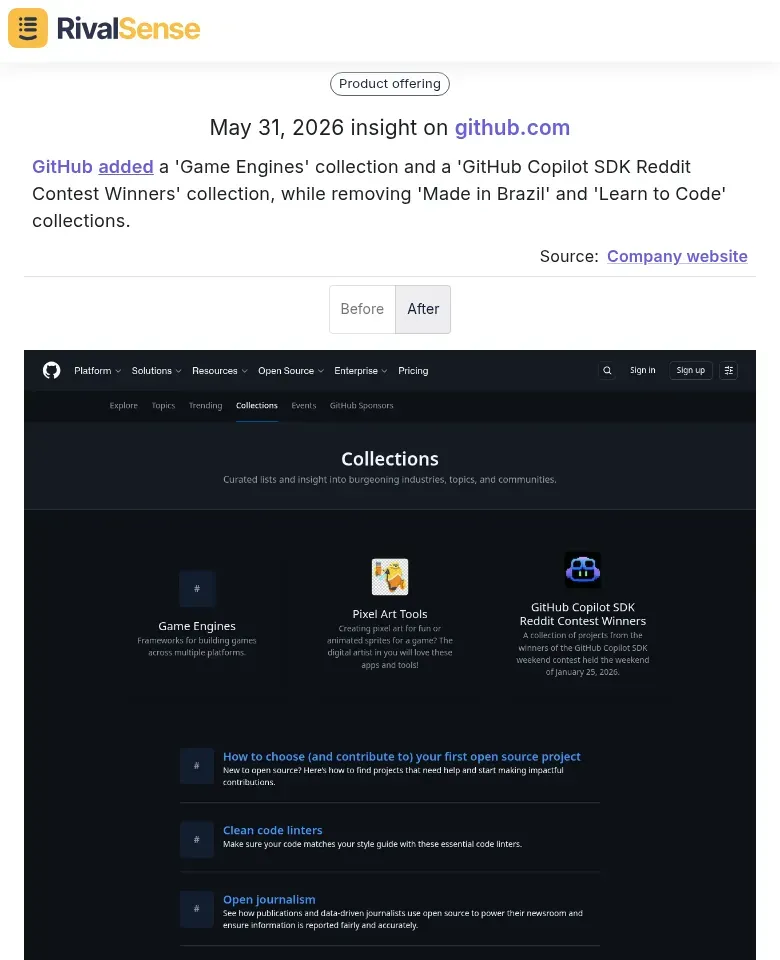
GitHub’s additions hint at market expansion into game development and deeper developer ecosystem engagement.
Spotting changes like these can alert you early to market expansion (Game Engines), developer community engagement (SDK contest winners), and audience retargeting away from general coding education (Learn to Code). This quick intelligence helps you adjust your own product roadmap and community strategy before announcements are made.
Actionable steps:
- Track additions weekly using automated alerts (e.g., Wachete, Distill) or a simple diff script to capture new pages.
- Note removals—they often precede pivots. Archive old pages for future reference.
- Categorize changes into: new segments, deprioritized audiences, and community plays.
- Cross-reference with job postings (e.g., new roles in game development) and funding news to validate signals.
Pro tip: Create a public changelog of competitor site changes. This not only sharpens your own strategy but positions your brand as an industry analyst. Consistency trumps depth—even 15 minutes weekly yields actionable intelligence.
Pricing and Partnership Shifts Hidden in Promotional Changes
When a competitor changes their discount percentage—say, moving from 20% to 40% off annual subscriptions—it often signals a strategic shift. A deeper discount could indicate an aggressive push for market share or pressure to close more deals before a funding round. Conversely, reducing discounts might suggest a pivot to profitability.
Replacing one promotional offer with another is equally telling. For instance, RivalSense observed Где мои дети replacing a 10% discount at cafe Андерсон with a 30% discount on a subscription in the Логопотам app.

A shift from a third‑party café discount to own‑platform subscription discount signals a new revenue model focus.
This type of promotional change reveals a clear strategic pivot: the company is moving from external partner‑driven acquisition toward in‑house recurring revenue. For competitors, it suggests a bet on higher‑margin subscription monetization and a possible deprioritization of co‑marketing channels.
Track these shifts weekly using a simple spreadsheet; note both the percentage and the context (e.g., seasonal, always-on). Set up alerts on their promotions page to catch these swaps in real time. Finally, watch which partners appear in promotions. A competitor touting a “free trial with HubSpot” vs. a “free trial with Shopify” reveals which ecosystem they’re betting on. Build a partner tracker map: list all co-marketing or co-selling partners they promote, then note any additions or removals monthly. This uncovers their customer acquisition channel focus and potential competitive threats to your own partnerships.
Building a System to Monitor and Interpret Website Changes
To systematically track competitors' website changes at scale, leverage automated tools like change detection services (e.g., Visualping, Wachete) or browser extensions. Configure monitors to check key pages daily or weekly, and store snapshots for historical comparison.
Categorize Changes for Systematic Analysis
- Navigation & UX: New product sections, simplified checkout flows—often signal feature launches or UX optimizations.
- Pricing & Plans: Updated tiers, promo banners, or pricing page copy—directly impact revenue models.
- Content & Messaging: New case studies, about page rewrites, or blog topics—reflect targeting shifts.
Create a spreadsheet or use a CRM to log each change with date, URL, category, and a brief description. Tag changes as “major,” “minor,” or “test” based on potential impact.
Correlate Changes with Financial Outcomes
Align website changes with public financial data (quarterly reports, funding announcements, or press releases). For example: a competitor adds a new pricing tier → 3 months later they report 20% revenue growth from that segment. Use this correlation to validate your competitive assumptions.
Practical Checklist
- Identify 3–5 competitors’ core pages to monitor.
- Set up automated screenshots and diff alerts.
- Weekly: review changes, categorize, and note financial signals.
- Monthly: cross-reference changes with earnings calls or industry reports.
By systematizing this process, you transform raw website noise into a predictable signal of competitor strategy and financial health.
Conclusion: From Website Signals to Strategic Decisions
Website changes are more than surface-level updates—they are leading indicators of strategic pivots, funding rounds, or product launches. By systematically monitoring competitors' sites, you can anticipate their next moves before press releases or earnings calls confirm them.
How to turn signals into strategy:
- Set up a weekly scan of competitor websites (pricing, case studies, team pages, blog posts). Tools like RivalSense automate this, but even a manual checklist works.
- Categorize changes by severity: minor (design tweaks) vs. major (new product pages, pricing shifts, executive hires).
- Cross-reference with other sources: Crunchbase for funding, LinkedIn for hiring surges, review sites for customer sentiment changes.
- Create an action matrix: If competitor drops price → adjust positioning. If they launch a feature → accelerate your roadmap. If they hire aggressively → expect a new market push.
A practical tip: Keep a shared "Competitor Signals Log" where your team notes each change and its potential impact. Over time, patterns emerge—like a competitor always updating their pricing page before quarterly earnings.
Remember, website intelligence is just one piece. Combine it with financial filings, job postings, and customer chatter for a 360° view. The goal isn’t to react—it’s to stay one step ahead.
Ready to spot competitor moves early? Try RivalSense for free at https://rivalsense.co/ and get your first competitor report today.
📚 Read more
👉 The Ultimate Competitor Content Tracking Template
👉 Decoding Competitor Product Moves: A Practical Guide to Key Account Tracking
👉 What Gives Our Competitors an Edge? — And How to Find Your Own
👉 Master Competitor Product Launch Monitoring for Fleet Success