
Master Competitor Product Launch Monitoring for Fleet Success
For fleet management companies, tracking competitor product launches isn't just about staying aware—it's a strategic imperative that drives smarter decision-making, uncovers market gaps, and protects your competitive edge. Below, we break down how to turn monitoring into actionable fleet strategy.
Why Competitor Product Launch Monitoring Drives Fleet Success
Monitoring competitor product launches gives you a direct line into the market's evolving priorities. Here's how it fuels fleet success.
1. Anticipate Market Shifts
By systematically tracking rivals, you spot emerging trends before they become mainstream. If three competitors launch AI-powered route optimisation tools within a quarter, that's a clear pivot. Tip: set up alerts for competitor press releases and product pages to catch these signals early.
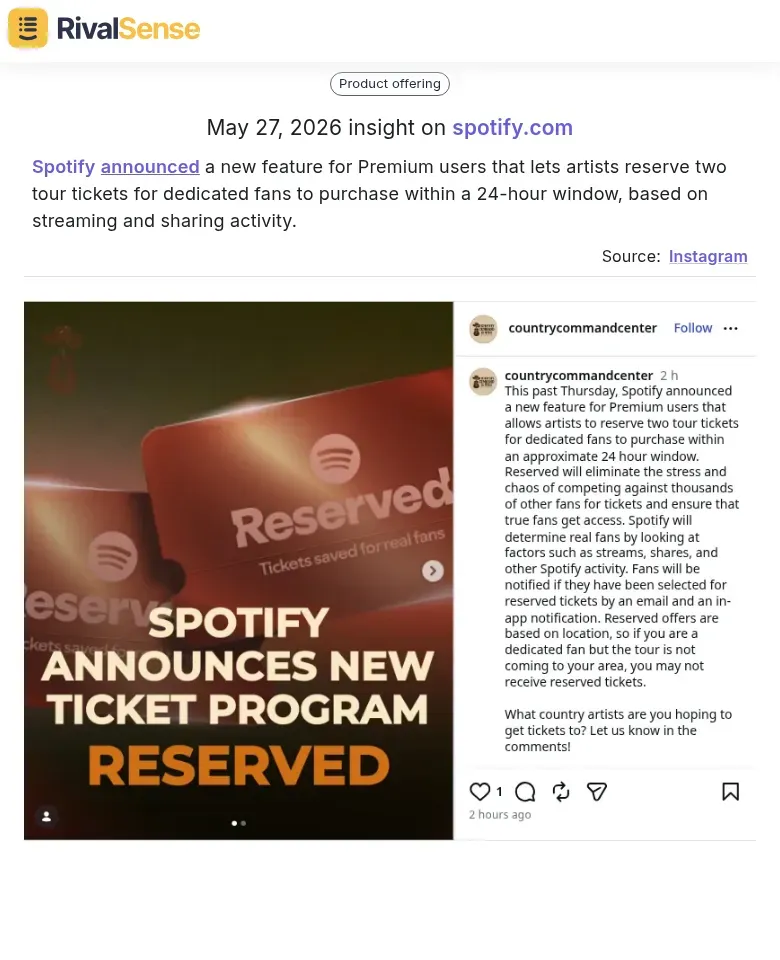
Equally powerful is identifying a single bold move that hints at a broader shift. For example, RivalSense captured Spotify's new feature that lets artists reserve tour tickets for dedicated fans based on streaming activity. This type of launch insight—spotting a move toward fan engagement monetisation—can alert your fleet business to consider similar engagement-centric features for logistics platforms or driver apps, helping you stay ahead instead of reacting late.
2. Identify Gaps & Opportunities
Look at what competitors emphasise—and what they ignore. If everyone focuses on premium telematics dashboards, there's room for a simplified, cost-effective fleet tracker. Checklist: map competitor offerings against customer pain points to find white space.
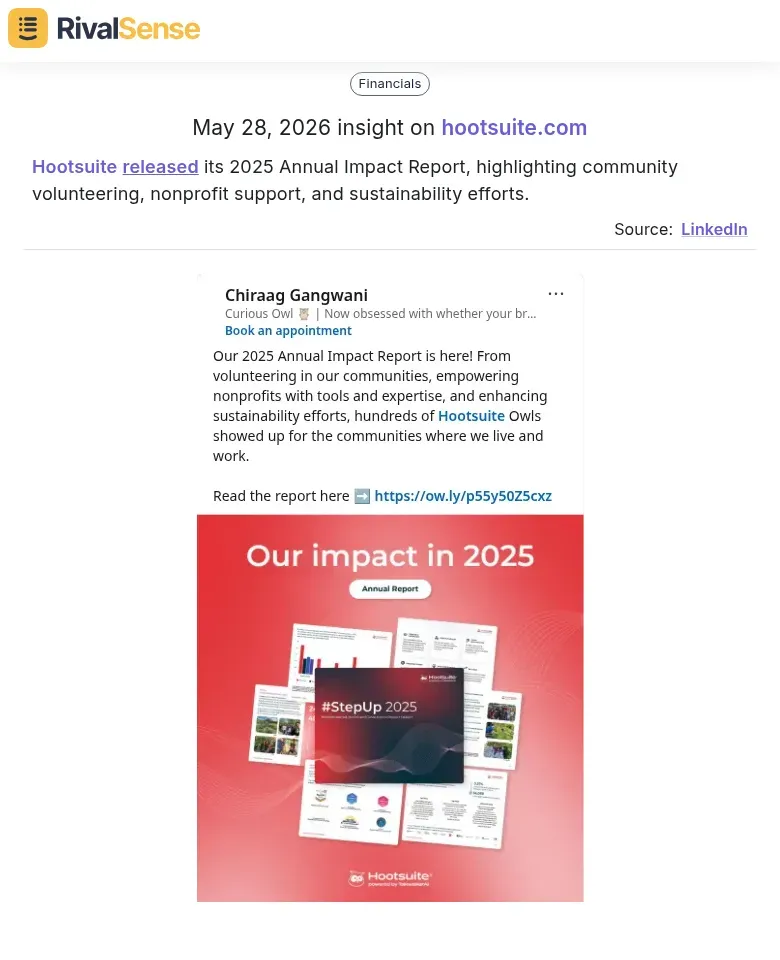
Beyond features, track corporate moves like social responsibility reports. When a rival releases a major impact report, it signals a shift in brand values that can open a positioning gap for you. RivalSense spotted Hootsuite's 2025 Annual Impact Report highlighting volunteering, nonprofit support, and sustainability. Such an insight reveals a competitor betting on ESG appeal—leaving room for a fleet solution provider to double down on pure ROI, uptime guarantees, or technical superiority.
3. Learn from Their Mistakes
Study failed launches to avoid similar pitfalls. Did a competitor's fleet maintenance module update cause integration headaches? That's a red flag for your roadmap. Action step: create a “lessons learned” log from competitor flops and review before your own launches.
When you consistently track launches, you turn reactive scrambling into proactive steering—exactly what fleet success demands.
Building a Robust Monitoring Framework
A strong framework ensures you never miss a relevant launch. Start by selecting the right signals.
Step 1: Pinpoint signal sources
Focus on three: press releases (track on PRWeb or Business Wire), social media (monitor LinkedIn for executive announcements, Twitter/X for teasers), and industry events (check conference agendas and exhibitor lists). Pro tip: create a signal priority matrix ranking by lead time and business impact.
Step 2: Automate real-time alerts
Use Google Alerts for brand mentions, Capterra or G2 for new product listings, and dedicated competitor tracking tools like RivalSense or Crayon for daily digests. Set up webhook-based alerts to Slack or Teams so your team gets instant notifications.
Step 3: Assign ownership and build a cross-functional team
Designate a competitive intelligence lead (often from Product or Strategy). Include members from Product (feature analysis), Marketing (messaging response), Sales (battle cards), and Customer Success (retention risks). Hold a weekly 30-minute sync to review alerts and assign actions.
✓ Checklist: Signal sources defined, Tools configured, Roles assigned, Response playbook created.
Critical Metrics to Evaluate Competitor Launches
To outmaneuver competitors, focus on three critical metrics during their launches.
Adoption Rates & Early Feedback
Track sign-ups, trial-to-paid conversion, and churn within the first 90 days. Scrape review sites (G2, Capterra) and social media for sentiment. Tip: set up Google Alerts for competitor product names + “review” or “alternative” to catch organic feedback.
Pricing, Features & Positioning
Monitor pricing page changes with tools like VisualPing. Compare feature matrices using a simple checklist: Must-have, nice-to-have, differentiators. Note shifts in messaging (e.g., from “enterprise fleet” to “SMB logistics”)—that signals target audience pivots.
Media Coverage & Analyst Sentiment
Track press mentions via tools like Meltwater. Look for analyst reports (Gartner, Forrester) citing the launch. Checklist: (a) number of articles in first month, (b) tone (% positive/negative), (c) key themes (e.g., “AI-powered route planning” vs “cost-effective”).
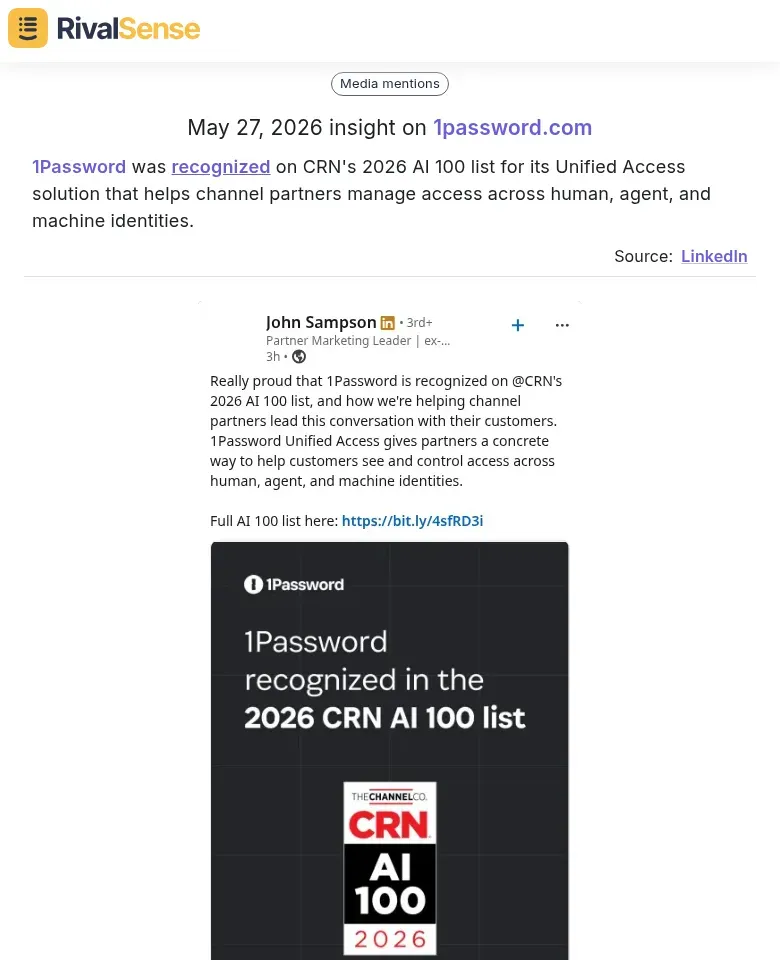
Media mentions aren't just about volume; accolades and recognitions carry immense weight. RivalSense identified that 1Password was named to CRN's 2026 AI 100 list for its Unified Access solution. Such an insight—a competitor receiving an industry award for a channel-friendly innovation—signals market validation and growing credibility. For your fleet business, knowing a rival just gained analyst trust can trigger a strategic review of your own partner programmes or positioning.
Quick Win: Create a shared spreadsheet with columns for each metric. Update weekly. Use conditional formatting to flag anomalies—sudden price drops or negative review spikes—so your team reacts in real time.
Deconstructing Competitor Launch Strategies
To dissect a launch, start with go-to-market tactics—note exact timing (pre-announcement vs. day-of), distribution channels (social, email, paid ads), and messaging themes (urgency, innovation, cost savings).
Next, assess target segments. Who are they speaking to? If they emphasise a feature you lack, that's a value proposition gap. Map their claim to your product's actual positioning.
Finally, identify ecosystem plays. Did they announce a partnership with a complementary tool? Check if they launched on a marketplace (e.g., Salesforce AppExchange) or integrated with a platform you use.
Practical tip: Create a “launch scorecard” with columns for timing, channels, messaging, target audience, partnerships, and your countermove. Fill it within 48 hours. This structured analysis reveals weaknesses you can exploit and strengths to learn from.
Translating Insights into Fleet Strategy
Raw competitive data is worthless without action. Turn launch intel into winning moves.
1. Prioritise Roadmap Adjustments
Rate each launch on relevance (affects your customer base?), urgency (immediate threat?), and difficulty (effort to respond). Focus only on high-score items; deprioritise noise.
2. Develop Counter-Strategies
- Marketing: Launch a side-by-side comparison page within 48 hours of a major release. Target weak spots (e.g., missing fleet compliance features, higher price).
- Sales Enablement: Equip reps with a one-pager titled “Why [Competitor]’s New Launch Isn't a Game Changer” plus three counterpoints.
3. Create Rapid-Response Playbooks
Build a template with: (a) trigger event (e.g., press release), (b) internal notification protocol (Slack channel + email), (c) pre-approved social/PR messaging, (d) cross-functional owner. Run a quarterly drill to test speed. Pro tip: keep a dedicated “war room” Slack channel where marketing, product, and sales convene within one hour of a launch.
Sustaining a Competitive Intelligence Culture
Lasting competitive intelligence requires more than sporadic checks. Establish a regular reporting cadence—weekly briefs for tactical teams, monthly deep-dives for leadership—using a one-page template covering competitor moves, impact analysis, and recommended actions.
Integrate insights into planning by embedding competitive reviews into quarterly OKR cycles and product roadmapping. Before each sprint, ask: “Which competitor launch could disrupt our next feature?” Assign a CI champion per team.
Foster company-wide awareness via a shared dashboard or Slack channel with real-time alerts. Celebrate wins where CI influenced a decision. Run quarterly workshops to analyse a rival's launch pattern. Rotate monitoring responsibility monthly so everyone builds the muscle. Audit your CI maturity every 6 months and iterate.
Sustaining the culture transforms competitive intelligence from a task into a strategic reflex—keeping your fleet business ahead.
Ready to turn competitor monitoring into your fleet company's superpower? RivalSense tracks competitor product launches, pricing updates, partnerships, and media mentions across websites, social media, and registries—delivering all the insights you need in one weekly email report. Try RivalSense for free and get your first competitor report today.
📚 Read more
👉 How to Turn Competitor Innovations Into Your Own Market Edge: A RivalSense Case Study
👉 Track Competitor Sentiment on LinkedIn: A Step-by-Step Guide
👉 Monitor Competitor Signals to Predict Fintech Expansion Moves
👉 Advanced Media Monitoring Tactics for Key Account Growth
👉 Uncovering Competitor Moves: How a Documentation Overhaul Signals Strategic Shift