
What Gives Our Competitors an Edge? — And How to Find Your Own
A competitor’s edge is any lever they pull that makes them more attractive to customers than you. It goes beyond a single feature or a temporary price cut—it’s the structural reason they keep winning deals you thought were yours.
It could be:
- Cost leadership – They offer the lowest price in the market.
- Differentiation – Their product or service stands out in a meaningful way (quality, features, brand).
- Niche focus – They serve a small, specific segment better than anyone else.
- Geographic advantage – Location gives them access to resources, talent, or customers.
- Customer service – They deliver an experience that builds fierce loyalty.
- Talent – They’ve hired a team that out-executes everyone else.
But before you can build your own edge, you need to know exactly what gives them theirs.
5 Signs Your Competitor Has a Real Edge
Not every competitor move signals a structural advantage. Often, it’s noise. Here’s how to spot the real thing:
- They win customers you thought were locked in. If a rival consistently siphons your best accounts, they’re offering something you’re not.
- They launch new products faster. Speed to market is often the result of superior processes, not luck.
- They raise prices without losing share. That’s a sign of differentiation and brand power.
- They dominate a niche you ignored. Narrow focus can be a moat.
- They attract top talent easily. The best people gravitate toward winning teams.
How to Find Your Competitors’ Edge: A 4-Step Practical Framework
Step 1: Audit Their Public Moves
Your competitors leave digital footprints everywhere—on their websites, in press releases, on social media, and across industry registries. Tapping into these signals consistently gives you a real-time picture of where they’re heading before the market catches on.
Track:
- Product launches & updates – What new features are they shipping? Why?
- Pricing changes – Are they moving upmarket or down?
- Partnerships – Who are they aligning with?
- Event participation – Which conferences do they sponsor or speak at?
- Management hires – New executives signal new priorities.
- Media mentions – What narrative is being built around them?
Instead of stitching these together manually, you can use a tool that does the heavy lifting. For example, RivalSense recently surfaced these insights that reveal how competitors build their edge:
🔍 Insight 1: A pricing move that repositions the product
Revolut increased the minimum price for a local eSIM data plan from £1.50 to £3.49 for 1 GB.
Why this matters: A pricing change like this often signals a deliberate strategic shift—upmarket push, higher perceived value, or response to cost pressures. When a competitor moves price, it tells you whether they are chasing cost leadership or leaning into differentiation. Tracking this type of signal helps you anticipate their next play and decide if you should match, ignore, or counter-position.
🔍 Insight 2: A product launch that redefines how users engage
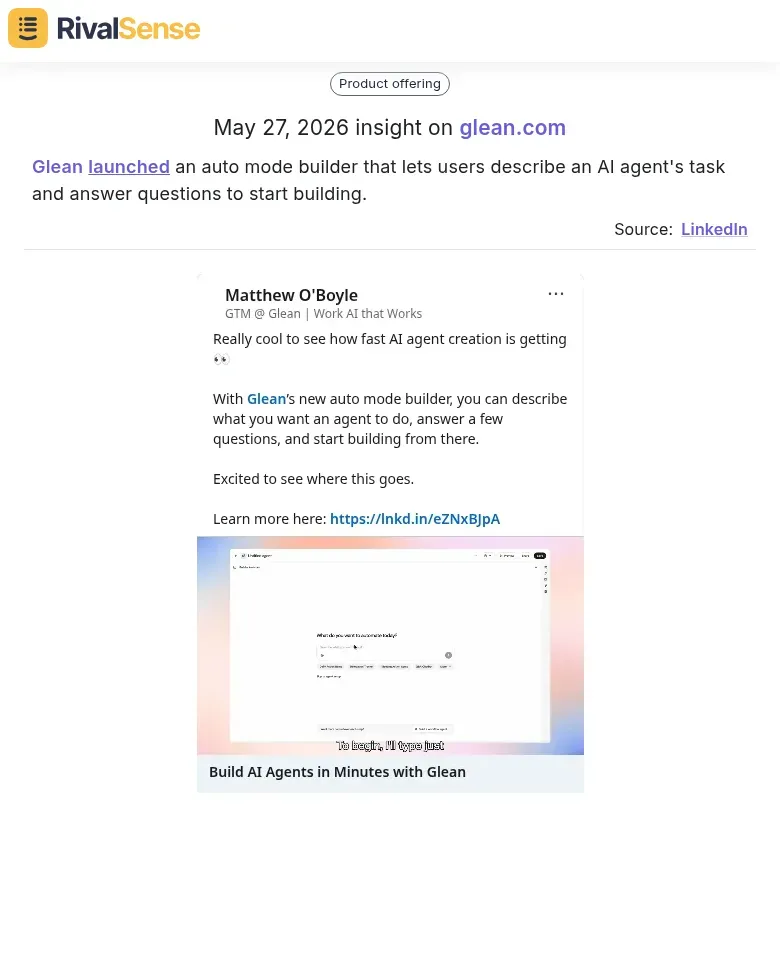
Glean launched an auto mode builder that lets users describe an AI agent's task and answer questions to start building.
Why this matters: Product launches—especially those that lower barriers for users—can create a powerful edge in innovation and speed to market. This type of insight reveals whether a competitor is investing in automation, user experience, or a new service layer. Knowing this early lets you benchmark your own roadmap and identify gaps you can’t afford to ignore.
🔍 Insight 3: An internal initiative that signals culture and talent strategy
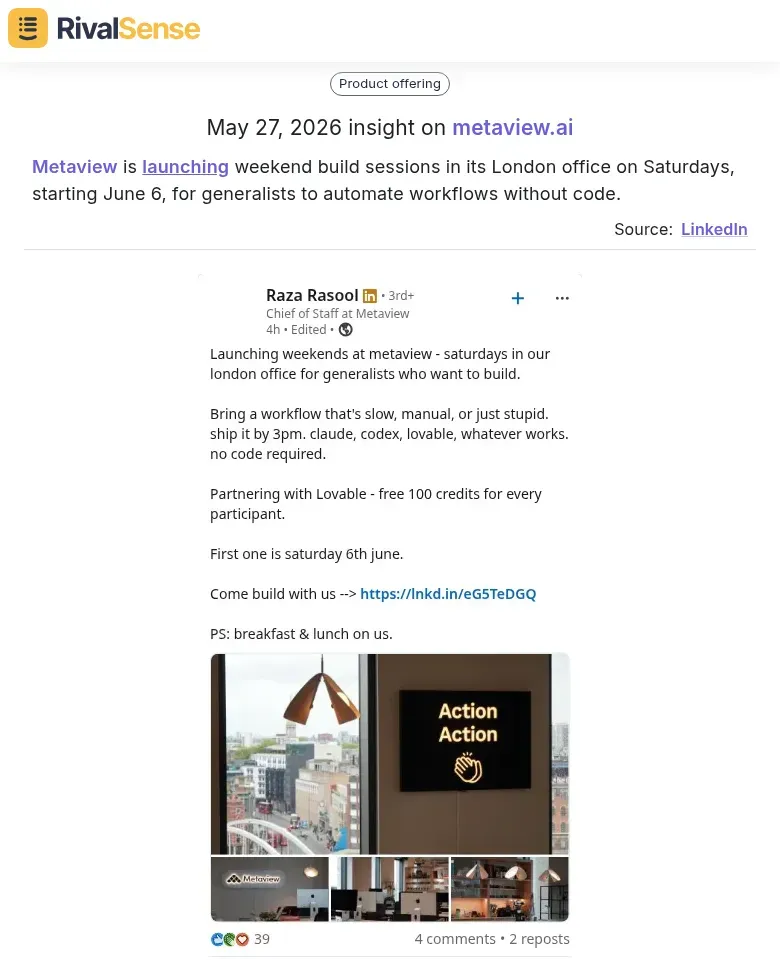
Metaview is launching weekend build sessions in its London office on Saturdays, starting June 6, for generalists to automate workflows without code.
Why this matters: An event like this isn’t just a cultural perk—it indicates where a company is placing bets (no-code automation, rapid prototyping) and how it’s attracting versatile talent. When a competitor fosters an environment that accelerates employee-driven innovation, they build an edge in execution speed and problem solving. Monitoring such moves helps you assess whether your own talent and development approaches stack up.
Pro tip: Manually piecing together all these signals across 80+ sources is a full-time job. Tools like RivalSense automate the scan and deliver a concise weekly email—so you never miss a strategic move.
Step 2: Use Porter’s Five Forces to Map the Landscape
Understanding a competitor’s edge also means looking at the structural forces in your industry. Five Forces gives you a lens to see where they’re protected and where they’re vulnerable.
| Force | What to Check |
|---|---|
| Supplier power | Do they have exclusive deals or better terms? |
| Buyer power | Do customers have few alternatives to their offering? |
| Threat of substitutes | Is their product hard to replace? |
| Threat of new entrants | Are barriers high enough to protect them? |
| Rivalry intensity | Are they in a less crowded segment? |
Step 3: Apply the VRIN Test to Their Resources
Not all advantages are sustainable. Use the VRIN framework to decide whether an edge is worth countering directly or whether you can bypass it.
- Value – Does their resource actually help customers? (e.g., a patented technology)
- Rarity – Do few others have it? (e.g., a unique data set)
- Imitability – Can you copy it easily? (e.g., brand reputation is hard to copy)
- Nonsubstitutability – Is there no alternative? (e.g., a network effect)
If you answer “yes” to all four, that edge is durable. If not, you can replicate or neutralize it.
Step 4: Benchmark Your Own Performance
With a clear view of their edge, map it against your own strengths. Direct comparison reveals exactly where you lag—and where you can win.
- Pricing vs. theirs
- Feature set vs. theirs
- Customer satisfaction scores vs. theirs
- Time to market vs. theirs
Use a simple scorecard (1–5 scale) to see the gaps. Focus only on the ones that matter most to your target customers.
What to Do Once You Know Their Edge
Finding the edge is only half the battle. The real work is choosing a response that plays to your own strengths.
- If they win on price: Can you differentiate on service, speed, or quality? If not, find a niche where price is less important.
- If they win on features: Prioritize the 1–2 features your core customers actually care about, and nail them.
- If they win on brand: Invest in customer stories, community, and thought leadership.
- If they win on talent: Improve your culture, equity, and growth opportunities.
Remember: You don’t have to beat them at everything. You just need to be the obvious choice for your ideal customers.
Practical Checklist: Weekly Competitor Edge Scan
Use this checklist to stay ahead:
- [ ] Checked competitors’ websites for product updates
- [ ] Reviewed their pricing page for changes
- [ ] Monitored their social media for announcements
- [ ] Read their latest blog posts and press releases
- [ ] Checked job boards for new hires (signals strategy shifts)
- [ ] Looked for new partnerships or event appearances
- [ ] Updated your competitive landscape document
Doing this every week manually is tedious. RivalSense automates the entire scan—covering websites, social, news, registries, and more across 80+ sources—and delivers a clean weekly email. You just read and decide.
Final Thoughts
Your competitors’ edge isn’t magic. It’s the result of specific choices—and those choices leave traces. By systematically tracking their moves, evaluating them with frameworks like Five Forces and VRIN, and benchmarking your own performance, you can not only understand what gives them an edge, but also find and sharpen your own.
The companies that win are the ones that know their rivals better than their rivals know themselves. Start scanning today, and if you want to see exactly how competitors are building their edge without spending hours on research, try RivalSense for free—get your first competitor report today at rivalsense.co.
📚 Read more
👉 Master Competitor Product Launch Monitoring for Fleet Success
👉 How to Turn Competitor Innovations Into Your Own Market Edge: A RivalSense Case Study
👉 Track Competitor Sentiment on LinkedIn: A Step-by-Step Guide
👉 Monitor Competitor Signals to Predict Fintech Expansion Moves