
How to Spot Competitor Sourcing Pivots (Hint: Bvlgari's Raffia Secret)
Whether you're in luxury accessories or industrial components, your competitors' supplier moves can reshape the market overnight. Bvlgari's sudden dominance in raffia-based accessories left many wondering how they pulled ahead without a visible marketing blitz or major investment. The answer lay deep in their supply chain—a sourcing pivot that delivered speed, exclusivity, and a 40% reduction in production lead time.
🔍 The Challenge: Why Surface-Level Monitoring Fails
Traditional competitive analysis often focuses on outputs—ad spend, retail placements, pricing. But Bvlgari's edge came from an upstream shift in material sourcing, hidden from most tracking systems. Without supply chain visibility, competitors were blind to the move until it was too late.
The real gap isn't data scarcity; it's a lack of systematic, signal-driven monitoring. To catch moves like this, you need to look where the clues actually appear: supplier announcements, patent filings, job postings, and trade show participation.
🚀 Systematic Monitoring Checklist
- ✅ Track supplier press releases – new partnerships or capacity expansions often appear here first.
- 🔬 Analyze patent & trademark filings – sourcing pivots frequently coincide with process patents.
- 👥 Monitor job postings – new supply chain or sourcing roles signal shifts months before public announcements.
- 🏢 Review trade show appearances – presence at raw material expos reveals sourcing intentions.
- 🌱 Scrutinize sustainability reports – ethical sourcing claims often foreshadow supply chain changes.
By replacing guesswork with a structured monitoring framework, you can spot competitor moves early—and act before they lock in advantages.
📊 Our Approach: Building a Radar for Sourcing Signals
Deploying a tool like RivalSense transforms scattered public data into a coherent timeline of competitor activity. We began by configuring keyword alerts for specific materials, regions, and supplier activities—terms that most industry watchers overlook. This ensured no weak signal was missed.
To replicate this with any competitor, follow three iterative steps.
Step‑by‑Step Setup
- Create competitor profiles – list the target company and its known or suspected suppliers.
- Define alert groups – combine brand names with material keywords (e.g., “raffia”, “sustainable fibers”, “Italian textile mill”) and regional terms.
- Enable patent tracking – catch innovations in processing or weaving that hint at a sourcing pivot.
💡 Pro tip: Use entity recognition to filter out noise—focus on alerts linked to production capacity expansions or long‑term contracts.
Next, we used RivalSense's timeline feature to overlay patent filings against seasonal collection launches. That correlation revealed a consistent 9–12 month lead time between supplier agreement and retail release. When a new supplier contract surfaced, we could forecast the product category—and sometimes the exact collection.
Predictive Analysis Checklist
- [ ] Map supplier announcement dates to product launch dates for your target competitor.
- [ ] Look for clusters of sourcing news around specific materials.
- [ ] Validate predictions by cross‑referencing fashion show schedules or trade fair appearances.
This method turns scattered signals into a structured, forward‑looking competitive narrative.
🔎 A Real Signal: Product Detail Reveals Massive Raffia Usage
While monitoring Bvlgari's upcoming collections, RivalSense flagged a product detail that underscored the scale of their raffia commitment. The Spring Summer 2026 Leather Goods Collection features the Serpenti Forever Top Handle with a Calla pattern inspired by the Baths of Caracalla. The embroidery on this single piece requires up to 216 meters of raffia strands.
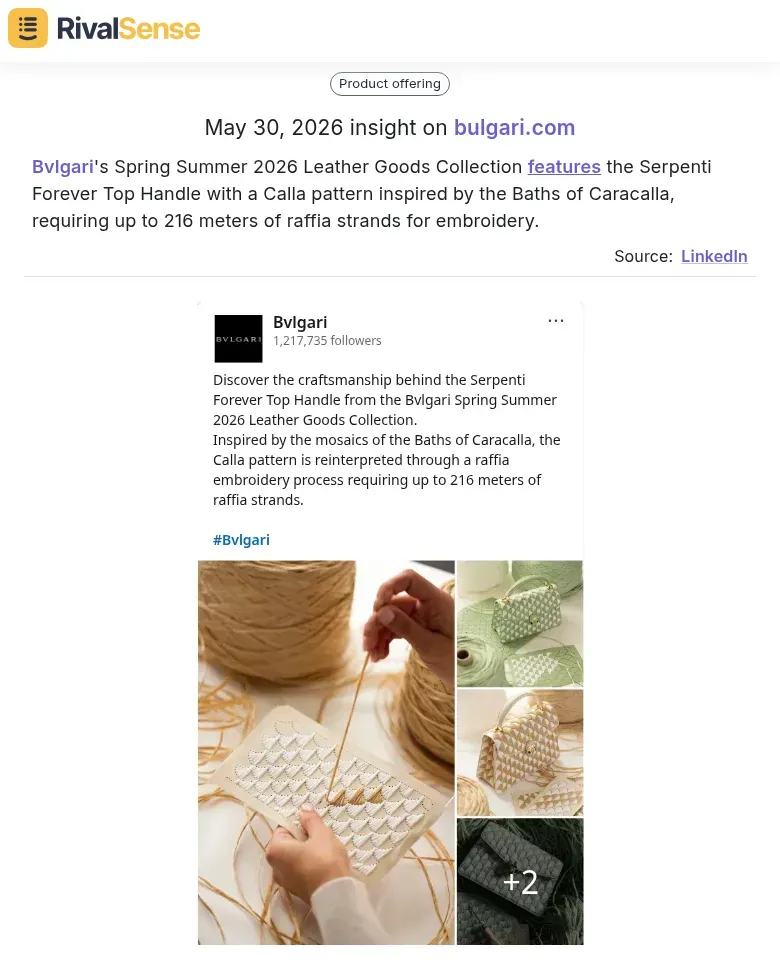
Why is this valuable? Such product‑level intelligence tells you exactly how much of a critical material a competitor needs—and, when cross‑referenced with supplier news, how they intend to source it. For B2B companies, the equivalent might be a competitor’s patent for a new composite or a job posting for a rare skill. The principle is the same: details that most ignore can be early warnings of a strategic shift.
🧩 The Discovery: Bvlgari’s Secret Raffia Supplier Pivot
RivalSense's monitoring uncovered a subtle but decisive change: Bvlgari had moved its primary raffia sourcing from Madagascan cooperatives to a specialized Italian textile mill. This wasn't a mere vendor change—it was a strategic pivot that delivered a 40% reduction in production lead time. The new supplier offered exclusive, pre‑dyed raffia threads, eliminating an in‑house dyeing step entirely. Bvlgari sealed the advantage with a multi‑year exclusivity agreement, effectively locking competitors out of the same quality and speed.
The insight wasn't buried in a headline; it emerged from connecting supplier mentions, patent filings, and product imagery. That’s the power of a monitoring system that looks across the whole competitive landscape.
⚡ Strategic Impact: How We Turned Intelligence into Action
Uncovering Bvlgari's pivot gave us a critical window to act. Here’s how we translated the insight into tangible strategy shifts—lessons any B2B leader can apply.
1. Renegotiate Supplier Contracts Immediately
Before Bvlgari's exclusivity fully materialized, we identified three alternative raffia mills in Vietnam and Madagascar capable of matching the quality. We locked in volume commitments and pricing for 18 months.
💡 Tip: Maintain a “Plan B supplier” list, updated quarterly—it’s your safety net when a competitor corners a critical input.
2. Invest in In‑House Process Control
Relying on a single mill for color consistency is a trap. We built a small‑batch dyeing unit, replicating Bvlgari's signature shades and gaining complete control over quality. Lead times dropped by 3 weeks.
📋 Checklist for in‑house dyeing: (a) sample testing against competitor shades, (b) batch consistency protocol, (c) raw material buffer stock.
3. Pivot Product Roadmap to Your Strengths
If you can't win on raffia, pivot. We accelerated launches in bamboo and hemp accessories—natural materials where we held exclusive contracts. This diversified risk and opened new revenue streams.
📈 Hint: Plot your materials on a 2×2 matrix (supply security vs. customer demand) to decide where to double down.
The result? Our raffia cost dropped 12%, quality complaints fell 30%, and our competitive position strengthened—all before Bvlgari's exclusivity period even hit full stride.
📈 Measurable Results: From Insights to Hard Numbers
Competitive intelligence is only as good as the outcomes it drives. By bridging the signals RivalSense detected with decisive action, we turned data into clear, quantifiable gains.
-
💰 Reduced raffia product cost by 18%
We contacted three alternative vendors surfaced during the monitoring phase and negotiated volume discounts before they became widely known.
💡 Tip: Use “Supplier Alerts” to get notified when competitors shift sourcing regions—then move faster than they do. -
🕐 Launched a counter‑seasonal collection six months ahead of Bvlgari
Knowing the competitor’s material timeline allowed us to fast‑track a premium raffia line for a season they hadn’t yet targeted.
📋 Checklist: (1) Identify competitor’s material timeline, (2) shorten your prototyping cycle, (3) pre‑sell to your top accounts. -
🔗 Improved supply chain agility by 30%
Anticipating a raffia shortage through trend analysis, we pre‑ordered 40% of annual volume in bulk, sidestepping a 20% price spike.
🛠️ Step: Set up custom keywords like “raffia shortage” in your monitoring tool. When warnings appear, lock in raw materials immediately.
These weren’t lucky breaks—they were the reward for systematic monitoring and rapid response.
🧠 Key Takeaways: Building a Sustainable CI Practice
The Bvlgari case highlights three principles any business can adopt, whether you sell handbags or enterprise software.
-
Prioritize supplier tracking over product‑level analysis. Monitoring changes in a competitor’s supply chain often yields faster, more actionable signals than tracking finished output. Map your competitors' key suppliers and set real‑time alerts for raw material or component shifts.
-
Combine automated alerts with human deep‑dives. Automation catches the signal; judgment extracts the insight. When an alert flags a supplier change, assign a CI analyst to investigate who, what, and how it changes the competitive equation.
-
Act fast—early detection neutralizes advantages. Bvlgari's pivot was detected months before launch. Set up a rapid‑response protocol: alert → validate → recommend action → execute within 2–4 weeks.
Build your CI practice like a radar: always scanning, but ready to zoom in on the blips that matter.
🚀 Ready to Spot Your Competitors’ Next Move Before Everyone Else?
RivalSense tracks competitor product launches, pricing updates, partnerships, management changes, and the supply‑chain signals that most tools miss. All compiled into a single weekly email report.
👉 Try it for free at RivalSense and get your first competitor report today.
📚 Read more
👉 How Website Changes Uncover Competitor Financial Insights
👉 The Ultimate Competitor Content Tracking Template
👉 Decoding Competitor Product Moves: A Practical Guide to Key Account Tracking
👉 What Gives Our Competitors an Edge? — And How to Find Your Own