
Decoding Competitor Moves: What Mayo Clinic’s Organ Recovery Research Tells You About Strategic Monitoring
Staying ahead in complex industries means reading the subtle signals competitors send through their research publications and internal initiatives. The difference between reacting to a public launch and anticipating it often lies in monitoring these early-stage developments.
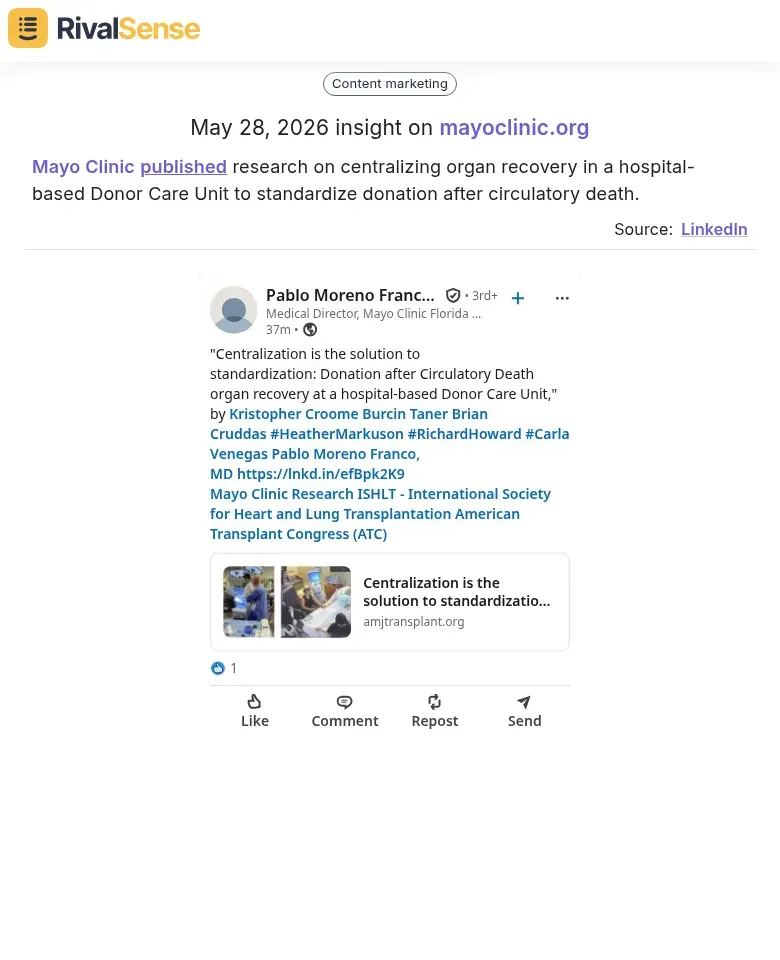
A recent insight from the healthcare sector offers a perfect case study. Mayo Clinic published research on centralizing organ recovery in a hospital‑based Donor Care Unit to standardize donation after circulatory death. On the surface, it’s a scientific paper; strategically, it is a window into how Mayo plans to differentiate its transplant services, potentially reshaping referral patterns and payer negotiations.
🔍 Why this insight matters for your competitor strategy
This kind of move doesn’t happen in isolation. For a medical device company, a pharma firm, or even a competing hospital system, the implications are immediate:
- Organ preservation tech – companies developing perfusion devices or cold storage solutions may see a shift in customer requirements toward centralized units.
- Transplant center networks – competitors must reassess their own organ recovery logistics to avoid losing donor referrals.
- Regulatory & reimbursement – a proven model can become the standard of care, putting late followers at a disadvantage.
RivalSense surfaces exactly these types of pre‑commercial signals by scanning company websites, scientific publications, registries, and social media – delivering a structured email report that would have highlighted this Mayo research long before a press release.
🧠 Practical steps: Turn competitor research into action
Here’s how you can apply this type of monitoring to your own key account or partnership management today:
- Set up thematic alerts – don’t just track names; monitor phrases like “Donor Care Unit,” “centralized organ recovery,” or “donation after circulatory death” to catch early signals from any player.
- Map the stakeholder web – when a hospital publishes research, note co‑authors, funding sources, and institutional affiliations – these become your next key account targets or partnership risks.
- Build a competitive response checklist ✅
| Step | Action | Timeline |
|---|---|---|
| 1 | Log the insight in your competitor file with date and source | Immediately |
| 2 | Distribute a one‑page impact note to product, sales, and strategy leads | Within 48 hours |
| 3 | Schedule a cross‑functional review to update account plans for affected key accounts | Next business week |
| 4 | Identify adjacent R&D gaps in your portfolio that need acceleration | Monthly innovation review |
- Leverage for partnerships – use this intelligence to approach complementary organizations (e.g., OPOs, preservation device vendors) with a tailored value proposition: “We see where the market is going – let’s align now.”
📈 From monitoring to advantage
The organizations that win are those that systematically catch such signals, interpret them, and move before the rest of the market. That’s not about luck – it’s about infrastructure.
RivalSense helps you build that infrastructure by tracking competitor product updates, pricing changes, management shifts, and research publications – all delivered in a single regular email. You no longer need to comb through dozens of sources manually.
👉 Get your first report today and see the signals you’ve been missing – try RivalSense for free.
📚 Read more
👉 What Gives Our Competitors an Edge? — And How to Find Your Own
👉 Master Competitor Product Launch Monitoring for Fleet Success
👉 How to Turn Competitor Innovations Into Your Own Market Edge: A RivalSense Case Study
👉 Track Competitor Sentiment on LinkedIn: A Step-by-Step Guide
👉 Monitor Competitor Signals to Predict Fintech Expansion Moves