
The Ultimate Competitor Content Tracking Template
Your competitors’ content is a real-time window into their strategic playbook. By monitoring what they publish, announce and promote, you can decode their next moves and act before they do. For founders, CEOs and business owners in B2B, this intelligence turns guesswork into proactive strategy.
Uncover strategic priorities by monitoring product update launches and messaging shifts. For example, if a competitor suddenly emphasizes “enterprise security” in blog posts and case studies, they’re likely pivoting upmarket. Tip: Set up alerts for specific keywords like “beta,” “now available,” or “integration” to catch changes early.
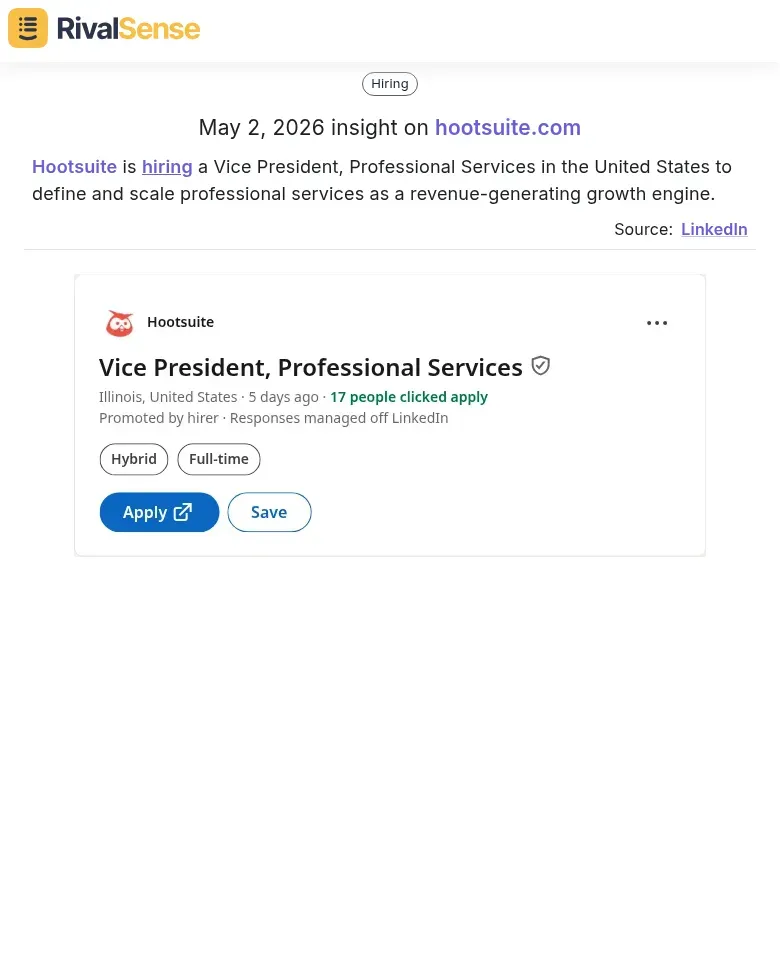
Detect new revenue models and target segments through hiring and partnership announcements. A spike in sales hires for a particular industry (e.g., healthcare) signals a new vertical focus. Take Hootsuite’s recent opening for a Vice President, Professional Services in the United States—this indicates a deliberate push to monetize services as a growth engine, long before any service packages appear on their website. Tracking such senior hires reveals revenue diversification strategies you can counter or emulate.
Checklist:
- [ ] Review “Careers” pages monthly for new leadership roles
- [ ] Track press releases for co-marketing partnerships
- [ ] Note any pricing page updates
Gain early signals on brand sentiment shifts by integrating third-party reviews and news. A sudden flurry of negative reviews on G2 or a critical industry report can foreshadow churn. Practical step: Use a free tool like Google Alerts for your competitor’s name + “review” or “lawsuit.” Set up a weekly digest to spot trends before they escalate.
Bottom line: Tracking competitor content isn’t about imitation—it’s about anticipation. Each piece of content is a breadcrumb leading to their next move.
Building Your Competitor Content Tracking Framework 🛠️
To turn scattered signals into a repeatable system, you need a clear framework. Start by defining what to watch, then layer on the right tools and a central log.
Define content categories that matter to your business. Common categories include:
- Product updates: new features, pricing changes, beta launches
- Hiring news: leadership hires, team expansions
- Partnerships and integrations: strategic alliances, API integrations
- Customer stories: case studies, testimonials, use cases
Next, select your tools and sources. Use RSS feeds (Feedly, Inoreader) for blog and news monitoring. Set up social listening with tools like Brandwatch or Mention for LinkedIn, Twitter, and Reddit. Monitor review platforms (G2, Capterra) for customer feedback, and check job boards (LinkedIn, Indeed) for hiring signals.
Pro tip: Create a centralized template to log everything. Use a spreadsheet with columns for:
- Content type (category)
- Date published
- Channel (blog, social, review site)
- Title/Headline
- URL
- Performance metrics (views, likes, shares, comments)
Automate where possible—Zapier can push RSS items into your sheet. Set a weekly review cadence to analyze trends and adjust your strategy.
Checklist:
- [ ] Define 4–6 content categories
- [ ] Set up RSS feeds for top competitors
- [ ] Add social listening keywords
- [ ] Create a shared template with metrics columns
- [ ] Schedule weekly review slots
Key Metrics to Monitor in Competitor Content 📊
Numbers tell only part of the story. To outmaneuver competitors, track three metric categories that reveal both performance and intent.
Engagement Indicators
Monitor views, shares, comments, and backlinks per content piece. Use tools like BuzzSumo or Ahrefs to benchmark. Tip: Filter by top 20% of posts—they reveal what resonates. Create a weekly rank chart to spot trends.
Sentiment Signals
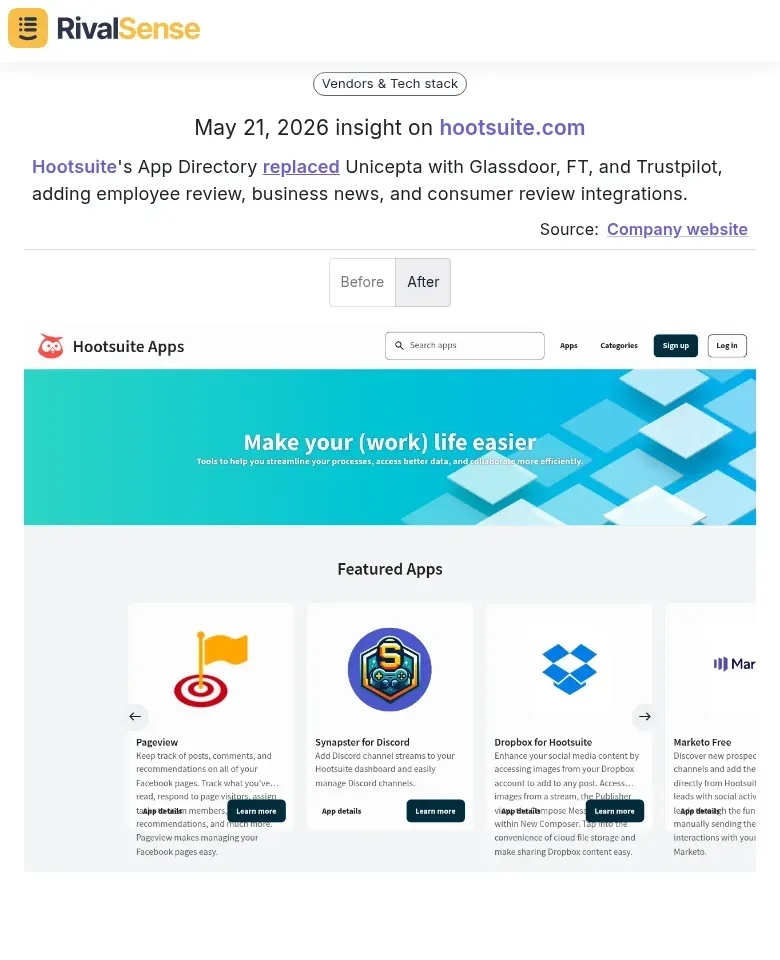
Analyze tone in customer reviews (G2, Capterra), employee reviews (Glassdoor), and media coverage (Google News alerts). For instance, when Hootsuite replaced Unicepta with Glassdoor, Financial Times, and Trustpilot in its App Directory, it wasn’t just an integration update—it signaled an intent to embed employee review, business news, and consumer review data directly into workflows. Tracking such additions uncovers where a competitor plans to strengthen its market intelligence, and that’s a signal you can act on.
Checklist: Scan monthly for shifts. Negative employee reviews often precede talent gaps; positive customer reviews hint at strong product-market fit.
Growth Signals
Track job posting frequency for new roles (e.g., VP of Sales, Head of AI) on LinkedIn. Also monitor partnership announcements (Twitter, press releases). Action: Set Google Alerts for “partner ecosystem” + competitor name. A surge in specialized hires or partnerships signals strategic expansion.
Compile these into a single dashboard (spreadsheet or tool) updated bi-weekly. Compare against your own metrics to spot opportunities—e.g., if competitors lack content in a high-engagement topic, you fill the gap.
Analyzing Content for Strategic Insights 🔍
Your competitors’ content is a goldmine of strategic intelligence. Here’s how to extract actionable insights:
1. Identify Patterns in Product Updates
Track recurring themes in release notes, changelogs, and blog posts. Create a topic map: list each feature launch with its frequency. If “AI-powered analytics” appears quarterly, that’s a long-term roadmap priority. Tip: Use a simple spreadsheet to log update themes monthly—look for clusters around compliance, integrations, or UX improvements.
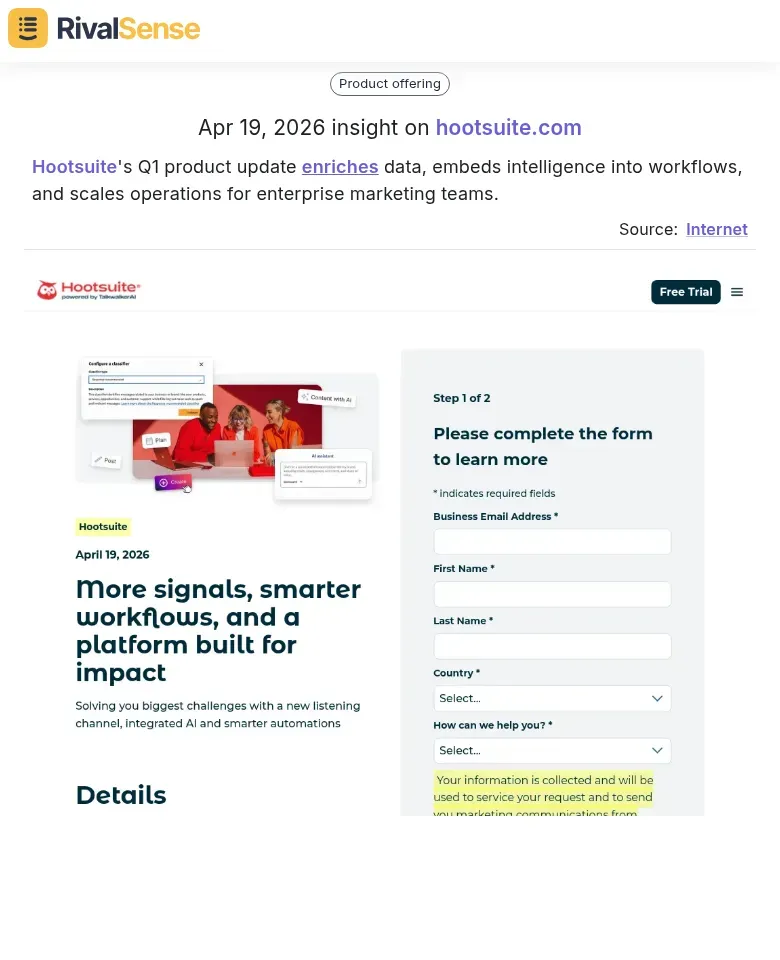
For example, Hootsuite’s Q1 product update enriches data, embeds intelligence into workflows, and scales operations for enterprise marketing teams. A regular cadence of enterprise-focused updates like this signals a deliberate move upmarket—a crucial insight for your own positioning and product roadmap.
2. Benchmark Content Effectiveness
Compare your content’s performance metrics (views, shares, backlinks) against competitors’ top-performing pieces. Tools like BuzzSumo or Ahrefs can reveal which topics drive engagement. Checklist:
- Identify your top 5 performing pieces by traffic.
- Identify competitors’ top 5 pieces on the same topics.
- Analyze differences: Did they use more data? Better visuals? Stronger CTAs?
- Adapt techniques that gap your performance.
3. Detect Positioning Shifts
Messaging changes signal strategic pivots. If a competitor suddenly emphasizes “enterprise security” after years of SMB focus, they’re moving upmarket. Step-by-step:
- Archive homepage copy monthly (use Internet Archive or screenshots).
- Watch for new jargon: “scalable,” “compliance-ready,” “global” often signal enterprise shift.
- Note changes in product vs. service promotion—transitioning to services may indicate commoditization.
Pro tip: Set Google Alerts for competitors + keywords like “announce,” “launch,” “now available.” React faster to market shifts.
Turning Insights into Actionable Strategy 🚀
Once you’ve identified competitor content gaps and strengths, it’s time to act. Follow this three-step strategy:
1. Adjust Your Content Calendar
Map competitor high-performing topics against your own. Use a spreadsheet to track: topic, competitor, engagement metrics, and your current coverage. Fill gaps by scheduling content that addresses underserved queries. For example, if a competitor’s “how-to” guides drive traffic but you lack them, create a series. Pro tip: prioritize topics with high search volume but low competitor saturation.
2. Create Counter-Narratives
Analyze competitor reviews and social mentions for recurring complaints. Build content that directly solves those pain points. If customers complain about poor customer support, publish “Our 24/7 Support: A Case Study” or a comparison highlighting your responsiveness. Action step: set up alerts for competitor review mentions using tools like G2 or Capterra.
3. Invest in Emerging Areas
If competitors are seeing success with new integrations, professional services, or video content, allocate resources accordingly. Start small: test one new format or partnership for a quarter. Track performance metrics (e.g., leads, sign-ups) before scaling. Checklist: ✅ Identify 3 competitor successes, ✅ Run a 30-day pilot, ✅ Review ROI before full investment.
By systematically turning insights into strategy, you stay ahead of the competition.
Building a Sustainable Tracking Process 🔄
Consistency is the backbone of effective competitor tracking. Without a structured process, you’ll drown in data noise. Here’s how to build a system that scales.
1. Schedule Regular Audits
- Weekly (15 min): Scan competitors’ social media (LinkedIn, X) for campaign launches and news (press releases, funding announcements). Use a shared doc with columns: Date, Channel, Key Insight, Action Item.
- Monthly (1 hour): Review product updates (changelogs, blog posts) and customer reviews (G2, Capterra). Track feature additions, pricing changes, and sentiment shifts.
2. Automate Data Collection
- Set up Google Alerts for competitor names + keywords (“pricing,” “new feature,” “partnership”). Route alerts to a dedicated Slack channel or email folder.
- Create an aggregator template (Airtable/Sheets) pre-loaded with competitor names, channels, and date filters. Use tools like RivalSense to auto-populate recent content and metrics, freeing up manual scraping.
3. Share Cross-Functional Reports
- For product: Monthly brief highlighting competitor feature releases and market gaps (e.g., “Competitor X launched AI summarization; we should prioritize this Q3”).
- For sales: Weekly bullet points on competitor positioning shifts or pricing changes (e.g., “Competitor Y dropped enterprise tier by 20%”).
- For leadership: Quarterly deck covering macro trends, competitive threats, and opportunities, tied to business KPIs.
Pro tip: Assign a “tracking owner” for each competitor to ensure accountability. Rotate ownership quarterly to prevent bias and burnout.
Automate Competitor Tracking with RivalSense ⚡
Manually stitching together product updates, hiring news, partnership signals and media mentions is time-consuming and error-prone. RivalSense monitors your competitors across their website, social media, job boards, review sites and registries—then delivers a clean weekly report directly to your inbox.
Instead of chasing breadcrumbs yourself, let RivalSense surface the insights you need to anticipate market moves, adjust your strategy, and win. Try RivalSense for free and get your first competitor report today.
📚 Read more
👉 Decoding Competitor Product Moves: A Practical Guide to Key Account Tracking
👉 What Gives Our Competitors an Edge? — And How to Find Your Own
👉 Master Competitor Product Launch Monitoring for Fleet Success
👉 How to Turn Competitor Innovations Into Your Own Market Edge: A RivalSense Case Study