
Decoding Competitor Product Moves: A Practical Guide to Key Account Tracking
Introduction: The Strategic Value of Key Account Tracking
Key account tracking transcends basic competitor monitoring—it reveals strategic pivots and feature innovations before they hit the mainstream. Consider how a SaaS leader’s sudden API documentation update hinted at a new integration marketplace, or a cybersecurity firm’s job postings for video engineers signaled an upcoming endpoint camera feature. In streaming, a competitor’s quiet beta of ad-supported tiers foreshadowed industry-wide pricing shifts. These signals are gold, but only if you track them systematically.
Practical Steps:
- Identify 3-5 key accounts (top competitors or adjacent innovators).
- Monitor product changelogs, support docs, job listings, and social media for feature hints.
- Categorize signals by product area (e.g., pricing, UX, integrations).
- Map to your roadmap—ask: “Does this signal confirm, challenge, or inspire our next sprint?”
Checklist for each tracking session:
- [ ] Any critical product update or beta launch?
- [ ] New or removed capabilities?
- [ ] Changes in API, documentation, or support articles?
- [ ] Relevant job postings indicating future features?
Structured tracking transforms raw data into actionable insights. Instead of reactive copying, you proactively inform your product strategy. Start small: dedicate 30 minutes weekly to scan these sources. Overlay with a competitive intelligence framework (e.g., SWOT or Porter’s Five Forces) to prioritize which signals warrant a response. The result? A faster, smarter product decision cycle.
Detecting Strategic Messaging Shifts and New Feature Launches
To detect strategic messaging shifts and new feature launches, start by monitoring competitor landing pages and key account dashboards weekly. Use tools like RivalSense to track changes in headlines, CTAs, and case study language. For example, when RivalSense flagged that Sprout Social updated its Influencer Marketing page to emphasize turning creator partnerships into measurable business impact, with new features like AI-powered Brand Fit Scores, centralized payments, and competitive intelligence for revenue measurement, it signaled a strategic pivot toward ROI-driven influencer marketing.
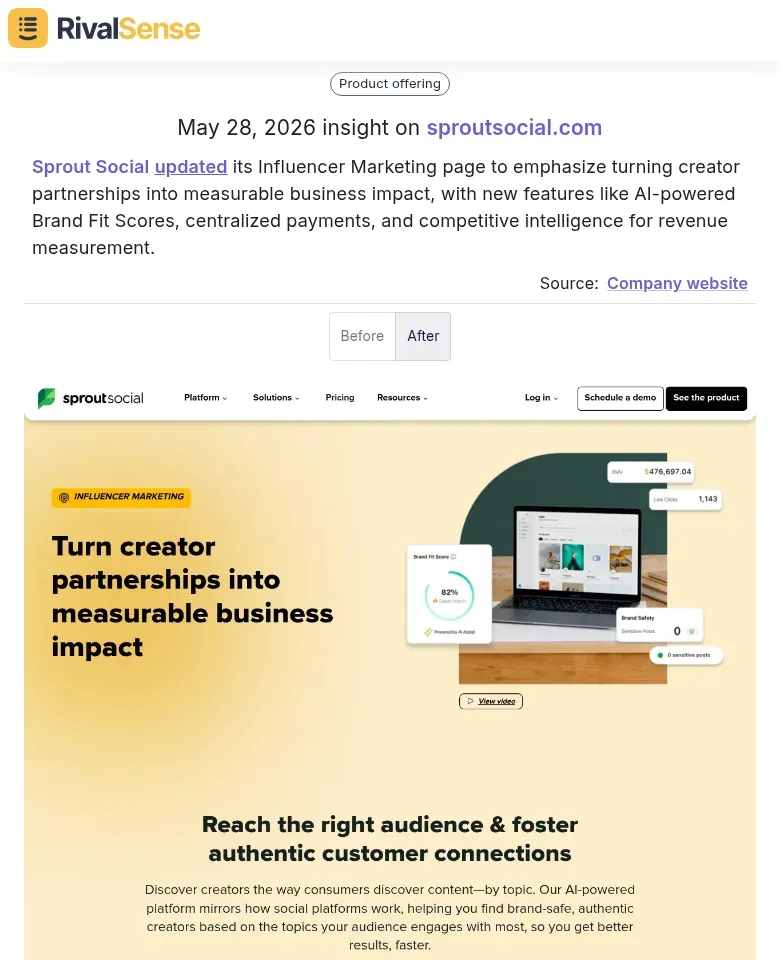
Monitoring this type of messaging shift—from vague “partnerships” to concrete “revenue measurement”—reveals a competitor’s growth priorities and helps you anticipate market trends. Such insights tell you where a competitor is investing and what customer pain points they’re now solving.
Practical tip: Set up alerts for specific keywords like “new,” “beta,” “launch,” or “now featuring” in your competitor’s product pages. Cross-reference with changelogs or press releases.
Checklist for tracking shifts:
- Capture landing page screenshots every Monday.
- Note value proposition changes (e.g., from “partnerships” to “revenue impact”).
- Identify new feature names (e.g., “AI Scoring,” “Centralized Payments”) and map them to customer pain points.
When you spot a new feature, ask: Which metric does it optimize? (e.g., scoring boosts conversion rates; centralized payments reduce churn). This reveals competitors’ growth priorities and helps you prioritize your own roadmap.
Pro hint: Compare old and new landing page copies using diff tools to highlight exact phrasing changes. This shows subtle shifts in targeting and messaging strategy.
Uncovering Feature Rebranding and Repositioning
When a competitor renames a feature, it’s rarely cosmetic. For example, RivalSense recently detected that NordVPN rebranded its “Threat Protection Pro™” feature to “Next-gen antivirus” and renamed “NordProtect” to “Coveron”.
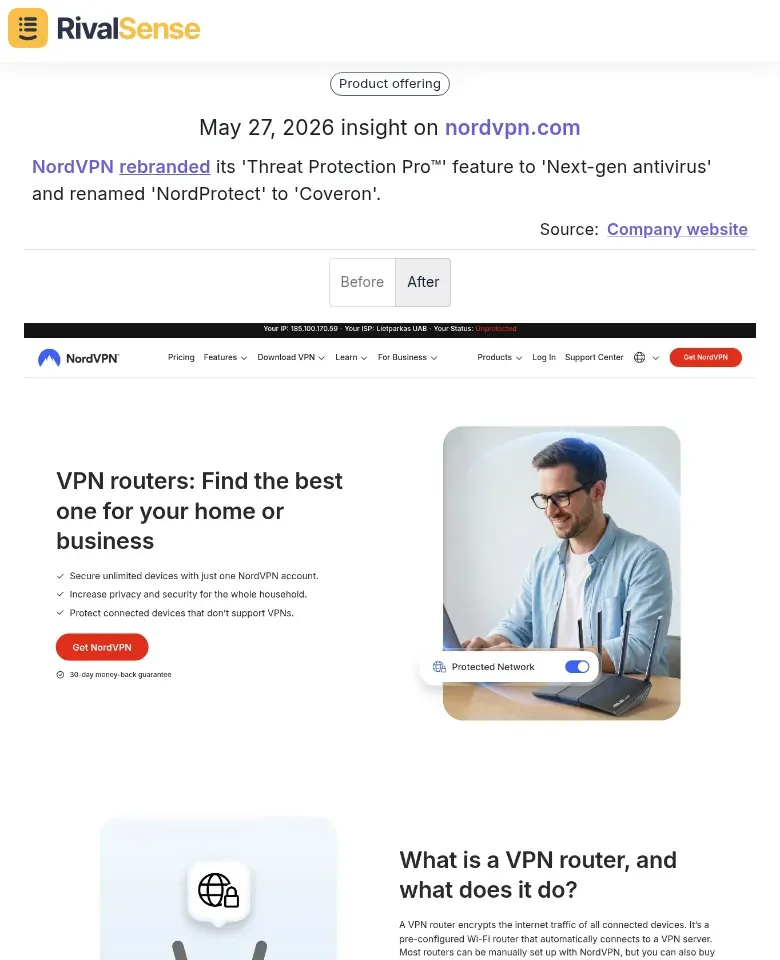
This rebranding simplifies the product for mainstream users and aligns with well-understood security categories, signaling a shift from technical complexity to user-friendly positioning. Similarly, Zoom’s streamlining of “AI Sheets” to “Sheets” and “AI Docs” to “Canvas” emphasized platform cohesion over AI add-ons. Such changes simplify messaging, reduce cognitive load, or target a new persona. Decoding why a competitor makes these changes gives you insight into their strategic direction and market segmentation.
To uncover the rationale:
- Monitor changelogs and website copy – Use tools like RivalSense to automate detection of renamed features.
- Map to market trends – Does the new name echo competitor terminology (e.g., “copilot”)? Convergence signals a shared strategic direction.
- Analyze positioning language – Shifts from technical jargon (e.g., “API orchestration layer”) to benefit-focused names (e.g., “Workflow Builder”) suggest a move toward user-friendly positioning.
Quick checklist:
- [ ] Set alerts for keyword changes on competitor product pages.
- [ ] Compare old vs. new names in a spreadsheet to spot patterns.
- [ ] Survey sales teams: which names resonate with prospects?
- [ ] Use renamed features as input for your own naming decisions.
Identifying Data-Driven Feature Innovations
To identify data-driven feature innovations, monitor how competitors use first-party data to create engagement loops. For example, RivalSense captured that Spotify announced a new feature for Premium users that lets artists reserve two tour tickets for dedicated fans to purchase within a 24-hour window, based on streaming and sharing activity.
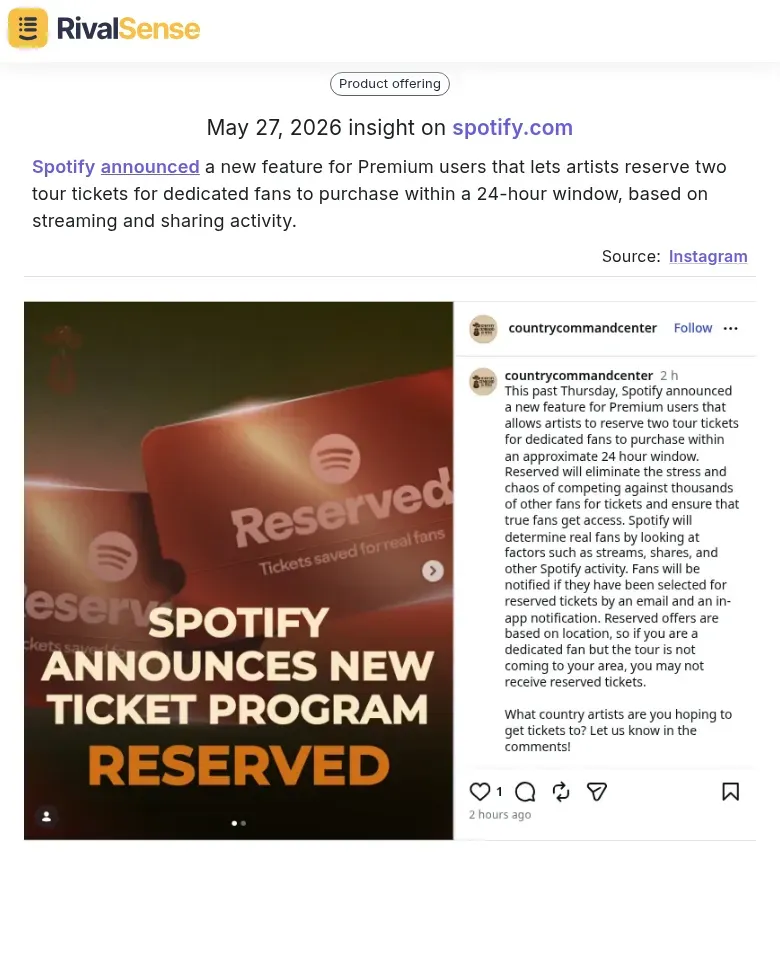
This leverages behavioral data to create exclusive, time-sensitive offers, turning passive listeners into engaged superfans. Understanding this type of data-driven loyalty loop can inspire similar strategies in your own product. The key insight here is how a competitor uses user activity data to bridge digital behavior with offline rewards, deepening retention and creating a competitive moat.
Practical steps:
- Set up key account tracking: Monitor competitor product changes, especially in personalization and loyalty features.
- Map user data to features: Identify what behavioral data (e.g., purchase history, content consumption, social shares) could power similar innovations.
- Brainstorm real-world connections: List ways your product can bridge digital behavior with offline experiences—like booking reminders, event perks, or curated bundles.
- Test and iterate: Run small-scale experiments with exclusive, time-bound offers tied to user actions. Measure engagement lift before scaling.
Tip: Look for patterns where competitors add urgency (e.g., “only for top listeners”) combined with exclusivity—these often signal high-impact data-driven loops you can adapt.
Turning Insights into Actionable Product Strategy
Once you’ve gathered competitor changes from key account tracking, the next step is turning raw intelligence into product strategy. Start by synthesizing observed moves into themes. For example, if multiple competitors emphasize ROI calculators or simplified pricing, that signals a market shift toward value clarity. Group such patterns into buckets like “ROI focus,” “simplification,” or “data monetization” to reveal shared industry pressures.
Validate resonance before acting. Run short user surveys or A/B test landing pages that mirror competitor features. For instance, if a competitor introduced a freemium tier, test a similar offer with a small segment to gauge interest. This separates noise from real demand.
Prioritize initiatives that differentiate while addressing common pain points. Use a simple matrix: plot competitor moves on axes of “customer impact” vs. “differentiation potential.” High-impact, high-differentiation ideas win. Example: If rivals all add AI chat, you might skip that and instead invest in seamless integrations—a deeper need they ignore.
Practical checklist:
- [ ] Cluster tracked changes into 3–5 themes.
- [ ] Survey 10–20 customers on top themes.
- [ ] Map each theme to your product roadmap with a “Do, Watch, Ignore” label.
- [ ] Identify one “anti-competitive” move—a feature competitors ignore but customers love.
Conclusion: Building a Sustainable Competitor Tracking Process
To build a sustainable competitor tracking process, start by scheduling weekly or bi-weekly scans of key accounts’ product pages, feature name changes, and marketing updates. Use a centralized tool like RivalSense to automatically capture changes, tag insights by category (e.g., pricing, features, positioning), and share them with your team in real time. Create a simple checklist: (1) Identify 5–10 key competitor accounts, (2) Set up page-level monitoring for product and pricing pages, (3) Review captured updates every Monday, (4) Tag each insight with relevance to your roadmap, (5) Archive outdated data quarterly. Integrate these insights into your product planning cycles by dedicating 15 minutes per sprint to review competitor moves before prioritizing your backlog. This ensures you move from reactive firefighting to proactive strategy—spotting shifts in competitor features or messaging before they impact your market position.
For example, if RivalSense flags a competitor adding an AI-powered dashboard, your team can decide whether to fast-track a similar capability or differentiate elsewhere. The goal is not to copy competitors but to inform decisions with real market signals. With a repeatable process and the right tool, competitive intelligence becomes a natural part of how you build products, not a frantic last-minute research scramble.
Ready to start tracking? Try RivalSense for free and get your first competitor report today: https://rivalsense.co/
📚 Read more
👉 What Gives Our Competitors an Edge? — And How to Find Your Own
👉 Master Competitor Product Launch Monitoring for Fleet Success
👉 How to Turn Competitor Innovations Into Your Own Market Edge: A RivalSense Case Study
👉 Track Competitor Sentiment on LinkedIn: A Step-by-Step Guide