
How to Predict Your Competitors' Next Content Moves (and Win in App Dev)
In the fast-paced app development industry, creating high-quality content is expensive—both in time and resources. Yet many teams produce content reactively, responding to competitors’ moves rather than anticipating them. This reactive approach leads to missed opportunities and wasted effort. Predictive analysis changes the game by uncovering gaps and opportunities before competitors act. By combining competitive intelligence with content strategy, you can forecast where competitors will invest next and position your brand to lead.
How to get started:
- Audit competitor content – Identify topics, formats, and channels they use. Tools like RivalSense can automate this.
- Spot patterns – Look for recurring themes, seasonal spikes, or new keywords they target.
- Predict next moves – If a competitor publishes a series on a trending technology (e.g., AI in app dev), they may soon release a deep dive or a case study. Prepare your counter-content in advance.
- Fill gaps – Use a content gap matrix: list competitor topics vs. your own. Prioritize areas with high search volume but low competitor coverage.
Pro tip: Set up alerts for competitor domain authority changes, new backlinks, and social shares. These signals often precede content pushes.
By shifting from reactive to predictive, you reduce content waste, capture early-mover advantage, and build authority in the app dev space.
Mapping the Competitive Landscape: Identifying Key Content Players
To map the competitive landscape, start by cataloging your top 5–10 competitors and their content domains: blogs, documentation, webinars, and community forums. Use tools like RivalSense to automate tracking of content frequency, topic clusters, and engagement metrics (shares, comments, backlinks). For example, set up alerts for new blog posts or webinar announcements to stay current.
Next, segment competitors by content maturity:
- Thought leaders publish original research, industry predictions, and long-form guides. They prioritize authority over volume.
- Feature-focused publishers churn out product updates, how-tos, and release notes. They emphasize timeliness and SEO.
Practical steps:
- Create a spreadsheet with competitor names, content types, publishing frequency, and engagement scores.
- Use RivalSense’s topic analysis to identify gaps—e.g., if no competitor covers “serverless security,” that’s your opportunity.
- Check content cadence: weekly bloggers vs. monthly webinar hosts. Adjust your strategy accordingly.
Tip: Look for “orphan topics”—high-interest subjects your competitors mention once but never revisit. These signal underserved niches you can own.
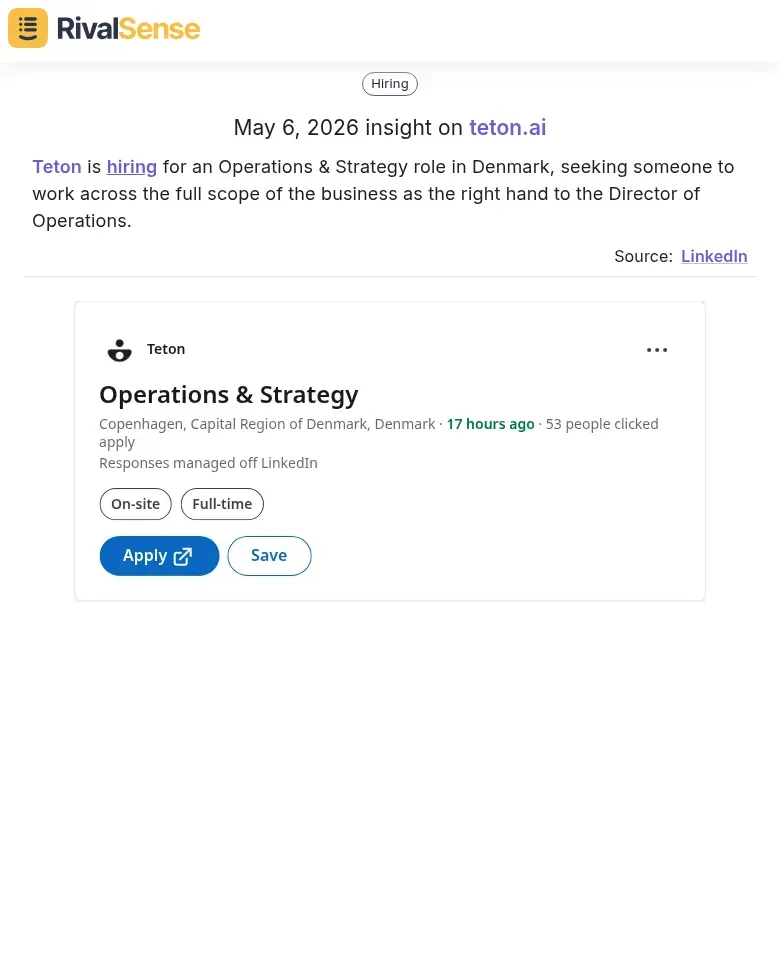
Real insight from RivalSense: Hiring signals often reveal strategic shifts before formal announcements. For example, we tracked that Teton is hiring for an Operations & Strategy role in Denmark, seeking someone to work across the full scope of the business as the right hand to the Director of Operations. This type of insight is valuable because it indicates expansion into new markets or operational scaling, which may soon be reflected in their content strategy (e.g., more region-specific case studies or thought leadership pieces).
Analyzing Content Performance Signals to Predict Advantage
To predict a competitor's content marketing advantage, focus on four key signals: organic traffic, backlinks, social shares, and lead generation data. Use tools like Ahrefs or SEMrush to track monthly traffic trends—a sudden spike often indicates a high-performing piece. Backlinks reveal authority; prioritize competitors gaining links from .edu or .gov domains. Social shares (especially LinkedIn for B2B) show resonance, while lead gen data (gated content downloads) signals conversion potential.
Spot emerging topics early: Monitor competitor blog categories and Google Trends for rising queries. Look for 3–6 month-old articles with accelerating traffic—these topics are gaining traction but not yet saturated. Create a content gap matrix: list competitor topics vs. your coverage, then target underserved angles.
Identify winning formats: Tutorials (how-to guides) typically drive the most organic traffic in app dev, while case studies generate backlinks. Comparison posts (e.g., "React vs. Vue") attract high social shares. Use a simple engagement score: (traffic × 0.4) + (backlinks × 0.3) + (shares × 0.3) to rank competitor content. Replicate their top formats but with unique data or insights.
Real insight from RivalSense: Pricing and feature updates are goldmines for content positioning. For instance, we observed that Parsley Health updated its gut health page to introduce 'Longevity Labs' in the navigation, revised pricing details (e.g., $150/month or $1,500 annually with a 12-month commitment), and added new membership benefits including 20% off supplements and member-exclusive perks. This type of insight is valuable because it reveals how competitors adjust their value proposition and monetization models, which you can counter with a content piece comparing your pricing flexibility or unique benefits.
Actionable checklist:
- Set up competitor content alerts (Google Alerts, Feedly).
- Export top 10 competitor posts monthly; score each using the formula above.
- Identify 2–3 emerging topics with <5 high-authority articles.
- Create a tutorial or case study on each, promoting via LinkedIn communities.
Predicting Competitor Moves Through Content Patterns
To predict competitor moves, start by mapping their publishing cadence. Use tools like Google Alerts or Feedly to track frequency—weekly posts may signal a consistent strategy, while sudden bursts often precede product launches. Analyze topic shifts: a spike in “SwiftUI” or “Kotlin Multiplatform” content might hint at upcoming SDK support. Leverage historical data—if a competitor always publishes “State of [Platform]” in Q3, expect it again. For deeper insights, run sentiment analysis with tools like Brandwatch or MonkeyLearn on their recent content; negative sentiment around a technology could indicate a pivot. Track keyword trends via Google Trends or Ahrefs—rising terms like “edge computing” in their niche may forecast a strategic shift.
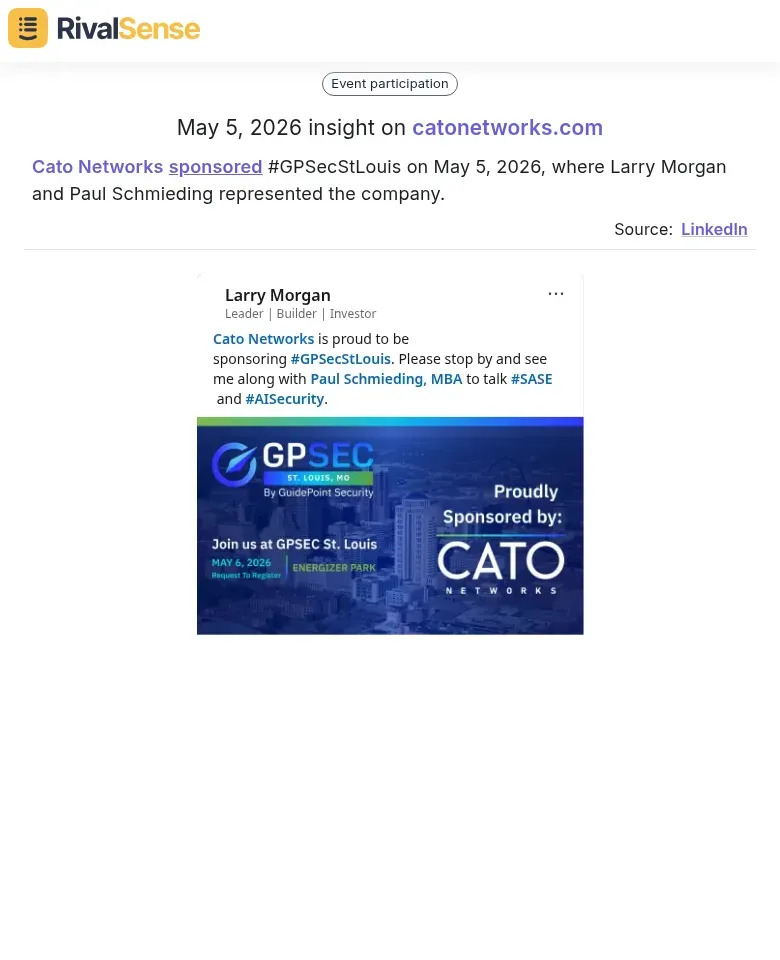
Real insight from RivalSense: Event participation signals where competitors are building relationships and establishing thought leadership. Recently, Cato Networks sponsored #GPSecStLouis on May 5, 2026, where Larry Morgan and Paul Schmieding represented the company. This type of insight is valuable because it indicates which communities and regions a competitor prioritizes—you can then target the same events with a stronger booth presence or create content that ties into those discussions while the audience is still engaged.
Create a simple checklist:
- Monitor cadence changes
- Identify new keywords
- Analyze sentiment shifts
- Cross-reference with product release timelines
This pattern recognition lets you anticipate moves before they happen, giving you a strategic edge in app dev.
Building Your Own Predictive Content Strategy
To build a predictive content strategy, start by mapping competitor gaps. Use tools like RivalSense to identify topics your rivals are neglecting—e.g., if they focus on iOS but ignore Android, that's your opening. Prioritize high-impact, low-competition keywords by analyzing search volume vs. competitor coverage. Aim for topics with decent demand but few authoritative posts.
Next, create a content roadmap that addresses these gaps. For each month, assign 2-3 cornerstone pieces targeting underserved areas. Use a simple scoring system: Topic Score = (Search Volume × Relevance) / Competitor Count. Focus on scores above a threshold you set.
Integrate real-time competitor alerts into agile cycles. Set up daily or weekly alerts for new competitor content. When a rival publishes on a topic you planned, decide: pivot to a different angle, accelerate your post, or skip it. Use a Kanban board (e.g., Trello) to manage this: columns for "Planned," "In Progress," "Published," and "Pivoted." Review alerts every Monday to adjust the week's tasks.
Checklist:
- Identify 5 competitor gaps.
- Score 20 potential topics.
- Create 3-month roadmap.
- Set up alerts.
- Weekly review cycle.
Conclusion: Staying Ahead in the App Dev Content Race
In the fast-paced app dev space, staying ahead means anticipating your competitors' next moves, not just reacting to them. The competitive intelligence framework we've outlined—monitoring topic shifts, engagement patterns, and content gaps—gives you a predictive edge. To implement it today:
- Identify your top 3 competitors and audit their last 20 posts for recurring themes.
- Use a tool like RivalSense to automate tracking of their publishing frequency, headline styles, and audience engagement.
- Cross-reference their content with trending industry keywords (e.g., via Google Trends) to spot emerging topics before they peak.
- Set up weekly alerts for competitor launches or format changes (e.g., moving from blogs to video).
- Create a content response playbook: when a competitor covers a topic, you can either counter with a deeper dive or pivot to an adjacent underserved angle.
For a quick win, analyze their top 5 performing posts—what questions do they answer? What formats do they use? Then produce your own version with unique data or case studies.
Ready to automate the heavy lifting? Try RivalSense for free to get real-time competitor content insights, so you can focus on strategy, not manual scraping. Get your first competitor report today!
📚 Read more
👉 How Movildata's New Module Alerted a Competitor to Act
👉 Leverage Website Changes for Competitor SEO Wins
👉 Key Account Dashboard Cheat Sheet for Compliance Automation
👉 Pricing Cheat Sheet: Key Account Management Insights
👉 The Key Account Management Playbook: A Leader's Guide to Empowering SAMs