
Key Account Sales Tracking: The Metrics That Actually Move the Needle
Most sales dashboards are lying. Not intentionally, but structurally. They track activity—calls made, outlets visited, reports submitted—while the real question goes unanswered: What changed because of that activity?
If you're managing key accounts, you know the pain. Your team hits their visit targets, but revenue stays flat. Your CRM is full of data, but insights are scarce. The problem isn't effort—it's focus. You're tracking the wrong things.
Let's fix that.
The 8 KPIs That Matter for Key Account Sales
Forget the dashboard overload. Here are the metrics that separate high-performing key account teams from the rest:
| KPI | Why It Matters | How to Track It |
|---|---|---|
| Account Penetration Rate | Revenue per account vs. total addressable spend | Compare quarterly revenue to estimated account potential |
| Share of Wallet | How much of the customer's category budget you own | Survey or estimate based on purchase data |
| Net Revenue Retention (NRR) | Growth from existing accounts (expansion minus churn) | Track recurring revenue changes month-over-month |
| Time to First Value | How quickly a new account sees ROI from your product | Measure from contract sign to first milestone achieved |
| Executive Engagement Score | Are you meeting with decision-makers or just users? | Log meeting titles and track % of C-level interactions |
| Contract Renewal Rate | % of accounts that renew within 30 days of expiry | Monitor renewal pipeline weekly |
| Customer Health Score | Composite of product usage, support tickets, NPS | Build a weighted score from support, product, and survey data |
| Upsell/Cross-sell Conversion Rate | % of upsell opportunities that close | Track offers made vs. accepted per account |
Pro Tip: Pick 3 KPIs max per quarter. As one sales leader put it: "More KPIs don’t drive better performance. Clear priorities do."
The Execution Gap: Why Plans Fail
You've seen it before. A solid account plan, a clear target, but results fall short. The gap is almost never strategy—it's execution. Here are the three most common breakdowns:
- Coverage Gaps – Key accounts look active on paper, but the real decision-makers are never contacted.
- Misaligned Distributors/Partners – Targets are set, but daily priorities don't match.
- No Real-Time Visibility – Decisions are based on last month's data, not today's reality.
How to Close the Gap
- Map your accounts by influence, not just title. Identify the economic buyer, technical buyer, and champion. Track touches with each.
- Set joint success criteria with partners. Don't just share targets—align on weekly actions.
- Use a weekly pulse check. Every Friday, ask: What changed because we visited this account? If the answer is "nothing," it wasn't a sales call.
A Practical Checklist for Key Account Tracking
Use this weekly to stay on track:
- [ ] Reviewed top 5 accounts by revenue and growth potential
- [ ] Checked each account's health score (usage, support, sentiment)
- [ ] Logged at least one executive interaction per key account
- [ ] Updated opportunity stage for all upsells/cross-sells
- [ ] Compared actual vs. planned account revenue for the month
- [ ] Identified one at-risk account and created a save plan
- [ ] Reviewed competitor activity affecting your accounts
The Competitive Intelligence Blind Spot: Real-World Examples
Here's something most key account teams miss: your competitors are watching your accounts too. A pricing change, a product launch, a new partnership—any of these can derail your relationship overnight. Yet most teams rely on sporadic manual checks or sales reps hearing something "through the grapevine."
That's where RivalSense comes in. Instead of scrambling to track competitor moves across websites, social media, news, and registries, you get a weekly email report that surfaces exactly what matters: product updates, pricing shifts, event appearances, management changes, and media mentions—all curated from 80+ sources. No more blind spots. No more last-minute surprises. Just the intel you need to protect and grow your key accounts.
Let's look at three real insights RivalSense recently surfaced—and why each matters for your key account strategy:
📱 Hootsuite's New Personalized Commentary Feature
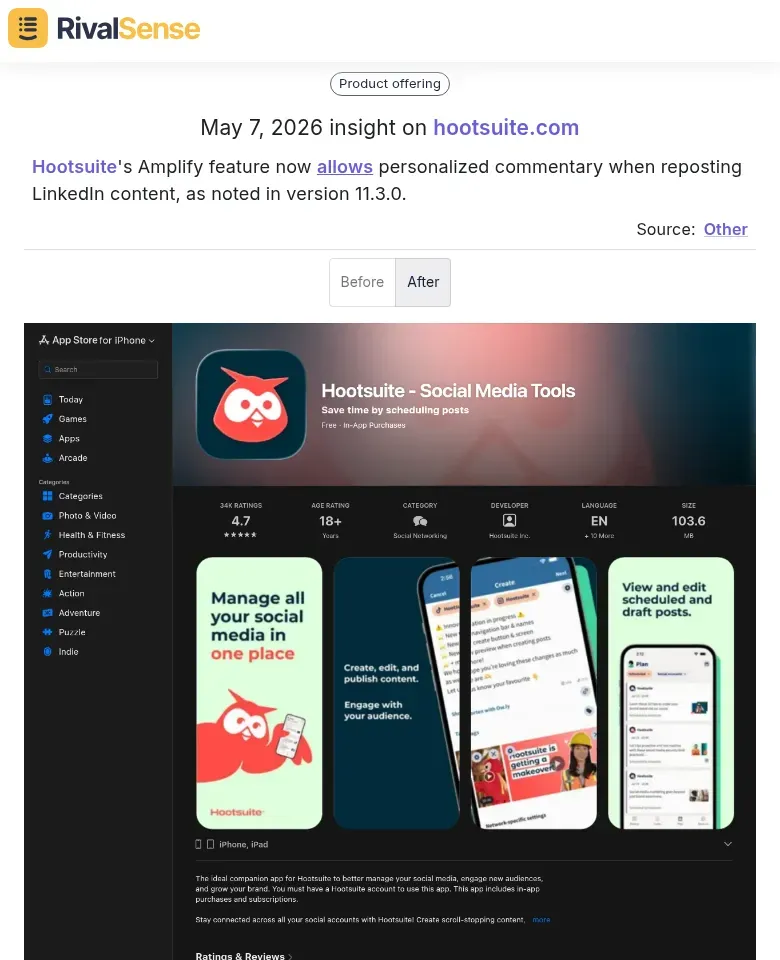
Insight: Hootsuite's Amplify feature now allows personalized commentary when reposting LinkedIn content, as noted in version 11.3.0.
Why it matters: If Hootsuite is a competitor or a client's tool, this product update signals a shift toward employee advocacy and social selling. For your key accounts, understanding this move can help you anticipate how your competitors might enhance their own social media capabilities—or how your clients might expect similar functionality from you.
🤖 Zapier's AI Pivot on Early Access Page
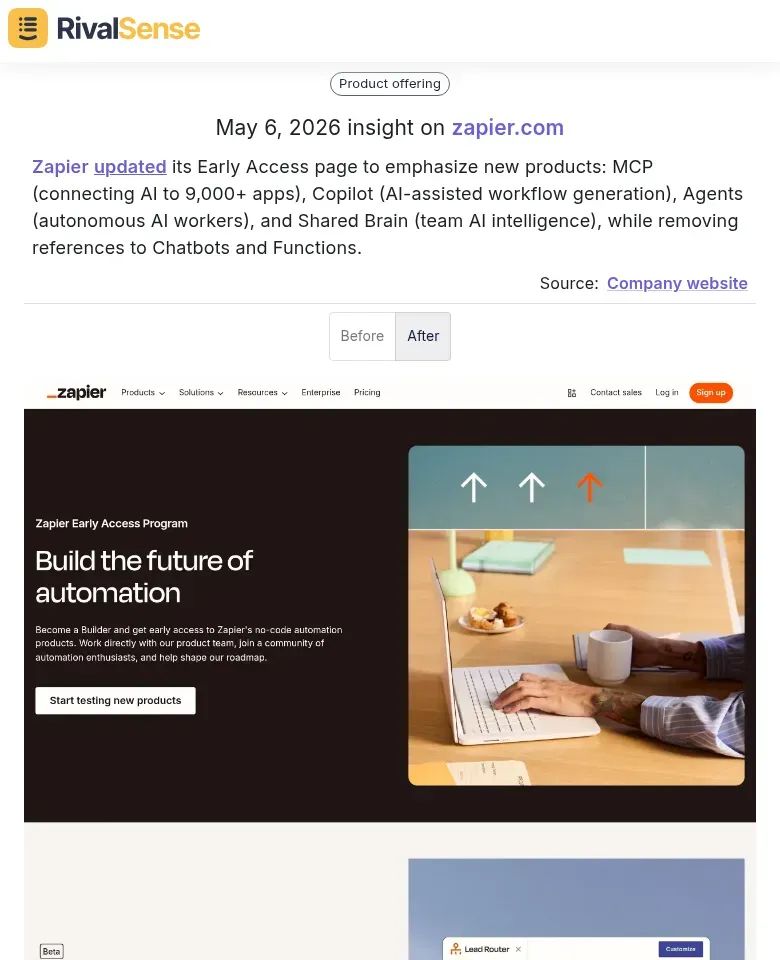
Insight: Zapier updated its Early Access page to emphasize new products: MCP (connecting AI to 9,000+ apps), Copilot (AI-assisted workflow generation), Agents (autonomous AI workers), and Shared Brain (team AI intelligence), while removing references to Chatbots and Functions.
Why it matters: This product strategy shift reveals where Zapier is investing—AI automation and multi-agent systems. If Zapier is a competitor or partner, this insight helps you adjust your own product roadmap or sales pitch. For key accounts exploring automation, you can position yourself as the more focused alternative—or align with the trend.
🚨 BounceTogether's Proactive Wellbeing Monitoring
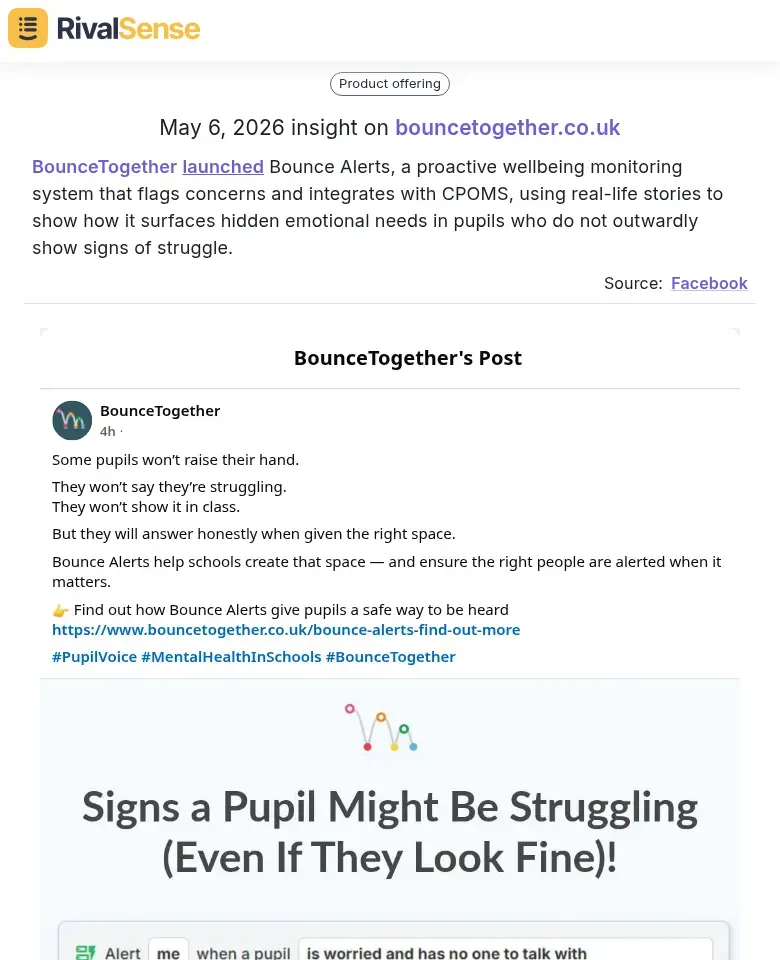
Insight: BounceTogether launched Bounce Alerts, a proactive wellbeing monitoring system that flags concerns and integrates with CPOMS, using real-life stories to show how it surfaces hidden emotional needs in pupils who do not outwardly show signs of struggle.
Why it matters: If BounceTogether competes in the education or wellbeing space, this product launch shows a move toward preemptive intervention—a value proposition that could sway accounts currently using a different platform. For your key accounts, knowing this allows you to proactively address potential objections or benchmark your own offerings.
These are the kinds of signals that can make or break a key account relationship. With RivalSense, you don't have to hunt for them—they land in your inbox weekly.
Final Thought
Sales isn't about tracking more metrics. It's about tracking the right outcomes. Activity fills reports. Outcomes build business. Choose your KPIs wisely, close the execution gap, and keep one eye on the competition. Your key accounts—and your bottom line—will thank you.
Ready to eliminate blind spots in your key account sales? Try RivalSense for free and get your first competitor report today.
📚 Read more
👉 How to Predict Your Competitors' Next Content Moves (and Win in App Dev)
👉 How Movildata's New Module Alerted a Competitor to Act
👉 Leverage Website Changes for Competitor SEO Wins
👉 Key Account Dashboard Cheat Sheet for Compliance Automation