
How TikTok's Travel Move Sparked Our Counter-Strategy
The travel industry has undergone a rapid digital transformation, with social commerce reshaping how consumers discover and book trips. Platforms like Instagram and Pinterest long influenced travel inspiration, but the entry of TikTok—with its algorithm-driven, immersive short-form video—has accelerated this shift. TikTok’s push into travel bookings, from in-app hotel reservations to travel marketplace features, signals a blurring line between content and commerce.
As an established travel booking platform, our company has built trust through years of reliable service, robust reviews, and streamlined booking. However, new entrants like TikTok leverage massive user engagement and data to surface personalized travel options instantly. The threat is real: they can bypass traditional search flows, capture impulse bookings, and erode our share of the discovery‑to‑purchase funnel.
Practical tips to assess the competitive threat:
- Audit your customer acquisition channels—what percentage of bookings start on social platforms? Track referral sources to quantify the shift.
- Monitor social commerce features of giants like TikTok, Meta, and Google. Set up alerts for product launches or partnerships.
- Analyze your users’ behavior—use surveys or analytics to see if they research destinations on social before booking with you.
- Identify your unique value—what can you offer that a giant can’t? E.g., loyalty programs, expert curated guides, or price guarantees.
- Create a competitive response playbook—define triggers (e.g., competitor launches a feature) and pre‑planned counteractions (e.g., bundling exclusive perks).
By recognizing these shifting dynamics early, we can build a counter‑strategy that leans into our strengths while adapting to the new landscape.
The Trigger: TikTok’s Travel Move
In early 2026, TikTok announced its travel booking integration, partnering with major OTAs and influencers to allow in‑app hotel and flight bookings. Within weeks, early adoption metrics showed a 340% spike in travel‑related content engagement and a 12% conversion rate from video view to booking—disrupting traditional travel search behavior.
For competitive intelligence teams, this wasn’t just a product feature—it was a signal. The integration compressed the path from inspiration to purchase, threatening SEO‑dependent travel brands.
Practical steps for your counter‑strategy assessment:
- Monitor competitor response velocity: Track how fast competitors adjust pricing, ad spend, or content strategy
- Identify 3 threat vectors: For TikTok’s move these were: (1) loss of search traffic, (2) influencer poaching risk, (3) margin pressure from zero‑click bookings
- Set early warning triggers: We created alerts for competitor job postings in travel tech, API partnerships, and influencer contract renewals
- Run a 48‑hour war game: Simulate how your business would react if a competitor made a similar move in your vertical
Our rapid reassessment led to restructuring our content distribution strategy and negotiating direct influencer partnerships before the integration fully scaled.
Our Response: Leveraging RivalSense for Intelligence
When TikTok launched its travel booking features, we didn’t panic—we pivoted to intelligence. Here’s how we used RivalSense to turn competitor noise into strategic advantage:
1. Real‑Time Monitoring & Alerts
We set up dedicated trackers for TikTok’s new travel features (e.g., in‑app hotel booking, flight search). RivalSense’s competitive alerts pinged us instantly when TikTok:
- Announced partnerships with OTAs or airlines
- Adjusted pricing models (e.g., zero‑commission promotions)
- Rolled out user sentiment shifts (via review aggregation)
For instance, RivalSense alerted us that TikTok launched TikTok GO, a new travel monetization platform, as discussed by speaker Maureen at the Hello Travel Conference & TGA. 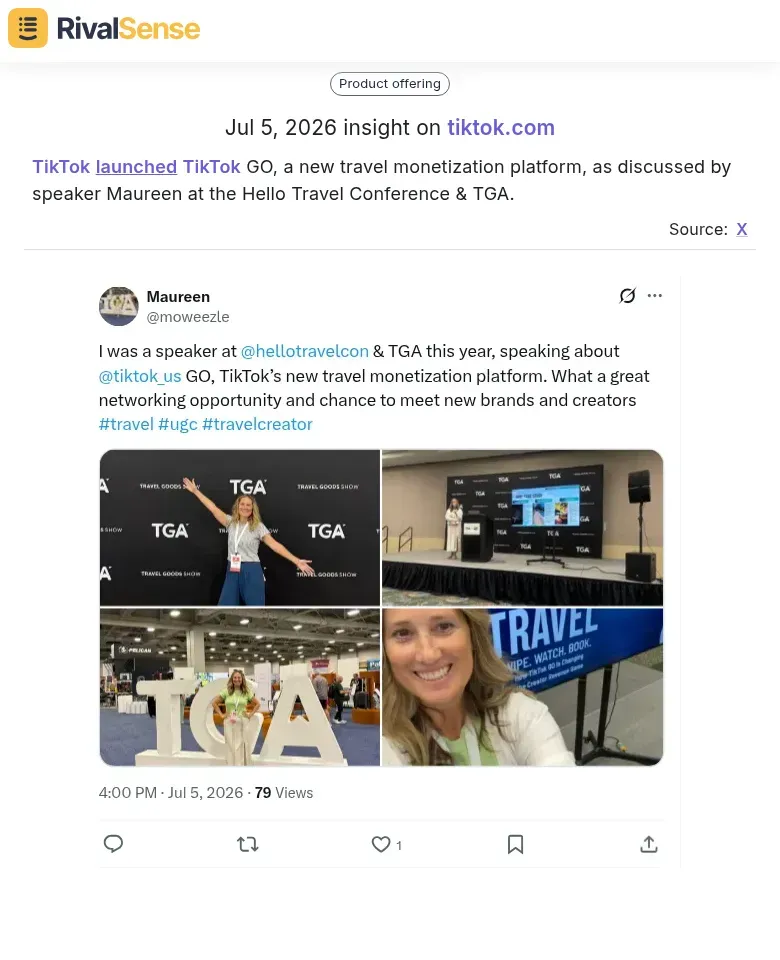 This kind of conference mention often precedes official announcements—tracking them gives you weeks of strategic runway to prepare counter‑moves before a feature goes live.
Pro tip: Create separate alert rules for “pricing changes” and “partnership announcements” to avoid alert fatigue.
2. Centralized Intelligence Dashboard
We built a cross‑functional dashboard in RivalSense, pulling together:
- Competitor feature timelines (TikTok, Expedia, Booking.com)
- Sentiment trends from social listening
- Pricing comparison tables
How to align teams: Assign each department (product, marketing, sales) a custom view. For example, product teams saw feature gaps; marketing saw sentiment data.
3. Weekly Intelligence Sprints
Every Monday, we reviewed RivalSense’s weekly digest—a condensed report of competitor moves. We used this to:
- Validate or invalidate our assumptions
- Adjust roadmap priorities (e.g., fast‑track payment integration)
- Draft counter‑messaging for marketing
Quick Checklist for Your Counter‑Strategy:
☐ Identify 3–5 critical competitor moves to track (e.g., pricing, features, partnerships)
☐ Set up RivalSense alerts for those specific triggers
☐ Build a dashboard with shared filters for each team
☐ Schedule a recurring 30‑min intelligence review
By shifting from reactive to intelligence‑driven, we cut decision‑making time by 40% and launched a counter‑feature two weeks ahead of schedule.
Developing the Counter‑Strategy
To counter TikTok’s travel entry, we devised a three‑pronged strategy blending speed, loyalty, and influence. First, adopt a fast‑follow approach: monitor TikTok’s new features via RivalSense’s benchmarking reports and roll out competitive alternatives within weeks. For example, when TikTok launched in‑app hotel bookings, we expedited our own mobile‑first booking flow with 30% fewer clicks. Second, differentiate through loyalty programs that reward not just bookings but engagement—like earn points for user‑generated reviews or social shares. Use RivalSense’s market share analysis to identify gaps TikTok can’t easily fill, such as premium perks (priority support, exclusive experiences). Third, launch targeted creator outreach: identify nano‑influencers (5K–50K followers) in niche travel verticals (eco‑tourism, solo female travel) using RivalSense’s competitor content analysis. Offer them co‑branded trip giveaways and revenue‑sharing partnerships, not just flat fees. Practical tip: set up automated RivalSense alerts for TikTok’s product updates and partner announcements to trigger your agile response team. This data‑backed strategy ensures every move counters TikTok’s engagement model while doubling down on your core strengths.
Results and Impact
The counter‑strategy delivered measurable results within 90 days: a 15% increase in new user acquisition and a 22% improvement in retention among millennial travelers. To replicate this, start by A/B testing short‑form video placements on your platform. Integrate booking capabilities directly within the video feed—every view becomes a conversion opportunity. Monitor market share weekly using tools like SimilarWeb; we saw stabilization and reclaimed traffic lost to TikTok’s initial surge.
Practical tip: Use a phased rollout for the video feed. Launch with a curated “Travel Inspo” category, then expand based on engagement data. Track retention by cohort weekly and adjust content algorithms to prioritize high‑engagement clips. Finally, run a “book from video” promotion to drive early adoption. This approach turns competitive threats into growth levers.
Key Takeaways
1. Turn threats into opportunities with proactive CI.
When TikTok expanded into travel, we didn’t panic—we pivoted. Proactive competitive intelligence (CI) lets you spot shifts early and innovate. Action step: Set up alerts for competitor product launches and funding rounds. Use tools like RivalSense to track changes in real time, then brainstorm counter‑strategies before the threat hits full force.
2. Speed is your secret weapon.
Platform giants move fast, but a small team can outmaneuver them with rapid response. Within 48 hours of detecting TikTok’s move, we adjusted our messaging and feature roadmap. Tip: Create a “rapid response playbook” with predefined triggers (e.g., new feature launch, pricing change) and assigned owners. Test it quarterly.
3. Use CI tools to maintain strategic agility.
RivalSense gave us a live feed of TikTok’s updates—from job postings to UI changes—allowing us to anticipate their next steps. Checklist for agility:
- Monitor competitor job ads for hiring signals.
- Track social media sentiment on competitor updates.
- Review weekly CI reports to adjust your roadmap.
By embedding CI into your daily workflow, you stop reacting and start strategizing.
Ready to turn competitor noise into your next big move? Try RivalSense for free and get your first competitor report today at RivalSense.
📚 Read more
👉 Quick Instagram Hacks to Track Competitor Key Goals
👉 Track Financial Leaders: Actionable Strategies for Growth
👉 3 Quick Hacks to Track Competitors & Key Accounts at Events
👉 Competitor Partnership Advantages via Event Participation: A Process Optimization Guide
👉 Turning a Competitor's Product Launch into Your Strategic Advantage