
Track Financial Leaders: Actionable Strategies for Growth
Tracking financial leaders isn't just about monitoring competitors—it's a strategic lever for growth. By systematically analyzing market leaders, you uncover operational benchmarks like cost-to-income ratios, customer acquisition costs, and digital adoption rates. For example, observing how a leading fintech reduced claims processing time by 40% through AI can reveal efficiency innovations to adapt. Financial sector pioneers often set trust-building standards—such as transparent fee structures or real-time fraud alerts—that directly impact customer retention.
Actionable Steps:
- Define KPIs: Identify 5–7 metrics (e.g., net promoter score, time-to-approval) that matter most to your growth.
- Set Up Alerts: Use tools like RivalSense to track quarterly reports, blog posts, and patent filings from top 3 competitors.
- Analyze Patterns: Map investments and partnerships over 12 months. Are they betting on AI underwriting, blockchain settlements, or embedded finance?
- Test & Adapt: Pilot one innovation (e.g., automated claim verification) on a small segment, measure impact, then scale.
Checklist: □ Competitor KPI dashboard □ Monthly pattern review □ Quarterly strategy pivot. Systematic tracking turns raw data into actionable intelligence—helping you replicate proven growth drivers before they become industry standards.
Operational Efficiency Through Deep Integration
Legacy workflows often bog down financial operations, turning simple tasks into multi-day ordeals. To reduce processing times from days to minutes, you must rethink these workflows and embrace third-party integrations. Start by mapping your current process end-to-end to identify every manual handoff and data re-entry point.
Actionable Steps:
- Audit existing systems for integration capabilities (APIs, webhooks, pre-built connectors).
- Implement deep integrations with industry standards like Unipass to automate identity verification, KYC checks, and document transfers. This eliminates manual handoffs and reduces error rates by up to 80%.
- Set up real-time data syncing between CRM, accounting, and compliance tools. Use middleware (e.g., Zapier, Tray.io) if native connections are absent.
- Test integration flows with a sandbox environment before going live. Monitor for latency or failure points.
Pro Tip: Prioritize integrations that touch the highest-friction steps in your customer journey. For example, linking your onboarding portal directly to Unipass can cut client verification from 3 days to under 15 minutes.
📊 Real Insight via RivalSense: Scottish Widows reduced Letter of Authority processing from 15 days to 15 minutes through deep Unipass integration.

Tracking such operational leaps gives you a concrete efficiency benchmark and surfaces proven integration partners—making it a valuable input for your own process modernization roadmap. Competitors’ time-to-completion figures often signal where technology is outpacing manual methods; by monitoring these signals, you can close gaps before they widen.
Operational speed becomes a competitive differentiator—faster processing improves customer satisfaction, reduces drop-off during onboarding, and strengthens retention. Companies that achieve sub-hour processing times see 2–3× higher conversion rates in competitive B2B segments.
Transparency as a Trust-Building Engine
In an industry built on trust, transparency is your strongest competitive advantage. Financial leaders like Lemonade and Metromile have turned claims data into a trust-building engine. By regularly publishing authentic performance numbers, they reduce skepticism and foster long-term relationships.
Publish Key Metrics – Lemonade publicly shares its claims payout data, including a 99% life insurance payout rate. This signals reliability and cuts through skepticism. Action step: Identify one core success metric (e.g., claim approval rate, average payout time) and publish it quarterly on your website.
Humanize with Numbers – Don’t just post percentages. Highlight total value paid and number of customers served. For example, “$X million paid to X customers” makes data relatable and strengthens credibility. Tip: Pair statistics with a customer testimonial for maximum impact.
🔎 RivalSense Insight: Scottish Widows paid £219 million in individual protection claims in 2025, covering 10,967 customers, with a 99% payout rate for life insurance and 91.9% for critical illness, according to claims strategy manager David Russell.
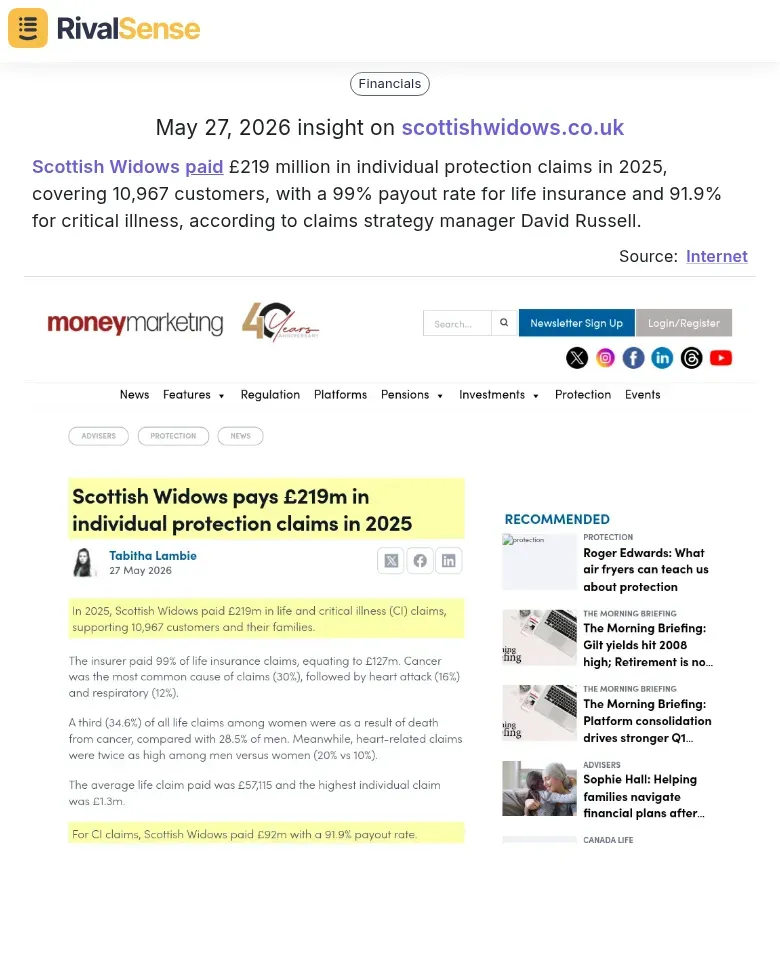
Monitoring such disclosures through competitor tracking tools reveals what metrics leaders prioritize to build credibility. This type of insight is invaluable—it tells you not just what target numbers to adopt, but also how to frame your own performance story to win trust and differentiate from opaque rivals.
Make Reporting a Habit – Regular, transparent reporting (e.g., monthly or quarterly) creates a narrative of accountability. It’s not just for investors; use these reports as PR assets. Checklist:
- Choose 2–3 metrics aligned with customer priorities.
- Create a simple one-page report with visuals.
- Distribute via blog, email, and social media.
- Track engagement and adjust based on feedback.
By treating transparency as an ongoing strategy, you build trust, differentiate your brand, and turn data into a marketing engine that prospects can verify.
Investing in Industry Leadership and Talent
Investing in industry leadership and talent is a strategic move beyond immediate ROI. By sponsoring educational programs—like trustee accelerators or fintech bootcamps—you position your company as a thought leader while nurturing the next generation of decision-makers. These initiatives often plant seeds for future partnerships, talent pipelines, and brand advocacy.
🎓 Spotted with RivalSense: Scottish Widows sponsors the PMI Trustee Accelerator Programme to help build skills and confidence for future trustees.
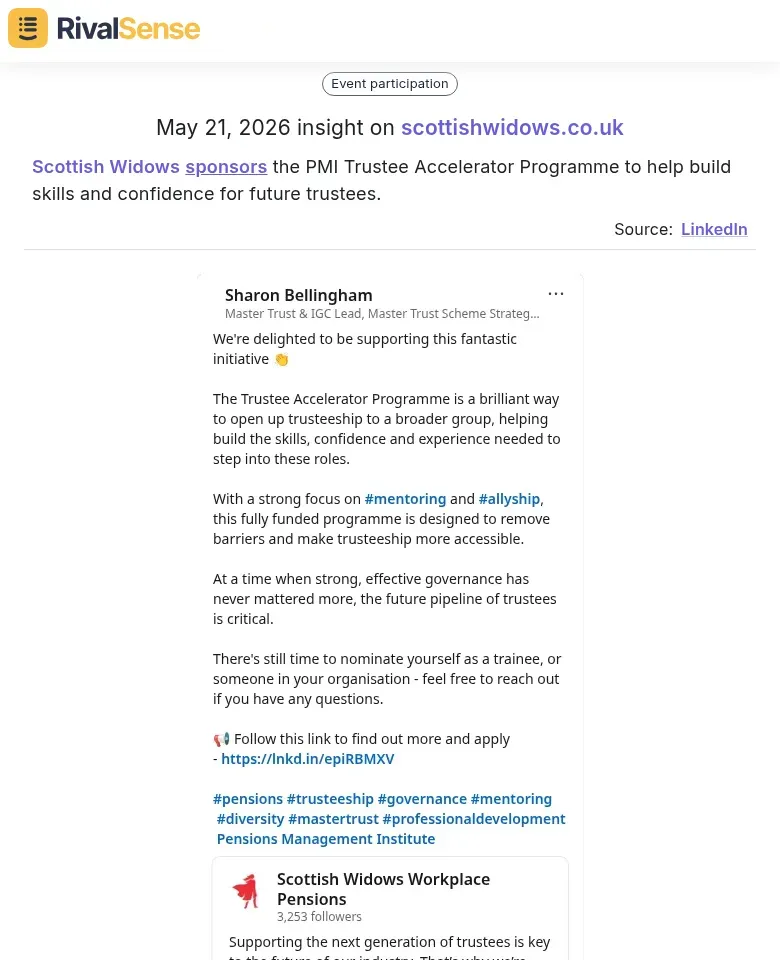
This kind of insight — a competitor’s talent development sponsorship — is a strategic treasure map. It reveals where rivals are investing in long-term influence and skills shortages. By tracking such sponsorships, you can identify underserved topics (e.g., ESG, digital banking) and launch your own accelerator or mentorship program, positioning your brand exactly where future buyers and influencers are being shaped.
Actionable Steps:
- Identify gaps: Look for underserved areas in financial education where your expertise adds value (e.g., ESG investing, digital banking).
- Partner strategically: Collaborate with universities, accelerators, or professional associations to co-create curriculum or offer mentorship.
- Measure impact: Track participant engagement, career progression, and resulting business referrals.
Tips for Success:
- Start small: Pilot a micro-scholarship or one-day workshop before full-scale commitment.
- Leverage employee volunteers to maximize authenticity and reduce costs.
- Document success stories and share via blog and social media to amplify thought leadership.
These investments build a pipeline of informed advocates and future partners. Over time, alumni trust your brand—turning talent strategy into a competitive advantage.
Synthesizing Learnings into a Growth Strategy
To synthesize competitive insights into a growth strategy, combine operational speed, transparency, and leadership investment — the triad that gives financial leaders an edge. Start by mapping your top three competitors across these dimensions using a simple scoring matrix (1–5).
Actionable steps:
- Audit operational speed: Identify where competitors automate (e.g., loan approvals, reporting). Use tools like RivalSense to track feature releases and hiring for ops roles. If they launch faster, your gap may be in tech stack or workflow design.
- Measure transparency: Review competitors’ public communications — blogs, investor letters, social media. Note how often they share metrics, admit mistakes, or discuss long-term risks. Create a “transparency scorecard” and benchmark your own content.
- Track leadership investment: Monitor C-suite hires, board appointments, and speaking engagements. Are they investing in compliance talent (trust) or AI specialists (speed)? Use that to infer strategic bets.
Key question to ask weekly: Are competitors prioritizing short-term efficiency (cost cuts, automation) or long-term trust (compliance, diversity, sustainability)? If they lean one way, you can differentiate by leaning into the opposite.
Tip: Set up alerts for competitor earnings calls or investor days — these reveal how they reconcile speed, transparency, and talent. Then update your own strategy quarterly by listing three gaps you can exploit (e.g., slower onboarding → faster UX; opaque fees → clear pricing).
Finally, turn gaps into action items with a simple checklist: ☐ Choose one speed improvement this quarter ☐ Publish one transparency metric ☐ Schedule one leadership hire or advisory board addition. This systematic approach turns competitor tracking into a sustainable growth engine.
Actionable Steps for Tracking Financial Competitors
To outpace financial leaders, implement a structured tracking process:
1. Set Up Real-Time Alerts
- Product Integrations: Use tools like RivalSense to monitor API updates, new platform partnerships (e.g., Plaid, Stripe), or feature launches. Set Google Alerts for “[Competitor Name] + integration.”
- Claims Reports: Track SEC filings, press releases, and blog posts for claims about transaction speed, uptime, or fraud rates. Create a shared spreadsheet to log discrepancies.
- Partnership Announcements: Follow competitors’ LinkedIn pages and Crunchbase for funding rounds or strategic alliances.
2. Analyze Talent Development Focus
- Review competitors’ sponsored events (e.g., fintech conferences) and training programs (e.g., certifications, hackathons). Identify which skills they prioritize—blockchain, AI, compliance—and note any public webinars or whitepapers they produce.
- Tip: Use Eventbrite or Meetup to see which events they host or sponsor. This reveals their talent investment areas.
3. Benchmark Processing Metrics & Transparency
- Quarterly, compare your metrics (e.g., transaction fees, settlement times, dispute resolution) against top rivals. Public sources like annual reports, customer reviews, or industry reports (e.g., Nilson Report) provide benchmarks.
- Checklist:
- [ ] Download competitors’ pricing pages and fee schedules.
- [ ] Read their transparency reports (if available).
- [ ] Analyze customer support response times via mystery shopping.
- Action: Adjust your own reporting to highlight strengths (e.g., faster settlement) and address gaps.
By systematizing these steps, you’ll turn competitive data into growth tactics.
See the Bigger Picture with RivalSense
The examples above—from operational leaps to transparency disclosures and talent investments—came from real competitive alerts delivered by RivalSense. Instead of manually digging through dozens of sources, you can get a curated weekly report summarizing product launches, pricing changes, event participations, management moves, and more for any financial competitor you choose.
👉 Ready to move from reactive monitoring to proactive strategy? Try RivalSense for free and get your first competitor report today, so you can start turning tracking into growth immediately.
📚 Read more
👉 3 Quick Hacks to Track Competitors & Key Accounts at Events
👉 Competitor Partnership Advantages via Event Participation: A Process Optimization Guide
👉 Turning a Competitor's Product Launch into Your Strategic Advantage
👉 How to Customize Key Account Tracking for Smarter Competitive Intelligence
👉 5 Quick Hacks to Track Industry Leaders (and Competitor Moves) for Consulting Success