
Competitor Partnership Advantages via Event Participation: A Process Optimization Guide
Events provide a uniquely low-stakes environment for exploring competitor partnerships. Unlike formal joint ventures or long-term agreements, co-hosting a webinar, panel, or workshop allows both parties to test collaboration without binding commitments. The strategic advantage is twofold: you gain access to a competitor's audience, expanding reach beyond typical marketing channels, while simultaneously positioning your brands as industry collaborators rather than adversaries. This signals maturity to the market and can open doors for future cooperation.
To treat these partnerships as an optimizable process rather than one-off experiments, start with a small, low-risk event like a co-branded webinar on a non-controversial topic. Use a checklist: define shared goals (e.g., leads, attendance), agree on promotion timelines (cross-promote 2 weeks before), and assign clear roles (who moderates, who handles Q&A). After the event, debrief with a simple scorecard: track registrations by source, engagement rate, and follow-up conversions. Refine your approach for the next event, scaling up to larger formats or recurring series. The key is to build a repeatable framework: identify potential partner events quarterly, allocate a small budget for experiments, and document learnings. Over time, this systematic approach turns ad-hoc collaborations into a reliable growth channel.
Identifying Events Aligned with Partnership Goals
To maximize ROI from competitor partnerships via events, zero in on gatherings where your audience and a competitor’s audience naturally intersect. This overlap ensures both parties derive mutual value—shared leads, accelerated trust, and richer conversations.
Prioritize Niche Over Broad
Skip sprawling industry conferences. Instead, target intimate formats: user group meetups, industry roundtables, or private dinners. Attendees at these events are more engaged, decision-ready, and open to meaningful dialogue. A single well-chosen dinner can yield more qualified connections than a three-day expo.
Match the Competitor’s Event Format
Study how your competitor engages their community. RivalSense insights can reveal these patterns in real time. For example, a recent alert showed that Cursor is hosting a meetup in Mendoza on July 8, focused on AI programming, automation, and rapid product development.
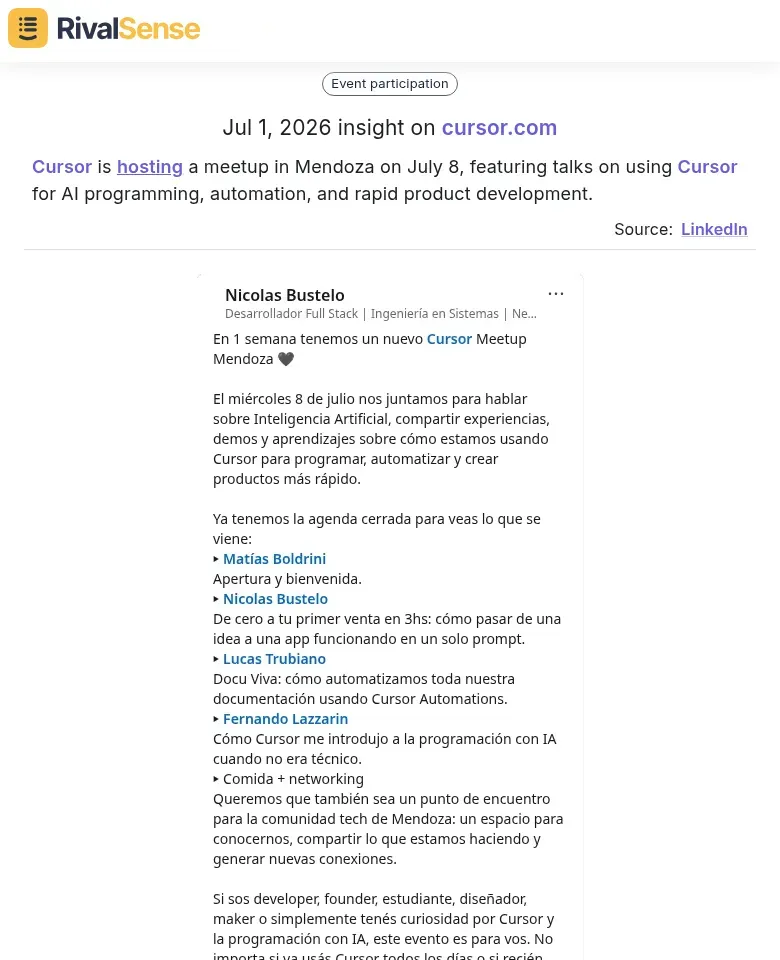
Why this insight matters: Knowing about a competitor's hands-on technical workshop lets you immediately assess whether a joint session makes sense—perhaps a co-demo or complementary tool showcase. Similarly, an insight about Sift and DevCode Identity hosting an intimate dinner for iGaming leaders in London during iGB Events signals an executive networking play, where relationship-building takes priority.
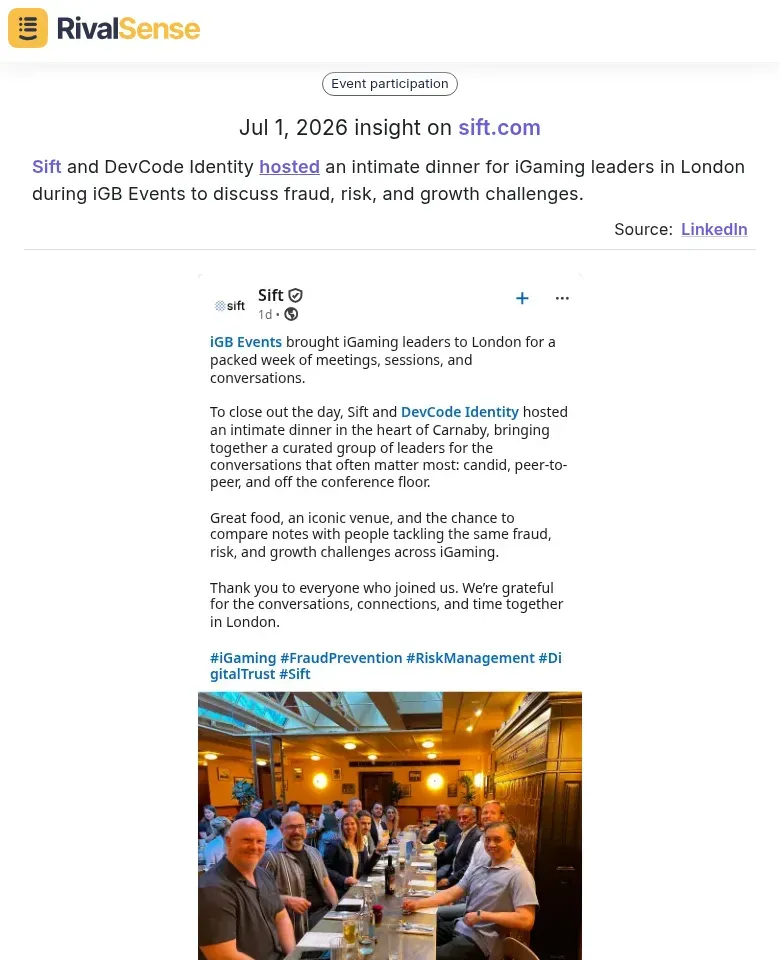
These examples show how competitor event intelligence uncovers partnership opportunities before they happen, so you can align your approach with the format:
- Co-demo? Choose hackathons or workshops.
- Executive relationship? Opt for invitation-only dinners or VIP briefings.
Checklist for Event Selection
☐ Audience overlap ≥ 40% with competitor’s customer base
☐ Event format matches partnership type (educational vs. networking)
☐ Attendee count between 20–100 for optimal depth
☐ No direct competition conflict (avoid head-to-head sessions)
☐ Joint branding opportunity exists (e.g., co-hosted track or reception)
Designing a Win-Win Event Collaboration
To design a win-win event collaboration, start by structuring shared speaking slots or co-hosted sessions that showcase complementary expertise. RivalSense can surface the exact events competitors are planning, so you can model your approach on proven pairings. For instance, insight data showed that Zed is organizing a Bay Area Rust meetup on July 15 at the Convex office, featuring three 20-minute talks.
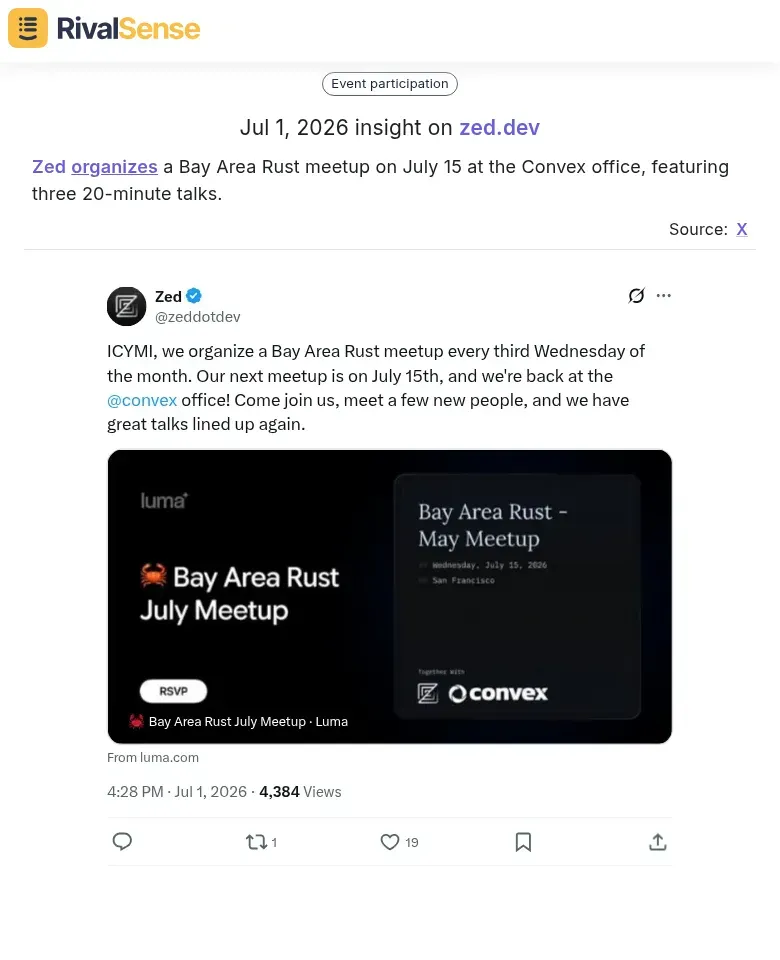
This collaboration pairs a code editor with a backend platform, demonstrating seamless dev workflows—each brand owns its niche without overlapping pitches. Spotting such events through competitor tracking can spark ideas for your own co-hosted sessions, where each speaker addresses their strength, ending with a joint Q&A. Practical steps:
- Identify a partner whose product fits adjacent to yours (e.g., analytics + CRM).
- Draft a session outline with clear handoffs. End with a combined Q&A.
- Promote jointly via email lists, social co-posts, and co-branded landing pages—track registrations per source to ensure equal reach.
Checklist:
☐ Session agenda with defined speaker blocks
☐ Shared promo calendar (post 2 weeks before event)
☐ Equal logo placement on all materials
☐ Post-event lead splits agreed upfront
Tip: Use a “carousel slide” for each brand’s key stat, then a combined slide with the partnership benefit—this visually reinforces “together we solve more.”
Optimizing Execution for Relationship Building
To transform event participation into lasting partnership advantages, optimize execution around relationship building.
Design for Deep Interaction. Avoid standard booths or panels. Instead, host co-branded roundtables (max 12 attendees) on a shared challenge, or schedule structured post-talk mingling where each partner leads a small discussion group. Provide prompt cards to steer conversations toward mutual value.
Assign Clear Roles. Friction arises when responsibilities blur. Pre-assign: Partner A owns logistics (venue, registration, AV), Partner B owns content (talk, handouts, data collection). Create a joint checklist shared 4 weeks prior:
- [ ] Booth staffing schedule (rotating, with overlapping gaps)
- [ ] Lead capture system (QR code or tablet)
- [ ] Follow-up sequence drafted
Capture Insights Together. Don't just collect leads—gather qualitative data. Design a shared feedback form (e.g., 'What’s your top 2027 challenge?') and debrief daily with your partner to identify common pain points or product requests. This joint intelligence feeds your next partnership initiative, product roadmap, or co-marketing content.
Pro Tip: Schedule a 15-minute 'insight sync' immediately after the event, before memory fades. Document top 3 attendee themes and agree on next steps (co-webinar, joint case study, or product tweak). This turns event data into a partnership asset.
Post-Event Follow-Up and Pipeline Integration
To maximize ROI from co-hosted events, design a joint follow-up sequence that nurtures leads without hard selling. Day 1: Send a personalized thank-you email referencing the attendee’s specific questions or engagement. Day 3: Share a combined resource (e.g., “Top 5 Insights from Our Event”) that subtly showcases each partner’s value. Day 7: Offer a no-commitment call to discuss how both solutions address their needs.
Qualify leads together by scoring event-generated data: session attendance, chat questions, poll responses, and booth visits. Use a shared CRM tag (e.g., “Event Q2 Co-Brand”) to track joint leads. Define a BANT framework adapted for partnerships: Budget (single or shared?), Authority (who decides for both solutions?), Need (pain points that require both products?), Timeline (when will they evaluate?).
Co-marketing content cadence keeps momentum:
- Week 1: Recap video (2 min) on social media
- Week 2: Blog post with key takeaways and partner spotlight
- Month 1: Case study or webinar co-presenting success metrics
- Monthly: Rotating guest posts on each other’s blogs
Pro tip: Automate follow-up using tools like HubSpot or Marketo with conditional logic based on event behavior. Track pipeline acceleration—compare time-to-close for event-sourced leads vs. other channels to prove partnership value.
Measuring Success and Iterating the Partnership Process
To ensure your co-hosted events with competitor partners deliver ROI, define shared metrics before the event. Agree on 3-5 key KPIs such as qualified leads generated, partnership advocacy score (e.g., Net Promoter Score among joint attendees), or joint pipeline contribution (value of deals influenced by both companies). Create a simple tracking spreadsheet accessible to both teams.
Post-event debrief checklist:
- Within 48 hours, hold a debrief call with your competitor partner.
- Review actual vs. target metrics.
- Discuss what worked: Was the agenda engaging? Did the venue facilitate networking?
- Identify pain points: technical glitches, mismatched audience, or unclear follow-up process.
Iteration strategy:
- Use feedback to refine event themes. For example, if large meetups generated many unqualified leads, test an intimate dinner format for 15-20 decision-makers with a structured discussion topic. This often yields higher conversion rates due to deeper conversations.
- Rotate hosting responsibilities to bring fresh perspectives and share costs.
- Run A/B tests: same content, different format, compare results.
Pro tip: Build a shared "lessons learned" document with your partner. Update it after every event to create a playbook for future collaborations. Continuous iteration turns one-off events into a scalable, repeatable acquisition channel.
Stay Ahead with Competitor Event Intelligence
Manually tracking competitor events is time-consuming and often reactive. The examples in this guide—Cursor’s meetup, Sift’s executive dinner, Zed’s co-located meetup—were surfaced automatically by RivalSense. Such insights let you anticipate partnership opportunities, align your outreach with the right format, and move faster than competitors who rely on guesswork.
RivalSense delivers weekly reports on competitor product launches, pricing changes, event participations, and more. Try it for free and get your first competitor report today: https://rivalsense.co/
📚 Read more
👉 Turning a Competitor's Product Launch into Your Strategic Advantage
👉 How to Customize Key Account Tracking for Smarter Competitive Intelligence
👉 5 Quick Hacks to Track Industry Leaders (and Competitor Moves) for Consulting Success
👉 How Barings Law's No-Fee PCP Model Sparked a Strategic Shift
👉 Predictive LinkedIn Analysis for Key Account Monitoring Wins