
Quick Instagram Hacks to Track Competitor Key Goals
Why Instagram is a Goldmine for Competitor Goal Tracking
Instagram isn’t just for lifestyle influencers—it’s a “real-time window” into your competitors' strategic playbook. Unlike press releases or LinkedIn posts, Instagram offers raw, “unpolished glimpses” of what matters most to a brand. Here’s how to mine it for competitive intelligence:
1. Track Product Launches & Campaigns
Watch for teaser posts, story countdowns, or IGTV demos. A spike in branded content often signals an upcoming launch—days or weeks before an official announcement.
2. Spot Partnership Hints
Check tagged accounts and co-branded stories. If a competitor suddenly tags a software provider or influencer repeatedly, they may be testing a collaboration.
3. Decode Content Timing
Log when your rival posts—“morning vs. evening”, “weekday vs. weekend”. A sudden shift (e.g., more weekend stories) could indicate a new audience targeting strategy.
4. Identify Strategic Pivots
Compare their posting cadence and topics week-over-week. A drop in educational posts and rise in behind-the-scenes content might mean they’re prioritizing brand awareness over lead gen.
Pro tip: Use a tool like RivalSense to aggregate Instagram activity alongside other channels, so you never miss a strategic signal. Track changes monthly—the subtle shifts you spot on Instagram today could be tomorrow’s major pivot.
Detecting Content Release Patterns and Schedules
To detect a competitor’s content release patterns, start by monitoring their Instagram feed for recurring announcement formats. Look for countdown stickers, teaser posts, or pinned launch announcements that signal a fixed cadence—like weekly podcast episodes or monthly product drops. Use Instagram’s ‘Sort by Oldest’ feature (via the mobile web) to manually map post dates and identify gaps or spikes.
Real-World Insight from RivalSense:
Netflix will release 11 episodes of JoJo’s Bizarre Adventure: Steel Ball Run weekly from September 25.
Why this matters: Content release schedules reveal an organization’s audience engagement rhythm. Knowing a competitor’s episode drop day and cadence helps you avoid timing clashes or even co-opt traffic spikes. Even if the starting signal came from outside Instagram, a tool like RivalSense ensures you catch it early and interpret its strategic weight.*

Create a simple tracking spreadsheet: note the day/time of each post, format (carousel, Reel, Story), and caption cues (e.g., “New episode out every Tuesday”). Tools like Later or Planable can reveal posting schedules by displaying content calendars.
Pay attention to time-of-day patterns—competitors often post launches at peak engagement windows (e.g., 9 AM or 7 PM in their audience’s timezone). Use Instagram Insights (if available) or third-party tools like Hootsuite to analyze best-performing times.
Finally, set up alerts for keywords like “coming soon”, “launch”, or “episode #” using a social listening tool such as Brandwatch. This proactive approach lets you predict their next release and adjust your own content strategy accordingly.
Uncovering Strategic Partnerships and Sponsorships
To uncover a competitor’s strategic partnerships and sponsorships on Instagram, audit their feed for sponsored posts—look for subtle disclosures like “Paid partnership with [Brand]” or branded content tags. These announcements often reveal new B2B relationships and shifts in market positioning.
Practical Steps:
- Scan tagged accounts – Go to your competitor’s profile > “Tagged” tab. Every account they’ve been tagged in (or have tagged) is a potential partner.
- Use the “Branded Content” filter – On their profile, tap the three-dot menu > “About this account” > “Branded content” to see all paid partnership posts in one place.
- Watch for behind-the-scenes stories – A welcome call for a new partner, co-hosted event, or product unboxing can signal deeper collaboration. Save these to a private collection for reference.
Pro Tip: Create a separate Instagram account dedicated to monitoring competitors. Follow their competitors, partners, and industry hashtags. Use a spreadsheet to log each partnership: partner name, post date, type of content (e.g., shoutout, co-branded giveaway, long-term sponsorship), and engagement rate. Over time, patterns emerge—like which partners are recurring or which campaigns drive the most B2B leads.
Checklist for Your Competitive Intel:
- [ ] Review last 30 days of posts for partnership tags
- [ ] Note any co-created content or cross-promotions
- [ ] Check partner bios for competitor mentions
- [ ] Set Google Alerts for competitor + partner names
Real-World Insight from RivalSense:
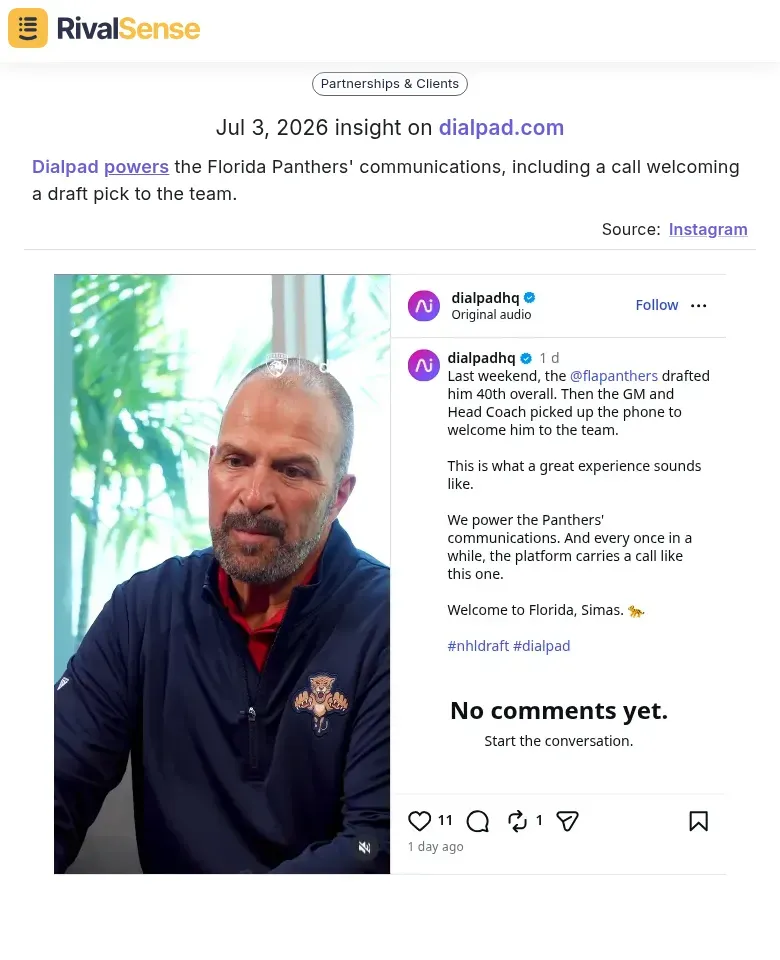
Dialpad powers the Florida Panthers’ communications, including a call welcoming a draft pick to the team.
Why this matters: B2B partnerships often fly under the radar but signal a competitor’s market expansion—here, Dialpad reinforced its sports-vertical credibility. Spotting such moves gives you a chance to approach analogous brands before the niche gets crowded. RivalSense automatically surfaces partnership signals from announcements, social posts, and press releases.*
By mapping this ecosystem, you’ll spot untapped partners your own brand could approach and understand how competitors position themselves through association.
Tracking Product Launches and Catalog Expansions
To track product launches and catalog expansions, monitor competitors’ Instagram posts featuring product photos, descriptions, and ‘swipe up’ links, as these often reveal new items or categories. Pay special attention to Stories and Reels, where competitors demo products—a high frequency indicates priorities in innovation or seasonal offerings.
Practical Steps:
- Create a monitoring checklist – Track 3–5 key competitors, noting post frequency, product types, and call-to-action links.
- Set up alerts – Use tools like RivalSense or Hootsuite to get notified when competitors post about specific keywords (e.g., “new,” “launch,” “exclusive”).
- Analyze frequency – Count product posts per week. A high cadence (>3/week) suggests rapid expansion goals; low frequency (<1/week) indicates a curated selection strategy.
- Review Story highlights – These often archive product demos and limited-time offers, revealing seasonal patterns.
Pro Tip: Use Instagram’s “Following” feed with a dedicated business account to view competitors’ posts chronologically without algorithm interference.
Real-World Insight from RivalSense:
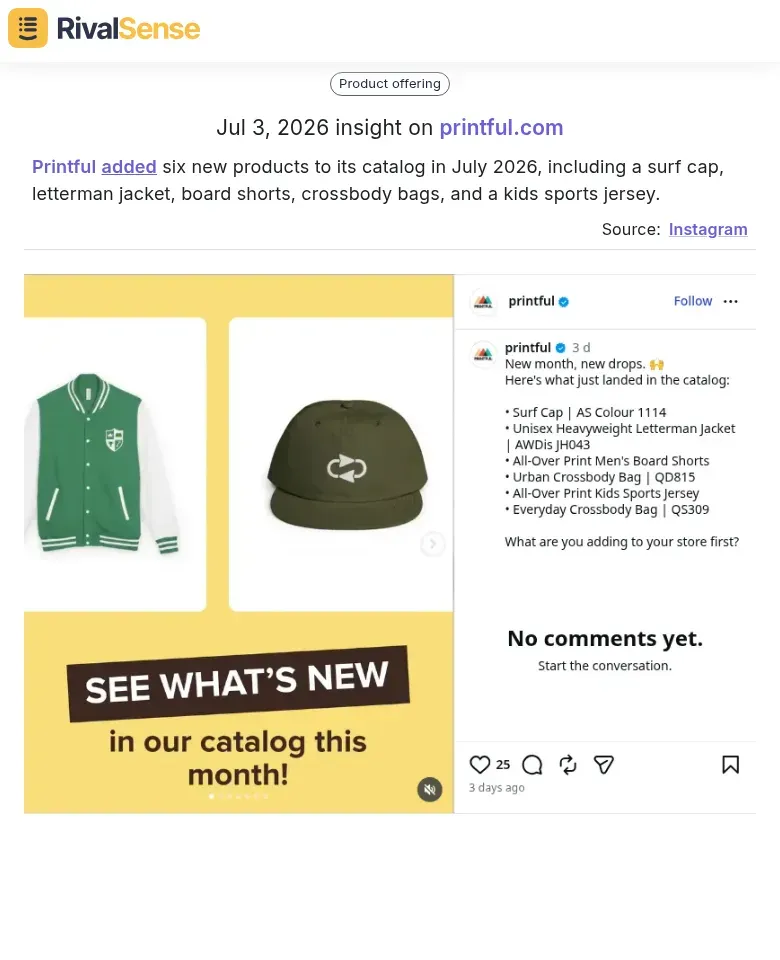
Printful added six new products to its catalog in July 2026, including a surf cap, letterman jacket, board shorts, crossbody bags, and a kids sports jersey.
Why this matters: Catalog expansions reveal a company’s product roadmap and market bets. Seeing Printful enter activewear and youth categories signals a push toward streetwear or team-sports merchandise. For your own brand, this intelligence can validate a new product direction or highlight a gap you can fill first.*
Cross-Referencing Instagram Data with Other Signals
Cross-referencing Instagram data with other signals transforms raw metrics into actionable intelligence. Here’s how to validate competitor goals:
1. Pair engagement spikes with website updates. A sudden jump in likes or comments on a product photo? Check if the competitor launched a new landing page, published a blog post, or updated pricing. Use tools like Wayback Machine or SimpleNote to track page changes.
2. Monitor press releases and job postings. If a competitor posts about a new feature on Instagram and simultaneously lists a job for a product manager in that area, you’ve confirmed a strategic push. Set Google Alerts for competitor names + “hiring” or “announces.”
3. Gauge market response through engagement rates. Compare comment sentiment and share counts across posts. High shares on a “sustainability” post vs. lower shares on a “sales” post reveal what resonates. Use a simple spreadsheet to track weekly averages.
4. Track hashtags and mentions for hidden moves. Search for branded hashtags or competitor account mentions. A sudden uptick in posts from small creators using a new hashtag could signal an unannounced partnership or product test. Check hashtags like #CompetitorNameAmbassador.
Tip: Create a cross-signal dashboard: one column for Instagram data (post type, engagement), another for external signals (press releases, job posts), and a third for your hypothesis. Update weekly for pattern recognition. To save time, a tool like RivalSense can automatically correlate announcements from websites, social media, and registries, helping you confirm a product launch or partnership you first spotted on Instagram.
Turning Instagram Insights into Competitive Strategy
To turn Instagram insights into competitive strategy, focus on three goal types: content timing, partnerships, and product expansion. Content timing reveals when your competitor posts and what resonates—track their top-performing posts’ days and times. Partnerships surface co-marketing moves; note any brand collabs or influencer tags. Product expansion shows launches or teasers; capture new product mentions or features.
Set a weekly routine: every Monday, review your top 3 competitors' Instagram profiles. Log changes in a competitive intelligence dashboard (e.g., Airtable, Notion, or a dedicated tool). Include columns for date, goal type, observation, and action. Quick tip: use Instagram’s ‘Following’ feed or a third-party scheduler to spot posting patterns.
Act on insights immediately. If a competitor posts at 2 PM on Wednesdays and gets high engagement, test that slot. If they partner with a micro-influencer, research similar accounts. If they hint at a new feature, adjust your product roadmap to address gaps. Checklist: □ Set up dashboard □ Schedule weekly review □ Log 3 observations □ Implement one change per week.
Never miss a strategic signal. The examples above were surfaced by RivalSense, which monitors competitor websites, social media, and registries—then delivers the most relevant product launches, partnerships, pricing moves, and management changes in a single weekly email report. Try RivalSense for free today and get your first competitor report right away.
📚 Read more
👉 Track Financial Leaders: Actionable Strategies for Growth
👉 3 Quick Hacks to Track Competitors & Key Accounts at Events
👉 Competitor Partnership Advantages via Event Participation: A Process Optimization Guide
👉 Turning a Competitor's Product Launch into Your Strategic Advantage
👉 How to Customize Key Account Tracking for Smarter Competitive Intelligence