
3 Quick Hacks to Track Competitors & Key Accounts at Events
Imagine walking into a single room where your top three competitors are showcasing their latest products, executives are networking with key partners, and market trends are unfolding in real time. That’s the power of event intelligence. Conferences and trade shows offer a rare, concentrated snapshot of competitor activity—product unveilings, pricing shifts, and partnership announcements—all in one place. These signals can reveal strategic pivots months before they hit the mainstream.
Practical tip: Before any major industry event, create a watchlist of competitors and key accounts. Assign team members to monitor specific booths, sessions, or social channels (e.g., Twitter/X and LinkedIn) for real-time updates. Use a shared spreadsheet or a tool like RivalSense to log observations immediately—capture booth messaging, giveaway items, and attendee reactions. These small details often hint at broader strategy changes.
By systematically tracking events, you don’t just react to market shifts—you anticipate them. Whether it’s a surprise product launch or a new partnership, event intelligence turns fleeting moments into actionable foresight.
🗓️ Hack #1: Scan Event Agendas and Speaker Lineups Beforehand
Before any major industry event, get ahead of the competition by dissecting the agenda and speaker lineup. Start by searching the event website for an exhibitor list or floor plan. Identify which competitors are exhibiting, sponsoring, or hosting workshops—these are clear signals of their priority markets.
Next, scan the speaker roster. Executive speaking slots often reveal regional or vertical focus areas; for example, a VP of EMEA taking the stage at a London conference hints at European expansion plans. Finally, look for scheduled product demos or technology showcases. These time slots are prime opportunities for competitors to unveil new features or partnerships.
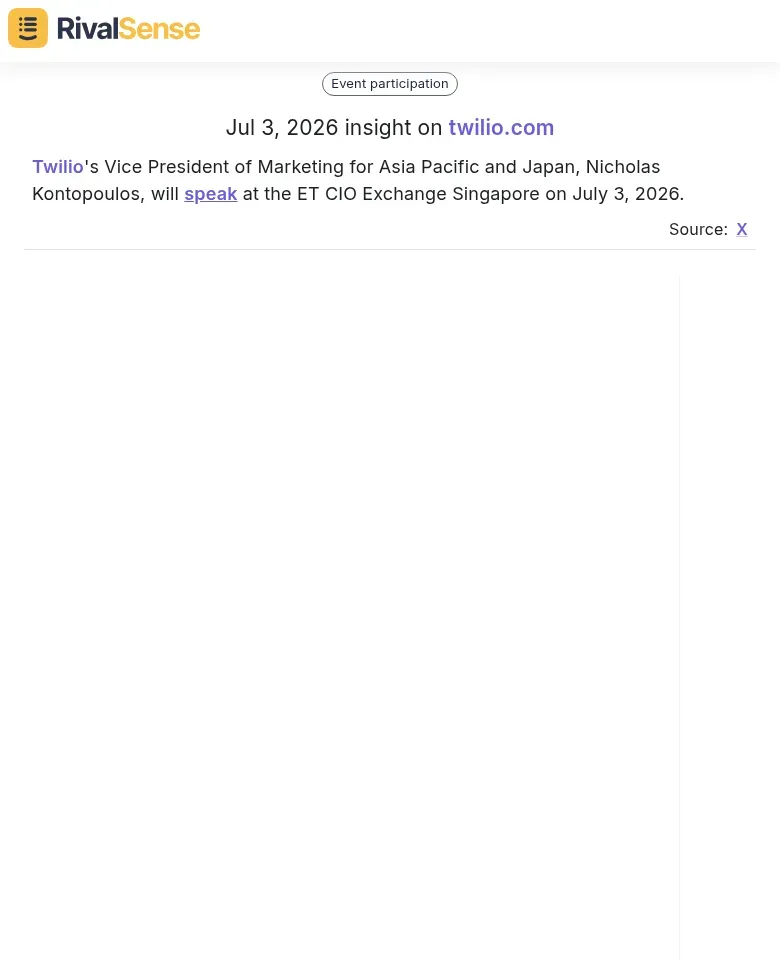
RivalSense in action 🤖: Platforms like RivalSense automatically monitor event agendas and speaker lists, surfacing high-signal moves weeks ahead. For instance, RivalSense recently highlighted that Twilio’s Vice President of Marketing for Asia Pacific and Japan, Nicholas Kontopoulos, will speak at the ET CIO Exchange Singapore on July 3, 2026. This kind of executive speaking slot signals a regional push, valuable intel for refining your own APJ strategy or account-based plays.
Create a simple checklist:
- [ ] List each competitor attending or speaking
- [ ] Note session type (keynote, workshop, demo) and any product names mentioned
- [ ] Flag unexpected verticals or regions (e.g., a US competitor at a Helsinki health-tech summit)
- [ ] Set alerts for agenda changes or late speaker additions
This pre-event scan turns a passive attendee into an informed intelligence gatherer, ready to ask pointed questions and spot subtle shifts in strategy.
📡 Hack #2: Harness Social Media and Live Coverage During the Event
Social media transforms events into a real-time intelligence feed—even if you’re not on the ground. By monitoring the right hashtags and accounts, you can capture competitor announcements, executive soundbites, and partnership reveals as they happen. This allows you to react instantly, or escalate a key finding to your team within minutes.
1. Follow event hashtags and competitor channels.
Set up real-time alerts for the official event hashtag and your competitors’ handles. Use tools like TweetDeck, Brandwatch, or RivalSense to track demos, launches, and booth announcements as they happen. For example, if a competitor unveils a new feature, you can immediately analyze its positioning and share insights with your team.
2. Capture quotes from executive panels and customer testimonials.
Monitor LinkedIn and X for live posts from attendees. Bookmark executive soundbites and customer success stories shared online. Create a running document of these quotes; they often reveal strategic priorities or pain points you can address in your own messaging.
3. Monitor for partnership announcements in unconventional spaces.
Competitors may host private dinners, co-booths, or suite meetings. Search for location tags, event sub-hashtags (e.g., #SaaStrPartnerSummit), or phrases like “stop by our suite.” Use Boolean search (e.g., “partner” + competitor name + event hashtag) to catch these before they’re widely known.
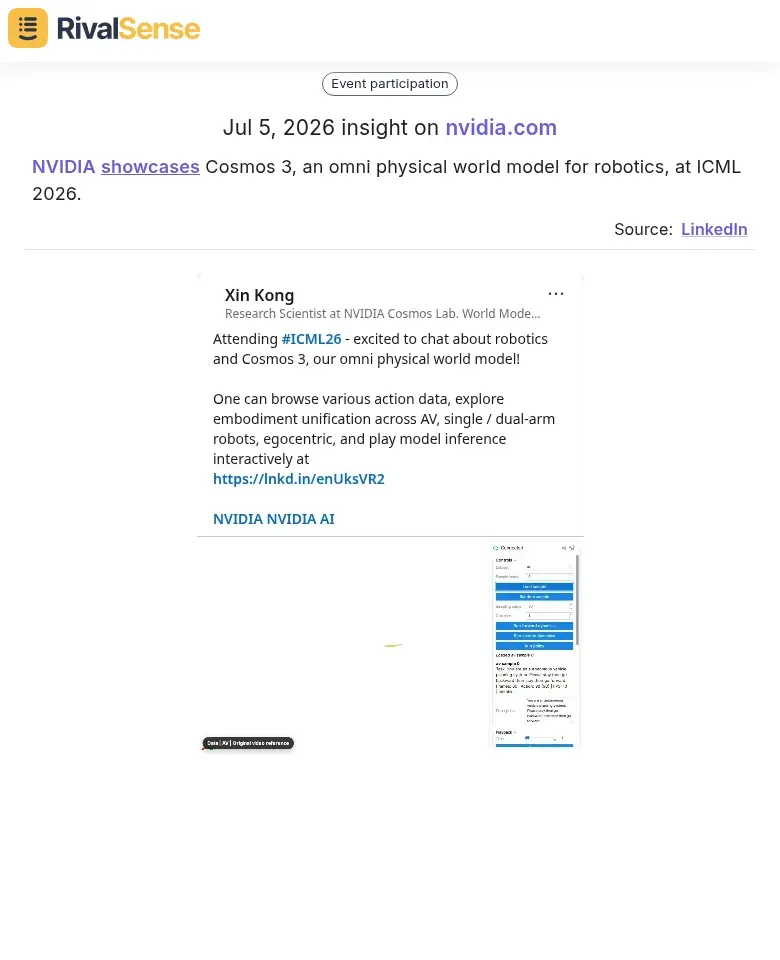
🚀 RivalSense live feed example: During ICML 2026, RivalSense captured that NVIDIA showcases Cosmos 3, an omni physical world model for robotics. Spotting such a product unveiling in real time gives you immediate insight into a competitor’s leap into a new domain—helping you brief your field teams before the event closes.
✅ Pro tip: Prepare a cheat sheet before the event with the top 10 hashtags, competitor handles, and keywords (e.g., “demo,” “launching,” “integrations”). Assign a team member to monitor and share findings in a Slack channel every 30 minutes.
By actively listening on social media, you turn the event into a live intelligence feed—no badge required.
📝 Hack #3: Analyze Post-Event Content for Deeper Insights
After the event, the noise subsides but the strategic signals remain. Post-event content—press releases, session recordings, and blogs—often contains the refined messages and product positioning that competitors want to stick. Systematically mining this material uncovers narrative changes, new use cases, and potential roadmap gaps.
Start by scanning competitor press releases and blog posts for narrative changes—new taglines, value props, or competitor mentions. Next, watch recorded demos and presentations on YouTube or event hubs. Note: do they demonstrate new use cases or target different industries than before? For example, a fintech startup demoing for healthcare signals a pivot. Finally, cross-reference their moves with your roadmap.
Create a simple table:
| Competitor | New Message / Demo | Target Vertical Shift | Your Gap / Opportunity |
|---|---|---|---|
| Competitor A | AI-driven supply chain | Healthcare | We lack a healthcare-specific solution – evaluate partnership |
| Competitor B | “Enterprise-grade” rebranding | Large enterprise | Refresh our battle cards and white paper |
Quick checklist:
- [ ] Collect all competitor session recordings
- [ ] Extract 3 core messages from each
- [ ] Compare against your last 3 roadmap updates
- [ ] Identify 1-2 gaps to address next quarter
This analysis turns event noise into strategic intelligence. Set up Google Alerts or Talkwalker notifications for post-event press coverage to catch additional signals.
🎯 Extending to Key Accounts: Who They’re Engaging With at Events
Your own accounts are also targets for competitors at events. By monitoring key accounts’ activities, you can spot competitive encroachment early. This section shows how to overlay account intelligence with event tracking to trigger proactive campaigns.
Step 1: Pre-Event Account Audit
- Run your top 20 accounts through the event’s agenda, speaker list, and exhibitor directory—using a tool like RivalSense to see who’s attending, sponsoring, or speaking.
- Create a spreadsheet: Account name, event, session titles, sponsor level.
Step 2: Spot Competitor–Account Collisions
- Cross-reference your accounts’ sessions and booth staff lists against your competitor list.
- Look for co-presentations (e.g., “John from [Competitor] and Jane from [Your Account]”) and scheduled booth visits.
- Flag these as high-intent signals — your account is actively listening to a competitor.
Step 3: Trigger Account-Based Campaigns
- Within 24 hours of identifying a collision, launch a personalized outreach: send a relevant case study or invite to a private dinner.
- Use the event theme in your subject line to cut through noise.
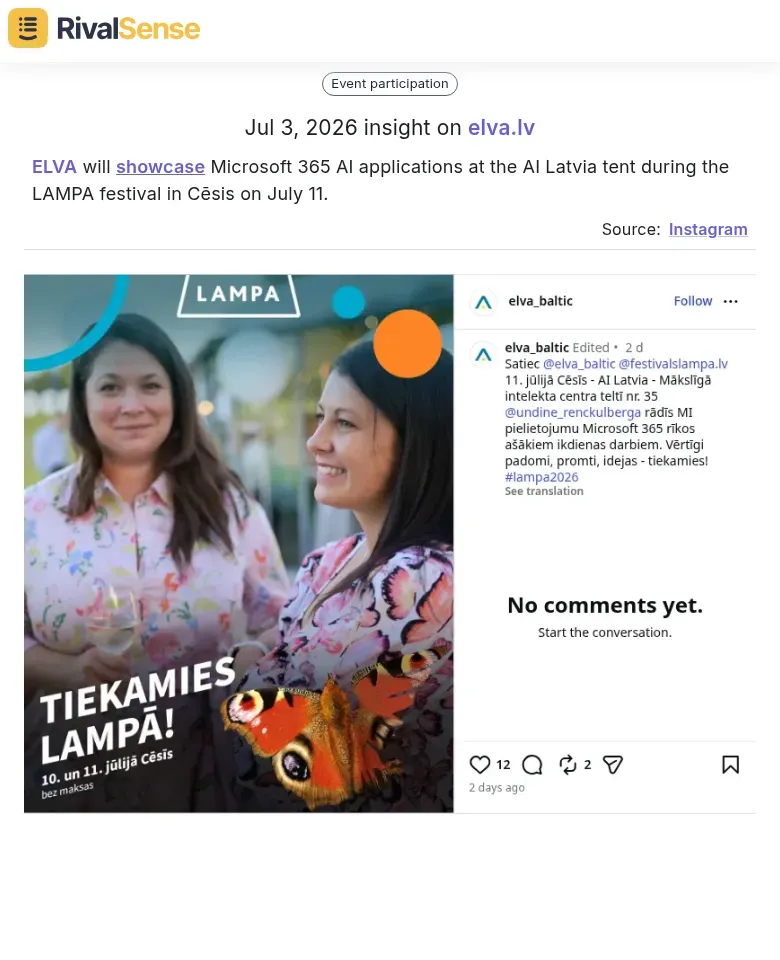
🔎 RivalSense insight on partnership moves: A RivalSense alert revealed that ELVA will showcase Microsoft 365 AI applications at the AI Latvia tent during the LAMPA festival. For a key account considering a Microsoft-oriented stack, this kind of exhibit signals a deepening alliance—crucial fodder for your solution positioning.
Pro Tip: Create a Slack alert for real-time updates when a competitor’s logo appears next to your account name in the event app. Speed is your advantage.
🔄 Conclusion: Making Event Tracking a Core Competitive Practice
Event tracking doesn’t have to be a one-off scramble. By embedding it into your regular competitive practice, you turn fleeting conference insights into a lasting strategic advantage. Start by automating data collection, then integrate findings into your team’s daily workflows.
1. Automate your alerts. Use tools like Google Alerts, Mention, or a competitive intelligence platform like RivalSense to monitor competitor booth sessions, keynote mentions, and social media activity during events. Set up dashboards (e.g., in Tableau or Looker) that pull in this data automatically, so you never miss a beat.
2. Integrate into your CI reports. After each event, add a dedicated “Event Intel” section to your weekly or monthly competitive intelligence digest. Include 3–5 key takeaways: product announcements, pricing moves, partner shifts, or customer wins. This ensures insights don’t get lost in inboxes.
3. Share findings cross‑functionally. Create a brief (e.g., a 1‑page memo or Slack summary) and route it to product, sales, and marketing leaders. Tag specific teams on action items—e.g., “Product: review new feature X,” “Sales: update battle card for competitor Y.” Aligned teams move faster.
Pro tip: Designate a single owner for each major event. This person collects field intel, synthesizes it, and distributes the summary within 48 hours. Fresh insights are more actionable.
By making event tracking a continuous practice, you’ll spot competitive moves earlier, respond smarter, and keep your entire organization ahead of the curve.
Ready to turn event noise into clear competitive signals? Try RivalSense for free and get your first competitor report today—no credit card required. Visit https://rivalsense.co/ to start.
📚 Read more
👉 Competitor Partnership Advantages via Event Participation: A Process Optimization Guide
👉 Turning a Competitor's Product Launch into Your Strategic Advantage
👉 How to Customize Key Account Tracking for Smarter Competitive Intelligence
👉 5 Quick Hacks to Track Industry Leaders (and Competitor Moves) for Consulting Success
👉 How Barings Law's No-Fee PCP Model Sparked a Strategic Shift