
How NVIDIA’s cuEST 0.2.0 Gives Competitors Their Next Move
Executive Summary
When NVIDIA shipped cuEST 0.2.0 in July 2026—just four months after the framework's March debut—the release looked like a routine point update. For our client, a mid-size computational chemistry software vendor (ISV) with a GPU-accelerated density functional theory (DFT) portfolio serving pharma, materials, and semiconductor customers, it was anything but routine. The 0.2.0 release marked NVIDIA's pivot from shipping GPU "building blocks" toward assembling a fuller quantum chemistry stack—a move that lands squarely in the client's core market.
Here's the practical takeaway: the client caught this shift early by running a three-step competitive workflow—detect, decode, act—and compressed their response cycle from months to two weeks.
- Detect: RivalSense flagged the 0.2.0 changelog and release notes the day they dropped, not weeks later.
Real Insight, Real Speed
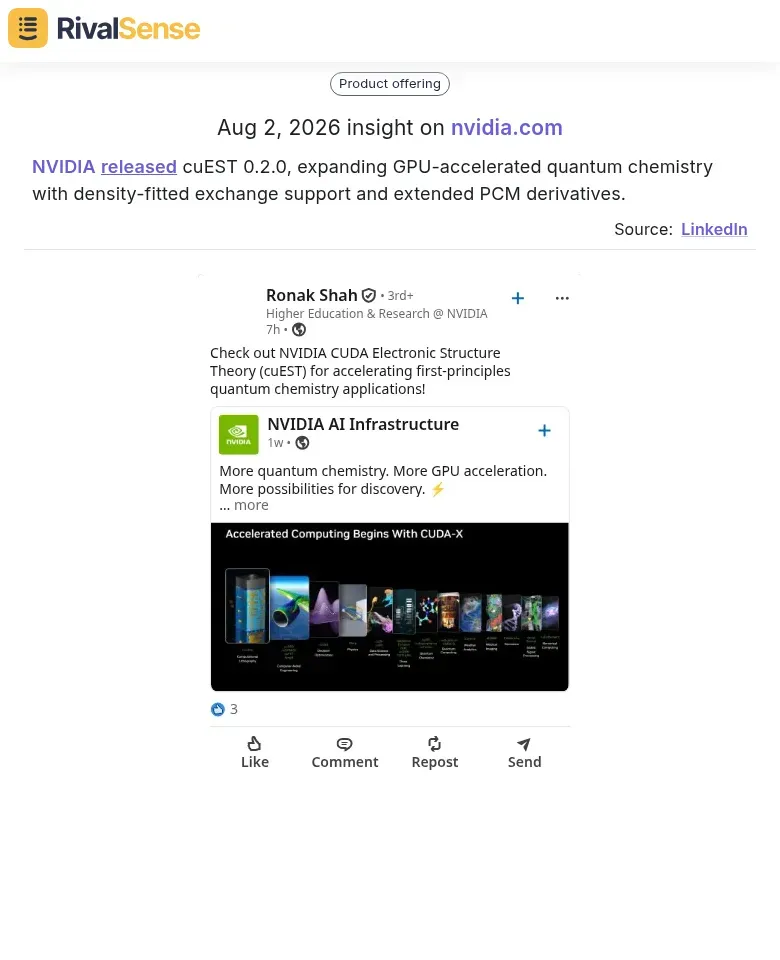
NVIDIA released cuEST 0.2.0, expanding GPU-accelerated quantum chemistry with density-fitted exchange support and extended PCM derivatives.
This kind of early-stage product update is exactly what RivalSense surfaces—so your team can decode and act before customers even hear about it. - Decode: automated analysis mapped each new API and performance claim against the client's own DFT roadmap, exposing which features were genuinely threatening and which were marketing noise.
- Act: leadership made an evidence-based decision—accelerating one planned feature and deprioritizing another—without a single reactive fire drill.
The result: roadmap decisions grounded in evidence, a compressed competitive response cycle, and a clearer read on where NVIDIA is heading next.
Tip for your team: treat every point release from a platform vendor as a strategic signal, not a patch note. Set up detection on release feeds, decode against your own roadmap, and act before the market notices.
The Competitive Threat: What Actually Landed in cuEST 0.2.0
Read the release notes like a competitor, not a fan. Three moves matter.
1. Chemistry depth. cuEST 0.2.0 adds range-separated hybrid exchange with nuclear derivatives, nine new functionals—including the workhorses ωB97X-V, ωB97M-V, CAM-B3LYP, HSE06, and M06-2X—plus PCM derivatives. Translation: production-grade solvation and accurate long-range exchange moved from "roadmap" to "shipped."
2. Beyond ground state. Nonsymmetric density-fitted exchange (K) matrices and AO-to-MO transformations (cuestDFMOIntegralsCompute) are the tell. These are exactly the primitives response and excited-state methods require. If your strategy assumed NVIDIA would stay a ground-state SCF toolkit, that assumption just expired.
3. Platform expansion. General multipole, angular momentum, and nabla integrals, plus float-float FP64 emulation and JIT kernel compilation (cached in ~/.cuest_cache), extend support to GeForce and workstation-class GPUs. Your customers' local workstations are now a demo target.
Your three-step response: (1) Map which of your differentiators overlap these primitives—features that took you years now take weeks to replicate. (2) Re-price the threat: with PCM derivatives live, solvent-aware workflows are next. (3) Revisit your GPU-support assumptions; the hardware floor just dropped.
Decoding the Signal: What NVIDIA's Strategy Reveals
Three signals in the 0.2.0 release tell competitors exactly where NVIDIA is heading.
1. It's climbing the value stack. NVIDIA's own docs still call cuEST "mid-level primitives," not an end-to-end DFT code. But 0.2.0 ships a working SCF sample, non-symmetric K/ωK and density routines for TD-DFT and CPKS (excited states), and AO→MO integral transforms that unlock post-DFT methods like MP2 and CCSD(T). That's a roadmap from toolkit to production workflow — moving directly into territory historically owned by quantum chemistry ISVs.
2. It's an ecosystem play, not a product launch. cuEST is bundled into the CUDA-X and Agent Toolkit stack beside PhysicsNeMo, cuISS, and cuDSS, so quantum chemistry becomes a "skill" AI agents can call. When Samsung, Synopsys, and TSMC publicly cite up to 50x speedups, NVIDIA turns customers into marketing.
3. It's removing every adoption barrier. The move to conda-forge, nanobind-based Python 3.12 bindings, and FP64 emulation (Ozaki schemes) on consumer GPUs means researchers no longer need data-center hardware to run DFT.
Your next-move checklist:
- Map which of your workflows the new ωK, non-symmetric K, and MO-transform primitives now cover.
- Watch which ISVs announce integration — Synopsys QuantumATK already has.
- Assume "agent-ready" packaging will commoditize primitive-level differentiation; build your moat at the workflow layer.
Strategic Response: The Client's Next Move
When NVIDIA's cuEST 0.2.0 landed, the client's leadership didn't panic—they moved. Here's how they turned an early alert into a strategic advantage.
Step 1: Reprioritize R&D against the gap map. RivalSense's early alerts flagged NVIDIA's momentum in excited-state methods and solvent modeling. The team audited their roadmap and pulled forward internal work in these exact areas. Within two sprints, they'd closed the two gaps where cuEST showed the most traction—denying NVIDIA an uncontested beachhead.
Step 2: Differentiate where it counts. The client refused to fight a primitives war they couldn't win. Instead, they doubled down on what NVIDIA doesn't offer: end-to-end workflow depth, enterprise-grade integration (SSO, audit logs, APIs), and true multi-platform support across CPU and multi-GPU clusters. Their pitch shifted from "faster kernels" to "one platform, every environment, zero rip-and-replace."
Step 3: Make the build-vs-partner call explicit. Leadership ran a structured decision: integrate cuEST as an acceleration backend, or keep proprietary kernels? They chose a hybrid—benchmarking cuEST behind their orchestration layer while retaining differentiated physics. Then they adjusted packaging, pricing, and sales narratives to defend pharma and semiconductor accounts before NVIDIA's sales motion reached them.
Checklist for your next competitor release:
- Map the alert to your roadmap within 48 hours
- Identify gaps you can close fast—and ones you shouldn't
- Reframe the competitive narrative around workflow, not primitives
- Run a build-vs-partner decision with clear criteria
- Brief sales on defensible differentiation before the vendor calls your accounts
Results & Impact
The day cuEST 0.2.0's release notes went live, RivalSense flagged the update and the accompanying documentation changes — replacing a week-long manual scan (changelogs, docs, forums) with a same-day competitive brief. By the time the old manual sweep would have finished, sales had already briefed two at-risk accounts.
Within two quarters, that speed compounded into measurable outcomes:
- Two strategic accounts protected, with reps walking into renewals carrying a precise 'why stay' narrative.
- One competitive deal won by demoing a superior end-to-end workflow built on gaps NVIDIA hadn't yet covered.
- One costly mis-investment avoided — the client shelved an internal capability NVIDIA was about to commoditize with native library support.
Just as valuable: the alignment it created. Product, sales, and marketing now run on a single competitive cadence. RivalSense alerts feed monthly competitive reviews, and anything hitting the early-warning trigger list (new functionals, API changes, packaging shifts) auto-notifies the right owner.
Practical playbook:
- Define triggers before you need them — e.g., 'new functional added' or 'conda-forge packaging change'.
- Time-box the brief: same-day alert → 24-hour summary → weekly deep-dive.
- Tag alerts by owner so nothing sits unclaimed.
- Revisit the trigger list quarterly; last quarter's signals rarely predict this one's.
The release itself isn't the edge — how fast you turn it into a decision is.
Key Takeaways: Competing With Platform Vendors
When NVIDIA ships cuEST 0.2.0, the release notes tell you what changed — but not what's coming. For anyone selling quantum chemistry or scientific software, that's where the real signal hides. Three moves separate reactive vendors from deliberate ones.
1. Track the stack, not just the product. PCM derivatives and density-fitted LRC exchange are one tile in a larger mosaic: CUDA-X libraries, conda-forge packaging, and partner integrations announced alongside them. Build a radar of adjacent releases, ecosystem announcements, and partner wins — not just the direct product line. Tip: keep a 'stack creep' tracker with one row per adjacent release and a column for what it unlocks for the platform.
2. Read beneath the features. Strategic intent lives in distribution, not APIs. cuEST shipping via conda-forge under the CUDA-X umbrella means NVIDIA is normalizing GPU-accelerated electronic structure as a default path — lowering switching costs toward their hardware. For every release, ask three questions: What channel does it ride? What hardware does it reach? What bundle does it extend? That's the actual move.
3. Operationalize the intelligence. Intelligence you can't act on is trivia. Set early-warning triggers (a new CUDA-X library, a preprint citing cuEST, hires in computational chemistry), route them into a monthly decision cadence, and pre-draft your responses. Your next move should be proactive and deliberate — not reactive and rushed.
Stay Ahead, Automatically
You don’t need a team of analysts to spot critical moves like cuEST 0.2.0. RivalSense monitors competitor websites, social media, registries, and news—distilling everything into a weekly email report so you never miss a shift. Whether it’s a platform vendor climbing your value stack or a new partnership threatening your accounts, you’ll get the signal you need to decide fast.
👉 Try RivalSense free and get your first competitor report today.
📚 Read more
👉 Instagram Competitor Insight Checklist for Key Account Tracking
👉 Data-Driven Insights: Track Telecom Competitor Pricing Moves
👉 Competitor Financials Cheat Sheet: Decoding M&A Signals to Stay Ahead
👉 Key Account Management vs Customer Success: 2026 Trend Shifts
👉 Biograph's Women's Health Shift Revealed a Blueprint for Member Growth