
Key Account Management vs Customer Success: 2026 Trend Shifts
Introduction: The Great Post-Sale Convergence of 2026
For a decade, Key Account Management and Customer Success evolved on parallel tracks: KAM owned revenue and relationships at the top of the house, while CS owned adoption and value below. In 2026, that separation is collapsing — and fast. The two disciplines are converging into a single strategic post-sale motion, and the teams that recognize this earliest are pulling decisively ahead.
What’s driving the shift? The economics. With acquisition costs at record highs, boards no longer treat retention and expansion as ‘soft’ metrics. Executives now ask both functions the same question: What did you contribute to EBITDA this quarter? Renewal rates, net revenue retention, and expansion revenue are being read like P&L lines. If your KAM and CS teams can’t speak that language jointly, you’re flying blind.
The result is a competitive battleground. In a flat-growth market, the most valuable accounts are stolen — not won. Competitors are converging their post-sale teams, arming them with shared account plans, unified health scores, and one commercial P&L per customer. Whoever evolves fastest keeps the crown jewels.
Practical first steps: 1) Merge KAM and CS into one P&L owner per account with shared targets. 2) Replace separate health scores with one executive-facing metric tied to expansion potential. 3) Co-build one strategic account plan your customer actually co-signs. 4) Track your ‘convergence velocity’ — how quickly both teams act as one — as a KPI. Post-sale is now a growth function. Act accordingly.
Where the Lines Still Hold: Core Differences Between KAM and CS
Even as KAM and CS converge on shared goals like retention and expansion, their cores remain distinct — and leaders who blur them pay for it.
Depth vs. breadth. KAM is engineered for depth: a handful of strategic accounts where you deliver business results, shape roadmaps, and earn a seat at the customer’s strategy table. CS is engineered for breadth: managing product adoption and lifecycle health across hundreds or thousands of accounts, often with a digital-led motion. Rule of thumb: if an account warrants a named executive sponsor and a joint business plan, it’s a KAM account; if it needs scalable onboarding and usage guardrails, it’s CS.
The KPI split tells you which function you’re actually running. KAM comps and dashboards center on account growth, whitespace expansion, share of wallet, and stakeholder expansion (mapping power users into executive buyers). CS tracks health scores, renewal risk, adoption and usage, and time-to-value. Both matter; they just measure different bets.
Org placement is shifting. KAM still reports through sales or RevOps, where commercial negotiation and pipeline discipline live. CS historically sat under the CCO — but in 2026, more teams report to the CRO as boards demand revenue accountability from post-sale. That’s the tell: follow the reporting line and you’ll see what leadership actually expects.
Quick audit: list your top 20 accounts, their named owner, and their primary KPI. If “usage” tops the list for your biggest revenue accounts, your model is misaligned.
Trend Shift #1: AI Redefines Both Roles — From Task Managers to Orchestrators
For years, the key account manager (KAM) was the “lone hero”: one person carrying relationships, institutional memory, and follow-through, while CSMs drowned in dashboards. In 2026, both roles are being reshaped by the same force — AI agents that gather, monitor, and summarize — and the result is a surprising convergence.
KAMs are becoming orchestrator-in-chief. Data scarcity is dead; the new enemy is intelligent overwhelm. With competitor signals, usage telemetry, and intent data arriving nonstop, access is no longer the advantage — discernment is. The winning KAM doesn’t collect more intelligence; they decide which insight actually changes a stakeholder’s decision.
CSMs get an operational relief valve. AI agents now absorb meeting prep, health-score monitoring, and renewal admin, adding 25–50% bandwidth. That surplus converts CSMs into executives of their own book of business: spotting expansion patterns, building their own QBR narratives, and owning outcomes rather than tasks.
The human premium has shifted to judgment, empathy, and narrative. Machines surface the “what”; people still own the “so what” and “now what.”
Practical playbook:
- Audit your week — hand every repeating task under 15 minutes to an agent.
- Adopt a “one insight per account per week” rule to force discernment.
- Build a narrative template: data → tension → recommendation → stakeholder ask.
- Re-invest 30% of recovered time in executive relationships and discovery calls — the two things AI can’t clone.
Trend Shift #2: Revenue Ownership — CS Gets Commercial, KAM Gets Accountable
For years, CS was a cost center and KAM a relationship role. In 2026, both are on the revenue hook — from opposite directions.
CS gets commercial. Renewal forecasting is no longer a guess; CSMs own it like sales owns new ARR. The shift shows up in balanced NRR: expansion is earned through deep discovery of customer goals early in the cycle, not last-minute pitch decks. CS leaders now report against expansion forecasts, and many answer to the CRO.
KAM gets accountable. Key Account Managers are evolving into cross-functional orchestrators — aligning sales, CS, marketing, product, and partners around one account narrative. The account, not the product, becomes the unit of strategy. One narrative, one revenue plan, one scorecard.
The convergence threat. CROs absorbing CS teams is accelerating, and AI now exposes value gaps in real time. AMs and CSMs who can’t defend their commercial seat risk displacement by platform-led motions.
How to stay relevant:
- Own a number — renewal rate, NRR, or expansion quota — and forecast it monthly.
- Run one joint account plan with CS and sales; make it a living doc, not an annual artifact.
- Document every expansion idea with the customer’s stated goal attached.
- Rehearse the “value story” with data before every QBR — AI will check your homework.
- Build a cross-functional account team chart and meet quarterly to keep the narrative aligned.
The winners in 2026 won’t be the loudest — they’ll be the most accountable.
Trend Shift #3: Outcome-Led Journeys Replace Adoption and Activity Metrics
Feature-led “adoption” metrics are dying. Logins, feature clicks, and dashboard views measure activity, not value — and customers know it. In 2026, forward-thinking teams redesign customer journeys around prescriptive, measurable business outcomes: “reduce time-to-close by 20%,” “cut churn risk by 15%.” Start by co-creating an outcome blueprint per account: define the target outcome, the metric that proves it, the baseline, and 90-day milestones.
The shift is accelerated by pricing. As consumption- and outcomes-based pricing spreads, renewals stop being calendar events and become continuous. Every invoice reflects delivered value, which blurs the line between KAM and CS: both teams now own revenue and outcomes, not just relationship or usage. KAMs track commercial expansion; CS tracks outcome attainment — but they run the same playbook.
Value proof becomes always-on. Replace the annual business review deck with dynamic value dashboards embedded in the customer’s own BI stack. Co-author ROI stories quarterly with your champion, not for them. And let AI validate attribution: connect product usage events to business-impact signals so you can show, in real time, that “your team’s use of X drove a 12% drop in processing time.”
Action checklist:
- Build an outcome blueprint per account (target, metric, baseline, milestones).
- Align pricing triggers with outcome milestones.
- Automate a live value dashboard inside the customer’s stack.
- Run quarterly co-authored ROI reviews, validated by AI attribution.
The outcome, not the activity, is the product.
Trend Shift #4: Real-Time Competitor Intelligence Becomes a Post-Sale Mandate 🔍
The old model assumed competitors were distant threats — monitored quarterly by a sales enablement team. In 2026, post-sale teams (KAM and CS) must absorb real-time competitor signals as part of daily account defense. Every website tweak, product update, and event appearance is a potential wedge your competitor is driving into your key accounts.
Tools like RivalSense track these signals across company websites, social media, and registries, delivering a curated weekly email — so account managers never miss a competitor move that could impact their book of business.
Why specific insight types matter for strategy:
-
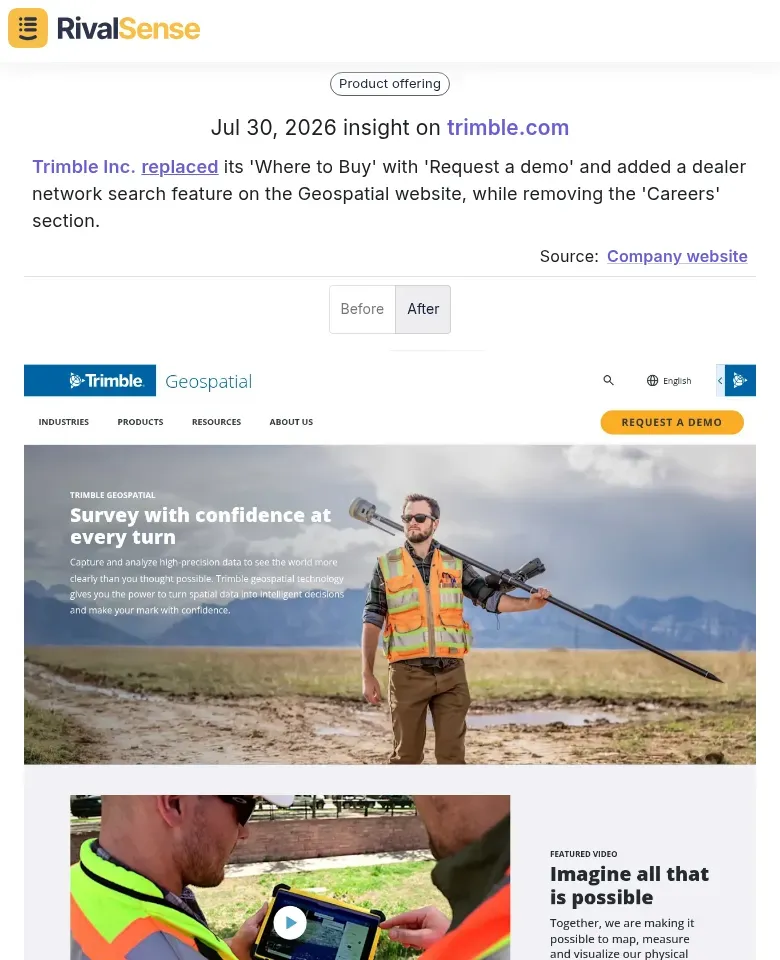
Go-to-market shifts: When a competitor changes a website’s call-to-action from “Where to Buy” to “Request a Demo,” it signals a move up-market into high-touch sales — a direct threat to your enterprise accounts. Your KAMs need to counter with executive access and joint business plans before the competitor gets a demo slot.
-
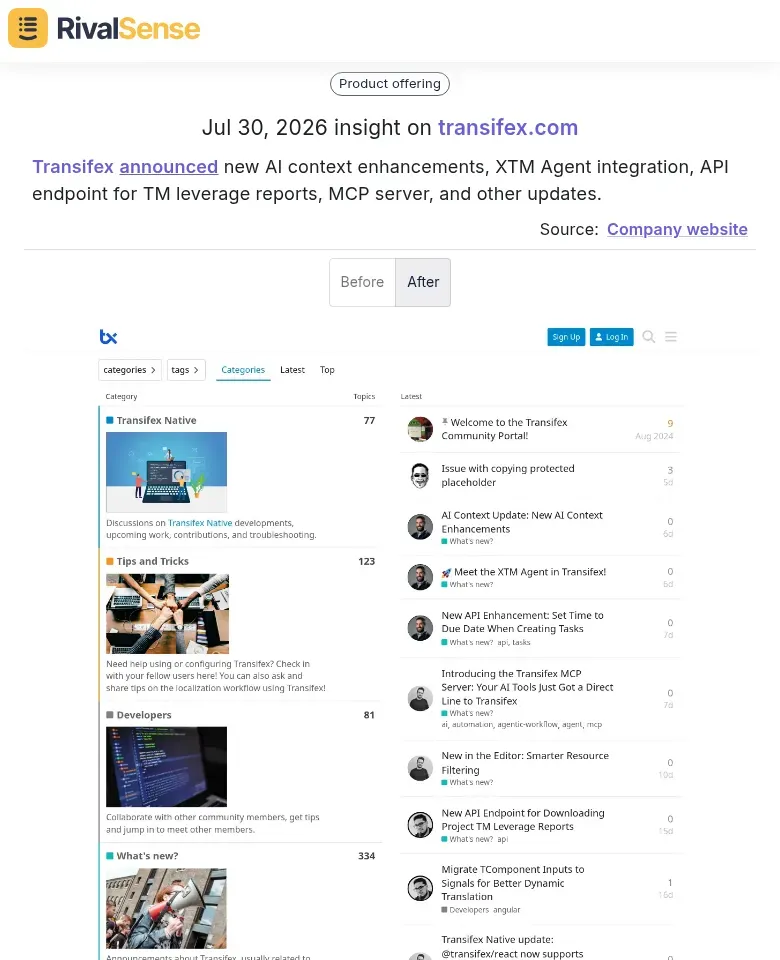
Product enhancement announcements: A flurry of AI updates — like Transifex’s recent AI context enhancements and MCP server — tells you a competitor is pulling ahead on features that promise efficiency. CS teams must equip champions with your own AI roadmap and proof points, or risk a “we found a better tool” conversation at renewal.
-
Event sponsorships: When a rival becomes the first signature sponsor of a vertical conference (e.g., Jane at Group Practice Con), they’re investing in mindshare among your customer base. KAMs and CS can immediately schedule QBRs with accounts in that niche, reinforcing partnership and pre-empting competitive whispers.

These aren’t nice-to-haves — they’re the difference between defending a retention and losing it to a stealth campaign. Embed competitor monitoring into your shared cockpit so that every account plan includes live competitor moves and counter-strategies.
The 2026 Playbook: Building a Unified Post-Sale Strategy That Wins
The days of separate account plans living in slide decks are over. In 2026, winners run one living, AI-augmented account operating system shared by account managers and customer success managers — a cockpit both teams check weekly, not a document dusted off quarterly.
Here’s how to build yours:
Step 1: Converge the system. Migrate AM and CSM workflows into one platform where health scores, renewal risk, expansion pipeline, and stakeholder maps live side by side. AI flags anomalies (dropping usage, churn signals, competitor mentions — such as product launches or website changes) and drafts next-best actions for both roles.
Step 2: Re-engineer incentives. Stop rewarding activity and responsiveness. Reward proactive risk mitigation, orchestration across teams, and commercial outcomes. Tie bonuses to net revenue retention and expansion, not tickets closed or CSAT scores.
Step 3: Upgrade capability, not just tooling. Tools fail without AI-ready skills, data literacy, and scenario thinking. Run monthly ‘what-if’ war-games: if a top competitor launches a discount bundle next quarter, what’s our counter-move per account?
The 90-day checklist:
- One shared cockpit with weekly check-ins, not quarterly reviews
- Metrics aligned to outcomes, not activity
- Incentives rewarding proactive orchestration
- Scenario-planning drills on the calendar
The stakes are real. Every quarter you delay, a competitor with a unified post-sale motion is quietly courting your most valuable accounts. In 2026, post-sale isn’t support — it’s your strongest competitive moat. Build it unified, or watch your best revenue walk out the door.
Your Unified Post-Sale Cockpit Starts with Competitor Intelligence
The playbook above demands constant awareness of what competitors are doing to your accounts. RivalSense makes that effortless — tracking website changes, product releases, and event plays across your competitive landscape, then delivering a clean weekly report directly to your inbox.
👉 Try RivalSense for free at https://rivalsense.co/ and get your first competitor report today — before your next QBR.
📚 Read more
👉 Biograph's Women's Health Shift Revealed a Blueprint for Member Growth
👉 Workflow Breakdown: Turning Internet Competitor Insights Into Pricing Power
👉 Map Competitor Customer Journeys in Printing Industry
👉 5 Mistakes in Competitor M&A Analysis for SaaS Key Accounts
👉 When a Competitor Shuts Down: How to Spot and Capitalize on Market Exits Before Everyone Else