
Competitor Financials Cheat Sheet: Decoding M&A Signals to Stay Ahead
Financial moves are the smoke before the fire. Funding rounds, acquisitions, and investment announcements rarely stay quiet for long—but they surface weeks or months before the strategy shifts they fund become public. By the time a competitor launches a new product line or undercuts your pricing, their balance sheet already told you it was coming.
Reading those signals reveals how a rival values scale, efficiency, and market position. A Series B earmarked for sales hiring signals a land-grab mindset. A bolt-on acquisition of a niche tool signals consolidation of your shared customer's stack. A cost-cutting round signals defensive positioning—prepare for price wars.
Here's how to build your cheat sheet:
- Track three events per key account: funding rounds, acquisitions, and capex announcements.
- Log the stated purpose (hiring, R&D, expansion) and the dollar amount relative to revenue.
- Identify the pattern: are they buying market share, capability, or time?
- Set alerts for regulatory filings and press releases—not just headline news.
The goal isn't perfect foresight. It's spotting patterns early enough to respond on your terms, not theirs. Build the sheet before you need it, and you'll stop reacting to news after the fact.
Reading M&A Deal Structures: Integration vs. Independence
Not all acquisitions are created equal—and the deal structure reveals more than the press release. How a competitor integrates (or doesn't) a new asset tells you exactly where they see defensible moats and where they're willing to sacrifice margin. Observing these choices can reshape your own competitive positioning.
A prime example surfaced through RivalSense: Printful still operates as a separate platform after merging with Printify in late 2024, and its in-house production yields consistent quality but higher per-unit costs. That's not indecision; it's a strategic signal.
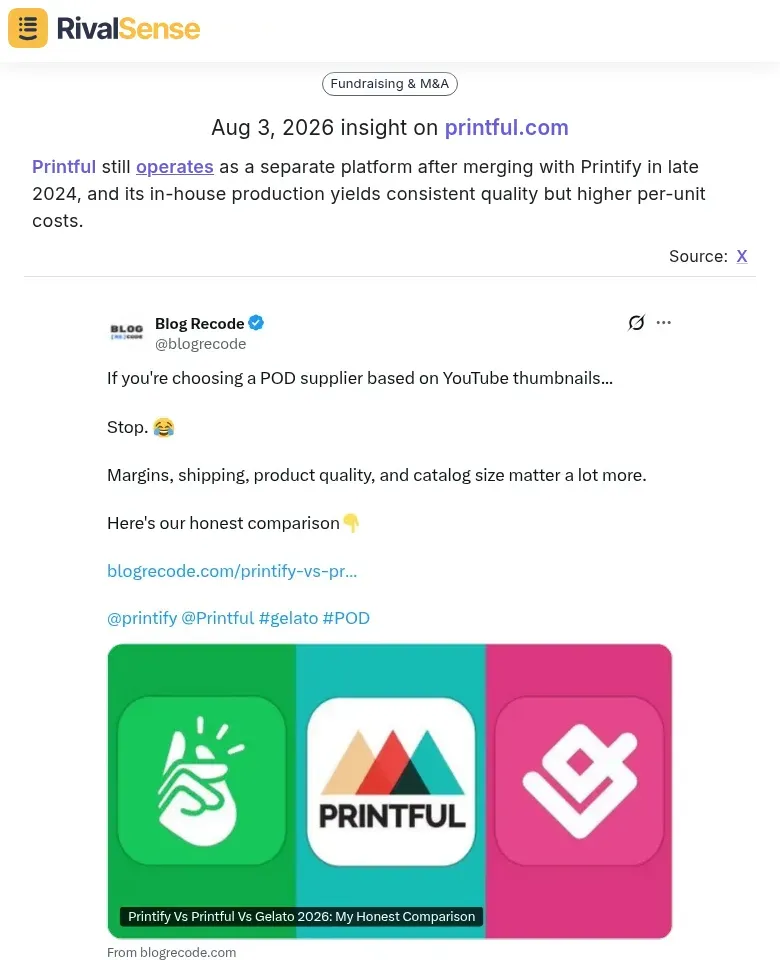
Management is betting that brand equity and customer stickiness generate more value than rapid consolidation savings. Translation: ask whether a competitor's deal is an integration play (cost synergies) or an independence play (revenue and brand synergies).
Operational choices are equally telling. Printful maintains in-house production while Printify runs a vast third-party supplier network. Keeping both models alive—rather than consolidating to the cheapest option—reveals a trade-off between quality consistency and per-unit cost. That reshapes your margin expectations and tells you where they'll compete (premium reliability) versus where they'll bleed (price wars).
The real lesson: what a competitor integrates versus keeps separate reveals where they believe the moat lives. Integrate back-office tech and data? They're chasing efficiency. Keep customer-facing brands separate? They're protecting loyalty and pricing power.
Your deal-reading checklist:
- Map what's integrated (ops, tech, GTM) vs. kept separate
- Identify claimed synergies—cost or revenue?
- Adjust your margin and pricing assumptions accordingly
- Re-test your own moat against theirs quarterly
Tuck-In Acquisitions as Geographic Expansion Signals
When a competitor wants new territory, they rarely build from scratch. They buy. Tuck-in acquisitions—small, cheap deals that bolt a regional player onto an existing platform—are the fastest, lowest-risk route to new geography. These seemingly tiny moves often signal a focused geographic strategy long before it becomes obvious.
RivalSense captured exactly this pattern. On July 31, 2026, Lyft, the owner of FREENOW, acquired taxi dispatch apps Lynk and Swift, based in Dublin and Limerick, which will be integrated into FREENOW.

Instead of bootstrapping an Irish presence, Lyft paid "financially immaterial" sums for two entrenched phone-based dispatchers with decades of local relationships: Swift is a 35-year Limerick institution and a B2B partner to pharma and health sectors; Lynk serves hundreds of public-sector and business clients. The signal isn't the deal size—it's the pattern. Folding local assets into an existing platform (both teams stay, drivers flow into the FREENOW app) reveals a density strategy: deepen one region rather than enter new markets cold. Where and when they buy tells you which niches they're quietly consolidating.
Your move:
- Log every sub-$50M deal by size, city, and target's client base—geography clusters reveal expansion roadmaps.
- Check whether the seller's B2B contracts transfer. Lynk's public-sector ties were the prize; track what relationships your competitor just inherited.
- Watch timing: tuck-ins often cluster after a platform acquisition (Lyft bought FREENOW in 2025, then Gett UK, then Lynk/Swift). That cadence is a strategy.
- Ask: if they're buying density near your key accounts, what's your counter?
Strategic Investments as Credibility and Direction Signals
When a competitor lands investment from a heavyweight institution, the check matters less than the message. Strategic investors bring validation that pure financial backers can't match: their due diligence is a public endorsement that signals enterprise-grade trust to every other customer watching. It's a credibility shortcut—and an early warning you should heed.
A noteworthy illustration came from RivalSense: Harvey announced strategic investments from Goldman Sachs Asset Management and J.P. Morgan Asset Management.
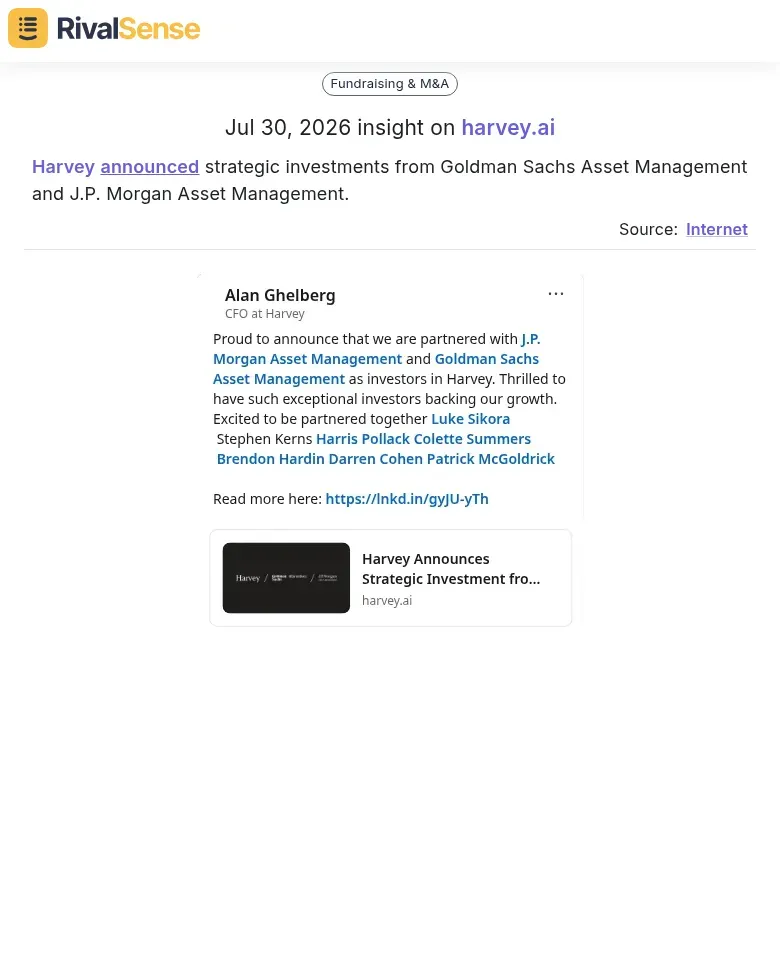
This type of signal—a legal AI startup securing funds from two of the world's most conservative institutional investors—tells you the company is being groomed for regulated, high-stakes enterprise deployments. The backer's identity reveals the segment a competitor is chasing. Sovereign wealth funds or top-tier asset managers typically point to regulated markets (fintech, healthcare, defense). A strategic corporate investor might signal a platform pivot or channel partnership. Ask: who wrote the check, and what doors do they open?
Treat rounds as early warnings. Fundraises precede expansion, hiring, and product launches by 6–12 months. Build a simple tracking ritual:
- Set alerts for your top 5 competitors on funding databases.
- Log every round in your competitor tracker with investor name and stated use of funds.
- Map investors to sectors—flag regulated-market plays immediately.
- Check the competitor's job board 30 days post-announcement; hiring patterns reveal where the money flows.
- Review their press page for new board members—advisors are directional clues.
Investors vote with capital. Decode their bets, and you'll see your competitor's roadmap before they announce it.
Building Your Own Competitor Financials Radar
Don't wait for the press release—build a radar that catches competitor financial moves while they're still forming. A systematic approach turns scattered news into a coherent intelligence picture.
Step 1: Build a monitoring scorecard. Track four signal groups: funding rounds (amount, stage, valuation), investor quality (tier-one VCs vs. strategic corporates), acquisition targets (who they bought and why), and post-deal operational changes (leadership shifts, hiring surges, office moves). A simple spreadsheet with columns for date, source, and confidence score works fine—no fancy tools required.
Step 2: Pair financial signals with operational observations. Money alone is ambiguous—a funding round can signal expansion or survival. Confirm intent by watching for corroborating moves: new production lines, platform integrations, function-specific hiring, or pricing changes. Two signals pointing the same direction are far more reliable than one.
Step 3: Set a regular cadence. Block time monthly (or quarterly in calmer markets) to update your scorecard and hunt for patterns. Ask: is a competitor raising repeatedly at higher valuations? Buying suppliers upstream? Integrating a rival's stack? These patterns emerge slowly—you'll spot them long before they become industry news.
Pro tip: Assign a single owner for the radar and route alerts from regulatory filings, press releases, and your sales team into one place. Consistency beats intensity. Within two quarters, you'll be anticipating moves your competitors haven't even announced yet.
Turning Signals into Competitive Action
A financial signal is only useful if it changes what you do next. The gap between insight and action is where most strategies fail—so build a responsive playbook.
1. Translate signal into scenario
- Acquisition of a supplier/partner → Competitor gains cost advantages. Scenario: expect aggressive pricing within 2–3 quarters. Prepare a value-based defense before they strike.
- Large funding round → Competitor will hire sales talent and expand into your key accounts. Scenario: lock in renewals early, tighten churn risk, consider a retention discount.
- Divestiture of a product line → Competitor is retreating. Scenario: position your offering as the safe replacement, approach their displaced customers with a migration playbook.
2. Weight before you react
Build a simple scoring model: deal size (revenue multiple), strategic fit (adjacency vs. distraction), and investor reputation (operators vs. tourists). A $5M round from a proven SaaS operator outweighs a $50M round from a passive fund. Never pivot on a single data point—require two independent signals before acting.
3. Turn insight into pre-emption
- Pre-empt: Map competitor expansion zones; plant your flag in accounts they'll target next.
- Sharpen differentiation: If they bought a feature, you can't win on features—compete on time-to-value and service.
- Decide invest vs. retreat: Redirect budget from losing battlegrounds to markets where their M&A creates integration chaos.
Weekly checklist: log new signals, score them, assign one action per signal, and review monthly for pattern shifts.
Stay Ahead Without the Manual Work
Manually tracking every competitor's financial moves, acquisitions, and leadership changes is a full-time job. RivalSense monitors competitor product launches, pricing updates, event participations, partnerships, regulatory aspects, management changes, and media mentions—across company websites, social media, the internet, and various registries. It delivers everything in one concise weekly email report, so signals like the deals above never slip through the cracks.
👉 Try RivalSense for free and get your first competitor report today.
📚 Read more
👉 Key Account Management vs Customer Success: 2026 Trend Shifts
👉 Biograph's Women's Health Shift Revealed a Blueprint for Member Growth
👉 Workflow Breakdown: Turning Internet Competitor Insights Into Pricing Power
👉 Map Competitor Customer Journeys in Printing Industry
👉 5 Mistakes in Competitor M&A Analysis for SaaS Key Accounts