
Instagram Competitor Insight Checklist for Key Account Tracking
🔍 Setting Up Your Instagram Competitor Tracking Framework
A scattershot approach to competitor tracking produces noise, not intelligence. A deliberate framework turns casual scrolling into a critical strategic asset. Here's how to build one that actually moves your strategy.
Step 1: Curate your watchlist (quality over quantity). Limit yourself to 5–10 accounts chosen for three reasons:
- Market overlap: They sell to the same buyers you do (direct competitors).
- Audience similarity: Their followers mirror your ICP, even if their product differs (indirect competitors).
- Strategic relevance: They're winning share, raising funding, or innovating in ways that signal where your market is heading.
Tip: Include 1–2 aspirational accounts from adjacent industries. They often pioneer tactics you can adapt before your direct competitors do.
Step 2: Set a tracking cadence that matches content lifespan.
- Daily (15 min): Stories, Reels, and posts from your top 3 competitors — capture anything time-sensitive like promos, launches, or crisis responses.
- Weekly (30 min): Follower growth, engagement rates, new hashtag strategies, and comment sentiment.
- Monthly (1 hr): Full profile audits — bio changes, pinned content, highlight structures, and content mix shifts.
Step 3: Build one centralized capture system. Use a shared spreadsheet or tool like Notion with columns for: date, account, post type, caption, hashtags, engagement metrics, and your takeaway. Screenshot everything — Instagram content disappears.
Your checklist:
- [ ] Watchlist defined with rationale documented
- [ ] Cadence scheduled in your calendar (recurring reminders)
- [ ] Capture template created with consistent fields
- [ ] Monthly review slot booked to extract actionable insights
Track consistently, and patterns — not posts — become your competitive advantage.
🤝 Monitoring Partnership and Social Impact Announcements
Partnerships and purpose-driven posts are rarely random. They reveal who your competitor wants to be seen with—and which new audiences they're chasing. By decoding these signals, you can uncover hidden partnership plays or community-driven strategies before they scale.
What to track:
- Co-branded campaigns – Note the partner, the product angle, and whose audience the collab is built to tap. A B2B tool pairing with a productivity influencer signals a mid-market expansion play, not just a promo.
- Philanthropic collaborations – Log the cause, the nonprofit partner, and the framing (donation, matching, volunteering). This exposes which values they want to be publicly associated with.
- Storytelling formats – Check whether they lean on Reels, carousels, or live events. Live events deepen community; Reels chase discovery; carousels invite saves and shares. Format choice reveals reach strategy.
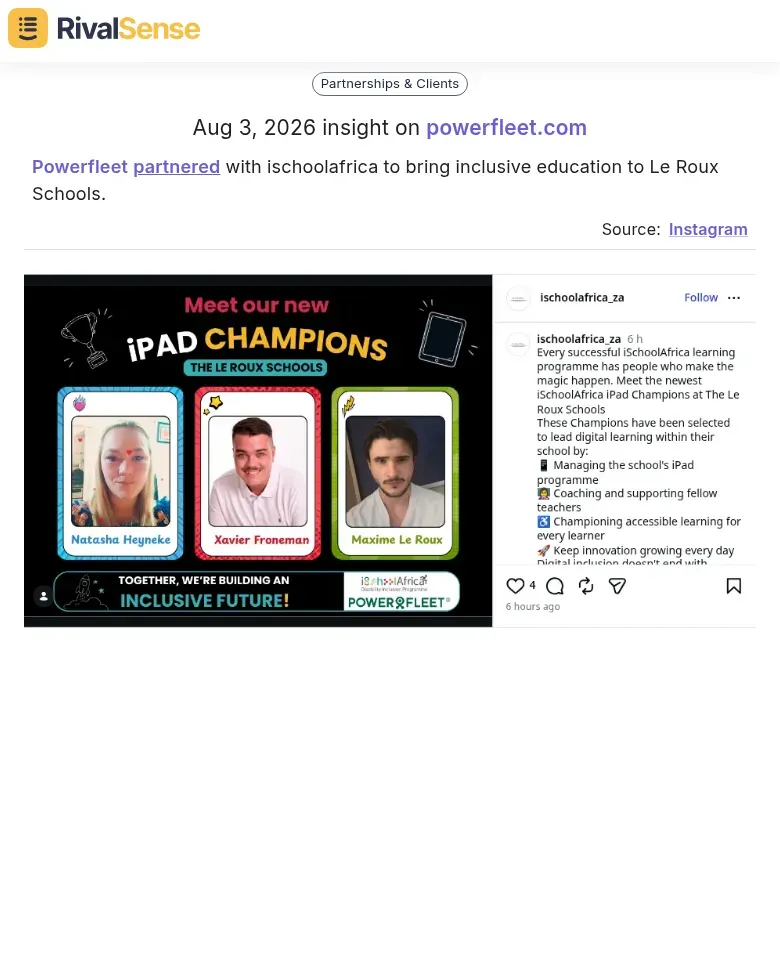
RivalSense recently surfaced how Powerfleet partnered with ischoolafrica to bring inclusive education to Le Roux Schools. Such a partnership insight signals a competitor’s intention to align with social causes and tap into entirely new community audiences. Spotting these moves early lets you evaluate whether a similar partnership could strengthen your own market positioning or if you can differentiate by ignoring the trend entirely.
The checklist:
- [ ] Screenshot the post and tag the partner handle in your notes.
- [ ] Estimate follower overlap between the two accounts.
- [ ] Compare engagement rate against their baseline—not raw likes.
- [ ] Verify whether the partner reposted (that's amplified reach).
- [ ] Log hashtags and tagged locations to spot event plays.
Stunt or strategy?
- One-off: A single post tied to a trending moment—likely noise.
- Sustained: Recurring campaigns, dedicated highlight folders, or an annual giving program—this is positioning worth a strategic response.
Fast tip: Set a monthly alert for your competitor's handle plus keywords like "partnership," "giving," or "collaboration" to catch announcements in real time, before the story ages. Better yet, use a tool like RivalSense that automatically monitors social media and web mentions, delivering these signals straight to your inbox.
💰 Tracking Promotions, Limited-Time Offers, and Urgency Tactics
Promotions expose a competitor's pricing psychology and appetite for trading margin for market share. They are never random—every discount, flash sale, or urgency trigger is a deliberate move to capture attention and shift demand. Build a checklist that decodes their urgency playbook.
1. Catalog discount mechanics. Note whether they use percentage-off, fixed-dollar, BOGO, or free-shipping thresholds. Log the anchor price and sale price side by side — the gap reveals how aggressively they frame value. Flag stock-availability language ("Only 3 left," "Selling fast") that manufactures scarcity and speeds decisions.
2. Audit creative format and timing. Screenshot the launch assets: static posts, carousels, Reels, or Stories with countdown stickers. Track posting days and hours — spot sales often drop mid-week or before payday. Record how long the offer lives and whether it's teased in advance to build anticipation.
3. Measure the response. Compare engagement rates and comment sentiment against their baseline posts. Do followers ask clarifying questions, tag friends, or complain about shipping? Identify which angles — savings, exclusivity, or scarcity — drive saves and shares, then test the winners on your own profile.
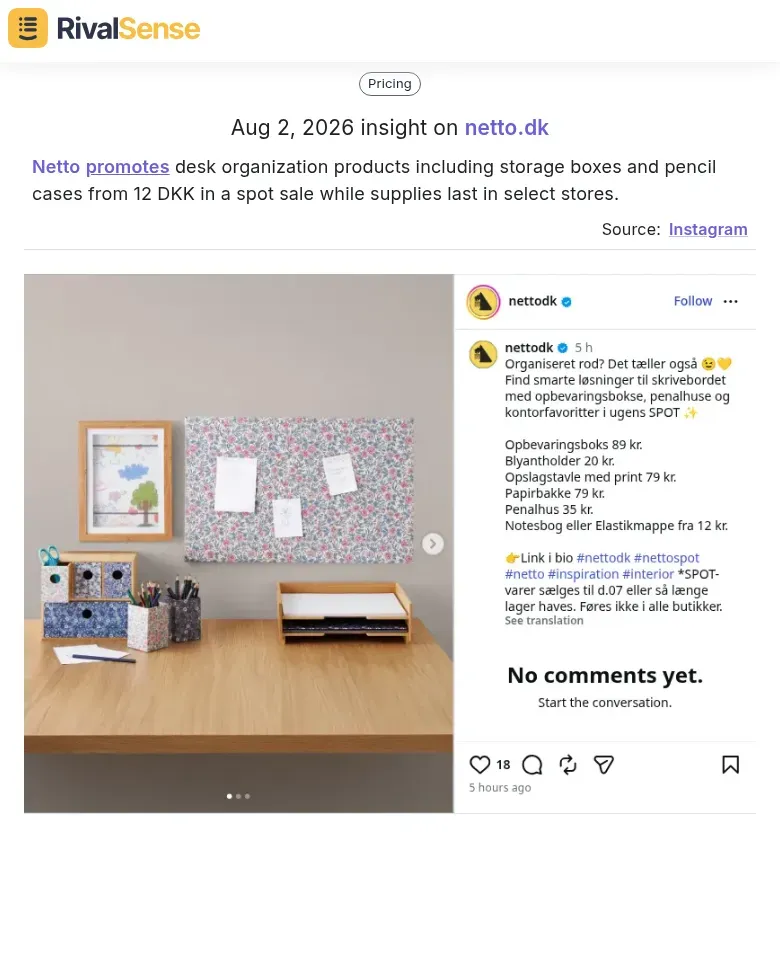
A recent RivalSense alert captured Netto promoting desk organization products from 12 DKK in a spot sale while supplies last. This single insight reveals pricing thresholds, inventory-clearing tactics, and the language of urgency used to drive foot traffic. Tracking such promotions helps you benchmark your own discounting strategies and spot when a competitor is about to ignite a price war.
Actionable tip: Set a recurring reminder to capture competitor Stories within 24 hours. They vanish fast and usually carry the most aggressive CTAs and codes. Keep a running log so you can spot patterns in cadence and discount depth — that becomes your early-warning system for price wars.
🚀 Detecting New Product, Feature, and Catalog Additions
New product launches rarely arrive unannounced — on Instagram, they're telegraphed weeks in advance. By reading the early signals, you can anticipate market shifts and refine your own roadmap. Here's how to decode the announcement playbook.
1. Map announcement patterns. Log the cadence of every launch post: date, format (Reel, carousel, story), and caption tone. Most brands follow a rhythm — teaser → reveal → feature deep-dive → offer. Once you spot the pattern, you can predict their next drop window and preempt it with your own messaging. Set a recurring monthly reminder to review the last 90 days of their feed.
2. Decode packaging strategy. Screenshot how they frame value: do they announce a new tier, bundle, or plan-specific feature? Look for captions emphasizing "included in Pro" or "add-on available." That tells you which segments they're chasing and where your pricing gaps are. Compare their tier names and limits against yours on a simple spreadsheet — the delta is your differentiation story.
3. Mine the comment section. Launch posts are focus groups disguised as announcements. Sort comments by "Newest" to catch early reactions before they're buried. Note recurring questions (missing integrations, pricing complaints) — these are unserved needs you can address in your own launch comms. Also watch their follow-up posts: clarification posts signal a confusing launch; an aggressive FAQ series signals weak product-market fit.
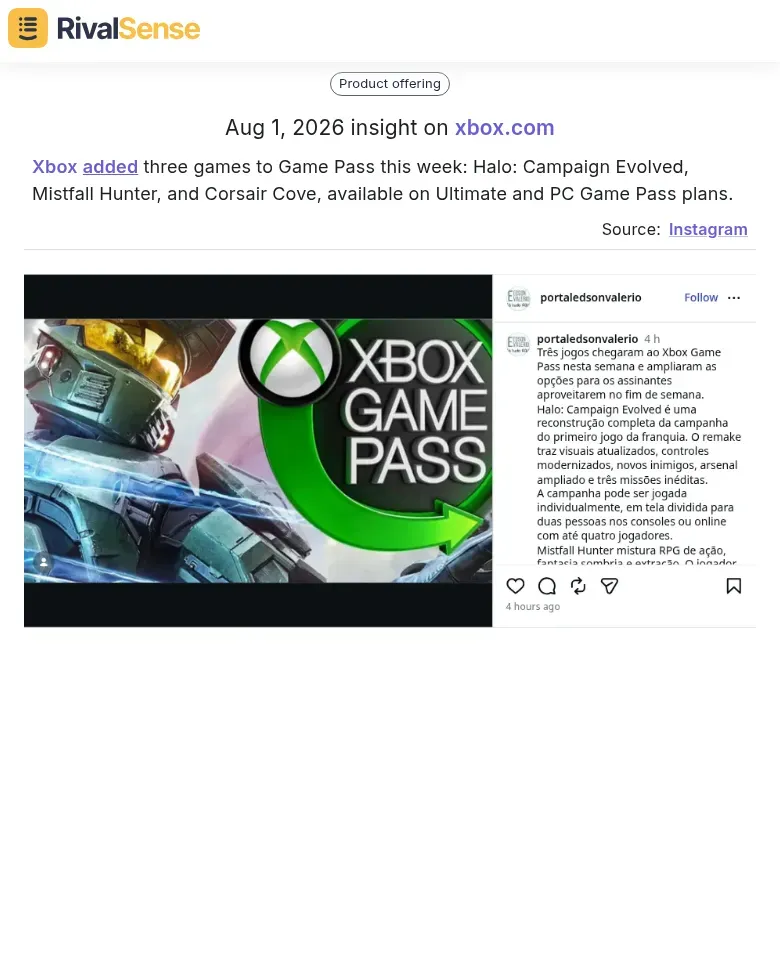
RivalSense recently detected Xbox adding three games to Game Pass this week, including Halo: Campaign Evolved, Mistfall Hunter, and Corsair Cove. This kind of product addition insight reveals content refresh velocity and platform expansion moves—valuable intelligence if you're competing in subscription-based or digital product markets. Use it to benchmark your own launch frequency and feature announcements.
Checklist:
- [ ] Track cadence (weekly)
- [ ] Catalog screenshots (monthly)
- [ ] Note comment sentiment (per launch)
- [ ] Evaluate packaging shifts (quarterly)
Turn every competitor launch into a rehearsal for yours.
⚙️ Translating Instagram Insights into Strategic Action
Collecting competitor intel is only half the battle—the value lies in converting observations into decisions. Without a translation process, your tracking remains a passive collection of data points rather than a strategic weapon. Here's how to turn raw Instagram data into action.
1. Turn observations into hypotheses. Every competitor move signals their strategy. When a rival launches a Reels series, don't just note it—ask: Are they chasing a younger segment? Testing a new pain point? Building top-of-funnel awareness? Frame each observation as a hypothesis (e.g., "They're expanding into SMB customers") and validate it against their other channels, ad spend, and pricing moves.
2. Benchmark against your own performance. Build a simple scorecard tracking engagement rate, follower growth, content mix, and posting cadence—for you and 3–5 key competitors. Look for gaps: Are they winning with UGC while you rely on polished brand content? Do they answer questions in comments you ignore? These gaps are your differentiation opportunities.
3. Prioritize by business impact. Not every post deserves a response. Score each signal: Does it affect your target segment? Threaten your positioning? Hint at a pricing or product shift? Filter for signals tied to revenue, churn, or positioning—ignore the noise of daily content.
Quick checklist:
- [ ] Convert each competitor move into a written hypothesis
- [ ] Maintain a monthly benchmarking scorecard (you vs. 3–5 rivals)
- [ ] Score signals by impact: segment, positioning, revenue
- [ ] Act only on high-impact shifts; revisit lower-tier signals quarterly
Apply this lens and your Instagram tracking shifts from passive monitoring to a genuine competitive intelligence engine.
🔄 Building a Repeatable Weekly Review and Reporting Routine
Consistency beats intensity when it comes to competitive intelligence. Without a repeatable routine, insights pile up, become outdated, and lose their strategic punch. Here's how to build a weekly habit that turns scattered observations into a competitive advantage.
Step 1: Standardize your review template. Create one weekly capture template that groups findings into three fixed categories: partnerships (new integrations, co-marketing deals, reseller agreements), promotions (discounts, pricing changes, campaign launches), and product updates (feature releases, UI changes, roadmap signals). A fixed structure makes week-over-week comparisons effortless and prevents valuable signals from getting lost.
Step 2: Assign ownership. Map your workflow to three roles: collection (an analyst or intern pulls screenshots, pricing pages, and changelogs every Monday), analysis (a product manager or strategist interprets what changes mean for your positioning), and dissemination (a marketing owner distills findings into a 15-minute Slack digest or Loom for sales and leadership). Tip: rotate ownership quarterly to keep analysis fresh and build CI literacy across the team.
Step 3: Track patterns, not just events. Maintain a rolling log (a simple spreadsheet works) tagging each insight by category and date. After 4–6 weeks, review the log for recurring behaviors—seasonal promo cadence, integration velocity, feature release timing. These patterns let you forecast competitor moves before they happen and continuously refine your playbook.
First-week checklist:
- [ ] Template created
- [ ] Owners assigned
- [ ] Log launched
- [ ] One digest sent
Automate Your Instagram Competitor Tracking with RivalSense
Manually monitoring dozens of Instagram accounts, stories, and comments is time-consuming and easy to miss. RivalSense automatically tracks your competitors’ latest product launches, pricing changes, partnerships, and more across websites, social media, and registries—including Instagram—and delivers them in one concise weekly email report. Spend less time scrolling and more time strategizing.
👉 Try RivalSense for free and get your first competitor report today.
📚 Read more
👉 Data-Driven Insights: Track Telecom Competitor Pricing Moves
👉 Competitor Financials Cheat Sheet: Decoding M&A Signals to Stay Ahead
👉 Key Account Management vs Customer Success: 2026 Trend Shifts
👉 Biograph's Women's Health Shift Revealed a Blueprint for Member Growth
👉 Workflow Breakdown: Turning Internet Competitor Insights Into Pricing Power