
Key Account Identification for Compliance Teams: A CEO's Productivity Playbook
Key accounts are the engines of your revenue — and the epicenter of your compliance exposure. When your compliance team can’t clearly identify which customers are high‑value, you’re not just missing an opportunity; you’re creating risk that can hit the bottom line and the boardroom.
Regulators increasingly judge programs by outcomes, not intentions. If a key account is misclassified, you may under‑apply enhanced due diligence, miss suspicious activity in high‑volume relationships, or file inaccurate reports. The fallout cascades: regulatory fines, forced remediation, audit findings, and reputational damage that erodes client trust — and can push those relationships straight into a competitor’s arms.
The payoff of accurate identification is proactive risk management. When your team knows the key accounts, you can:
- Tailor monitoring frequency to relationship risk and revenue impact
- Trigger enhanced due diligence before red flags become violations
- Allocate limited compliance resources where they matter most
- Present a defensible risk posture to auditors and regulators
Practical steps to get there:
- Build a scoring model that weights revenue, transaction volume, jurisdiction, and product complexity — not just nominal spend.
- Review your key account list quarterly; relationships change faster than policies.
- Cross‑check classifications with sales and relationship managers to validate assumptions.
- Document the rationale for every decision so your list is audit‑ready.
💡 Pro tip: Your key account list isn’t a marketing artifact — treat it as a living risk document, versioned and reviewed like any other compliance control.
⚠️ Common Pitfalls Slowing Down Compliance Teams
Even the sharpest compliance teams trip over the same three obstacles — often because they are buried in manual work and disconnected data. Recognizing these pitfalls is the first step to fixing them fast.
1. Fragmented customer data
Customer records scattered across spreadsheets, CRMs, and legacy systems force analysts to stitch together a picture manually. Each source tells a different story, and key details slip through the cracks.
🔧 The fix: Build a single source of truth. Consolidate data into one system, standardize fields, and enforce naming conventions so “Acme Corp” and “ACME Corporation” never live as separate accounts.
2. Over‑reliance on manual review
When risk decisions depend on individual judgment, results vary wildly. One analyst flags a prospect; another clears it. Human review has its place, but it should not carry the whole workload.
🔧 Practical step: Create a scoring rubric with defined thresholds for risk indicators like ownership complexity, jurisdiction, and transaction velocity. Automate the triage and let reviewers focus only on accounts that genuinely need attention.
3. Stale account profiles
Relationships change — new shareholders, new jurisdictions, new risk exposure. If profiles are only refreshed during annual reviews, you are deciding on outdated intel.
🔧 Tip: Set triggers to refresh a profile whenever a material event occurs — a change of control, a PEP flag, or a sanctions list update.
✅ Quick checklist:
- [ ] Centralize data
- [ ] Standardize scoring
- [ ] Automate triage
- [ ] Trigger profile refreshes
📊 Building a Data‑Driven Identification Framework
Gut feel doesn’t scale. A data‑driven framework turns key account identification from a guessing game into a repeatable process that your leadership team can trust.
Here’s how to build one in three moves — with a CEO’s eye on audit‑ready consistency.
1. Centralize and cleanse your data
A single source of truth is the foundation. Pull customer data from CRM, ERP, onboarding systems, and spreadsheets into one warehouse. Then cleanse: deduplicate records, standardize fields (e.g., legal entity names, jurisdictions), and flag missing or stale data.
🔎 Tip: Run a data quality audit before building anything — garbage in, garbage out. Aim for 95%+ completeness on core fields like revenue, ownership structure, and geography.
2. Define risk‑based tiering and scoring
Not all accounts deserve equal attention. Define tiering criteria that reflect your compliance risk appetite: transaction volume, jurisdiction risk, ownership complexity, PEP/sanctions exposure. Build a quantitative scoring model (e.g., 0–100) that weights these factors.
✅ Checklist: Assign thresholds, document the rationale, and pressure‑test scores against known cases. Keep the model explainable — regulators and auditors will ask.
3. Automate initial screening
Automation handles the volume so analysts handle the value. Use rules engines or workflow tools to score accounts automatically, flag tier‑1 candidates, and queue them for review. Only exceptions and high‑risk cases reach analysts.
🔁 Tip: Start with a “human‑in‑the‑loop” pilot, track false positives, and refine thresholds monthly.
Result: Faster identification, consistent decisions, and analysts freed up for what matters — deep due diligence on the accounts that actually warrant it.
⚡ Productivity Techniques to Accelerate Identification
Speed without structure just multiplies noise. These three techniques help compliance teams cut identification time while keeping audit‑ready rigor — essential when every deal depends on timely risk clearance.
1. Prioritize with a risk‑weighted matrix
Score every account on two axes: risk exposure (sanctions, PEP status, adverse media, jurisdiction) and business criticality (revenue, relationship tenure).
| High Business Criticality | Low Business Criticality | |
|---|---|---|
| High Risk | 🕵️ Investigate first | ⚙️ Automate or outsource |
| Low Risk | ✅ Batch & fast‑track | 📨 Minimal review, fast‑track |
🧊 Tip: Freeze your scoring weights quarterly and document them — reviewers waste hours re‑litigating the same calls.
2. Triage with a structured workflow
Route every account through a fixed three‑gate pipeline:
- Automated name‑match screening
- Rule‑based flagging
- Human review
Only ~10‑15% of alerts typically reach a human. For each review, confirm identity match, check source reliability, and record the decision rationale. If a case takes more than one extra look, escalate it — don’t let it linger.
3. Standardize templates and batch the repetitive work
Build one master template for evidence, one for escalations, and one for cleared accounts. Never let analysts reinvent formats mid‑flow. Batch daily: run all name screenings in the morning, all adverse‑media checks at midday, all file uploads at end‑of‑day. Batching cuts context‑switching, which studies show eats up to 40% of productive time.
🤖 Automation multiplier: Use AI‑assisted screening to pre‑rank alerts by likelihood of a true match, letting reviewers open the highest‑probability cases first — review time per file can drop by half.
🔗 Aligning Compliance with Business Strategy
Compliance teams that work in silos produce checklists; compliance teams aligned with strategy produce competitive advantage. As a founder or CEO, you can turn compliance from a cost centre into a strategic partner.
1. Build a single source of truth.
Create a shared account intelligence hub (CRM integration or a shared workspace) where compliance, sales, and leadership see the same tier definitions, risk flags, and ownership. Sales surfaces expansion signals; compliance adds regulatory context; leadership sees revenue exposure. Everyone edits one living document — no emailed spreadsheets, no version chaos.
2. Map tiers to strategy, not just risk.
Tie each tier to a business outcome:
- Tier 1 (flagship enterprises) supports land‑and‑expand revenue targets
- Tier 2 (fast‑growth challengers) supports market‑entry campaigns
- Tier 3 (watchlist) supports early‑warning coverage
When tiering mirrors the go‑to‑market plan, compliance screening accelerates growth instead of slowing it.
3. Institute a regular review cadence.
Run a 30‑minute tier review monthly (operational) and a strategy deep‑dive quarterly (executive).
🗓️ Agenda checklist:
- [ ] Accounts promoted or demoted
- [ ] Intelligence shared since last review
- [ ] Pending risk decisions
- [ ] Alignment with latest market‑expansion plans
Keep a running change log so every move is auditable. Appoint a “tier steward” who owns the process and chases updates — without one, cadences decay within two quarters.
🔭 Add External Intelligence to Sharpen Your Tiering
Competitor movements often signal shifts that should trigger a compliance reassessment. By monitoring what your rivals are doing — from new government contracts to fresh market entries — you can proactively adjust risk profiles and stay ahead of regulatory exposure.
Here are three real‑world examples of the kind of intelligence that can feed your compliance strategy:
-
Government contract wins: When a competitor lands a major public‑sector deal, it may signal deeper ties to regulated industries or an increased need for government‑specific due diligence. Keeping an eye on such contracts helps you refine your own risk modelling for similar accounts.

Example: Geotab was selected by the New Hampshire Department of Transportation to power its statewide fleet — a move that could shift the competitive landscape in government‑facing compliance requirements. -
Geographic expansion: A competitor opening a physical location in a new town or region uncovers market‑entry activities that your compliance team may want to mirror with jurisdiction‑specific risk checks.

Example: WeightWatchers opens an in‑person workshop in Grimsby, expanding its footprint — a signal to map local regulatory risk for your own comparable initiatives. -
Promotional and product overhauls: When a competitor rolls out new promotions or retires existing ones, it reveals tactical shifts that may attract new customer segments — and possibly invite different regulatory scrutiny.
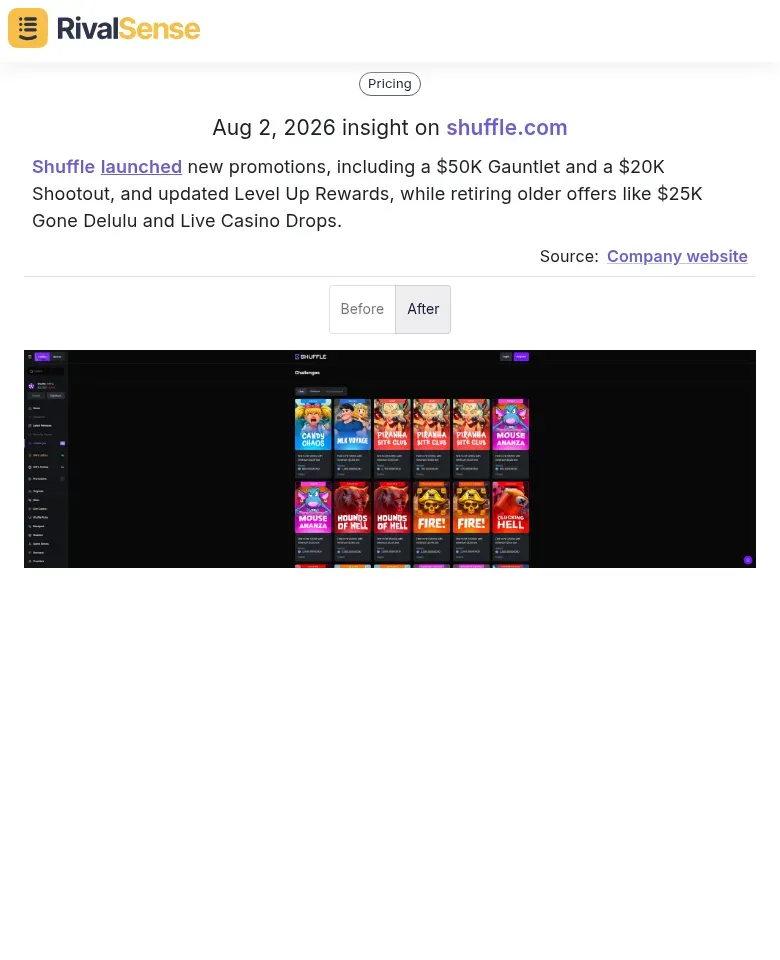
Example: Shuffle updated its promotions with a $50K Gauntlet and $20K Shootout while retiring older offers — a change worth monitoring for any compliance ripple effects in aggressive promotional models.
By weaving external competitor intelligence into your key ‑account identification process, your compliance team moves from reactive to anticipatory — exactly the posture auditors and boards want to see.
📈 Measuring Impact and Driving Continuous Improvement
What gets measured gets improved. For compliance teams — and the leaders who oversee them — tracking the right KPIs turns subjective risk management into an objective, defensible process.
Three core KPIs to watch:
- Identification accuracy – the share of flagged accounts confirmed as genuinely high‑risk (precision) versus those missed (recall). Track both; a high accuracy score with low recall means real risks are slipping through.
- Processing speed – time from account onboarding to risk decision. Measure median and 95th‑percentile (p95) times, not averages — outliers reveal bottlenecks.
- Coverage – the percentage of the customer portfolio actually assessed, including dormant accounts that often hide risk.
Set baseline metrics before launch, then review them monthly against targets.
Build feedback loops.
When an alerted account later triggers a SAR, or a clean account gets falsely flagged, feed that outcome back into your scoring model. A simple “was this right?” tag on each disposition creates a labeled dataset to retrain models and recalibrate thresholds quarterly — so criteria stay sharp as risk shifts.
Adopt emerging tech wisely.
Regulatory and market risk evolve faster than static rules. Pilot AI‑driven anomaly detection to surface novel risk patterns, and use natural language processing to monitor regulatory updates so criteria stay current. Don’t chase hype: run a 90‑day pilot, compare results against your baseline KPIs, and scale only what beats them.
✅ Quick checklist:
- [ ] Define KPIs pre‑launch
- [ ] Automate reporting dashboards
- [ ] Log every false positive/negative
- [ ] Recalibrate models quarterly
- [ ] Pilot one new technology per year
- [ ] Document learnings for the next cycle
🚀 Stay Ahead of the Market with RivalSense
Aligning compliance with business strategy demands more than internal data — you need real‑time awareness of the competitive landscape. RivalSense tracks competitor product launches, pricing updates, event participations, partnerships, regulatory aspects, management changes, and media mentions across company websites, social media, the internet, and various registries. All of it lands in one clean weekly email report, so your compliance and strategy teams never miss a critical signal.
Start turning competitor intelligence into a compliance advantage. Get your first competitor report today for free →
📚 Read more
👉 How NVIDIA’s cuEST 0.2.0 Gives Competitors Their Next Move
👉 Instagram Competitor Insight Checklist for Key Account Tracking
👉 Data-Driven Insights: Track Telecom Competitor Pricing Moves
👉 Competitor Financials Cheat Sheet: Decoding M&A Signals to Stay Ahead
👉 Key Account Management vs Customer Success: 2026 Trend Shifts